

 GIVE US A CALL
What a Self-Directed Roth IRA Actually Is (And Why It Matters for Real Estate Investors)
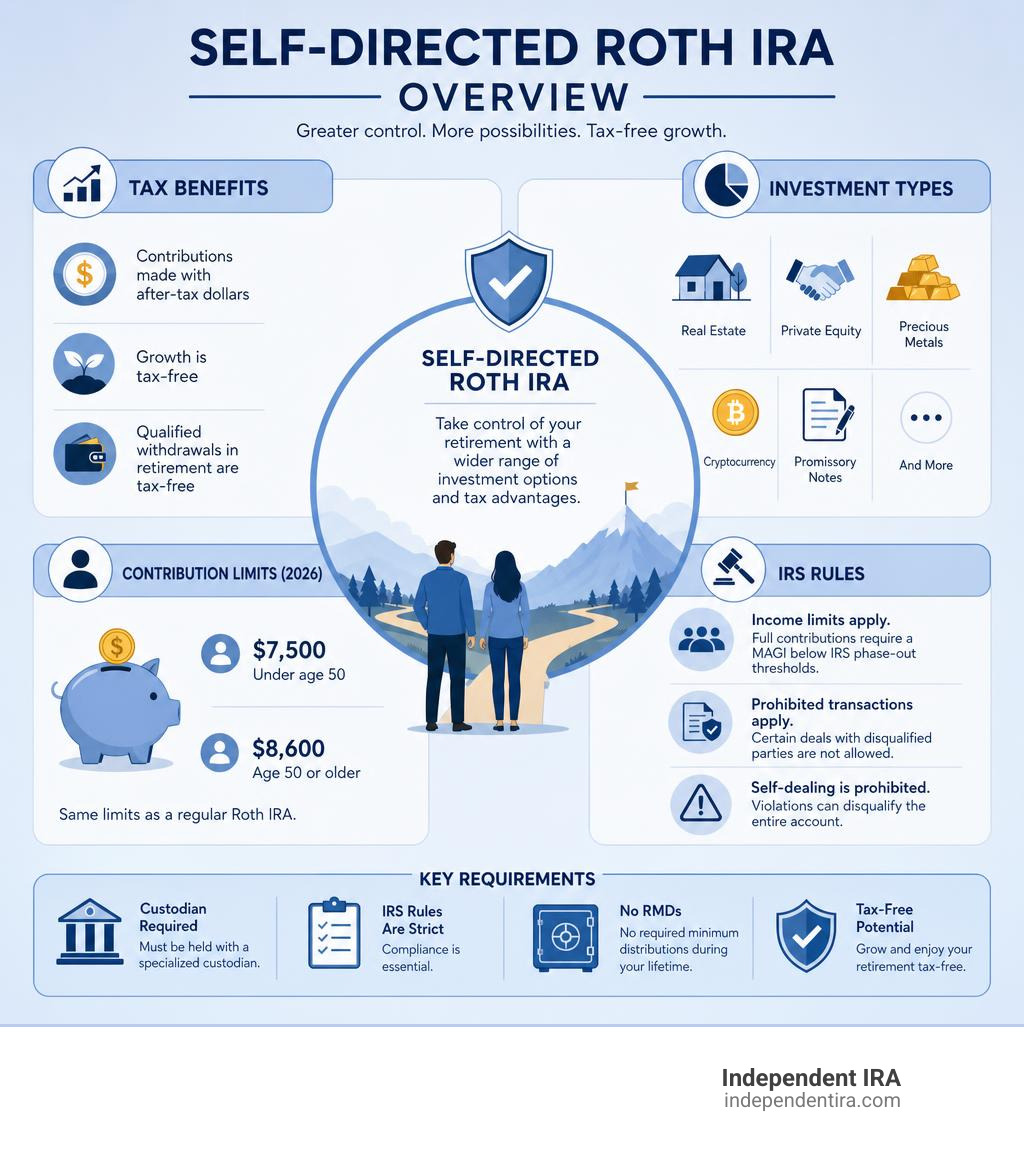
A self-directed Roth IRA is a retirement account that combines the potential tax-free growth of a standard Roth IRA with the freedom to invest in alternative, IRS-permitted assets like real estate, private loans, cryptocurrency, and precious metals. Here is a quick overview of what sets it apart:
Self-Directed Roth IRA at a Glance:
- Tax treatment: Contributions are made with after-tax dollars; qualified withdrawals in retirement may be tax-free under current IRS rules
- Investment options: Real estate, private equity, precious metals, cryptocurrency, promissory notes, and other IRS-permitted assets
- No RMDs: Under current rules, you are generally not required to take mandatory distributions during your lifetime
- Custodian required: Must be held with an IRS-approved custodian (Independent IRA acts as an Authorized Agent of Accuplan to help facilitate this process)
- Same contribution limits as a regular Roth IRA: $7,500 per year in 2026 ($8,600 if you are age 50 or older)
- Income limits apply: Full contributions require a MAGI below IRS phase-out thresholds
- IRS rules are strict: Prohibited transactions and self-dealing can disqualify the account, potentially leading to taxes and penalties
If you have spent years watching your retirement savings sit in mutual funds while your real estate investments outside your IRA do the heavy lifting, a self-directed Roth IRA is worth understanding closely. More than 24% of U.S. households already own some form of Roth IRA, but the vast majority are limited to the stocks and bonds their brokerage offers. The self-directed version removes that ceiling, letting you put your IRA capital to work in alternative asset classes. The tradeoff is a stricter compliance environment and higher custodial costs than a standard brokerage account — both of which are manageable once you understand the rules.
What Is a Self-Directed Roth IRA and How Does It Work?
To understand a self-directed Roth IRA, you must first understand the legal structure that supports it. By law, every IRA must have an IRS-approved custodian. Standard Wall Street firms act as custodians, but they typically only allow you to buy assets they sell: mutual funds, ETFs, stocks, and bonds.
A self-directed custodian, on the other hand, exists to provide administration and recordkeeping. They do not sell investment products, nor do they give investment advice. Instead, they give you the platform to invest in alternative, IRS-permitted assets. When you find an investment—such as a piece of commercial property or a private placement—you direct the custodian to fund that asset using the cash in your IRA. The asset is then titled in the name of your IRA, and financial returns flow back into your account.
Understanding how SDIRAs work under California law is highly beneficial for local investors. Under California law, assets purchased by your IRA are typically treated as separate legal entities. You cannot simply sign your personal name on a deed; the buyer must be “Independent IRA FBO [Your Name] IRA.” Maintaining this strict legal separation is designed to help protect your retirement assets from potential tax penalties and personal liability.
Traditional vs. Self-Directed Roth IRAs
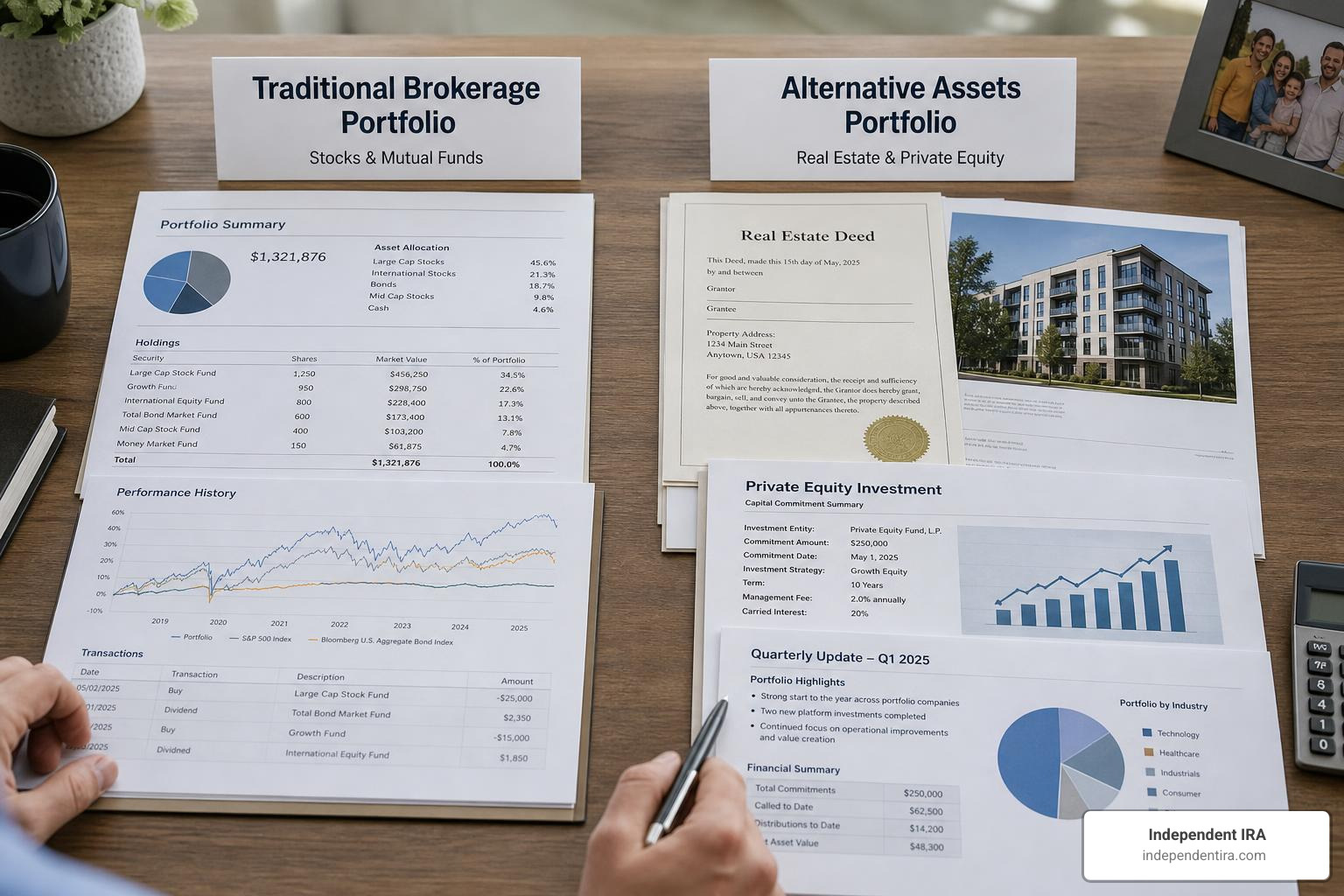
The primary difference between a traditional brokerage Roth IRA and a self-directed Roth IRA lies in investment options and administrative control. A standard brokerage account restricts you to a pre-selected menu of paper assets.
With a self-directed account, you gain the freedom to invest in alternative assets. However, this freedom comes with the responsibility of performing your own due diligence. Your custodian will not evaluate whether a real estate deal is profitable or if a startup is a sound investment. You are responsible for managing your portfolio.
| Feature | Traditional Brokerage Roth IRA | Self-Directed Roth IRA |
|---|---|---|
| Permitted Investments | Stocks, bonds, mutual funds, ETFs | Real estate, private lending, crypto, gold, private equity |
| Custodian Role | Selects investment menu, provides financial advice | Purely administrative, processes transactions per your direction |
| Transaction Control | Instant online trading | Checkbook control or custodian-directed processing |
| Fee Structure | Often low-cost or zero-fee (monetized via spreads/funds) | Flat annual fees, asset processing fees, setup fees |
| Due Diligence | Handled largely by fund managers | 100% the responsibility of the account owner |
Alternative Assets You Can Hold in a Self Directed Roth
The IRS does not actually provide a list of what you can invest in; instead, it only specifies what you cannot buy (specifically life insurance contracts and certain collectibles like rugs, antiques, or stamps). This open-ended rule allows for a variety of alternative assets:
- Real Estate: You can purchase single-family rentals, multi-family apartment complexes, raw land, commercial buildings, and tax liens.
- Private Lending: You can offer private lending services to real estate flippers or businesses. Your IRA holds the promissory note and the deed of trust, and the interest paid on the loan flows back into your Roth account.
- Cryptocurrency: By utilizing specialized cryptocurrency options, your IRA can buy, hold, and trade Bitcoin, Ethereum, and other digital assets directly on secure platforms.
- Precious Metals: You can hold physical gold, silver, platinum, and palladium bullion, provided they meet specific IRS purity standards and are stored in an approved depository.
- Private Equity and Startups: You can buy shares in privately held companies, LLCs, joint ventures, or venture capital funds before they go public.
The Key Benefits of a Self-Directed Roth Account
Many investors choose a self-directed Roth IRA for the potential power of tax-free compounding. In a traditional IRA or 401(k), you defer taxes today but pay ordinary income tax on withdrawals in retirement. If you invest in a highly profitable real estate deal or a startup that grows significantly, a portion of your future wealth may be subject to taxes.
With a Roth structure, you pay taxes on your contributions upfront. From that point forward, the compounding growth may offer tax advantages. When you reach age 59½ and have met the five-year holding rule, qualified withdrawals—including real estate capital gains or private lending interest—are generally tax-free under current IRS rules.
Additionally, Roth IRAs do not require minimum distributions (RMDs) during your lifetime under current tax laws. Traditional retirement accounts force you to start liquidating your portfolio and paying taxes at a certain age. A Roth IRA allows you to leave your assets untouched, letting them compound. If you choose, you may pass the account to your heirs with potential tax advantages, making it a useful tool for multi-generational wealth planning.
With 24% of U.S. households utilizing Roth accounts to build their futures, adding self-direction allows you to diversify away from Wall Street volatility and explore alternative asset classes.
IRS Rules: Navigating Prohibited Transactions in Your Self Directed Roth
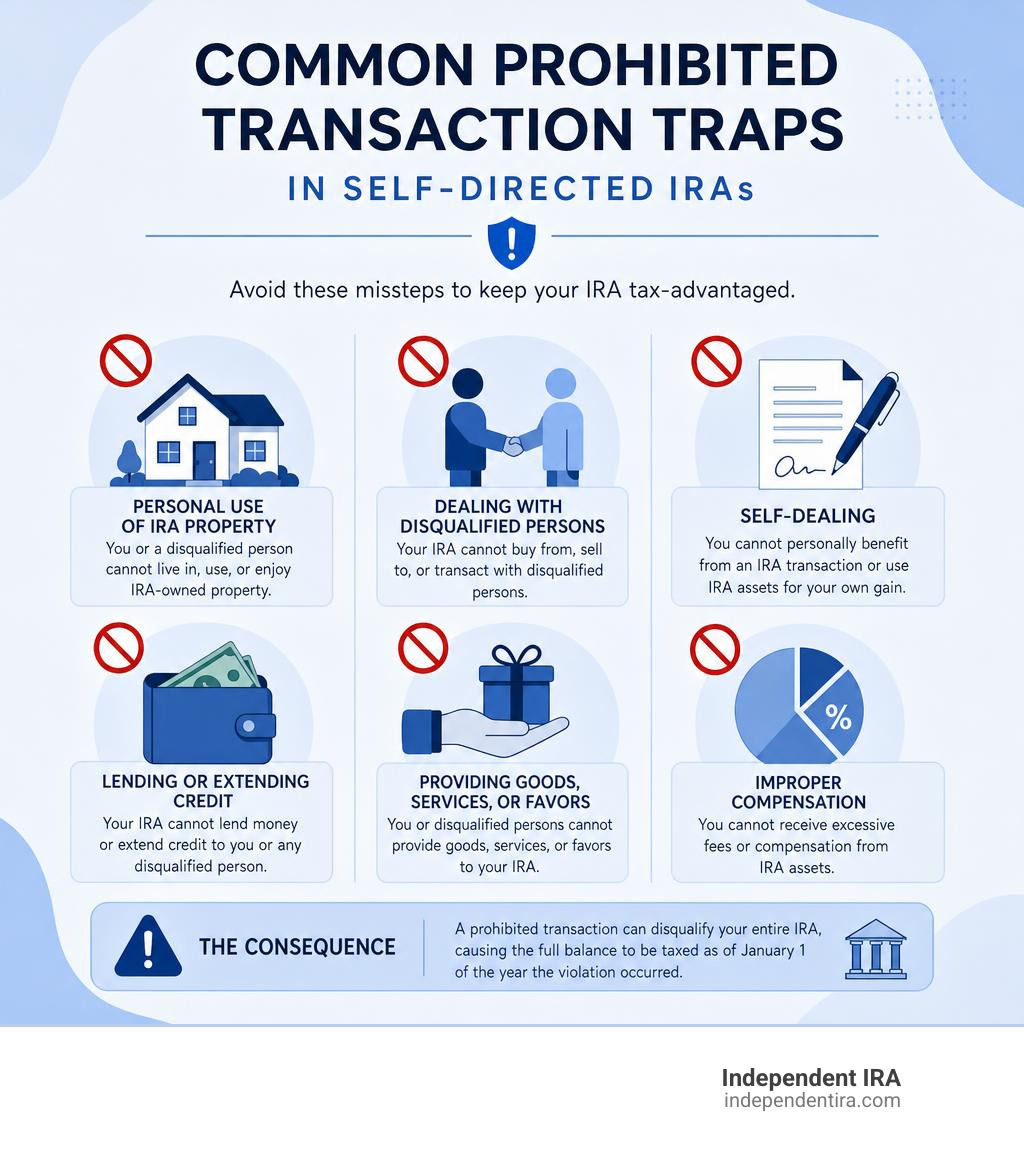
The IRS permits alternative assets in self-directed accounts, but it enforces strict rules to ensure these accounts are used strictly for retirement savings. Failing to follow these rules may lead to a prohibited transaction, which could disqualify your entire account, potentially treating the full balance as a taxable distribution as of the first day of the tax year.
To help maintain compliance, you must understand two core concepts: disqualified persons and self-dealing.
Disqualified Persons and Self-Dealing
IRS rules generally prohibit your IRA from doing business with anyone who is considered a “disqualified person.” This category includes:
- You (the account owner) and your spouse.
- Your lineal ascendants (parents, grandparents) and lineal descendants (children, grandchildren) and their spouses.
- Any entity (corporation, partnership, trust) owned 50% or more by a disqualified person.
- Any investment advisors, fiduciaries, or partners who provide services to the IRA.
Note: Brothers, sisters, aunts, uncles, and cousins are generally not considered disqualified persons under IRS rules.
Self-dealing occurs when a disqualified person derives a direct or indirect personal benefit from an IRA asset. For example, if your self-directed Roth IRA buys a beachside rental property, you cannot stay in it, nor can your children live there while attending college. You cannot hire your father’s construction company to remodel the kitchen, and you cannot personally perform physical labor on the property. Transactions must be strictly arm’s-length.
Keeping Expenses Inside the Self Directed Roth Structure
Because your self-directed account is typically treated as a separate legal entity, it must operate independently from your personal finances.
Every expense related to an IRA asset—property taxes, HOA fees, insurance, repair bills, or management costs—must be paid directly out of the cash held within your IRA. If you pay a plumber out of your personal pocket to fix a leak in an IRA-owned rental property, you may commit a prohibited transaction by making an undocumented contribution.
Conversely, revenue generated by your SDIRA assets must flow directly back into the IRA account. You cannot collect a tenant’s rent check and deposit it into your personal checking account, even if you plan to transfer it to the IRA later.
How to Fund and Grow Your Alternative Retirement Portfolio
Getting started with a self-directed portfolio is a structured process that requires careful coordination. First, you open an account with an IRS-approved custodian. Independent IRA, acting as an Authorized Agent of Accuplan, can assist you with this setup process. Once the account is established, you can fund it using a variety of strategies: making an annual contribution, transferring funds from an existing Roth IRA, rolling over a former employer’s 401(k), or executing a Roth conversion.
Once your account is funded, you can begin identifying assets. If you prefer high transactional speed and want to avoid paying custodian transaction fees for every check you write, you can utilize a Checkbook IRA LLC structure. We can assist you in establishing a specialized LLC owned entirely by your IRA. You are named as the manager of the LLC, giving you a dedicated business checking account. When you want to purchase a property or fund a private loan, you simply write a check or send a wire directly from your LLC bank account.
Navigating these setup steps and compliance rules can feel overwhelming, but you do not have to do it alone. Brian Davis can help guide you through the self-directed setup process to help you establish your account.
Contribution Limits and Income Thresholds for 2026
For the 2026 tax year, the annual contribution limit for a Roth IRA is $7,500 if you are under age 50. If you are age 50 or older, you can make an additional catch-up contribution of $1,100, bringing your total annual limit to $8,600.
However, direct contributions to a Roth IRA are subject to Modified Adjusted Gross Income (MAGI) phase-out limits. If your income exceeds these thresholds, your ability to contribute directly is reduced or eliminated entirely.
For self-employed individuals looking to maximize their tax-free savings, a Solo 401(k) is an alternative. In 2026, the total contribution limit for a Solo 401(k) is up to $72,000 per participant (plus catch-up contributions for those 50+), which is higher than the $7,500 cap for Roth IRAs. Under a Solo 401(k), you can designate your employee contributions as Roth, potentially allowing you to build a tax-advantaged alternative portfolio.
Rollovers, Transfers, and Roth Conversions
If your income prevents you from making direct Roth contributions, or if you want to fund your account with a large lump sum immediately, you can use alternative funding methods:
- Trustee-to-Trustee Transfers: If you already have a Roth IRA at a traditional brokerage, you can transfer any portion of those funds directly to your new self-directed custodian. This process is typically tax-free and penalty-free.
- Direct Rollovers: If you have a Roth 401(k) from a former employer, you can execute a direct rollover into your self-directed Roth account without triggering taxes.
- Roth Conversions (The Backdoor Roth): You can convert pre-tax funds from a Traditional IRA or a Traditional 401(k) into a self-directed Roth IRA. You will owe ordinary income taxes on the converted amount in the year of the conversion, but future qualified growth and withdrawals may be tax-free.
Frequently Asked Questions About Self-Directed Roth IRAs
Can I buy real estate with my self-directed Roth IRA?
Yes, IRS rules permit purchasing residential or commercial real estate directly through your account, provided all transactions are arm’s-length and all expenses and revenues flow directly through the IRA.
What are the typical fees for a self-directed Roth IRA?
Self-directed accounts generally incur custodial costs that vary depending on the provider and the types of assets you hold. First-year fees typically range from $249 to $720 depending on the provider and account complexity. To understand how these costs fit into your investment strategy, you can review our straightforward pricing or contact our team for a clear breakdown.
How do I avoid prohibited transactions in my self-directed Roth IRA?
To help avoid penalties, IRS rules require that you, your family members, and your business entities do not personally use, manage, or benefit from any assets held within the retirement account.
Before You Move Retirement Funds
Taking control of your retirement through a self-directed Roth IRA is one way to build tax-advantaged wealth, but it requires a commitment to proper administration and compliance. Because custodians do not provide investment advice, the responsibility of performing deep due diligence on every asset falls squarely on your shoulders.
At Independent IRA, an Authorized Agent of Accuplan, we provide administrative support and assistance with entity creation. Whether you want to establish a Checkbook IRA LLC for real estate investing or set up a Solo 401(k) plan, we can help facilitate the process.
Ready to explore your options? Contact our team today to schedule a consultation.
This content is for informational and educational purposes only and does not constitute legal, tax, or investment advice. Rules, limits, and requirements may change. Consult a qualified tax advisor, attorney, or financial professional before making retirement planning or investment decisions. Independent IRA is an Authorized Agent of Accuplan Benefits Services and is not a custodian or trust company.