

 GIVE US A CALL
If you’re researching tax auction bidding tips, the strategy changes significantly when your money is sitting inside a self-directed IRA or Solo 401(k). Auction prices at tax deed and tax lien sales can run below market value, but hidden costs, legal hurdles, and strict payment deadlines can quickly impact those gains — unless your retirement account is structured correctly before you ever register to bid. Here are the core tips to know up front:
- Calculate your Maximum Allowable Bid (MAO) before the auction using the formula: (Market Value x 0.70) – Renovation Costs – Title/Legal Costs – Holding Costs.
- Know your auction type — tax deed sales transfer ownership immediately, while tax lien certificates earn interest during a redemption period (typically 6 months to 3 years).
- Set a hard maximum bid in writing and stick to it; auction fever is real and expensive.
- Budget for hidden costs beyond the winning bid: quiet title actions run $1,500-$5,000, documentary transfer taxes apply at closing, and IRS redemption windows can freeze your plans for 120 days.
- All funds must flow through your retirement account — your self-directed IRA or Solo 401(k) pays the deposit, the winning bid, and all post-sale costs, to avoid potential tax penalties or account disqualification.
- Register early and prepare payment in the accepted format (cashier’s check or wire transfer), typically due within 24-72 hours of winning.
- Perform a title search and drive-by inspection before bidding on any parcel, since tax auction properties are sold strictly as-is.
Most investors arriving at a tax auction for the first time focus entirely on the price — and walk away either outbid or overpaying on a property they didn’t fully understand. The investors who consistently participate without overpaying do the hard work weeks before the auction opens. When your capital is inside a retirement account, that preparation also means getting your account structure, custodial approvals, and liquidity lined up well in advance. I’m Brian Davis, and throughout this guide I’ll walk you through each step of the tax auction process as it applies specifically to self-directed retirement investors.
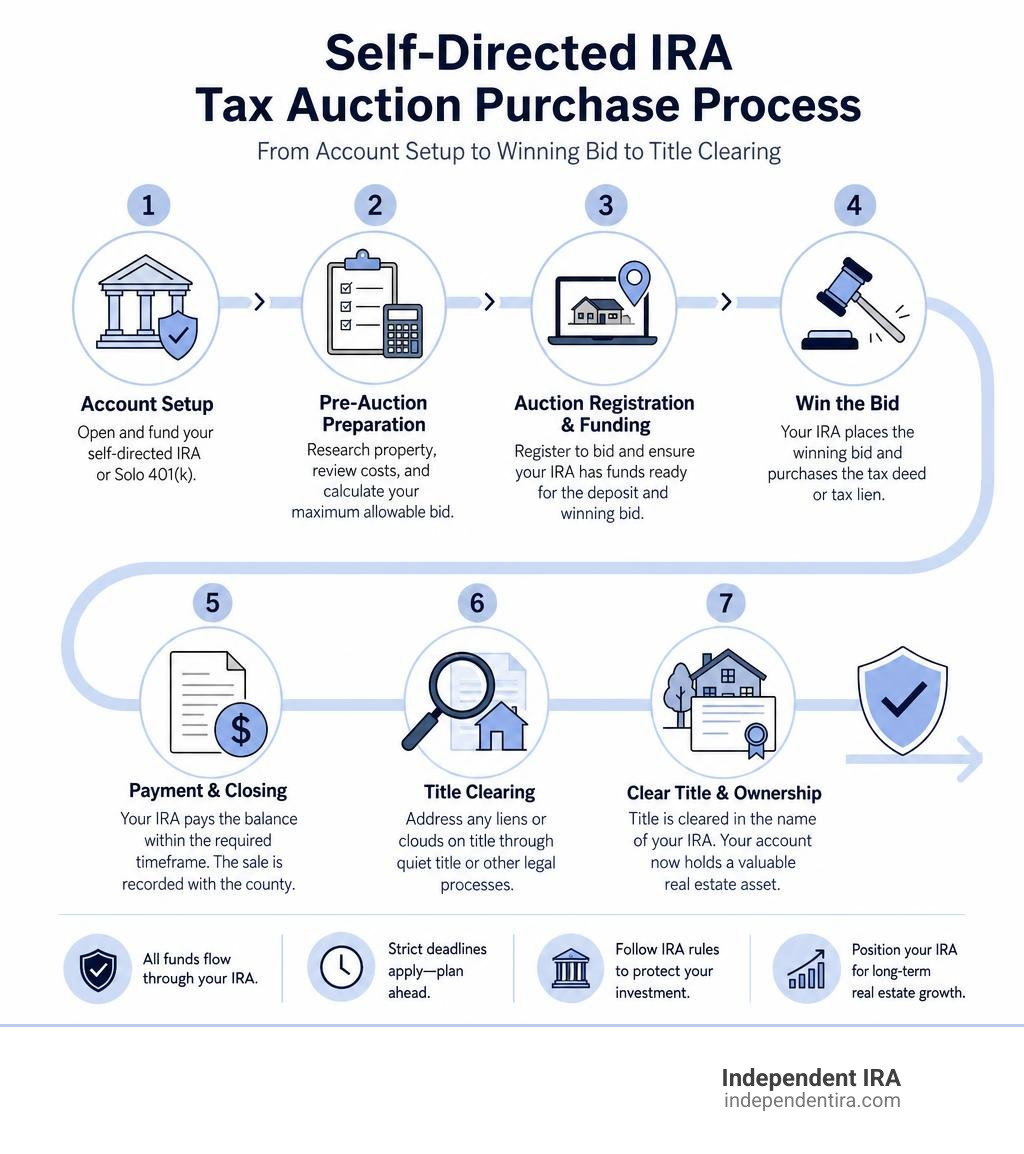
Framing Your Strategy: Tax Deeds vs. Tax Liens in a Retirement Account
Before entering the auction room or logging onto an online portal, we must understand the fundamental difference between tax deeds and tax liens. How you approach these two assets within a self-directed retirement account determines how your capital is positioned, how long it is tied up, and what your ultimate exit strategy will be.
When you purchase a tax deed, you are purchasing the actual real estate. The county has foreclosed on the property due to unpaid property taxes, and the auction transfers ownership of the physical property directly to the highest bidder. If you win a tax deed within your self-directed IRA, your retirement account immediately becomes the owner of record. Any rental income generated or capital gains realized upon resale flow directly back into your IRA, which may offer tax advantages (such as tax-deferred growth, or potential tax-free growth if you are utilizing a Roth IRA, subject to IRS rules).
Conversely, a tax lien is a certificate of debt. When a property owner fails to pay their property taxes, the local municipality places a lien on the property and auctions off that lien as a certificate. As the winning bidder, you do not own the property; instead, you have paid the owner’s back taxes in exchange for the right to collect that debt plus interest rates (often ranging from 8% to 24% per year, depending on the state). The property owner enters a “redemption period” — which typically lasts anywhere from 6 months to 3 years in 23 states — during which they must pay you back. If they redeem the debt, your IRA receives its principal back plus the accrued interest. If they fail to redeem, your IRA can initiate foreclosure proceedings to take ownership of the property.
For a comprehensive breakdown of how these rules apply in our local market, read our guide on Tax Liens Tax Deeds San Diego.
| Feature | Tax Deed Sales | Tax Lien Sales |
|---|---|---|
| What You Buy | Physical real estate ownership | A certificate of delinquent tax debt |
| Primary Goal | Equity play (acquire property to rent or flip) | Yield play (earn interest on back taxes) |
| Ownership | Immediate transfer (subject to challenge periods) | None, unless the owner fails to redeem and you foreclose |
| Redemption Risk | Low to Moderate (depends on state redemption laws) | High (most owners redeem, returning your cash + interest) |
| Self-Directed IRA Fit | May suit long-term rental portfolios or flips | May offer potential for hands-off, fixed-income growth with tax advantages |
Understanding this distinction is critical for retirement planning. If your Solo 401(k) needs consistent, short-term liquidity to fund other investments, tax liens provide a path of returning capital with interest. If you want to build long-term wealth through tangible real estate, tax deeds are the vehicle. For a deeper look at purchasing land via these auctions, check out How to Buy Land at a Tax Auction: A Buyer’s Guide for 2026.
Essential Tax Auction Bidding Tips for Self-Directed Investors
Winning an auction isn’t just about being the highest bidder — it is about being a prepared bidder. When we use retirement capital, we must rely on cold, hard data rather than emotion.
One of our favorite tax auction bidding tips involves understanding bidding psychology. Auctions are designed to trigger “auction fever” — a psychological state where the competitive drive to win outpaces financial logic. Suddenly, you find yourself bidding $85,000 on a property you swore you would stop bidding on at $65,000.
To combat this, experienced investors write their maximum bid on a physical notecard before the auction starts and place it directly in front of them. Additionally, consider your bidding increments. Bidding in confident, round numbers (such as jumping directly to $10,000 instead of creeping up by $100 increments) communicates to the room that you have a firm strategy, which can often discourage competing bidders. While we focus heavily on California, general psychological strategies like those found in the Texas Tax Sale Bidding Strategy guide apply nationwide.
For automated bidding strategies and calculating the exact yield of your investment, you can run the numbers using the analytical frameworks found in the Calcix — Run the numbers. Or be run by them. guide.
Setting Your Maximum Bid with Tax Auction Bidding Tips
To help manage potential profitability within your self-directed IRA, you can establish your Maximum Allowable Bid (MAO) before the bidding starts. We calculate this using a strict mathematical formula:
$$text{MAO} = (text{Market Value} times 0.70) – text{Renovation Costs} – text{Title/Legal Costs} – text{Holding Costs}$$
Let’s break down these components:
- Market Value: The actual, conservative value of the property once it is fully repaired, based on comparable sales.
- Renovation Costs: A realistic estimate of what it will take to make the property habitable or marketable.
- Title/Legal Costs: The cost of clearing the title (such as a quiet title action, which typically runs $1,500 to $5,000).
- Holding Costs: Property taxes, vacant property insurance (which can cost 2 to 4 times more than standard homeowners insurance during redemption periods), utilities, and HOA fees.
Additionally, you must know the minimum bid. State law requires that the minimum bid on a tax-defaulted parcel offered at a public auction for the first time be no less than the total amount necessary to pay all of the delinquent taxes on the parcel, plus the accrued penalties and the costs of conducting the sale. If you want to learn more about budgeting for vacant land acquisitions specifically, read How to Score Land Bargains at Auctions and Tax Sales.
Executing the Bid: Live and Online Tax Auction Bidding Tips
Whether you are participating in a live auction at the county courthouse steps or bidding online via platforms like Bid4Assets, you must master the mechanics of the platform.
For online sales, most platforms utilize a maximum auto-bid system. You input your absolute maximum limit, and the computer bids on your behalf in pre-set increments only when another bidder challenges your position. This is an excellent tool for self-directed investors because it completely removes emotional, heat-of-the-moment decision-making.
Furthermore, be aware of the “overtime feature” used in modern online tax sales. If a bid is placed in the final minutes of an auction, the system automatically extends the closing time by a few minutes. This prevents “sniping” (placing a bid at the very last second to win) and ensures all participants have a fair chance to respond.
Before you can bid, you will be required to submit a registration deposit. In many Southern California counties, this deposit is a flat rate or a percentage of your intended bid. For example, some jurisdictions require a deposit of 25% of your bid price or $1,000 (whichever is greater), up to a maximum of $20,000. If you do not win any properties, online tax sale vendors typically refund this deposit back to your account within ten business days. For detailed step-by-step registration rules, see the Riverside County Tax Auction: How to Register and Bid guide.
Pre-Auction Due Diligence: Protecting Your Retirement Capital
At a tax auction, the rule of the land is strictly caveat emptor — buyer beware. The county makes no warranties, guarantees, or representations regarding the physical condition, location, or legal status of the properties being sold. If your self-directed IRA purchases a property that turns out to be a toxic waste site or a completely landlocked sliver of a cliffside, the county will not refund your money.
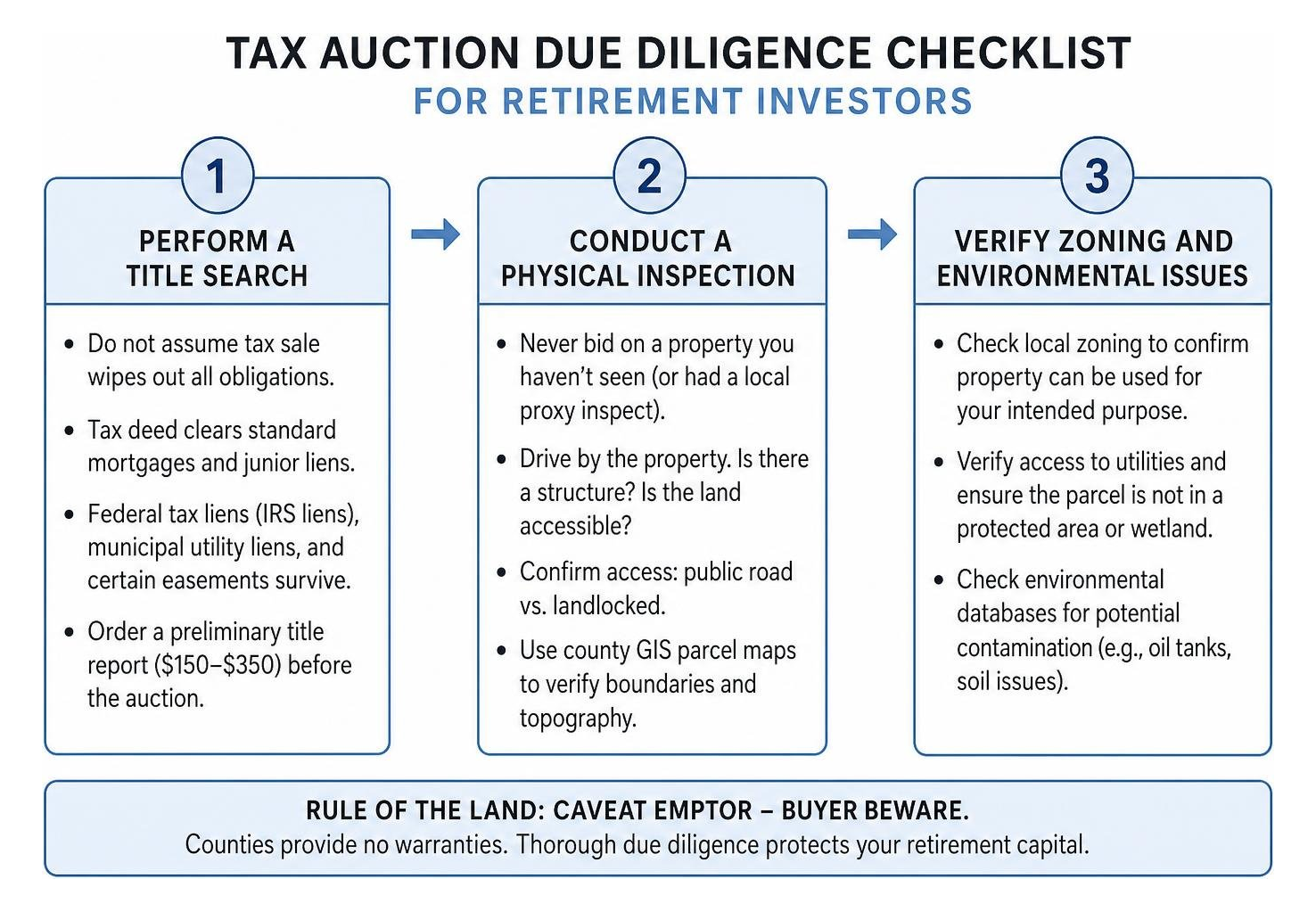
To protect retirement capital and maintain Self-Directed IRA Control, investors often execute a rigorous three-step due diligence process:
- Perform a Title Search: Do not assume the tax sale wipes out all prior obligations. While a tax deed clears standard mortgages and junior liens, certain encumbrances survive the sale. Federal tax liens (IRS liens), municipal utility liens, and certain easements will remain attached to the property. Ordering a preliminary title report ($150 to $350) before the auction is a cheap insurance policy against inheriting tens of thousands of dollars in surviving debt.
- Conduct a Physical Inspection: Never bid on a property you have not seen with your own eyes (or hired a local proxy to inspect). Drive by the property. Is there a house standing, or did it burn down three years ago? Is the vacant land accessible by a public road, or is it completely landlocked behind a neighbor’s security gate? Use GIS parcel maps from the county assessor’s office to verify exact boundaries and topography.
- Verify Zoning and Environmental Issues: Check local zoning maps to ensure the parcel can legally be used for your intended purpose. If you are buying land to build a rental property, verify that it has access to utilities and is not designated as a protected wetland. For older structures, check environmental databases to rule out oil tank contamination or soil issues.
If you are looking at properties seized and auctioned directly by the federal government, understand that these sales operate under entirely different federal guidelines. Learn the unique rules by reading How to Buy a House at an IRS Auction: Risks and Rules.
Navigating Post-Auction Rules and Hidden Costs
Winning the bid is just the beginning of the transaction. To successfully close the deal and protect your retirement account from legal liabilities, you must navigate a minefield of post-auction rules and hidden fees.
First, let’s talk about the title. When you win a tax deed, the county issues a Tax Deed to Purchaser. However, this deed is considered “clouded” by major title insurance companies. Because the previous owner lost the property through a forced foreclosure, title companies are highly reluctant to issue a title insurance policy right away. They worry the previous owner might challenge the sale in court due to a lack of proper notification or procedural errors.
In California, former owners and lienholders have exactly one year from the date the tax deed is recorded to challenge the validity of the sale in court. Because of this, some investors choose to avoid spending money on property improvements or repairs during this one-year challenge window to mitigate risk. If the sale is successfully overturned, the purchase price may be returned, but capital spent on renovations could be lost.
To clear the cloud on your title so you can secure title insurance, sell the property, or refinance it, you have two primary options:
- Wait out the statutory period: In some cases, you can wait for the challenge period to expire (though some title companies require a multi-year waiting period before insuring a tax deed property without legal action).
- File a Quiet Title Action: This is a formal lawsuit filed in court to extinguish any competing claims to the property. Filing a quiet title action typically costs $1,500 to $3,000 in attorney fees plus court costs (bringing the total to $3,000 to $5,000) and takes 4 to 8 months to resolve.
Additionally, be aware of the federal government’s rights. If there was a pre-existing federal tax lien on the property, the IRS has a 120-day redemption window after the sale. During this period, the federal government can effectively take the property from you by reimbursing your winning bid amount plus interest — but they will not reimburse you for any unapproved repairs.
Finally, do not forget the local taxes. In California, winning bidders are required to pay a Documentary Transfer Tax of $0.55 per $500 of the sales price (which equates to $1.10 per $1,000). For example, a $50,000 winning bid incurs a $55 transfer tax, which must be paid alongside your purchase price.
To review local guidelines, schedules, and specific county transfer rules, visit the San Diego County Property Tax Sales page and browse our dedicated Category Tax resources.
Before You Move Retirement Funds
Participating in a tax auction using a retirement account can be a wealth-building strategy, but it requires precision. Because of strict IRS rules regarding “prohibited transactions,” you cannot use personal funds to pay for any portion of an IRA-owned tax deed or lien.
If you pay an auction deposit with your personal credit card and the winning bid with your IRA, the IRS can deem the entire account disqualified, which could result in taxes and penalties. Every dollar — from the initial registration deposit to the quiet title attorney fees and the documentary transfer tax — must flow directly from your self-directed retirement account.
This is where the structure of your account makes all the difference. If you use a standard, custodian-controlled IRA, you must submit a buy-direction letter and wait for the custodian to manually approve and wire the funds. At a tax auction, where payments are strictly due within 24 to 48 hours (or two business days for internet sales), this custodial delay can cause you to miss the deadline, forfeit your purchase, and lose your deposit.
To navigate this, some investors utilize a Checkbook Control IRA or a self-trusteed Solo 401(k). With this structure, Independent IRA, acting as an Authorized Agent of Accuplan, can assist in establishing a specialized LLC owned by your IRA. As the manager of that LLC, you have a dedicated business checking account. When you register for the auction, you register in the name of your IRA LLC. When you win, you write a check or initiate a wire transfer directly from your LLC bank account. This structure is designed to provide control and reduce custodial delays.
Before you move retirement funds, you can consult with our team at Independent IRA. As an Authorized Agent of Accuplan, we help facilitate real estate IRAs, providing investor control with local expertise in Southern California. Contact us today to learn more about the setup process. Discover more about our local services at Self-Directed IRA San Diego.
Frequently Asked Questions About Tax Auctions
How do I qualify to bid at a tax auction using a retirement account?
To qualify as a bidder, you must first ensure you do not owe any delinquent property taxes to the local taxing jurisdiction where the auction is being held. To bid using a retirement account, you must register for the auction using your IRA’s legal vesting name (e.g., “Independent IRA FBO [Your Name] IRA”) or the name of your Checkbook IRA LLC. All registration deposits and winning bid payments must be made using funds held within that specific retirement account.
What happens to existing mortgages and liens after a tax sale?
Pursuant to Section 3712 of the California Revenue and Taxation Code, a tax deed conveys title to the purchaser free of most prior encumbrances, including standard mortgages and junior deeds of trust. However, specific liens survive the sale. These include federal tax liens (IRS liens) that are not discharged, municipal utility liens, easements, and any active Lis Pendens actions. Performing a thorough title search before bidding can help identify surviving liabilities.
How soon must I pay for the property after winning the auction?
Payment deadlines are strict and vary by county. For internet tax sales in Southern California, the winning bidder typically has exactly two (2) business days from the close of the sale to submit the full payment via wire transfer. In-person auctions often require payment in full (or a substantial deposit) on the day of the auction via cashier’s check. Failure to meet these deadlines results in the forfeiture of your winning bid and your registration deposit. For specific local rules, consult the SDTTC.MyTaxSale.com – Frequently Asked Questions – San Diego portal.
This content is for informational and educational purposes only and does not constitute legal, tax, or investment advice. Rules, limits, and requirements may change. Consult a qualified tax advisor, attorney, or financial professional before making retirement planning or investment decisions. Independent IRA is an Authorized Agent of Accuplan Benefits Services and is not a custodian or trust company.