

 GIVE US A CALL
Alternative asset custodian reviews help self-directed IRA and Solo 401(k) investors compare the firms that administer investments traditional brokerages often do not support, including real estate, private notes, precious metals, and certain digital assets. The quick answer: prioritize a custodian’s IRS approval or applicable regulatory status, experience with your intended asset type, transparent fees, transaction process, security controls, and the quality of its customer support. A legitimate custodian handles account administration and reporting, but it generally does not evaluate whether an investment is sound or protect you from fraud. This self-directed IRA guide explains why control also comes with responsibility when you move beyond stocks and mutual funds.
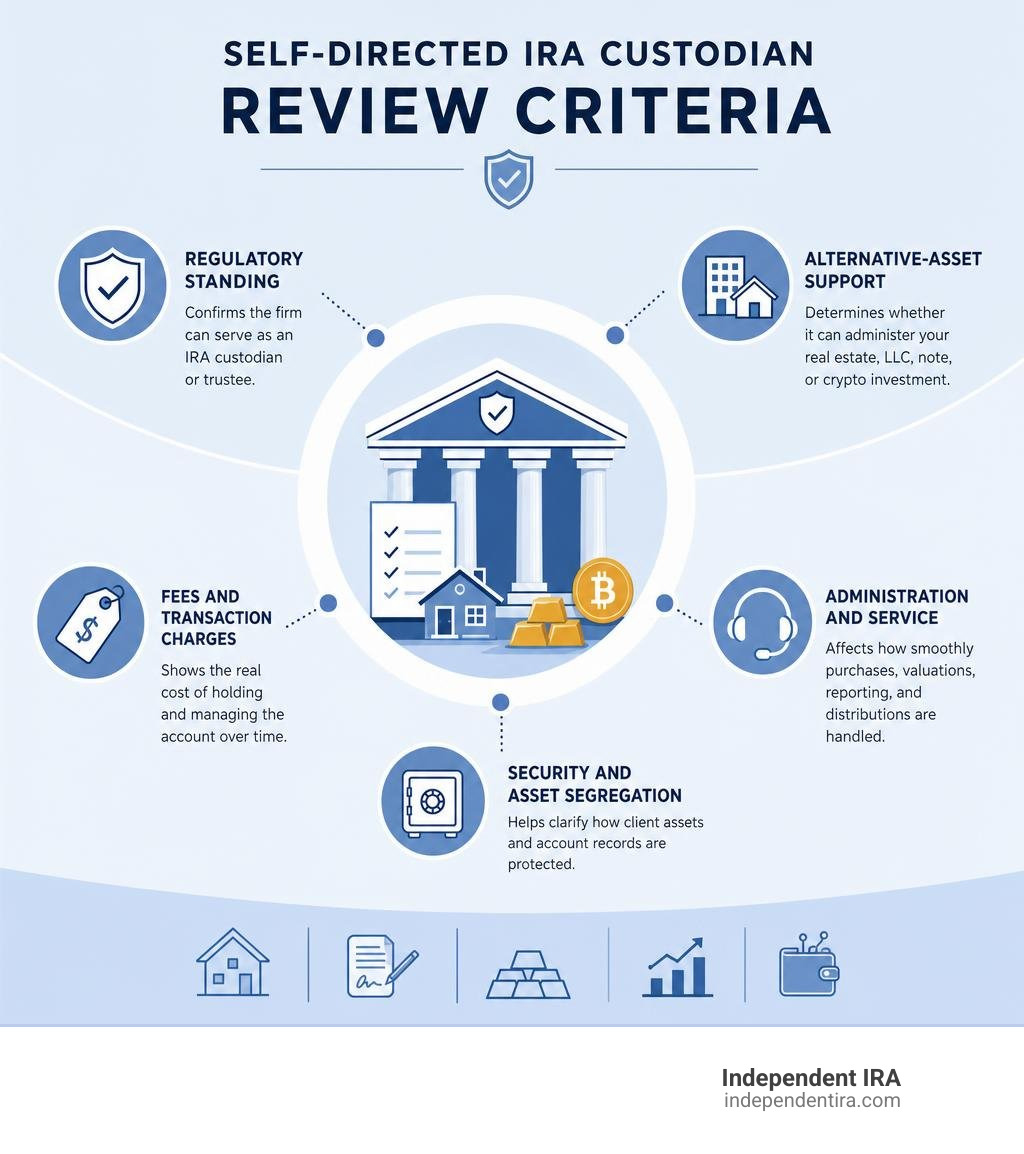
| What to compare | Why it matters in a self-directed retirement account |
|---|---|
| Regulatory standing | Confirms the firm can serve as an IRA custodian or trustee |
| Alternative-asset support | Determines whether it can administer your real estate, LLC, note, or crypto investment |
| Fees and transaction charges | Shows the real cost of holding and managing the account over time |
| Administration and service | Affects how smoothly purchases, valuations, reporting, and distributions are handled |
| Security and asset segregation | Helps clarify how client assets and account records are protected |
For an investor seeking more control over retirement capital, the right comparison is not simply about finding the lowest advertised fee. It is about finding a custody structure that fits the investment, preserves IRA compliance, and gives you a clear view of each party’s responsibilities. At Independent IRA, an Authorized Agent of Accuplan Benefits Services, I am Brian Davis, and this guide will help you assess those trade-offs before placing retirement funds into an alternative asset.
Understanding SDIRA Custodians vs Traditional IRA Custodians
When investors transition from traditional Wall Street brokerages to self-directed retirement structures, the first shift they encounter is the definition of custodial custody. Traditional IRA custodians (such as standard discount brokerages) act as financial gatekeepers. They limit investment choices to publicly traded securities—stocks, bonds, mutual funds, and exchange-traded funds (ETFs). These traditional firms generate revenue primarily through transaction fees, expense ratios, and asset-management fees, operating under strict fiduciary frameworks that govern public market execution.
In contrast, a self-directed IRA (SDIRA) custodian specializes in non-traditional holdings. While both types of custodians must comply with basic IRS trust and custodial regulations, their operational focus is completely different. SDIRA custodians hold legal custody of asset title deeds, private placement notes, partnership units, and digital asset wallets, performing administrative services rather than advising investors on market allocation.
At Independent IRA, we emphasize that moving into self-directed investing changes the operational balance: you gain complete freedom to select private assets, but you also assume complete responsibility for conducting thorough due diligence.
Key Differences in Alternative Asset Administration
The primary function of an SDIRA custodian is administrative holding, transaction execution, and reporting to the Internal Revenue Service (IRS). Unlike conventional wealth management advisors, an SDIRA custodian operates strictly in a non-advisory, passive capacity.
- No Investment Vetting: SDIRA custodians do not evaluate the financial merit, profitability, or legitimacy of your chosen alternative asset.
- No Fiduciary Protections Against Loss: If a private equity deal fails or a real estate property loses value, the custodian incurs no liability.
- Direct Execution Duty: The custodian’s primary duty is to execute your direct written investment instructions provided that the transaction complies with standard tax rules (such as avoiding prohibited transactions with disqualified persons).
Understanding these limits is essential when evaluating alternative asset custodian reviews. Investors often mistakenly assume that because a custodian executes an investment transaction, the firm has verified the safety of the deal. In reality, the custodian is solely verifying that the transaction documentation is correctly titled in the name of your retirement account (e.g., Accuplan Benefits Services FBO [Your Name] IRA).
For 2026, IRA contribution caps stand at $7,500, with an additional $1,100 catch-up contribution permitted for individuals aged 50 or older. Because these tax-advantaged contribution limits compound over decades, selecting an administrative custodian that accurately handles reporting and asset titling is paramount to protecting your tax status.
Regulatory Oversight and Verification
Because SDIRA custodians operate in a specialized financial niche, regulatory oversight varies based on entity structure. SDIRA administration is conducted either by chartered trust companies regulated at the state level, national trust banks regulated by federal banking entities, or qualified nonbank custodians.
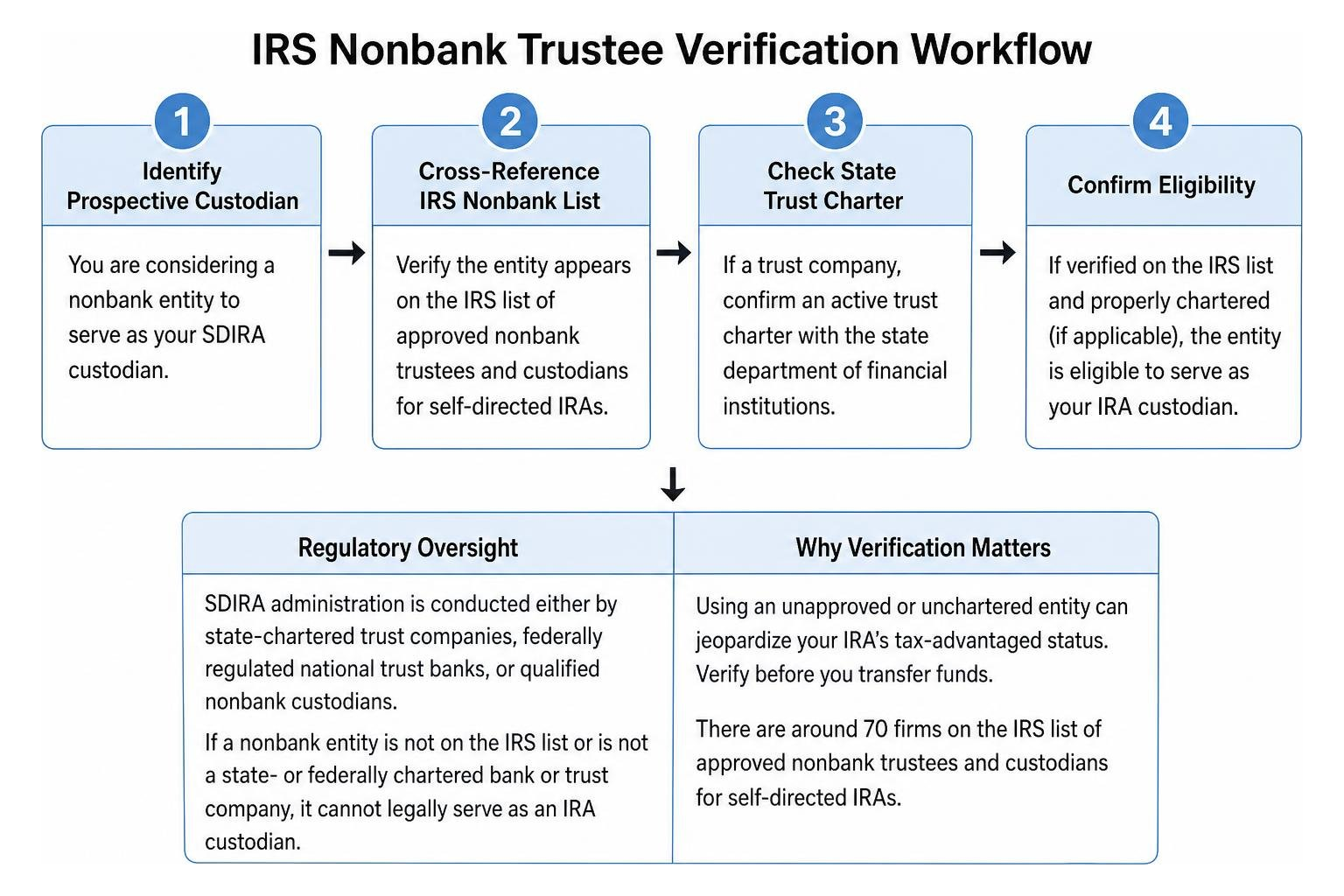
The IRS maintains a published list of approved nonbank trustees and custodians. Currently, there are around 70 firms on the IRS list of approved nonbank trustees and custodians for self-directed IRAs. If a nonbank entity is not on this official list or is not a state- or federally chartered bank or trust company, it cannot legally serve as an IRA custodian.
To verify that a prospective custodian is legitimate before transferring funds:
- Cross-reference the IRS Nonbank List: Verify that non-depository entities appear explicitly on the IRS approved listing.
- Check State Banking Charters: For trust companies, consult state financial regulation registries (such as state departments of financial institutions) to confirm their active trust charter.
- Review Regulatory Enforcement Actions: Search SEC, FINRA, and state regulatory databases for any historical regulatory sanctions, administrative actions, or fraud disclosures.
- Evaluate BBB and Public Complaint Records: Inspect the Better Business Bureau (BBB) and consumer feedback archives to assess operational responsiveness and resolution of transaction disputes.
Regulators such as the SEC frequently issue consumer alerts reminding investors that custodian authorization from the IRS does not constitute an endorsement of the underlying alternative investments held within those accounts.
Key Criteria for Evaluating Alternative Asset Custodian Reviews
Reading alternative asset custodian reviews effectively requires looking beyond subjective rating scores. Online reviews can sometimes reflect user frustration with rigid IRS compliance rules rather than true operational deficiencies. To systematically evaluate custodians, you should focus on three foundational criteria: asset class expertise, fee transparency, and administrative security.
Our team at Independent IRA regularly helps clients navigate account structures tailored to their specific holdings through our comprehensive range of Services.
Analyzing Alternative Asset Custodian Reviews for Crypto and Bitcoin SDIRAs
Investors exploring digital asset retirement options should carefully evaluate how prospective custodians manage keys and secure cold storage. Holding digital assets inside a tax-advantaged account requires specialized custodial architecture that satisfies IRS requirements for asset control while mitigating cybersecurity threats.
When reading reviews for a Bitcoin IRA or digital asset provider, examine how the underlying platform handles cryptographic signing keys. Institutional frameworks vary from traditional third-party enterprise storage to semi-custodial collaborative models. For instance, evaluating enterprise-level key arrangements against collaborative setups involves assessing trade-offs between key recovery protocols, system access boundaries, and operational friction, as detailed in this analysis of Fidelity Digital Assets Bitcoin Control-Model Profile 2026: Control, Recovery & Fit | Pledge .
Key technical features to evaluate in digital asset SDIRA reviews include:
- Air-gapped Cold Vault Storage: Assets should be maintained offline in deep cold storage vaults using Hardware Security Modules (HSMs) and multi-person access controls.
- Multi-Signature (Multisig) Key Architecture: Multi-key setups prevent single points of failure by requiring multiple independent signatures to authorize outbound transfers.
- Proof of Reserves and Segregated Wallets: Ensure the platform utilizes dedicated, on-chain verifiable client wallet addresses rather than omnibus pooled accounts.
- Security Audits: Look for regular third-party audits, such as SOC 2 Type 1 and Type 2 compliance examinations.
Fee Structures: Flat Fees vs. Percentage-Based Pricing
Fee schedules represent one of the largest long-term differentiators among alternative asset custodians. Because alternative assets often involve long holding periods, an inefficient fee structure can quietly erode your compound returns over time. Custodians generally utilize one of three core pricing frameworks:
| Fee Structure | How It Works | Best Used For | Potential Drawbacks |
|---|---|---|---|
| Flat Annual Fee | Fixed annual cost regardless of account asset balance | High-value accounts, real estate, large private placement holdings | Can feel disproportionately expensive for small account balances |
| Asset-Based Fee (Percentage) | Charged as a percentage (e.g., 0.10%–0.75%) of total asset value | Small initial balances or fast-liquidating asset accounts | Penalizes compounding wealth; costs scale dramatically as assets appreciate |
| Transaction-Based Fee | Pay per purchase, sale, re-titling, or outgoing wire transfer | Buy-and-hold assets with low transaction frequency | Can become costly for active note portfolios or automated DCA buying |
When comparing prospective custodians, scrutinize the fine print for hidden operational charges, such as:
- Asset re-titling and deed processing fees
- Outgoing check writing and wire fees
- Mandatory annual asset valuation fees
- Account termination, rollover, and distribution transfer fees
Choosing a custodian with transparent, predictable pricing prevents unexpected friction when executing transactions or taking required distributions.
Comparing Custody Models for Digital and Physical Alternative Assets

Alternative investments span physical property, private debt, paper securities, and digital tokens. Each asset class presents distinct custody requirements, legal titling rules, and administrative workflows.
For investors seeking specialized structures for physical assets like investment properties or private syndications, exploring resources such as our Self-Directed IRA San Diego guide can help align account setups with specific asset needs.
TradFi Custody vs. Crypto-Native Infrastructure
Traditional finance (TradFi) institutional custodians typically manage alternative assets within established trust structures governed by state charters or national banking approvals. For example, traditional trust companies operate under stringent capital requirements and state banking oversight, establishing clear legal boundaries for client asset segregation.
In contrast, digital-asset-focused platforms rely heavily on technological controls alongside regulatory licensing. institutional trading and custody infrastructure providers utilize off-exchange settlement mechanisms and specialized storage systems to minimize counterparty exposure, as outlined in detailed operational profiles like the Matrixport · Trust Check: Reliability & Support (2026) .
Similarly, European platforms operating under frameworks like the Markets in Crypto-Assets Regulation (MiCAR) demonstrate how strict legal segregation via independent foundation structures (such as Dutch Stichting models) isolates client holdings from corporate operating liabilities, as analyzed in the Blockrise Review 2026: MiCA-Licensed Bitcoin Platform (8.8/10) | Bitcoin.diy .
Understanding these jurisdictional and technical frameworks ensures that whether your SDIRA holds physical real estate deeds or digital asset keys, the underlying custody arrangement legally isolates your capital from the administrative custodian’s balance sheet.
Red Flags to Spot in Alternative Asset Custodian Reviews
When reading user experiences and online feedback regarding alternative asset custodians, watch for these critical operational warning signs:
- Claims of Investment Endorsement or Vetting: Be wary if marketing material or third-party promoters claim that a custodian has “approved” or “vetted” a private investment deal. Legitimate SDIRA custodians perform strict administrative verification, not investment analysis.
- Pooled Account Structures Without Individual Segregation: Avoid providers that fail to maintain segregated client records or transparent, on-chain/on-deed title separation.
- Unclear Liquidity or Withdrawal Delays: Pay close attention to reviews citing unexpected administrative delays in transferring funds out, executing outgoing wires, or processing asset distributions.
- Vague Fee Schedules: Watch out for custodians that conceal asset valuation fees or impose steep account termination fees buried in agreement footers.
- Pressure tactics from investment promoters: Promoters who insist you use a specific, obscure custodian without allowing independent verification often represent a heightened risk for fraudulent private placement schemes.
Due Diligence Checklist Before Choosing a Custodian

Before opening an account or transferring funds, perform your own structured due diligence. Working with experienced account managers like Brian Davis at Independent IRA—an Authorized Agent of Accuplan Benefits Services—during account setup ensures that documents are drafted correctly, avoiding costly administrative delays.
Investors interested in broader industry research can review public listings such as Alternative Investment Jobs, Employment in San Diego, CA to understand the broader professional ecosystem.
Use this systematic due diligence checklist when comparing custodians:
Verify Regulatory Credentials:
- Confirm state trust charter or national trust bank status.
- Verify inclusion on the IRS Nonbank Trustee/Custodian listing.
- Review state regulatory databases for enforcement actions.
Inspect Security Protocols & Insurance:
- Confirm SOC 2 audit status and independent compliance checks.
- Review crime and specie insurance coverage limits for digital or physical physical assets held in vault storage.
- Verify that client assets reside off the custodian’s corporate balance sheet in segregated accounts.
Assess Service and Administrative Workflows:
- Test customer service responsiveness prior to opening an account.
- Review standard processing turnaround times for real estate earnest money deposits, private placement funding, and routine distributions.
- Confirm digital account management capabilities and document portal access.
Audit Commercial Terms:
- Compare total cost of ownership across flat annual rates versus percentage-based asset fees.
- Audit transaction costs, wire fees, and valuation charges.
- Check account transfer-out and termination schedules.
Crucial Questions to Ask Custodians
Before committing your retirement assets to any administrative platform, ask prospective representatives these direct questions:
- “Are client assets legally segregated from your corporate balance sheet, and what legal entity structure guarantees asset isolation in the event of custodian insolvency?”
- “What specific insurance policies (such as commercial crime or specie coverage) protect assets held under your administrative custody?”
- “What is your standard turnaround time for executing funding instructions once complete paperwork is submitted?”
- “What are the exact fees charged to acquire, hold, value, and eventually sell or distribute my specific target asset class?”
- “Do you require external annual asset valuations, and what documentation do you accept to verify fair market value for reporting?”
Frequently Asked Questions About SDIRA Custodians
How can I verify that a self-directed IRA custodian is legitimate and IRS-approved?
To verify a custodian’s legitimacy, start by checking the official IRS listing of approved nonbank trustees and custodians. For trust companies, cross-reference their charter status with state banking regulators (such as state departments of financial institutions) or federal authorities like the OCC. Additionally, search regulatory enforcement databases (SEC, FINRA) and inspect complaint histories on the Better Business Bureau to ensure the firm maintains a compliant operational track record.
What are the main risks of using a self-directed IRA custodian for alternative assets?
The primary risk stems from misinterpreting the custodian’s limited operational scope. SDIRA custodians provide administrative recordkeeping and IRS reporting, but they do not conduct financial due diligence, assess investment viability, or protect account holders against investment fraud. Investors bear full responsibility for evaluating investment quality, verifying promoter claims, ensuring compliance with IRS prohibited transaction rules, and managing asset liquidity.
How do flat-fee SDIRA custodians differ from percentage-based custodians?
Flat-fee custodians charge a fixed annual dollar amount to maintain your account regardless of how much your investments appreciate. Percentage-based custodians charge an annual fee calculated as a percentage of your total account valuation. For high-value alternative assets—such as commercial real estate, growing private equity positions, or substantial cryptocurrency balances—flat-fee models generally offer significant cost savings over time by allowing asset growth without increasing custodial overhead.
Before You Move Retirement Funds
Selecting the right custodian is one of the most critical decisions you will make when expanding your retirement portfolio into alternative assets. While online alternative asset custodian reviews offer valuable context regarding customer support and platform usability, your final choice should rest on verified regulatory status, clear fee structures, robust asset protection, and administrative efficiency.
At Independent IRA, we believe that self-directed investing should give you true control over your financial future without sacrificing operational transparency or compliance security. Whether you are building a real estate portfolio, investing in private notes, or setting up a checkbook control structure, having an experienced partner to guide the administrative process ensures your retirement funds are handled properly every step of the way.
Ready to explore your options or speak with our team about opening a self-directed IRA or Solo 401(k)? Take the next step today:
- Reach out directly through our Contact page to schedule a one-on-one consultation with our specialists.
- Learn more about our background and mission on our About page.
- Review official application forms and rollover guides in our Documents center.
- Explore expert strategies and tax-advantaged setup advice on our Blog.
This content is for informational and educational purposes only and does not constitute legal, tax, or investment advice. Rules, limits, and requirements may change. Consult a qualified tax advisor, attorney, or financial professional before making retirement planning or investment decisions. Independent IRA is an Authorized Agent of Accuplan Benefits Services and is not a custodian or trust company.