

 GIVE US A CALL
If you want total control over your retirement capital without waiting days for custodian transaction approvals, structuring a Self directed IRA LLC provides the ideal solution. In this legal framework, your traditional or Roth IRA purchases 100% of a newly created single-member LLC, allowing you to act as the manager and execute deals instantly. By utilizing a Self Directed IRA LLC, your self-directed custodian retains legal custody of the IRA funds while you gain checkbook authority over account assets. This setup combines maximum execution speed with robust liability protection for alternative investments.
Because the IRA is the sole member of the entity, the LLC is classified by the IRS as a disregarded entity for tax reporting purposes. The IRA owner acts as the designated, non-member manager of the LLC.
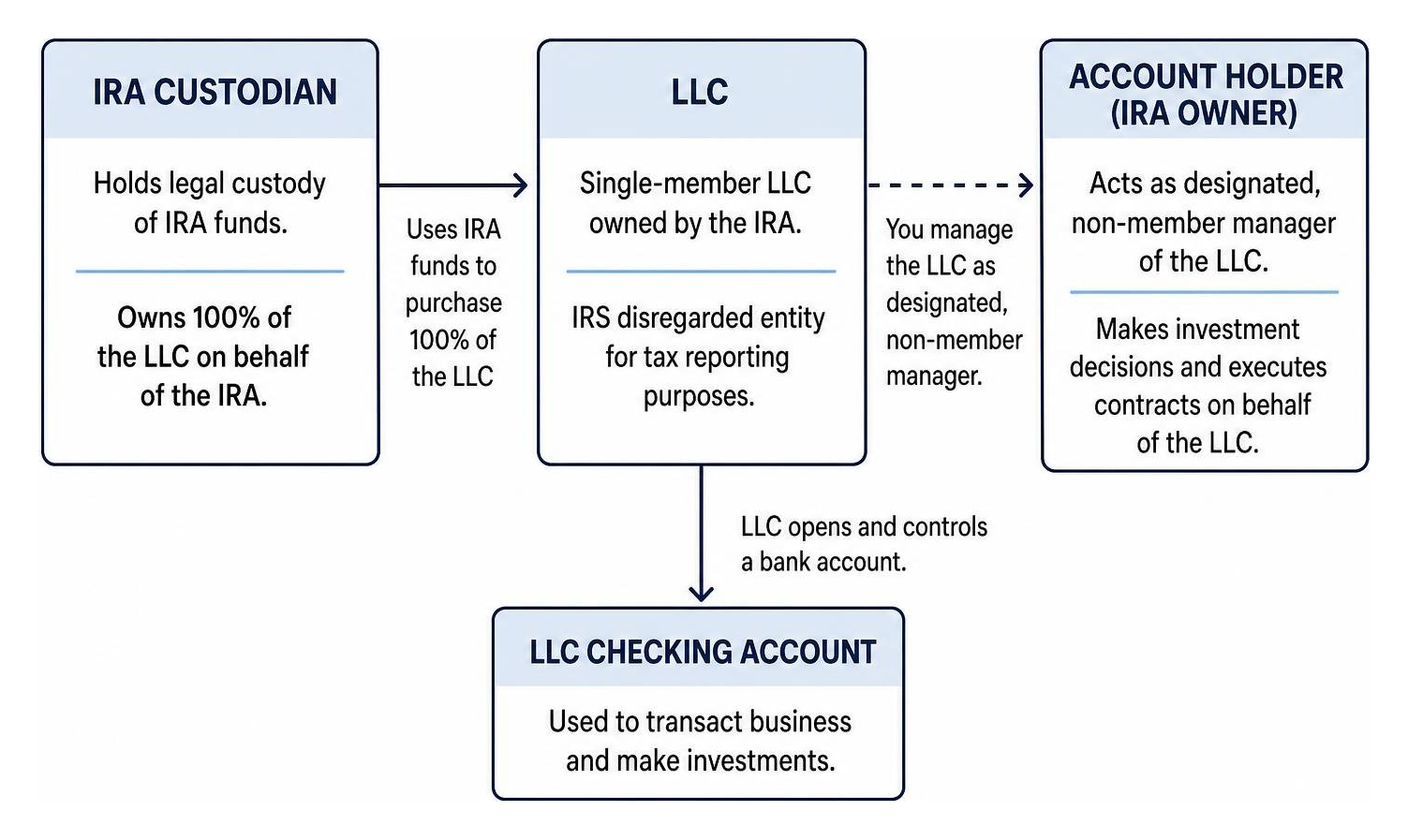
This legal layout establishes clear boundaries:
- Legal Ownership: The self-directed IRA custodian holds ownership of the LLC on behalf of your IRA account.
- Management Control: You, as the manager, make investment decisions and execute contracts on behalf of the LLC.
- Liability Protection: The LLC structure provides an additional layer of protection, keeping potential claims—such as property liabilities—contained within the LLC rather than reaching your broader IRA assets or personal wealth.
To explore how this framework integrates with your current retirement savings, review our comprehensive resources.
What Makes a Self Directed IRA LLC Different From Traditional Accounts?
Traditional brokerage IRAs limit your choices to stocks, bonds, mutual funds, and exchange-traded funds (ETFs). Every transaction must pass through the broker’s platform, and alternative assets like private real estate or notes are typically not offered.
A Self directed IRA LLC broadens your investment scope. By transferring your retirement money to a self-directed custodian who places those funds into an IRA-owned LLC, you gain access to alternative investments while maintaining full tax-deferred or tax-free status.
| Feature | Traditional IRA | Custodian-Directed IRA | Self-Directed IRA LLC |
|---|---|---|---|
| Permitted Assets | Stocks, Bonds, ETFs | Alternative Assets (Real Estate, Notes) | Alternative Assets + Direct Management |
| Transaction Speed | Instant for public assets | Days or weeks (Custodian approvals) | Immediate via direct checking account |
| Transaction Fees | Standard brokerage commissions | Custodian processing fees per transaction | Low administrative fees; direct payments |
| Checkbook Control | No | No | Yes |
While standard custodian-directed accounts allow alternative investing, every purchase, bill, or invoice requires sending documents to the custodian for approval and disbursement. The LLC structure bypasses those delays through direct checkbook authority. Learn more about taking direct command of your investment velocity with Self Directed IRA Control.
How Checkbook Control Works Within a Self Directed IRA LLC
Checkbook control simplifies how your retirement funds operate on a day-to-day basis. Once your IRA capitalizes the newly formed LLC, the LLC opens a dedicated business checking account. As the manager of the LLC, you receive signing authority over this checking account.
When an opportunity arises—such as acquiring a rental property, securing tax liens, or funding a private bridge loan—you write a check or wire funds directly from the LLC checking account. Expense payments, including property management fees, property taxes, repairs, and insurance premiums, are paid directly from this account.
All rental income, note repayments, or investment dividends return directly into the LLC checking account. This eliminates custodian transaction delays and per-transaction processing fees, giving you a streamlined workflow.
Key Benefits, Approved Assets, and Comparative Structures
Self-directed accounts, including those utilizing an LLC structure, represent roughly 3% of the total $13.9 trillion IRA market. Alternative assets held within these accounts, such as private placement deals and real estate, offer investors a way to diversify beyond standard public stock and bond indexes over long time horizons.
Real estate remains a common asset class for self-directed IRA investors, representing a significant portion of alternative investments held in these accounts. The combination of checkbook control and real estate investing allows investors to react quickly to market conditions.
Permitted vs Prohibited Asset Classes
According to IRS guidelines on retirement plans, Internal Revenue Code (IRC) Section 408 permits IRAs to invest in almost any asset class, provided it is not explicitly restricted by the tax code.
Permitted Investments Include:
- Real Estate: Residential rentals, commercial buildings, multi-family units, raw land, and mobile homes.
- Private Lending: Secured promissory notes, mortgage notes, real estate debt, and peer-to-peer loans.
- Tax Liens & Deeds: Purchasing tax certificate liens and deeds directly from municipalities.
- Private Equity: Early-stage startup capital, private company placements, and LLC units.
- Precious Metals: IRS-permitted bullion meeting specific purity thresholds held in qualified depositories.
Prohibited Asset Classes (Per IRC Section 408):
- Collectibles: Artwork, antiques, stamps, gems, historical artifacts, and most coins.
- Life Insurance Policies: Buying life insurance contracts directly through an IRA.
- S-Corporation Stock: IRS regulations prohibit IRA entities from holding shares in S-Corps.
If you are evaluating specific asset acquisitions, review our Checkbook IRA program options to confirm eligibility.
Comparing the Self-Directed Account to a Solo 401(k)
Investors often compare a Self directed IRA LLC to a Solo 401(k) when planning an alternative asset strategy.
If you operate a sole proprietorship, partnership, or owner-only business, a Solo 401(k) offers higher annual contribution caps and potential tax advantages regarding real estate debt leverage. However, if your funds reside in an existing employer rollover plan or traditional IRA, the Self directed IRA LLC provides access to self-directed alternative assets without requiring active business operations.
Setup Steps, IRS Compliance, and Tax Rules

Establishing a Self directed IRA LLC requires strict coordination between entity creation, custodian funding, and tax registrations. Brian Davis and the team at Independent IRA, an Authorized Agent of Accuplan Benefits Services, assist investors through every stage of this setup process.
Step-by-Step Setup and Custodian Involvement
- Establish a Self-Directed IRA Custodial Account: Open a specialized self-directed IRA account with a qualified custodian capable of holding alternative assets.
- Execute a Direct Transfer or Rollover: Move capital tax-free from an existing 401(k), 403(b), traditional IRA, or Roth IRA into your new self-directed IRA.
- Form the Special-Purpose LLC: Draft customized Articles of Organization and file them with your state government. The LLC’s language must explicitly comply with IRS self-directed retirement rules.
- Draft an IRA-Compliant Operating Agreement: Prepare an operating agreement specifically tailored for retirement entities, naming the IRA as the 100% member and you as the manager.
- Obtain an Employer Identification Number (EIN): Secure a federal EIN from the IRS for the LLC to facilitate banking setup.
- Fund the LLC: Instruct your IRA custodian to invest your account capital into the LLC in exchange for 100% membership interest.
- Open the Checking Account: Establish the LLC’s bank account, sign as the manager, and begin directing investments.
To learn how our team manages this setup process, explore our specialized IRA Services.
Prohibited Transactions and Disqualified Persons
The tax benefits of a self-directed retirement account depend on strictly avoiding prohibited transactions. IRC Section 4975 forbids transactions between an IRA/LLC and a “disqualified person.”
Disqualified Persons Include:
- The account holder and their spouse.
- Lineal ascendants (parents, grandparents) and lineal descendants (children, grandchildren) and their spouses.
- Investment advisors, managers, or custodians handling the account.
- Any business entity where a disqualified person holds a 50% or greater controlling stake.
(Note: Siblings, aunts, uncles, cousins, and non-lineal relatives are generally not considered disqualified persons under federal guidelines).
| Permitted Transactions | Prohibited Transactions |
|---|---|
| Buying a single-family home using LLC funds as a pure rental investment to third-party tenants. | Renting an IRA LLC-owned condo to your daughter or parent. |
| Paying a third-party plumber to repair a rental property pipe using LLC checking funds. | Fixing a broken property sink yourself or buying materials with personal cash. |
| Making a hard money private loan to an unrelated business partner or third party. | Loan funds from your IRA LLC to yourself or your spouse’s business enterprise. |
| Paying LLC property taxes directly from the designated LLC checking account. | Paying LLC property taxes using personal funds and seeking reimbursement later. |
Violating these rules can trigger severe penalties: the IRS may disqualify the entire IRA, treating the entire account value as a taxable distribution as of January 1st of that tax year.
Managing UBIT, UDFI, and Avoiding Common Pitfalls
While IRAs generally offer tax-deferred or tax-free growth, two specific tax scenarios require careful monitoring when using an LLC structure:
1. Unrelated Debt-Financed Income (UDFI)
If your IRA LLC acquires real estate using a mortgage, the loan must be a non-recourse loan. You cannot personally guarantee the loan or provide personal collateral. Because the property is leveraged, the percentage of income derived from the borrowed debt is subject to UDFI taxes under IRC Section 514. IRS Form 990-T must be filed by your account if gross taxable leverage income exceeds $1,000 in a tax year.
2. Unrelated Business Income Tax (UBIT)
If your IRA LLC operates an active business (such as opening a restaurant, running a service business, or engaging in continuous property flipping), the income generated is treated as active trade or business revenue under IRC Section 512, making it subject to UBIT. UBIT rates can quickly reach the top federal trust tax brackets.
To learn how to properly structure real estate purchases and note portfolios while keeping federal reporting in order, consult our IRA 1 reference materials.
Frequently Asked Questions About Self-Directed Investing
What are the main risks and downsides of managing an account structure like this?
The main risks center on administrative oversight and personal compliance responsibility. Because you serve as the direct manager with checkbook authority, you assume full responsibility for avoiding disqualified transactions. A single operational error—such as paying an LLC property bill with personal capital—can invalidate your account’s tax status, resulting in immediate taxation and potential early withdrawal penalties.
Additionally, maintaining an LLC involves ongoing state filing fees, annual franchise taxes, and tax filing requirements (like IRS Form 990-T) when debt financing is used.
How are leverage and debt financing handled when purchasing real estate?
Leverage is entirely legal within a self-directed real estate transaction, provided it uses non-recourse debt financing. A non-recourse loan uses the property itself as sole collateral; the lender has no legal recourse against you personally or your broader IRA assets if default occurs.
Income derived from leverage is subject to UDFI tax obligations. These tax liabilities are paid directly from your LLC checking account balance using IRS Form 990-T.
What are the most common administrative mistakes account holders make?
The most frequent operational mistakes include:
- Commingling personal capital with LLC cash accounts.
- Executing DIY repairs or property maintenance on IRA properties instead of hiring third-party service providers.
- Transferring money back into a personal account instead of maintaining all earnings within the retirement structure.
- Delaying annual property valuations or failing to submit mandatory status reports to the custodian.
Before You Move Retirement Funds

A Self directed IRA LLC offers flexibility and execution speed for alternative investments like real estate, private equity, and tax liens. By removing custodian transfer delays, checkbook control puts you directly in command of your retirement assets.
However, added authority requires strict adherence to IRS compliance rules, prohibited transaction guidelines, and proper legal structuring. Working with experienced self-directed account professionals helps ensure your entity setup remains compliant.
As an Authorized Agent of Accuplan Benefits Services, Independent IRA guides investors through entity formation, custodial transfers, and administrative rules, helping you execute your investment strategy with confidence.
Take the next step in evaluating your options:
- Explore our comprehensive array of Independent IRA Services to choose the legal arrangement right for you.
- Contact Independent IRA Today to speak with a self-directed specialist and evaluate your portfolio goals.
This content is for informational and educational purposes only and does not constitute legal, tax, or investment advice. Rules, limits, and requirements may change. Consult a qualified tax advisor, attorney, or financial professional before making retirement planning or investment decisions. Independent IRA is an Authorized Agent of Accuplan Benefits Services and is not a custodian or trust company.