

 GIVE US A CALL
When expanding beyond standard stock and bond portfolios, choosing the right san diego investment firm is a critical decision point for alternative asset allocation. Evaluating a firm requires analyzing its track record, target sector expertise, and operational execution to ensure alignment with your financial objectives. By deploying capital through a self-directed IRA, account holders can fund private equity deals while preserving potential tax advantages. As an Authorized Agent of Accuplan Benefits Services, Independent IRA helps investors establish self-directed accounts to efficiently access private market opportunities.
You can also explore the regional ecosystem through the Top Private Equity Firms Guide.
Operational Criteria for Choosing a San Diego Investment Firm
Evaluating private equity sponsors or investment managers requires looking closely at operational execution, sector expertise, and clear strategy alignment. San Diego investment firms typically specialize in distinct investment tiers:
- Growth Equity & Lower Middle-Market Services: Many local firms focus on making control investments in established providers of mission-critical services. Target acquisitions often feature EBITDA ranges between $3 million and $15 million, targeting stable cash flows and scalable operating models.
- Sector Specialization: Look for firms with deep operational experience in mission-critical business services, healthcare technologies, enterprise software, or commercial landscaping maintenance. Industry expertise helps operational partners drive post-acquisition efficiency rather than relying solely on financial leverage.
- Track Record & AUM: Firms in the region range from boutique sponsors to massive multi-billion-dollar global managers. For instance, major institutional players headquartered in La Jolla handle hundreds of billions in capital responsibility, while established lower middle-market private equity groups manage active flagship funds of $580 million or more, with over $1.2 billion in total equity commitments raised across dozens of completed transactions. You can learn more about lower middle-market operational strategies through the Seaside Equity Partners Overview.
Aligning Alternative Strategies with Self-Directed Retirement Accounts
Finding an established private equity or real estate firm is only half the process; the capital structure must also comply with IRS regulations for self-directed retirement accounts. When deploying capital from a self-directed IRA or Solo 401(k), maintaining tax-deferred or tax-free compounding requires proper setup.

Using a checkbook IRA LLC or self-trusteed Solo 401(k) allows account holders to execute private placement subscription agreements efficiently. Instead of relying on traditional brokerages that limit choices to publicly traded funds, a self-directed structure puts you in direct control of IRS-permitted assets. You can explore our dedicated services for Private Equity & Private Lending San Diego to learn how checkbook control simplifies alternative capital deployments.
Key Sectors Driving Private Investment Opportunities in San Diego

San Diego’s economy is built on a diverse set of resilient growth drivers. With a population of 3.3 million across 18 cities, the region consistently outperforms many traditional metropolitan markets.
Life Sciences, Technology, and Binational Growth Engines
San Diego ranks as the #3 life sciences cluster in the United States, backed by 2 million square feet of existing lab space and millions more under development. The region is home to 108,000 STEM workers and confers approximately 10,800 STEM degrees locally each year.
- Life Sciences & Biotech: Local biomedical firms attract over $2.6 billion annually in biotechnology venture capital, funding breakthroughs from pre-clinical research through commercialization.
- Defense & Strategic Technology: San Diego ranks #1 nationally in military asset concentration, generating over $35 billion in direct military spending into the local economy. This defense backbone fuels commercial technology spin-offs in artificial intelligence, cybersecurity, and autonomous systems.
- Cali Baja Binational Economy: The Cali Baja region—encompassing San Diego County, Imperial County, and Baja California—creates a unique cross-border economic engine. Retaining $6.2 billion in cross-border trade exports, this binational dynamic enables companies to pair San Diego-based R&D with cost-effective advanced manufacturing across the border.
Private real estate firms also capitalize on these regional dynamics. High population density and strict zoning rules create opportunities for specialized private equity funds targeting infill housing, accessory dwelling units (ADUs), and life science real estate. Interested investors can review real estate market models at Fletcher Cove Capital Real Estate.
Venture Capital Innovation and Community Impact Models
The San Diego venture ecosystem features distinct funding models designed to bridge local capital gaps. Historically, San Diego companies have raised massive growth rounds while having fewer resident venture dollars compared to markets like Silicon Valley or Boston.
To solve this, innovative venture capital approaches have emerged:
- Philanthropic Evergreen Funds: Models like the TL Foundation Evergreen Model operate non-profit venture structures where 100% of investment returns (carry) are returned directly to the community fund to sponsor future innovation perpetually.
- Impact Ecosystem Funds: Initiatives like the Prebys Ventures Impact Fund deploy $50 million funds targeting early-stage seed, Series A, and Series B rounds with check sizes ranging from $500,000 to $2 million. Returns earned by sidecar fund co-investors flow back into local economic development.
- Regional Deal Syndicates: Local managing directors actively form syndicates with national private capital firms to keep emerging life science and software unicorns grounded in San Diego.
How Self-Directed IRAs Empower Investments with a San Diego Investment Firm
Investing in private equity, private debt, or real estate syndications through a traditional custodian can be cumbersome, slow, and expensive. Self-directed structures streamline private capital placements.
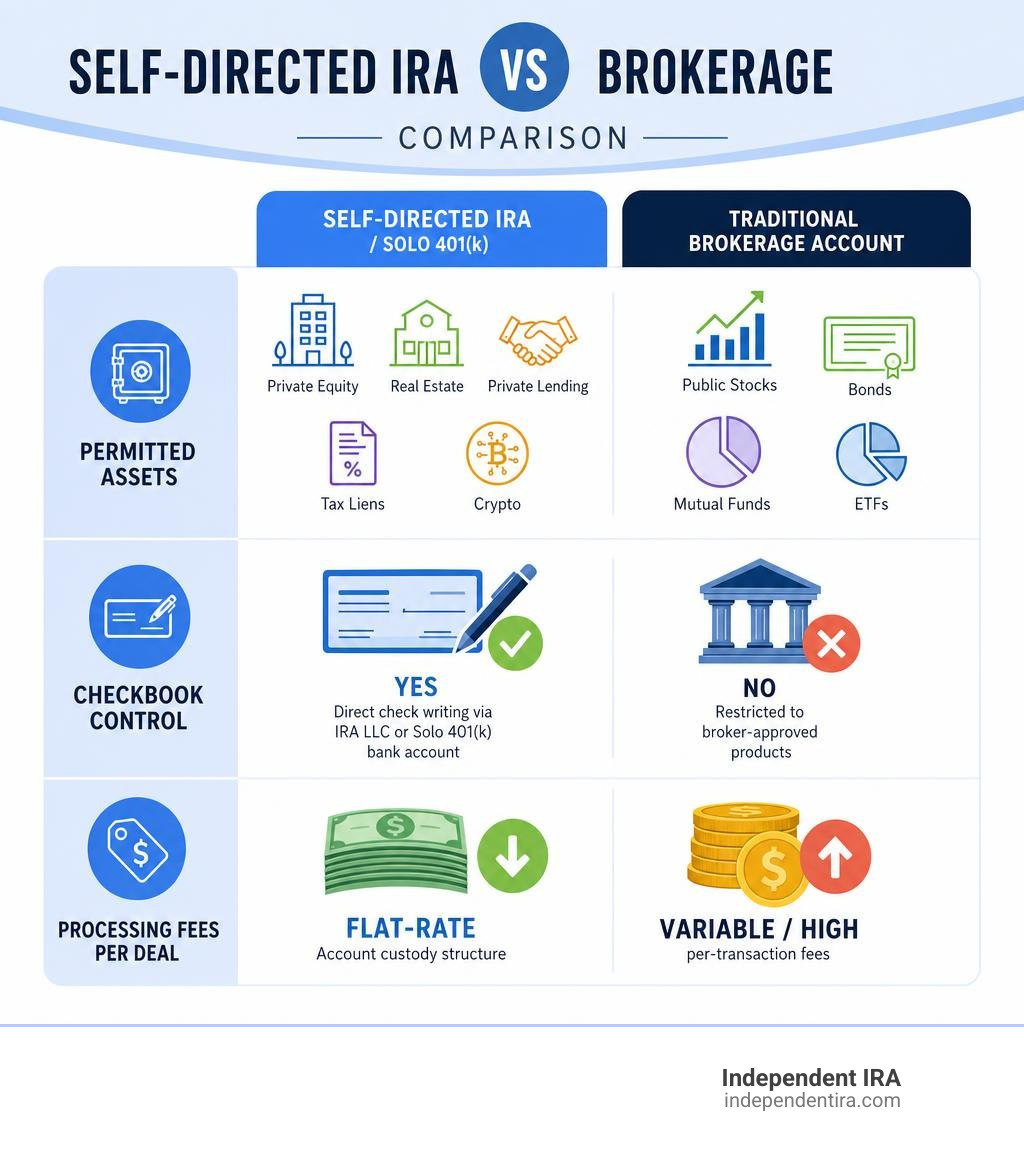
| Feature | Traditional Brokerage Account | Independent IRA Self-Directed IRA / Solo 401(k) |
|---|---|---|
| Permitted Assets | Public Stocks, Bonds, Mutual Funds, ETFs | Private Equity, Real Estate, Private Lending, Tax Liens, Crypto |
| Checkbook Control | No (Restricted to broker-approved products) | Yes (Direct check writing via IRA LLC or Solo 401(k) bank account) |
| Processing Fees per Deal | Variable / High per-transaction fees | Flat-rate account fee structure |
| Turnaround Time for Funding | Weeks (Requires institutional approval) | Same-day wire execution via checkbook control |
| Tax Treatment | Taxable capital gains or standard IRA limits | Tax-deferred (Traditional) or Tax-Free (Roth) growth |
Deploying Retirement Capital into a San Diego Investment Firm
When a san diego investment firm opens a private placement memorandum (PPM) for a new growth fund or real estate project, accredited investors must act within specific subscription timelines.
With a checkbook IRA LLC or Solo 401(k) facilitated through Independent IRA, the investment process follows straightforward steps:
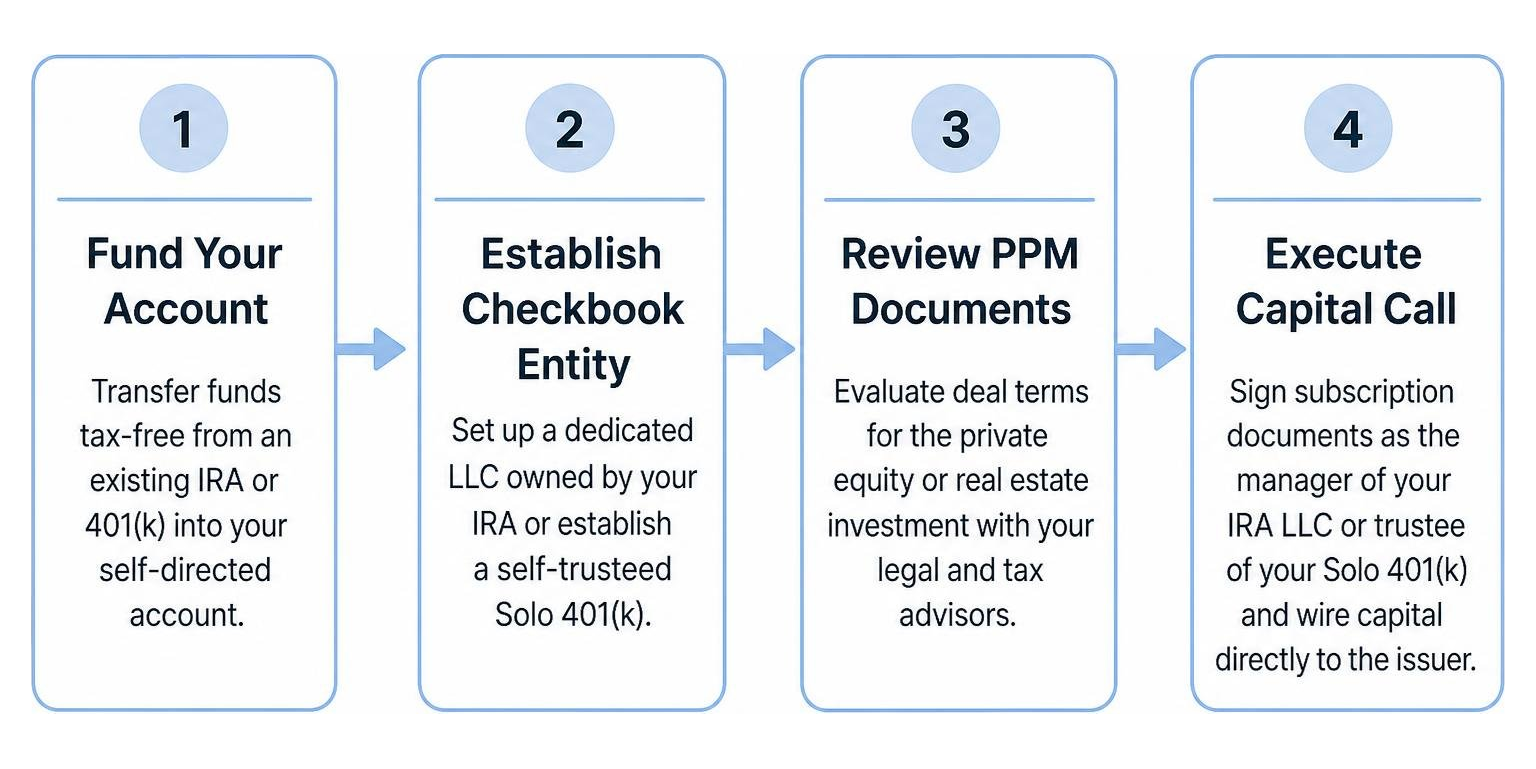
- Fund Your Account: Transfer funds tax-free from an existing IRA or 401(k) into your self-directed account.
- Establish Checkbook Entity: Set up a dedicated LLC owned by your IRA, or establish a self-trusteed Solo 401(k).
- Review PPM Documents: Evaluate the private equity or real estate deal terms alongside your legal and tax advisors. Brian Davis assists clients throughout the account setup process to provide administrative support.
- Execute Capital Call: Sign subscription documents as the manager of your IRA LLC or trustee of your Solo 401(k) and wire capital directly to the issuer.
To explore how to raise or deploy capital using tax-advantaged accounts, check out our resource on Raising Private Capital IRAs.
Optimizing Tax-Advantaged Growth via Self-Directed Structures
Using self-directed accounts may offer compound growth advantages. When a private equity sponsor exits a portfolio company or a real estate syndication distributes quarterly rental income, those returns flow directly back into your IRA bank account tax-free (Roth) or tax-deferred (Traditional).
For self-employed individuals and business owners without full-time employees, a self-trusteed Solo 401(k) offers higher annual contribution limits alongside direct checkbook control without needing a separate LLC. Discover your account options through our guide to Self-Directed IRA San Diego.
Critical Due Diligence Guidelines for Self-Directed Alternative Investments

Self-directed investing puts you in complete control, which also means due diligence rests squarely on your shoulders. Neither Independent IRA nor account custodians act as fiduciary investment advisors or endorse specific deal sponsors.
Evaluating General Partner Track Records and Waterfalls
Before committing capital to any private investment firm, perform deep due diligence on the General Partner (GP):
- Sponsor Co-Investment: Ensure the GP has significant personal capital invested in the deal alongside Limited Partners (LPs). Alignment of interest is critical.
- Preferred Return & Waterfalls: Review the capital distribution waterfall. A standard structure offers LPs an 8% preferred return before the sponsor receives performance carry fees.
- Track Record Verification: Ask for audited historical performance metrics across prior funds. Verify gross vs. net Internal Rate of Return (IRR) and Total Value to Paid-In (TVPI) multiples.
- Operational Transparency: Confirm that the firm provides regular, plain-language reporting and direct access to decision-makers.
Navigating UBIT and Retirement Account Tax Compliance
While IRAs and 401(k)s enjoy general tax-exempt status, investing in certain private operations can trigger Unrelated Business Income Tax (UBIT) or Unrelated Debt-Financed Income (UDFI):
- Active Businesses in an IRA: If your self-directed IRA invests in an operating pass-through entity (such as an LLC or LP running an active service business or restaurant), net active income exceeding $1,000 per year may be subject to UBIT under IRS rules.
- Debt-Financed Real Estate (UDFI): When an IRA uses non-recourse debt to purchase real estate within a private fund, income proportional to the leveraged portion of the asset may trigger UDFI tax.
- Solo 401(k) Debt Exception: Solo 401(k) plans benefit from an exemption under IRC Section 514(c)(9), allowing them to acquire real estate using non-recourse debt without triggering UDFI on rental income.
Understanding these tax nuances keeps your account compliant while maximizing net returns. For additional details on managing retirement plans, review our overview of 401(k) Services San Diego.
Frequently Asked Questions About Private Investing in San Diego
Can I use a self-directed IRA to invest in a local private equity firm?
Yes. Self-directed IRAs and self-trusteed Solo 401(k)s permit investments in IRS-permitted non-public assets, including private equity funds, venture capital syndicates, private debt offerings, and real estate partnerships. The deal sponsor must accept IRA capital, and all subscription documentation must be executed in the name of your self-directed account or checkbook LLC.
What target industries do private equity firms in San Diego focus on?
Private equity and venture firms in San Diego focus heavily on high-growth and mission-critical sectors. Key target industries include life sciences and biotechnology, enterprise software platforms, defense technology and aerospace, infill residential housing, lower middle-market business services, and clean energy transition solutions.
How does Unrelated Business Income Tax (UBIT) apply to IRA private equity deals?
UBIT applies when a tax-exempt account earns active business income from a pass-through entity (like an LLC or LP operating an active business) rather than passive income (like interest, dividends, or real estate capital gains). If UBIT applies, the tax must be paid directly from your self-directed retirement account funds using IRS Form 990-T.
What is the difference between an institutional private equity firm and a self-directed retirement account provider?
An institutional private equity firm manages investment funds by acquiring companies or real estate assets to pursue portfolio growth. Independent IRA is an Authorized Agent of Accuplan Benefits Services that assists clients in establishing self-directed retirement account structures (such as checkbook IRA LLCs and Solo 401(k)s), enabling tax-advantaged capital deployment into private equity opportunities.
Before You Move Retirement Funds
Connecting with a reliable san diego investment firm opens up compelling growth opportunities across private equity, real estate, and local tech innovation. However, true investment control comes from directing how your capital is deployed. By combining thorough deal-level due diligence with a self-directed IRA LLC or Solo 401(k) structure setup through Independent IRA, you can back high-conviction alternative assets while preserving potential tax advantages.
Brian Davis and our team are ready to assist you in setting up the checkbook control accounts needed to participate in private placements seamlessly. Contact Independent IRA today to establish your account and take control of your private wealth journey.
This content is for informational and educational purposes only and does not constitute legal, tax, or investment advice. Rules, limits, and requirements may change. Consult a qualified tax advisor, attorney, or financial professional before making retirement planning or investment decisions. Independent IRA is an Authorized Agent of Accuplan Benefits Services and is not a custodian or trust company.