

 GIVE US A CALL
If you want your retirement funds to do more than sit in traditional market assets, private lending with IRA funds can give you more control. With a self-directed IRA, your account can make loans, collect interest, and potentially grow on terms you help set. For investors comparing options, this approach can be a practical way to turn retirement capital into private debt investments while staying within IRS rules. A good starting point is understanding how Self-Directed IRA Control works and where the guardrails are.
Private lending with IRA funds means using a self-directed IRA (SDIRA) to act as the lender – issuing loans to borrowers, collecting interest, and potentially growing your retirement account in a way that many standard brokerage IRA platforms do not support.
Here’s what you need to know at a glance:
- What it is: Your IRA issues a loan (via promissory note) to a borrower – a real estate investor, small business, or individual – and earns interest that flows back into your retirement account
- Who controls it: You decide the borrower, the rate, the term, and the collateral – the custodian, through an authorized agent, executes on your direction
- What types of loans qualify: Personal loans, private mortgages, hard money loans, bridge loans, business loans, and equipment financing
- Who you can’t lend to: Yourself, your spouse, your parents, or your children (more on disqualified persons below)
- Potential tax advantage: Interest earned stays inside the IRA – which may grow tax-deferred in a Traditional IRA or tax-free in a Roth IRA
For real estate investors who feel boxed in by conventional retirement accounts, private lending through a self-directed IRA offers a different model. Instead of waiting for the stock market to move, your IRA becomes the bank – setting its own terms and seeking returns that reflect the loan structure, collateral, and borrower risk. The interest, points, and principal repayments all return directly to your IRA, not your personal bank account.
The appeal is straightforward: you already understand deals, borrower risk, and collateral values. Private lending lets you put that expertise to work inside a tax-advantaged wrapper. Self-directed IRAs collectively hold hundreds of billions in assets, with a share flowing into IRS-permitted assets like promissory notes and private mortgages.
This guide walks through the process, from IRS rules and prohibited transactions to loan documentation, default scenarios, and how to fund your first loan.
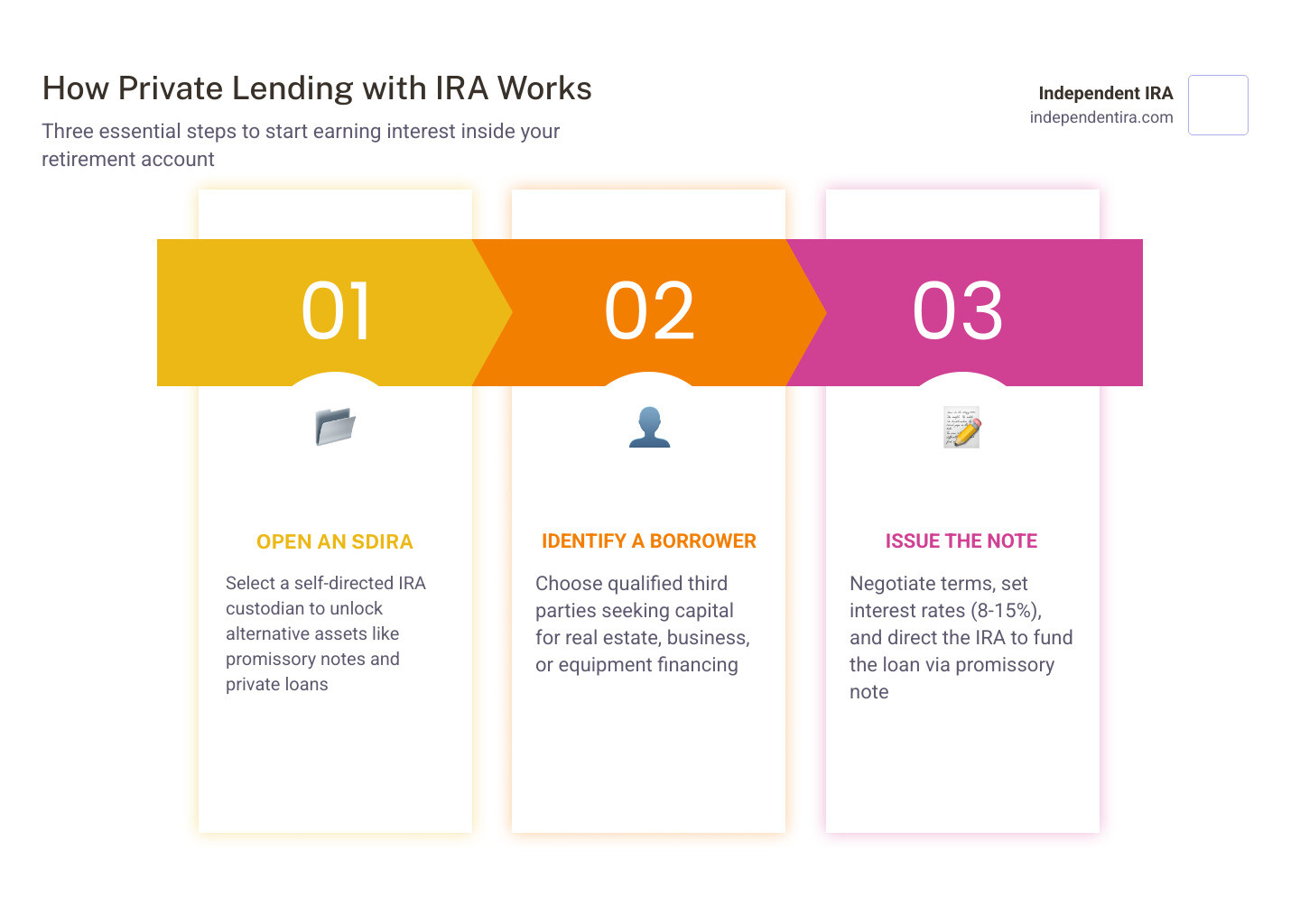
At its core, private lending with IRA funds is the process of using your retirement capital to provide debt financing to third parties. In a traditional retirement account, your money is usually tied up in mutual funds or stocks. With a self-directed IRA, you have the authority to move that capital into promissory notes – essentially legal “IOUs” that outline how much was borrowed, the interest rate, and the repayment schedule.
The mechanics are simpler than most people think. Once you have a self-directed account, you identify a borrower who needs capital. You negotiate the terms, such as the interest rate and the term. Your IRA then buys that note. The borrower makes payments directly to your IRA custodian, and those funds sit in your account, ready to be reinvested or held for retirement.
One of the biggest advantages here is Self-Directed IRA Control. You aren’t relying on a fund manager’s choices; you are the one performing the due diligence on the borrower. Because you are acting as the bank, you can negotiate interest rates based on the risk and the collateral involved.
Types of Loans and Collateral Strategies
When you engage in private lending with IRA funds, you aren’t limited to just one type of loan. You can diversify your “loan portfolio” across various sectors:
- Hard Money Loans: Short-term loans typically used by real estate “fix-and-flip” investors.
- Bridge Loans: Temporary financing used until a person or company secures permanent financing.
- Business Financing: Lending to startups or established small businesses for operational costs.
- Equipment Loans: Financing the purchase of machinery, vehicles, or even livestock.

Secured vs Unsecured Private Lending with IRA
One of the most critical decisions you’ll make is whether to offer a secured or unsecured loan.
| Feature | Secured Loans | Unsecured Loans |
|---|---|---|
| Collateral | Real estate, vehicles, or equipment | None (Signature only) |
| Risk Level | Lower (Asset can be seized) | Higher (No asset to seize) |
| Interest Rates | Negotiated based on risk | Negotiated based on risk |
| Best For | Mortgages, rehab projects | Trusted business partners |
Secured loans are often a preferred route for retirement accounts because they provide collateral. If you lend funds for a real estate project and the borrower fails to pay, your IRA can initiate foreclosure on the property to recoup the investment. Collateral isn’t limited to houses; IRAs can be secured by everything from private stock and business receivables to livestock.
Real Estate Debt and Mortgage Notes
Real estate is a common area for private lending with IRA investors. Many clients prefer being the “lender” rather than the “landlord.” When you own the debt (the mortgage note) instead of the property, the IRA collects the payments without the responsibilities of property management.
By focusing on Private Equity & Private Lending, you can position your IRA in a “first-lien” position. This means if the borrower defaults, your IRA is the first in line to be paid from the sale of the asset. This strategy is used for funding fix-and-flips or providing long-term private mortgages for rental properties.
Navigating IRS Rules and Prohibited Transactions
The IRS provides freedom with self-directed IRAs, but there are specific rules you must follow. The most important is avoiding “prohibited transactions.” According to IRS Publication 590, your IRA is meant to provide for your future retirement, not your current lifestyle.
This means you cannot engage in “self-dealing.” For example, your IRA cannot lend money to you personally, nor can it lend money to a business you own. The transaction must be an “arm’s length” deal with a third party. If you violate these rules, the IRS could disqualify your entire IRA, treating the full balance as a taxable distribution.
However, when done correctly, the process of Raising Private Capital with IRAs may grow your wealth with tax advantages.
Who are Disqualified Persons in Private Lending with IRA?
To stay compliant, you must know who you cannot lend to. The IRS defines “disqualified persons” as:
- You (the account owner) and your spouse.
- Your lineal ascendants (parents, grandparents).
- Your lineal descendants (children, grandchildren) and their spouses.
- Any entity (LLC, Corporation) where these individuals own 50% or more.
The Sibling Loophole: Interestingly, the IRS does not consider siblings, aunts, uncles, or cousins as disqualified persons. This means you could potentially use your IRA to fund a sibling’s business or real estate investment, provided the loan is a legitimate investment with fair market terms.
The Step-by-Step Process to Funding Your First Loan
Ready to act as the bank? Here is the standard process for private lending with IRA funds:
- Open a Self-Directed Account: You need a custodian that allows for alternative assets. Independent IRA, an Authorized Agent of Accuplan, can facilitate this process.
- Fund the Account: This is usually done via a rollover from a former employer’s 401(k) or a transfer from an existing IRA.
- Identify the Borrower: Perform your due diligence. Check their credit, their track record, and the value of the collateral.
- Draft the Documents: You will need a formal promissory note and, if secured, a Deed of Trust or Mortgage. Our team provides process support to ensure your documents are properly titled in the name of the IRA.
- Submit to Custodian: You send the finalized (but unsigned) documents to us. We review them for administrative requirements and then the custodian disburses the funds directly from your IRA to the borrower or escrow company.

Managing Risks and Default Scenarios
Every investment carries risk, and private lending with IRA is no different. The primary risk is borrower default. To mitigate this, experienced lenders look at the Loan-to-Value (LTV) ratio. For example, if a property is worth $500,000, you might only lend $350,000 (a 70% LTV). This 30% “equity cushion” is intended to provide a buffer for your IRA if property values drop or if there are costs associated with a foreclosure.
Another nuance is the non-recourse loan. In the context of SDIRAs, if your IRA borrows money to buy real estate, that loan must be non-recourse (meaning the lender cannot come after you personally). However, when your IRA is the lender, you can choose whether the loan is recourse or non-recourse to the borrower.
If a borrower defaults, the process is similar to a bank’s. Your IRA (not you personally) would initiate foreclosure. It is often wise to hire a third-party loan servicer to handle payment collection and late notices. This keeps the investment passive and ensures all records are maintained for tax purposes.
Before You Move Retirement Funds
Private lending with IRA funds is one way to take control of your financial future. By shifting to a “private debt” mindset, you can seek to build retirement wealth secured by tangible assets.
At Independent IRA, we specialize in helping investors navigate the administrative requirements of self-directed accounts. Whether you are looking for a Checkbook IRA to fund deals or need an Authorized Agent of Accuplan for your San Diego real estate notes, we are here to help.
- Explore our Self-Directed Services
- Learn about Real Estate IRAs in San Diego
- Contact us to start your application
Frequently Asked Questions about Private Lending
Can I lend IRA funds to my brother or sister?
Yes. While the IRS prohibits lending to “disqualified persons” like parents, children, or spouses, siblings are generally not considered disqualified. This allows you to use your IRA to fund their business ventures or real estate projects, provided the transaction is for the exclusive benefit of the IRA and carries market-rate terms.
What happens if a borrower defaults on an IRA loan?
If the loan is secured, your IRA can initiate foreclosure or repossession to take ownership of the collateral. All legal and collection fees must be paid by the IRA, and any recovered value or proceeds from a sale return directly to the account. It is recommended to work with a professional loan servicer to manage this process.
Is the interest earned from private lending taxable?
Generally no, as long as the funds remain within the IRA. Profits may grow tax-deferred in a Traditional IRA or potentially tax-free in a Roth IRA. This may allow your interest payments and loan points to compound differently than they would in a standard taxable brokerage account.
What is the minimum amount needed to start private lending?
There is no legal minimum required by the IRS. However, many private mortgages typically start at higher amounts to ensure the interest returns justify the administrative costs, custodian fees, and the time spent on due diligence.
Can my IRA lend money for a project I am personally involved in?
No. This is an example of a prohibited transaction. Your IRA cannot lend money to a project where you are the developer, the contractor, or the owner. The IRA must remain a passive lender in a transaction with an unrelated third party to maintain its tax-advantaged status.
This content is for informational and educational purposes only and does not constitute legal, tax, or investment advice. Rules, limits, and requirements may change. Consult a qualified tax advisor, attorney, or financial professional before making retirement planning or investment decisions. Independent IRA is an Authorized Agent of Accuplan Benefits Services and is not a custodian or trust company.