

 GIVE US A CALL
Self-directed IRA hedge funds give retirement investors access to sophisticated, actively managed private investment strategies that simply aren’t available inside a standard brokerage IRA. If you’re trying to understand whether this is allowed, who qualifies, and how it actually works, here’s the short answer:
Can a self-directed IRA invest in hedge funds?
- Yes — hedge funds are IRS-permitted assets for self-directed IRAs to hold as private placements
- The IRA must be held with a custodian that supports alternative assets
- You will likely need to qualify as an accredited investor (net worth over $1 million excluding your primary residence, or annual income of $200,000+)
- Certain tax rules, especially around Unrelated Business Taxable Income (UBTI), may apply depending on the fund’s structure
- Strict prohibited transaction rules apply, self-dealing or investing in funds where disqualified persons have ownership interests can disqualify your entire IRA
For investors in their 50s who already manage real estate or private placements, this can be a way to manage assets inside a tax-advantaged account. But the structure matters enormously and getting it wrong has serious consequences.
Hedge funds are privately managed investment pools that can buy and sell virtually any asset class, from public equities and commodities to distressed debt and derivatives. Unlike mutual funds, they operate with far fewer regulatory constraints and are generally reserved for qualified investors. When you hold a hedge fund interest inside a self-directed IRA, the IRA, not you personally, becomes the investor, and all gains flow back into the account with the same tax treatment that applies to your other IRA assets.
This guide walks through everything you need to know: the IRS rules that make this possible, the real tax risks, how to find the right custodian, and how to execute the investment correctly from start to finish.
Understanding Self-Directed IRA Hedge Funds and IRS Rules
When most people think of an IRA, they think of the “menu” provided by big-box banks or brokerage firms – stocks, bonds, and mutual funds. A Self-Directed IRA (SDIRA) is different. It is a retirement account that gives you the legal authority to invest in nearly any asset allowed by law. This includes alternative investments like real estate, private equity, and, of course, hedge funds.
Hedge funds are essentially private capital pools. Because they are largely unregulated compared to mutual funds, they have the flexibility to use complex strategies like short-selling, leverage, and arbitrage to generate “alpha” (returns that aren’t just following the stock market).
For a long time, the rules around these funds were murky. However, the Pension Protection Act of 2006 provided a significant boost for retirement investors. It liberalized the “25% test,” which previously limited how much benefit-plan money (like IRAs) could be in a fund before the fund’s assets were considered “plan assets.” This change made it much easier for hedge fund managers to accept IRA capital, paving the way for the growth of self directed IRA hedge funds.
The Role of the Custodian
The IRS requires every IRA to have a custodian – a bank or trust company that holds the assets and ensures the account stays in compliance. However, not all custodians are created equal. Most traditional brokers won’t touch a hedge fund because they can’t easily track the value or sell the shares on a public exchange.
Independent IRA, an Authorized Agent of Accuplan, facilitates the administrative services needed for these non-traditional assets. The custodian’s role includes:
- Asset Custody: Holding the private placement interest in the name of your IRA.
- Recordkeeping: Tracking all contributions, distributions, and investment values.
- IRS Reporting: Handling the annual filings (like Form 5498) required by the government.
- Administrative Oversight: Ensuring that the paperwork for your investment is processed correctly.
By maintaining Self-Directed IRA Control, you decide where the money goes; we facilitate the administrative process to make it happen.
Why the IRS Allows Hedge Funds
The IRS does not provide a list of “approved” investments. Instead, they have a list of “prohibited” ones (like life insurance and collectibles). Since hedge funds aren’t on the prohibited list, they are fair game.
These investments are typically structured as private placements. When you use your IRA to invest, you are essentially buying a “membership interest” or “limited partnership interest” in the fund. This allows for tax-advantaged growth – meaning the dividends and capital gains generated by the fund’s sophisticated investing strategies stay inside your IRA, shielded from immediate taxation.
| Feature | Traditional Brokerage IRA | Self-Directed IRA (SDIRA) |
|---|---|---|
| Asset Options | Stocks, Bonds, ETFs | Real Estate, Hedge Funds, Private Equity |
| Investor Control | Limited to Broker’s Menu | Control over Asset Selection |
| Complexity | Low | Moderate to High |
| Accreditation Req. | None | Often Required for Alternatives |
Benefits and Risks of Alternative Fund Investing
Investing in hedge funds isn’t just about seeking potential returns; it’s often about portfolio diversification. Because hedge funds often use strategies that aren’t tied to the S&P 500, they may provide “uncorrelated returns.” This means when the stock market is zigging, your hedge fund might be zagging, potentially offering different risk profiles.
Some investors even pair these with other alternatives, like a Bitcoin IRA, to create a modern retirement portfolio. With over $2 billion in assets under custody across the industry for alternative funds, it’s clear that sophisticated investors are moving away from the “60/40” stock-and-bond model.
However, with these strategies come fees. Hedge funds famously charge a “2 and 20” structure (a 2% management fee and a 20% performance fee on profits). There’s also the issue of liquidity. Unlike a stock you can sell in seconds, hedge funds often have “lock-up periods” where you can’t withdraw your money for a year or more.

Tax Implications: Navigating UBTI and UDFI in Self-Directed IRA Hedge Funds
While IRAs are generally tax-exempt, there is a specific tax called Unrelated Business Taxable Income (UBTI) that can apply to self directed IRA hedge funds.
UBTI is triggered if the hedge fund:
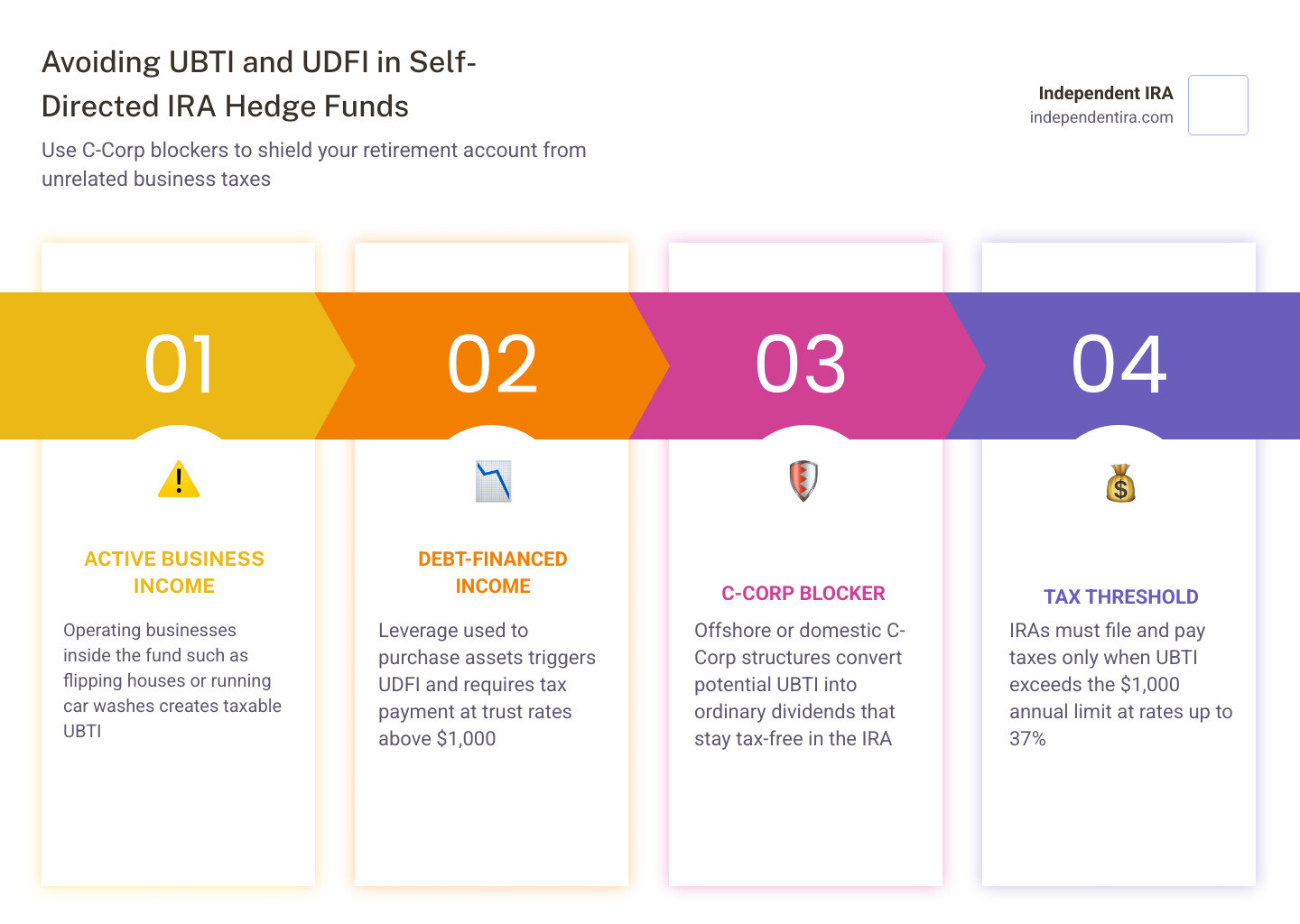
- Operates an active business: If the fund buys an LLC that flips houses or runs a car wash, that’s “active business income,” not “passive investment income.”
- Uses Leverage: If the fund borrows money to buy assets, the portion of the profit tied to that debt is considered Unrelated Debt-Financed Income (UDFI).
If your IRA earns more than $1,000 in UBTI in a year, it must pay taxes at trust tax rates, which can be as high as 37%. To address this potential tax liability, many hedge funds use “C-Corp blockers” – offshore or domestic corporations that sit between the fund and your IRA to “block” the UBTI and turn it into a standard dividend.
Investor Eligibility and Accreditation
Because these are private offerings, the SEC requires you to be an accredited investor. This usually means:
- An individual net worth (or joint net worth with a spouse) exceeding $1 million, excluding your primary residence.
- An annual income exceeding $200,000 ($300,000 with a spouse) in each of the two most recent years.
Some even more exclusive funds require you to be a “Qualified Purchaser,” which generally requires owning $5 million or more in investments. The hedge fund manager will ask you to sign a verification document as part of the subscription process.
How to Set Up Your Account and Fund the Investment
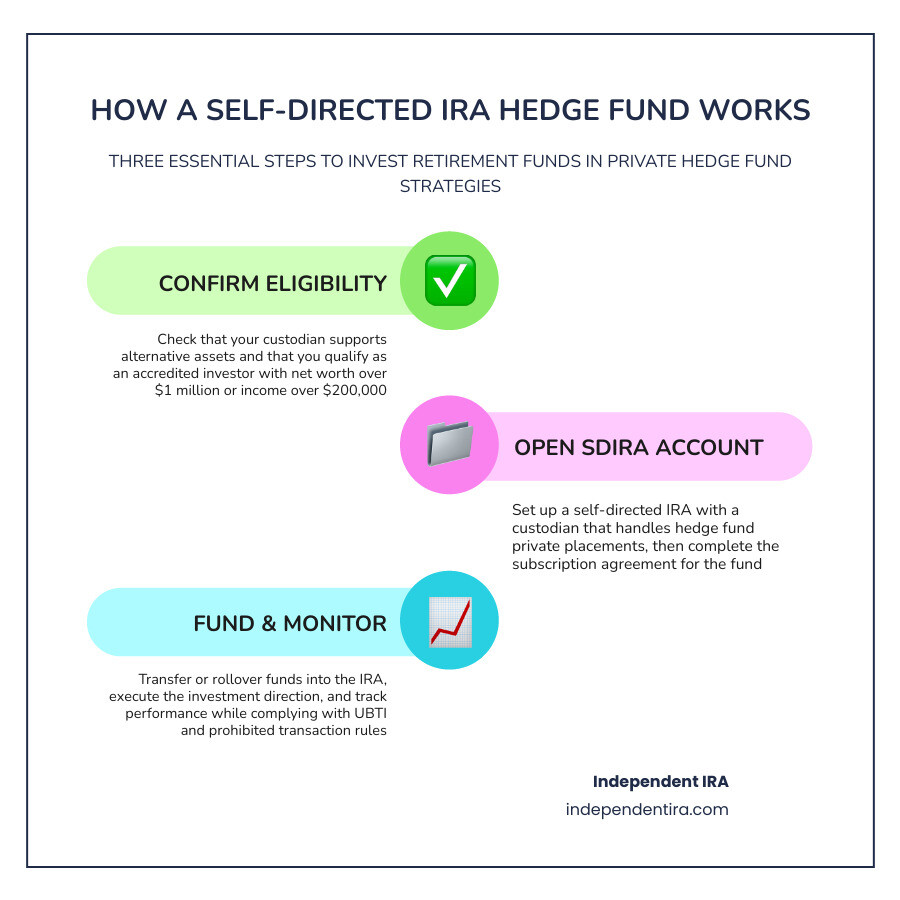
Setting up your account is a straightforward process, but it requires precision. Think of it as a three-step dance:
- Open the Account: You’ll fill out an application with Independent IRA, an Authorized Agent of Accuplan, to establish your new SDIRA through the custodian.
- Fund the Account: You can fund it via a trustee-to-trustee transfer from an existing IRA or a 401(k) rollover from a former employer. This is typically structured as a non-taxable event.
- Select and Vet: You find the hedge fund you want to invest in and perform your due diligence.
Our team, including experts like Brian Davis, provides process support to ensure that the transition of funds is seamless. You’ll need to review the Private Placement Memorandum (PPM) and the Subscription Agreement, these are the legal “rulebooks” for the hedge fund.

Executing the Investment Direction
Once your account is funded, you don’t just write a check. Your IRA owns the investment, so the paperwork must reflect that.
You will submit a Direction of Investment (DOI) form to the custodian. This tells the custodian to send the funds to the hedge fund. The asset must be titled correctly, for example: Independent IRA FBO [Your Name] IRA.
If you want even more speed, you might consider a Checkbook Control LLC. In this structure, your IRA owns an LLC, and you are the manager of that LLC. This allows you to write checks or wire funds directly from a dedicated bank account, which is especially helpful for raising private capital IRAs or meeting fast-moving capital calls.
Maintaining Your Self-Directed IRA Hedge Funds Account
Your work isn’t done once the money is sent. Because these are private assets, they don’t have a daily ticker symbol.
- Fair Market Value (FMV): Every year, you must provide the custodian with an updated valuation of the hedge fund interest so it can be reported to the IRS.
- Annual Reporting: The custodian handles the Form 5498, but they need your fund’s year-end statements to do it accurately.
- Recordkeeping: Keep copies of all capital call notices and distribution statements.
Most of our clients manage this through a digital dashboard, making it easy to track their alternative portfolio in one place.
Compliance and Avoiding Prohibited Transactions
IRS rules allow for various asset types with a self-directed account, but they have one big “No-No”: Prohibited Transactions. Under IRC Section 4975, your IRA cannot engage in transactions with “disqualified persons.”
Disqualified persons include:
- You (the account owner)
- Your spouse
- Your parents and grandparents
- Your children and grandchildren
- Any entity (like a business) owned 50% or more by the above people.
This means you cannot invest your IRA into a hedge fund that you own or manage. You also cannot use the hedge fund investment to provide a personal benefit to yourself today, the benefits must stay “at arm’s length” until you retire and take a distribution.
Common Pitfalls to Avoid
Even with the best intentions, investors can trip up. Here are the most common mistakes we see:
- Improper Valuation: Failing to provide an accurate FMV can lead to IRS penalties or the “deemed distribution” of your account.
- S-Corp Restrictions: An IRA cannot own shares in an S-Corporation. If a hedge fund is structured as an S-Corp (which is rare, but possible), it’s off-limits.
- Collectibles and Life Insurance: You can’t use your SDIRA to buy art, rare coins, or life insurance policies through a fund structure.
- Ownership Concentration: Be careful not to let your IRA and other disqualified persons own more than 50% of the fund entity, as this can trigger “prohibited transaction” status.
Frequently Asked Questions about SDIRA Hedge Funds
Can I invest in a hedge fund with a Roth IRA?
Yes, you can use a Roth SDIRA to invest in hedge funds. This is a popular strategy because, while you don’t get a tax deduction for the contribution, all future gains and distributions may offer tax advantages. This is often utilized for high-growth hedge fund strategies where investors seek significant returns over time. Just remember you must meet the five-year holding rule and be over age 59½ to take tax-free withdrawals.
What is the minimum investment for hedge funds in an IRA?
The IRS does not mandate a minimum. However, the hedge funds themselves certainly do. Because of the administrative costs of managing private investors, most hedge funds set minimums ranging from $50,000 to $250,000. Some “mini-hedge funds” or emerging managers might accept $25,000, but these are less common.
Do I need to be an accredited investor to use my IRA for hedge funds?
In almost all cases, yes. Because hedge funds are typically offered under SEC Regulation D (Rule 506), they are not registered with the SEC and can only be sold to “accredited investors.” This is to ensure that the investors have the financial sophistication and “cushion” to handle the higher risks and lower liquidity associated with these funds.
Before You Move Retirement Funds
Investing in self directed IRA hedge funds is a sophisticated move that requires more than just a signature. It requires a partnership with a custodian and an authorized agent that understands the nuances of alternative assets and the strict compliance landscape of the IRS.
Before you pull the trigger:
- Conduct Rigorous Due Diligence: We don’t vet the investments for you. You must investigate the fund manager’s track record, the fund’s strategy, and the fee structure.
- Consult Your Tax Pro: Discuss the potential for UBTI and whether the fund uses a blocker corporation.
- Review the Structure: Ensure the investment is titled correctly in the name of the IRA.
At Independent IRA, an Authorized Agent of Accuplan, we are here to help you navigate the paperwork and the process. Whether you are looking for Self-Directed IRA Control or need help with a complex 401(k) rollover, our team provides the support you need. Contact Brian Davis or our San Diego office today to start the conversation.
This content is for informational and educational purposes only and does not constitute legal, tax, or investment advice. Rules, limits, and requirements may change. Consult a qualified tax advisor, attorney, or financial professional before making retirement planning or investment decisions. Independent IRA is an Authorized Agent of Accuplan Benefits Services and is not a custodian or trust company.