

 GIVE US A CALL
401k bond insurance — more formally known as an ERISA fidelity bond — is a federally required form of protection that shields your retirement plan from losses caused by fraud, theft, or embezzlement by anyone who handles plan funds. Under ERISA Section 412, virtually every person who touches 401(k) assets must be covered by this bond, and failing to have one in place puts your plan at serious risk of a Department of Labor audit, personal liability, and even plan disqualification.
Here is a quick summary of what you need to know:
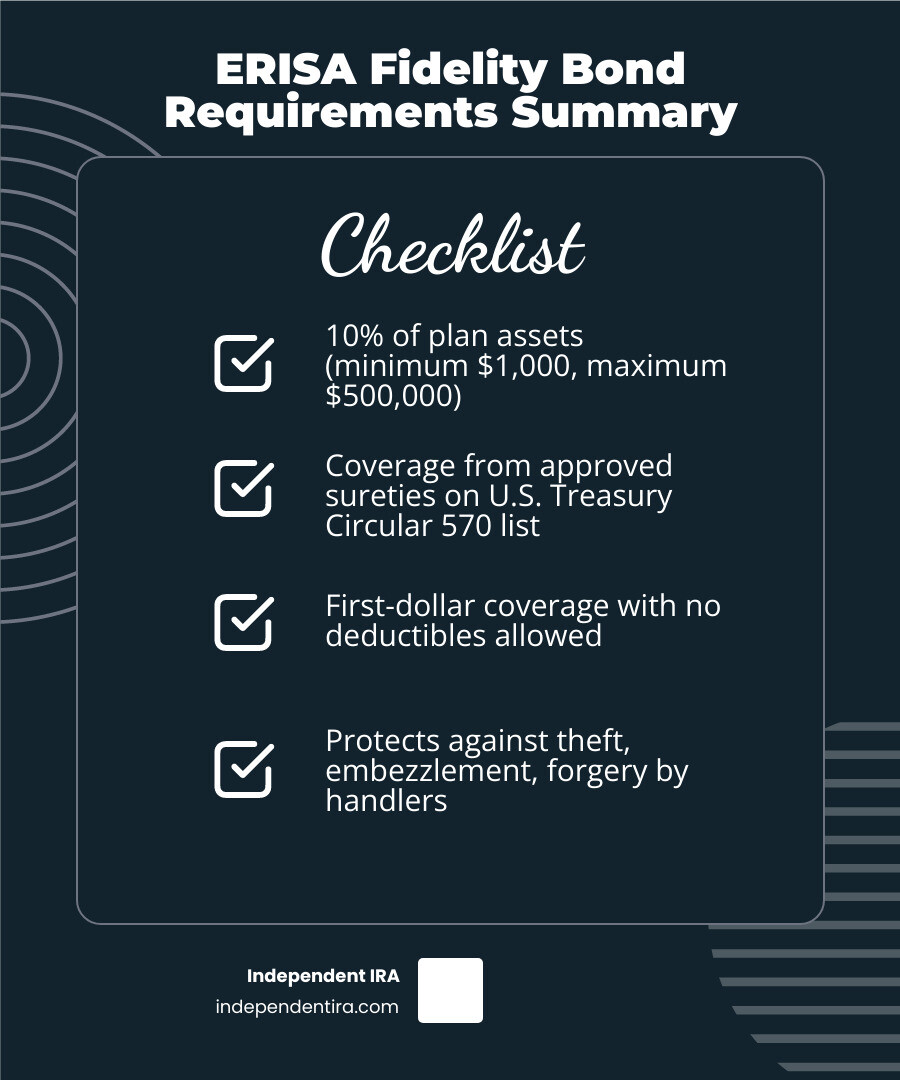
- What it covers: Losses from dishonest acts — theft, embezzlement, forgery, and misappropriation — by anyone handling plan assets
- Who needs it: Plan administrators, fiduciaries, employees with fund access, and qualifying third-party service providers
- How much: At least 10% of plan assets handled in the prior year, with a minimum of $1,000 and a maximum of $500,000 (or $1,000,000 for plans holding employer securities)
- Where to get it: Only from sureties listed on the U.S. Treasury’s Circular 570 approved list
- Key rule: No deductibles are allowed — the bond must provide first-dollar coverage up to the required amount
- Not the same as: Fiduciary liability insurance, which is optional and covers legal claims arising from mismanagement decisions
If you sponsor or administer a 401(k) plan — especially a self-directed one involving real estate or alternative assets — understanding this requirement is not optional. The good news is that getting properly bonded is usually straightforward and affordable once you know the rules.
Many plan sponsors first hear about ERISA fidelity bonds only when they’re already setting up or reviewing an existing 401(k), which means gaps in coverage are more common than they should be. This guide walks you through exactly what is required, who needs to be covered, how to calculate the right amount, and how to stay compliant year after year.
Understanding ERISA Fidelity Bonds and Section 412
At Independent IRA, we often speak with business owners who are excited to launch a self-directed 401(k) but are a bit surprised by the paperwork. One of the most critical pieces of that paperwork is the ERISA fidelity bond. To understand why this exists, we have to look back at the Employee Retirement Income Security Act of 1974 (ERISA).
ERISA was designed to protect the retirement assets of American workers. Section 412 of this act specifically addresses the risk of “sticky fingers.” It mandates that every person who handles funds or other property of an employee benefit plan must be bonded. This isn’t just a suggestion; it’s a legal requirement to ensure that if someone with access to the plan’s money decides to take an unauthorized “loan” to Vegas, the plan (and its participants) won’t suffer the loss.
A fidelity bond is essentially a three-party agreement. The surety (the insurance company) guarantees to the obligee (the 401(k) plan) that the principal (the person handling the money) will act honestly. If the principal commits a dishonest act like embezzlement or theft, the surety pays the plan to make it whole.

Who Must Be Covered Under Your Plan?
It’s a common misconception that only the “boss” needs to be bonded. In reality, ERISA’s reach is much broader. Anyone who meets the definition of a “plan official” must be covered by 401k bond insurance.
This includes:
- Plan Administrators: The people responsible for the day-to-day operations of the plan.
- Fiduciaries: Anyone who exercises discretionary authority or control over plan management or assets.
- Officers and Employees: Any staff members who have access to payroll deductions or the plan’s bank account.
- Third-Party Providers: Sometimes, your outside service providers need to be bonded if they have the authority to move money.
The goal is to cover every link in the chain where money could potentially go missing. You can learn more about how these roles interact by looking at how commercial ERISA bonds work.
Defining the “Handling” of Plan Assets in 401k Bond Insurance
The Department of Labor (DOL) uses a very specific definition for “handling” plan assets. It isn’t just about who physically touches cash. In a modern 401(k), very few people actually hold physical dollar bills.
“Handling” includes:
- Physical Contact: Actually touching cash, checks, or land deeds.
- Disbursement Authority: Having the power to sign checks or authorize wire transfers.
- Supervisory Responsibility: Even if you don’t touch the money, if you are the direct supervisor of someone who does, the DOL may consider you a “handler.”
- Fund Transfers: The ability to move assets from the plan to another account.
If you have the power to influence where the money goes, you likely need to be bonded.
Why 401k Bond Insurance is Mandatory for Compliance
Compliance isn’t just about following rules for the sake of it; it’s about protecting yourself from personal liability. If a loss occurs due to fraud and you didn’t have the required 401k bond insurance, the DOL can hold the plan fiduciaries personally liable to restore the lost funds.
Furthermore, the government monitors this through the annual Form 5500 filing. There is a specific question on that form asking if the plan was covered by a fidelity bond and for what amount. Answering “No” or leaving it blank is an immediate red flag that can trigger a DOL audit. In the worst-case scenarios, failing to maintain a bond can lead to the disqualification of the plan’s tax-exempt status, which would be a nightmare for everyone involved.
Calculating Your Required 401k Bond Insurance Amount
Calculating your bond amount is actually one of the simpler parts of the process, provided you have your prior year’s asset totals handy. The “10% Rule” is the standard used by ERISA.
The bond must cover at least 10% of the funds handled in the preceding year.
- Minimum Bond: $1,000. Even if your plan only has $5,000 in it, you still need a $1,000 bond.
- Maximum Bond: $500,000 for most plans.
- The Exception: If your plan holds employer securities (company stock), the maximum required bond jumps to $1,000,000.

At Independent IRA, we help clients navigate these requirements, especially when dealing with 401k services that involve alternative assets. If your plan holds “non-qualifying assets” (like certain types of real estate or private placements) that exceed 5% of total plan assets, the bonding requirements can sometimes become more complex, occasionally requiring a bond for the full value of those assets if other audit requirements aren’t met.
| Plan Type | Asset Value | Required Bond (10%) |
|---|---|---|
| Small Startup Plan | $5,000 | $1,000 (Minimum) |
| Standard 401(k) | $2,000,000 | $200,000 |
| Large 401(k) | $6,000,000 | $500,000 (Cap) |
| Plan with Company Stock | $15,000,000 | $1,000,000 (Cap) |
Fidelity Bonds vs. Fiduciary Liability Insurance
This is the area where we see the most confusion. Many business owners tell us, “I already have fiduciary insurance, so I’m covered, right?”
Actually, no. These are two completely different types of protection.
401k bond insurance (Fidelity Bond) is a “first-party” coverage. It protects the plan from the people running it. It is mandatory. Think of it as an “honesty bond.” It only pays out if there is a criminal act like theft.
Fiduciary Liability Insurance, on the other hand, is “third-party” coverage. It protects the people running the plan from lawsuits. It covers “breaches of fiduciary duty,” such as making a poor investment choice or failing to monitor high fees. This is optional (though highly recommended) and usually has a deductible.
Crucially, ERISA prohibits using plan assets to pay for a deductible on a fidelity bond. The bond must provide “first-dollar” coverage. To dig deeper into these differences, check out this guide on understanding fidelity bonds for 401k.
How to Secure and Maintain Your Coverage
You can’t just buy a fidelity bond from any neighborhood insurance agent. To be valid under ERISA, the bond must be issued by a surety company named on the U.S. Department of the Treasury’s “Circular 570” list. This is a list of approved sureties that the government trusts to pay out if a claim is filed.
When we work with clients in San Diego, we emphasize that the plan itself must be named as the “insured” on the bond. You cannot simply rely on your company’s general crime policy unless it specifically includes an ERISA rider that meets all the Section 412 requirements (including the no-deductible rule).
The Role of Process Support Maintaining compliance is an annual task. As your plan assets grow, your 10% requirement grows with them. Brian Davis and our team provide the necessary support to ensure your entity structures and plan documents align with these bonding needs. We recommend an annual review of your bond amount every time you prepare your Form 5500. For specialized help, our 401k Services San Diego team can help ensure your self-directed accounts stay within the lines.
Frequently Asked Questions about 401k Bonds
Can the 401(k) plan pay for its own fidelity bond?
Yes! Because the fidelity bond is required by law to protect the plan’s assets, ERISA allows the plan to pay the premium out of plan assets. This is different from fiduciary liability insurance, which generally cannot be paid for by the plan unless the policy includes a “recourse” provision.
Are Solo 401(k) plans required to have bond insurance?
Generally, no. If your plan only covers you (the owner) or you and your spouse, it is typically exempt from the ERISA fidelity bond requirement. This is because ERISA is designed to protect employees from their employers. If you are the only one in the plan, the government figures you aren’t going to steal from yourself. However, once you hire your first non-owner employee, the bonding requirement kicks in immediately.
What happens if a plan fails to report a bond on Form 5500?
Failing to report a bond (or reporting an insufficient amount) is like waving a red flag in front of the Department of Labor. It significantly increases your chances of a plan audit. If the DOL finds you are unbonded, they will require you to obtain coverage retroactively (if possible) or provide alternative proof of protection, and they may assess penalties for the compliance breach.
Next Steps for Your Plan Compliance
Staying compliant with 401k bond insurance is a small price to pay for the peace of mind that comes with a secure retirement plan. Whether you are holding traditional stocks or utilizing a self-directed structure for real estate, the rules remain the same: protect the assets, bond the handlers, and report accurately.
If you are setting up a new plan or haven’t reviewed your current bond in a few years, here is your checklist:
- Check your assets: Look at your total plan value as of the end of the last plan year.
- Verify your bond: Ensure your current bond is at least 10% of that value.
- Confirm the surety: Make sure your provider is on the Treasury Circular 570 list.
- Review your “handlers”: Ensure everyone with access to the money is covered by the policy.
At Independent IRA, we specialize in helping investors take full control of their retirement through self-directed accounts. If you’re looking for a one-stop shop for 401k services in San Diego, we are here to help you navigate the complexities of ERISA so you can focus on growing your wealth.
Ready to ensure your plan is fully protected? Contact Independent IRA today to review your self-directed 401(k) setup and ensure your bonding and compliance are up to date.