

 GIVE US A CALL
Setting up a 401k for self-employed individuals is a strategy that may offer tax advantages while building retirement savings. By utilizing a solo 401(k), you can contribute as both the employer and the employee, allowing for higher annual limits than a traditional IRA. If you are interested in these options, 401k Services San Diego can provide information on establishing a plan. This guide will show you the general steps to get started.
When we talk about setting up 401k for self employed success, we are usually referring to the Solo 401(k), also known as an Individual 401(k) or Uni-k. This is a traditional 401(k) plan covering a business owner with no employees. The eligibility criteria are straightforward: you must have self-employment income and no full-time employees other than yourself and your spouse.
If your spouse works in the business and receives compensation, they can also participate. This may increase the amount your household can save for retirement. Because there are no common-law employees, these plans are exempt from the complex nondiscrimination testing required for larger corporate plans. Whether you are a freelance consultant, a gig worker with a side hustle, or a small business owner in San Diego, this plan offers high contribution limits with low administrative overhead.
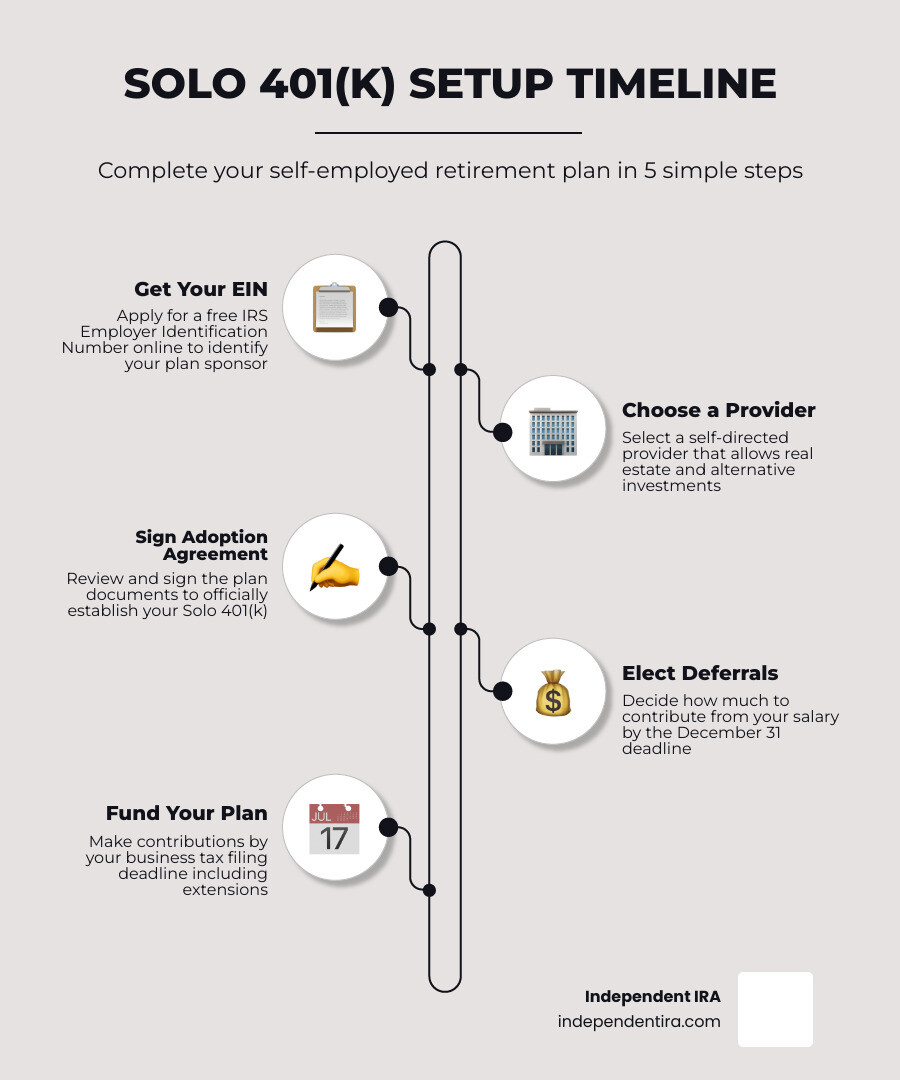
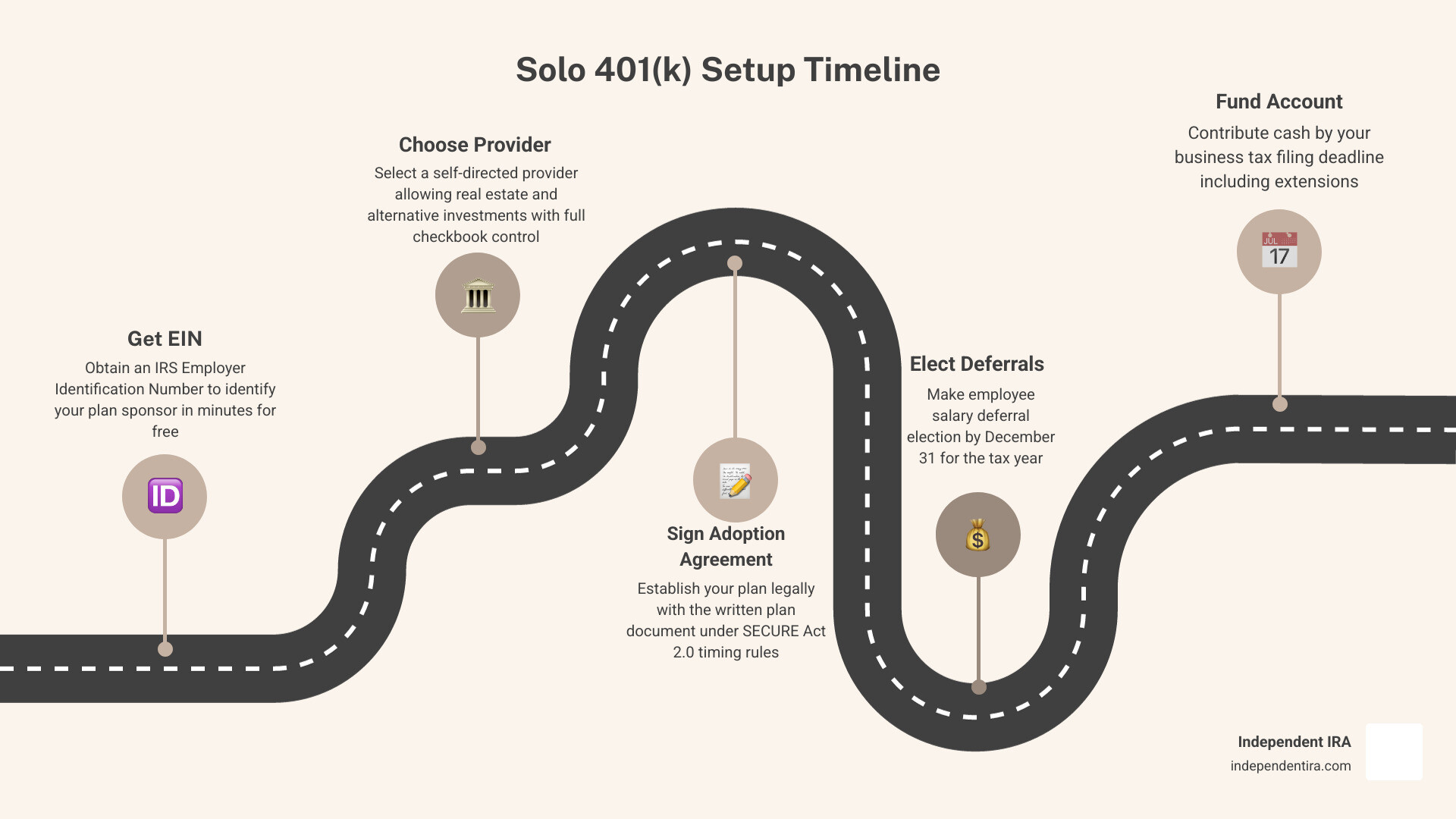
Step-by-Step Guide to Setting Up 401k for Self Employed
Setting up your plan doesn’t have to be a multi-day ordeal. In fact, if you have your business details ready, you can often complete the paperwork in less than an hour.
- Obtain an EIN: Even if you are a sole proprietor using your Social Security number for taxes, the IRS requires an Employer Identification Number (EIN) to identify the 401(k) plan. You can get one for free on the IRS website in minutes.
- Select Your Provider: Not all providers are created equal. Some big-box brokerages offer solo 401(k)s but restrict you to their proprietary mutual funds. If you want the option to hold IRS-permitted alternative assets, you’ll want a self-directed provider.
- Consult with our Team: At Independent IRA, an Authorized Agent of Accuplan, our team can help you navigate the nuances of plan adoption. We specialize in helping you understand “checkbook control” features.
- Adopt the Plan: You will sign a Plan Adoption Agreement. This is the legal document that establishes the plan. Under the SECURE Act 2.0, you can now establish a plan as late as your tax filing deadline (including extensions) and still make employer contributions for the prior year.
- Open the Bank Account: Once the plan is adopted, you’ll open a dedicated bank or brokerage account under the name of the 401(k) trust.
- Funding the Plan: You can then begin making contributions. For 2026, you’ll need to make your employee salary deferral election by December 31, though the actual cash doesn’t necessarily have to leave your bank account until your tax deadline.
For more details on the specific types of accounts we offer, visit our Services 401k page.
Contribution Limits for Setting Up 401k for Self Employed
The primary reason for setting up 401k for self employed individuals is the high contribution ceiling. In 2026, the maximum combined contribution is $72,000 (up from $70,000 in 2025).
This total is reached through two “buckets”:
- Employee Elective Deferral: You can defer 100% of your compensation up to $24,500 in 2026.
- Employer Nonelective Contribution: Your business can contribute up to 25% of your net self-employment income (or W-2 wages if incorporated).
For those over age 50, a catch-up contribution of $8,000 is available. However, the SECURE Act 2.0 introduced a “super catch-up” for those aged 60-63. In 2026, individuals in this age bracket can contribute a catch-up of $11,250.
Required Forms for Setting Up 401k for Self Employed
To stay compliant with the IRS, you must maintain several key documents. The One Participant 401k Plans | Internal Revenue Service guidelines specify that you need a written plan document.
Key forms include:
- Adoption Agreement: The “birth certificate” of your plan.
- Basic Plan Document: The fine print detailing how the plan operates.
- Salary Deferral Election: A written record of how much you decided to defer from your pay.
- Beneficiary Designation: Ensuring your assets go to the right people.
Tax Advantages and Investment Flexibility
When setting up 401k for self employed use, you can choose between Traditional or Roth structures. Traditional contributions may provide an immediate tax deduction, while Roth contributions are made with after-tax dollars, where growth and qualified withdrawals may be tax-free.
One of the features available through Independent IRA, an Authorized Agent of Accuplan, is the ability to hold IRS-permitted alternative assets. While many 401(k)s limit you to the stock market, certain plan designs allow for “checkbook control.” This means you can use your retirement funds to purchase residential real estate, tax liens, or private equity.

For investors in the San Diego area, this can be a significant tool for diversification. You can find more information on how this works at 401k Services San Diego Real Estate IRA San Diego.
Solo 401(k) vs SEP and SIMPLE IRAs
Why choose a Solo 401(k) over a SEP IRA?
- Higher Limits at Lower Income: In a SEP IRA, you are limited to 25% of your income. In a Solo 401(k), you can contribute $24,500 plus 25%. If you earn $100,000, a SEP limits you to roughly $20,000, while a Solo 401(k) could allow nearly $45,000.
- Loan Provisions: You can take a loan from your Solo 401(k) of up to $50,000 or 50% of the balance. SEP IRAs do not allow loans.
- Mega Backdoor Roth: If your plan is designed correctly, you can use after-tax non-Roth contributions to move funds into a Roth bucket.
Explore our full range of Services to see which plan fits your specific business structure.
Compliance and Administrative Requirements
While the Solo 401(k) is low-maintenance, it isn’t “no-maintenance.” The most important rule to remember is the Form 5500-EZ filing requirement.
If your plan assets (including cash and the fair market value of real estate) exceed $250,000 at the end of the year, you must file this information return with the IRS. Failure to file can result in steep penalties. Additionally, you must keep records of all contributions and distributions.

As you age, you must also be aware of Required Minimum Distributions (RMDs). Currently, these begin at age 73. For official guidance on these rules, you can refer to the Retirement plans for self-employed people | Internal Revenue Service page.
Frequently Asked Questions about Self-Employed 401(k)s
Can I contribute to both a solo 401(k) and an employer-sponsored plan?
Yes, you can. However, the IRS views the employee elective deferral as a “per person” limit. For 2026, you cannot defer more than $24,500 in total across all 401(k) plans. The employer contribution (the 25% profit-sharing) is calculated per business, so you can still utilize that side of the equation in your solo plan.
What is the deadline to set up a solo 401(k) for the current tax year?
Thanks to the SECURE Act 2.0, the deadline for setting up 401k for self employed individuals has become more flexible. You can now establish a plan up until your business tax filing deadline, including extensions. However, to make employee salary deferrals, you should still have your election forms signed by December 31.
Do I need an EIN to open a solo 401(k)?
Yes. Even if you are a “solopreneur” operating under your own name, the 401(k) is a separate legal entity. You must obtain an Employer Identification Number (EIN) specifically for the plan to open bank accounts and file tax forms.
Can I take a loan from my solo 401(k)?
Yes. One of the features of the Solo 401(k) is the ability to borrow from yourself. You can generally borrow up to 50% of your vested account balance, with a maximum loan amount of $50,000. This must be paid back over five years with a market interest rate (which you pay back to your own account!).
Before You Move Retirement Funds
Setting up 401k for self employed individuals is a way to manage your financial future, and the provider you choose is an important consideration. Independent IRA, an Authorized Agent of Accuplan, focuses on investor control. We provide information on entity creation and support for plans that allow for IRS-permitted assets—whether that’s San Diego real estate, private lending, or traditional equities.
Before you commit to a plan, speak with our team. We specialize in information regarding self-trusteed plans that offer “checkbook control.” If you’re ready to learn more about your 2026 contribution options, contact us today to learn more about our 401k Services San Diego.
This content is for informational and educational purposes only and does not constitute legal, tax, or investment advice. Rules, limits, and requirements may change. Consult a qualified tax advisor, attorney, or financial professional before making retirement planning or investment decisions. Independent IRA is an Authorized Agent of Accuplan Benefits Services and is not a custodian or trust company.