

 GIVE US A CALL
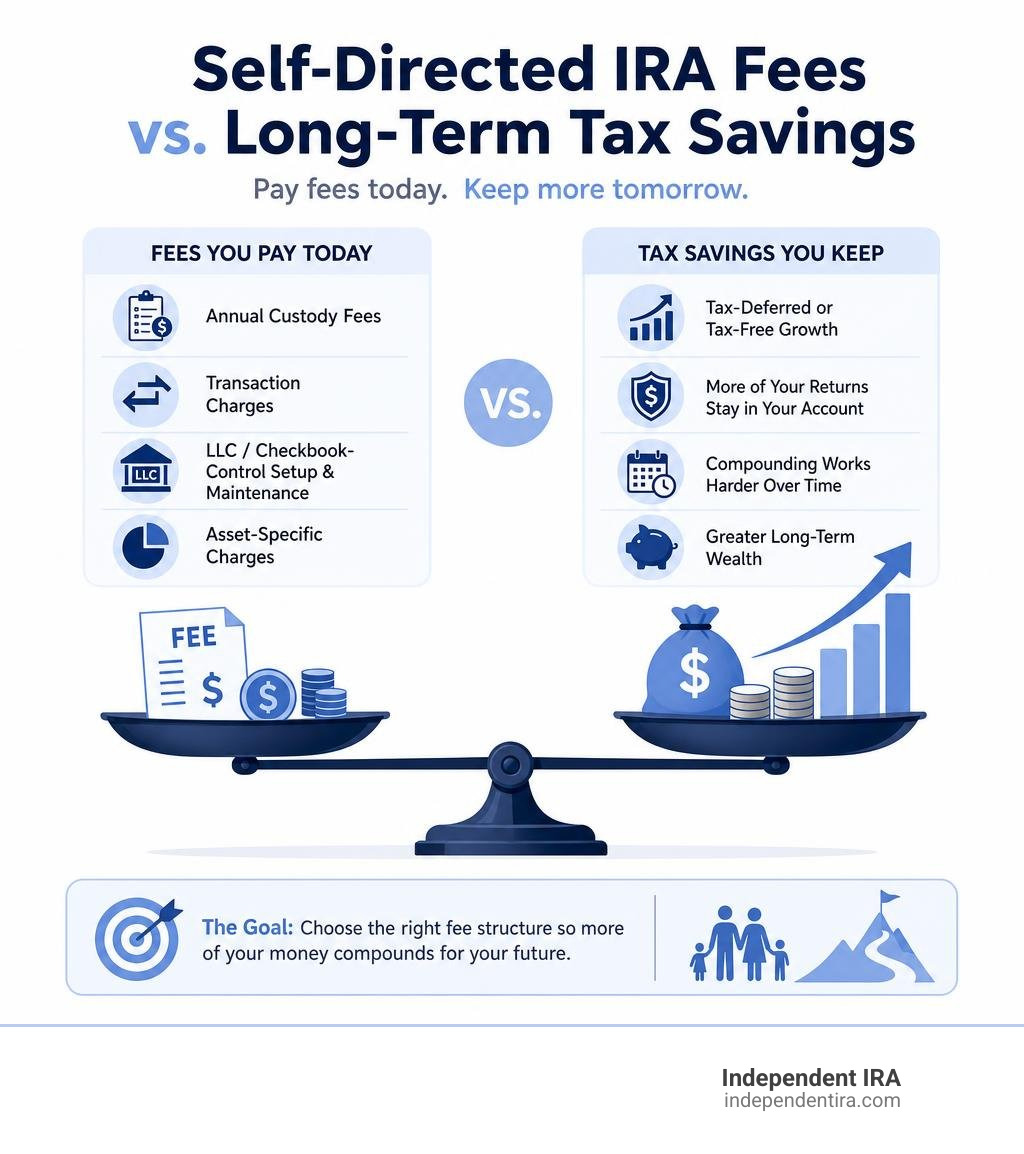
A self-directed ira cost comparison starts with one practical decision: whether a custodian’s fees preserve enough of your retirement return to justify the control and tax advantages you want. Compare annual custody fees, transaction charges, LLC or checkbook-control setup and maintenance costs, and any asset-specific charges before opening an account. Percentage-based fees can be manageable on smaller balances but grow with your portfolio, while flat annual fees often become more competitive as assets increase. This guide from Independent IRA, an Authorized Agent of Accuplan Benefits Services, helps retirement investors look beyond the advertised price and evaluate the long-term cost of true self-direction.
For context, a 2% annual fee on a $100,000 portfolio earning 8% before fees can reduce its 20-year value by roughly $149,000 compared with a no-fee account. The right structure depends on your balance, how often you invest, the assets you hold, and whether Roth tax-free withdrawals or Traditional IRA deductions better fit your retirement plan. A careful comparison is especially important for investors using real estate, private investments, or checkbook-control structures, where custody, valuation, and entity costs can vary substantially.
I am Brian Davis, and next we will build a clear framework for comparing self-directed IRA costs without letting small line items become large retirement leaks.
Comprehensive Self-Directed IRA Cost Comparison Framework
When evaluating self-directed IRAs (SDIRAs), understanding how different fee schedules impact your balance over time is critical. SDIRA provider cost structures generally fall into three core categories: percentage-based Assets Under Management (AUM) fees, flat annual subscription fees, and transactional or checkbook control LLC structures.
A percentage-based fee structure charges an annual fee ranging from 0.5% to 2.5% of your total account value. While this model requires little to no upfront cost, making it attractive for smaller accounts (e.g., under $20,000), it compounds aggressively as your wealth grows.
Conversely, flat annual custody fee models charge a fixed dollar amount—typically between $100 and $300 per year—regardless of total asset growth. For larger portfolios, flat fees drastically reduce fee drag, allowing full tax-advantaged compounding.
Below is a detailed comparison of how these fee structures affect various portfolio sizes over time:
| Portfolio Size | Percentage AUM Fee (1.5% Avg) | Flat Annual Subscription Fee ($200 Avg) | Checkbook LLC Setup + Annual Fee ($1,000 Setup + $200/yr) | 10-Year Fee Impact Difference (AUM vs. Flat) |
|---|---|---|---|---|
| $10,000 | $150 / year | $200 / year | $1,200 (Year 1) / $200 ongoing | Flat fee costs $50 more initially |
| $30,000 | $450 / year | $200 / year | $1,200 (Year 1) / $200 ongoing | Tipping point: Flat fee saves $250/yr |
| $100,000 | $1,500 / year | $200 / year | $1,200 (Year 1) / $200 ongoing | Flat fee saves $1,300/year |
| $250,000 | $3,750 / year | $200 / year | $1,200 (Year 1) / $200 ongoing | Flat fee saves $3,550/year ($35k+ over 10 yrs) |
As shown above, as soon as an account crosses the $30,000 mark, percentage-based AUM models quickly erode portfolio gains compared to flat-fee arrangements.
5 Essential Fee Comparison Tips for SDIRA Investors
To maximize long-term wealth retention, investors must analyze fee schedules through the dual lenses of tax efficiency and asset holding strategy. Below are five strategic tips to help you navigate your self-directed ira cost comparison.
Tip 1: Evaluate Fee Structures in Your Self-Directed IRA Cost Comparison
The fundamental starting point for any self-directed ira cost comparison is separating pricing models into percentage-based charges, flat fees, and transaction spreads.
- Percentage AUM Models: Custodians charging 0.5% to 2.5% of total asset value usually offer seamless online portals and low setup friction. However, as portfolio capital appreciates, these fees drag down net yields.
- Flat-Fee Subscriptions: These accounts charge fixed monthly or annual maintenance costs. Regardless of whether your portfolio holds $50,000 or $500,000 in alternative assets, your custodial fee stays static.
- Trading Spreads & Per-Asset Fees: Some specialized custodians charge $0 upfront or low subscription fees but insert a 1% to 2% trading spread on asset buys/sells or charge $10 to $20 per month per distinct asset held.
For comprehensive insights into specialized alternative asset accounts and structural breakdowns, explore the detailed Crypto IRA & Bitcoin IRA Guide 2026: Tax-Free Growth | EarnifyHub . When analyzing providers, carefully calculate your projected trading volume and portfolio growth to identify which pricing model offers the lowest overall friction.
Tip 2: Calculating Breakeven Points for a Self-Directed IRA Cost Comparison
A critical step in evaluating an SDIRA is identifying the mathematical breakeven point where tax-free or tax-deferred growth outweighs custodial administrative costs compared to a low-cost taxable brokerage account.
When holding high-growth alternative investments in a taxable account, long-term capital gains taxes (typically 15% to 20% federal plus state taxes) trigger every time you rebalance or realize profits. Inside an SDIRA, assets grow completely tax-sheltered.
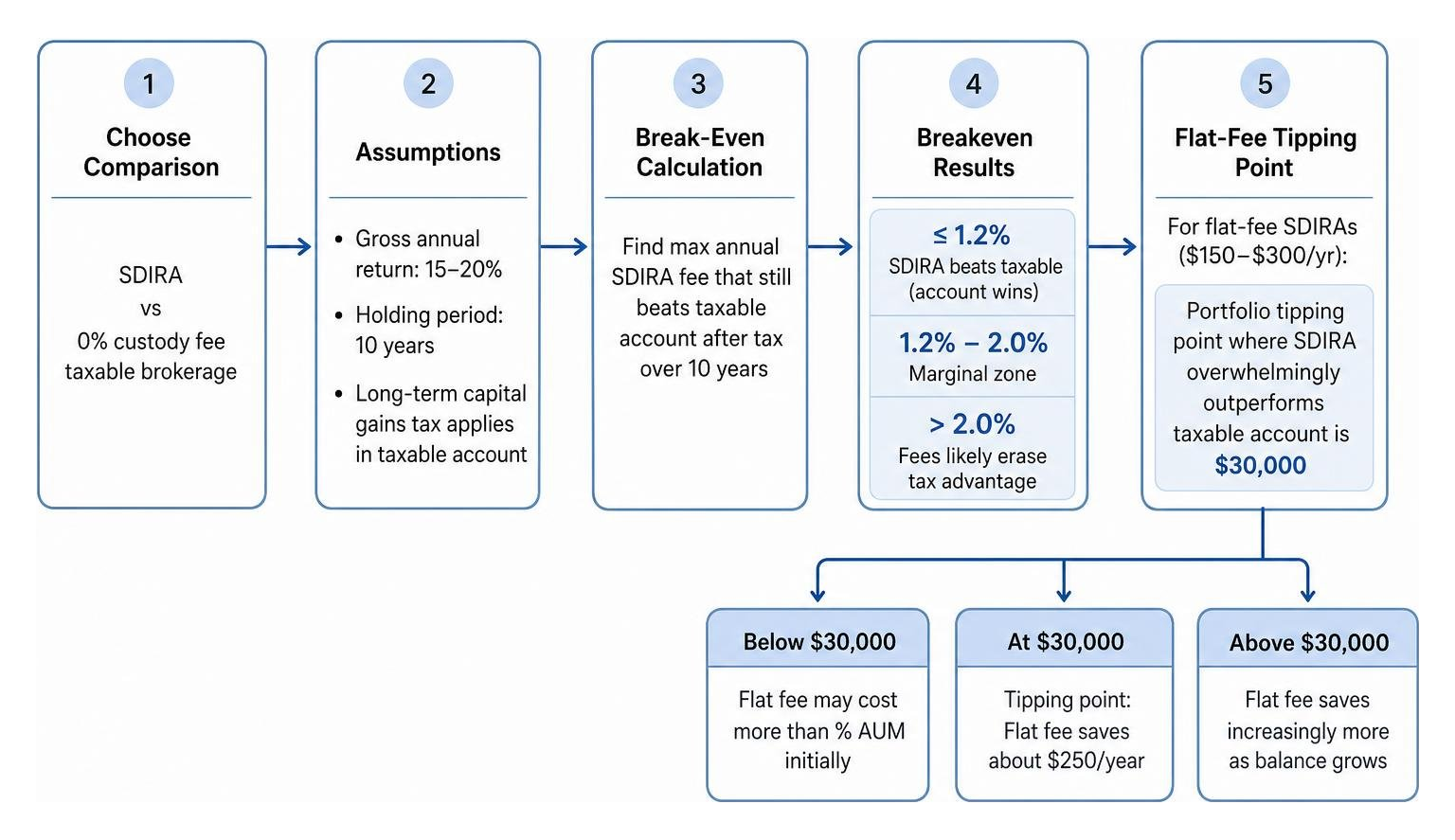
Mathematical modeling indicates that for a portfolio yielding a gross annual return of 15% to 20% over a 10-year holding period, the maximum allowable annual custodian fee before losing to a 0% custody fee taxable brokerage is approximately 1.2% annually.
- If total annual SDIRA fees are below 1.2%, the account beats a taxable brokerage due to tax shelter benefits.
- If total annual SDIRA fees exceed 2.0%, the fee drag over a 10-to-20-year horizon can negate the tax shelter entirely.
- For flat-fee SDIRAs ($150–$300 flat per year), the portfolio tipping point where the SDIRA overwhelmingly outperforms a taxable account is $30,000.
Tip 3: Uncover Hidden Custodial and Asset-Specific Fees
Advertised headline setup fees rarely reveal the true complete cost of maintaining a self-directed retirement plan. Many custodians keep setup fees artificially low while collecting ancillary service revenue through operational line items.

When reviewing custodian fee disclosures, our process support specialist Brian Davis recommends requesting a complete fee schedule to check for these less visible costs:
- Wire and Payment Processing Charges: Ranging from $15 to $40 per outgoing or incoming wire transfer when buying real estate, funding private placements, or purchasing private equity.
- Asset Valuation Fees: Annual charges ($50–$150 per asset) for conducting mandatory fair market value (FMV) updates required for IRS reporting.
- Account Termination & Transfer Fees: Penalty charges ($100–$250) if you close the account or transfer assets out to another custodian.
- Inactivity or Minimum Balance Fees: Monthly operational assessments charged if no trades or contributions occur during a quarterly cycle.
- Checkbook LLC State Filing Fees: Annual state LLC registration fees (such as California’s $800 annual franchise tax) required to maintain checkbook control entity status.
Checking these details before funding an account prevents unexpected operational costs from draining your cash balance.
Tip 4: Account for Roth vs. Traditional SDIRA Tax Drivers
Your selection between a Roth SDIRA and a Traditional SDIRA directly influences your net cost of capital over time. While fee schedules may look identical across both account types, the tax treatment dramatically alters long-term net wealth retention.
To understand the core regulatory foundations of IRA selection, review this comprehensive analysis on Personal Finance Advice and Information | Bankrate.com .
- Traditional SDIRA: Contributions may be tax-deductible in the year they are made, offering immediate tax relief. However, all distributions taken during retirement are taxed as ordinary income at your future tax rate. Furthermore, Required Minimum Distributions (RMDs) mandate withdrawals starting at age 73, which can force the liquidation of illiquid SDIRA assets (like real estate or private debt) at non-ideal market times.
- Roth SDIRA: Contributions are made with after-tax dollars, meaning no immediate tax deduction. However, all capital appreciation, dividends, and yields accrue completely tax-free. Qualified distributions taken after age 59½ (and meeting the 5-year holding rule) are 100% tax-free, with zero RMD obligations during the original owner’s lifetime.
For high-growth alternative assets, locking in tax-free growth potential via a Roth SDIRA may offer tax advantages over a Traditional SDIRA, helping offset upfront fee structures.
Tip 5: Select the Right SDIRA Structure for Your Holding Frequency
The structure you choose for your SDIRA must align directly with your expected transaction frequency and operational style:
- Direct Custodial SDIRA: The custodian holds assets directly and executes every transaction on your behalf. This structure works best for passive, buy-and-hold investments like long-term private equity notes, physical gold, or single-tenant real estate where transactions occur infrequently.
- Checkbook Control LLC IRA: The SDIRA owns a dedicated single-member LLC, and you serve as the non-compensated manager of the LLC. This grants direct checkbook and wire control, eliminating transaction processing delays and per-transaction custodian charges.
If you plan to execute multiple transactions per year—such as managing rental property expenses, tax lien bidding, or active asset trading—a Checkbook Control IRA saves substantial capital over time. Learn more about establishing direct control through our dedicated guide on self-directed ira control and explore our tailored administrative solutions at services/checkbook.
Frequently Asked Questions About Self-Directed IRA Fees
At what portfolio size does a flat-fee SDIRA outperform a percentage-based fee structure?
A flat-fee SDIRA generally outperforms a percentage-based fee structure once your portfolio balance exceeds $30,000.
At $30,000, a standard 1.5% AUM fee equals $450 per year, whereas a flat-fee subscription model typically averages $150 to $250 annually. As your balance grows to $100,000 or $250,000, percentage-based fees escalate to $1,500 and $3,750 per year respectively, while a flat-fee structure remains fixed at $200 per year, saving thousands of dollars annually in compounding wealth.
How do self-directed IRA fees compare to holding assets in a standard taxable account?
While standard taxable accounts often feature zero custodial fees, they subject your investments to federal and state capital gains taxes (15% to 20%+), annual tax friction on dividend/interest distributions, and tax complexity upon asset sales.
A self-directed IRA charges custodial administrative fees (typically $150 to $300 annually or 0.5%–1.5% AUM), but shields your growth from capital gains taxes. As long as the total annual SDIRA operational fee remains under 1.2% of account value, the tax-sheltered compounding inside an SDIRA generates higher net returns over a 5-to-10-year holding period than a taxable account.
What are the typical hidden costs in a self-directed IRA?
Common hidden costs include outgoing/incoming wire fees ($15–$40 per transaction), asset purchase/processing fees ($50–$100 per deal), mandatory annual asset revaluation fees ($50–$150 per alternative asset), account termination/transfer fees ($100–$250), and state LLC maintenance taxes for checkbook structures. Always carefully examine a custodian’s complete fee disclosure schedule before establishing an account.
Can I transfer assets I already own into a self-directed IRA to save on setup costs?
No. IRS regulations strictly prohibit transferring personally owned property or assets directly into a tax-advantaged retirement account. Doing so is categorized as a prohibited transaction under IRC Section 4975.
All SDIRA contributions must be made in cash, adhering to annual IRS contribution limits ($7,000 for individuals under age 50, or $8,000 for those age 50 and older in 2026). Alternatively, you can move capital tax-free via direct trustee-to-trustee rollovers or transfers from existing 401(k) plans or traditional IRAs.
Before You Move Retirement Funds

Conducting a thorough self-directed ira cost comparison is the most effective way to protect your long-term retirement returns before committing capital. By matching your anticipated transaction volume, holding period, and portfolio size with the proper fee model—whether a direct custodial setup or a Checkbook Control LLC—you eliminate unnecessary fee drag and keep your money working for you.
At Independent IRA, an Authorized Agent of Accuplan Benefits Services, we provide straightforward, flexible self-directed account administration designed to give you complete control over alternative asset investments. Whether you are seeking seamless checkbook control, real estate investment capabilities, or customized plan structures, our expert team provides dedicated administrative support every step of the way.
To explore how our custom solutions can help optimize your retirement strategy, review our full suite of options on our services page, or learn more on our self-directed ira san diego hub today.
This content is for informational and educational purposes only and does not constitute legal, tax, or investment advice. Rules, limits, and requirements may change. Consult a qualified tax advisor, attorney, or financial professional before making retirement planning or investment decisions. Independent IRA is an Authorized Agent of Accuplan Benefits Services and is not a custodian or trust company.