

 GIVE US A CALL

Alternative asset custodian fees can quietly reduce the returns of a self-directed IRA or Solo 401(k), especially when you hold real estate, private equity, private notes, or digital assets for years. The quick answer: costs usually combine a flat annual account or asset fee, an asset-value-based charge, and transaction or document-processing fees; the lowest advertised custody price is not always the lowest total cost. Before committing retirement funds, compare the complete schedule and the control you retain through options such as Self-Directed IRA services.
| Fee category | How it is commonly charged | Why it matters in an SDIRA or Solo 401(k) |
|---|---|---|
| Base custody | Flat annual fee or basis points on asset value | May rise as assets grow under asset-based pricing |
| Asset administration | Per asset, property, LLC, or private-fund position | Multiple holdings can create layered annual costs |
| Transactions | Wires, purchases, sales, and manual instructions | Active investors may pay more than buy-and-hold investors |
| Fund-level expenses | Management, servicing, placement, and redemption fees | These can sit outside the custodian’s published fee schedule |
| Specialized services | Valuations, tax reporting, foreign custody, or staking | Often billed separately or passed through at cost |
For a retirement investor seeking more control, the key comparison is not simply flat fees versus percentages. It is whether the account structure, asset type, holding period, and administrative process create predictable costs or a growing stack of charges. This guide will help you see the full cost before a fee line item becomes an unpleasant surprise.
I am Brian Davs, and I will walk through how to evaluate these costs while keeping the focus on control, compliance, and long-term retirement investing.
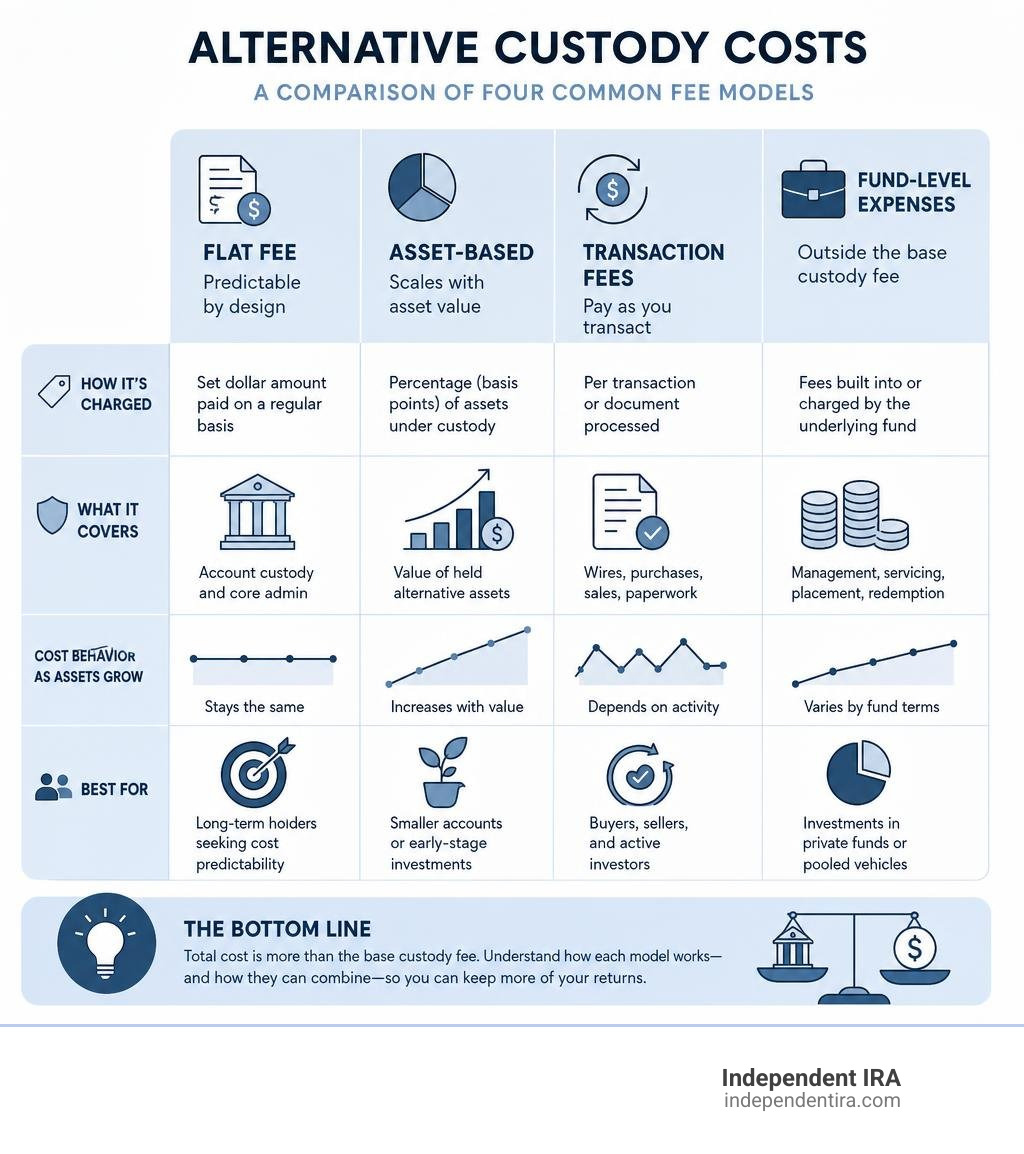
Understanding Alternative Asset Custodian Fees: Flat vs. Asset-Based Models
When setting up a self-directed retirement account to hold non-traditional assets, the primary structural decision revolves around how base custody fees are calculated. Custodians generally utilize one of two primary pricing frameworks: flat fee schedules or asset-based (percentage) models. Selecting the wrong model for your investment strategy can result in unnecessary custodial overhead over the lifecycle of your account.
In asset-based custody models, charges are calculated as a percentage—measured in basis points—of your total Assets Under Custody (AUC). For example, institutional digital asset pricing schedules often start at 14 basis points (0.14%) annually for initial assets under management, dropping down to 9 basis points (0.09%) for larger balances, while institutional custodians holding multi-billion dollar portfolios may scale down from 8 basis points to 3 basis points. While percentage pricing can appear attractive for smaller, newly formed accounts, it scales directly with your capital gains. As your alternative investments appreciate, your annual custody expense grows proportionally, even though the administrative burden on the custodian remains unchanged.
Flat Annual Fee Schedules for Self-Directed Accounts
For long-term retirement investors, flat annual fee schedules offer total predictability. Under a flat-fee structure, the custodian charges a fixed dollar amount—typically ranging between $200 and $500 per year per asset position—regardless of whether the underlying asset is worth $50,000 or $5,000,000.
This model aligns with tax-advantaged growth. If you buy a real estate property or invest in a private equity deal inside a self-directed IRA, a flat fee structure ensures that fee growth does not erode your account growth. As an Authorized Agent of Accuplan Benefits Services, Independent IRA emphasizes flat, predictable fee models that help maintain account value as your portfolio expands.
How Account Size Impacts Alternative Asset Custodian Fees
Account scale plays a critical role in establishing cost efficiency. Larger institutional custody contracts frequently implement graduated tier schedules or minimum monthly fee floors. For instance, institutional agreements often mandate minimum base account fees of $500 to $1,000 per month, plus additional $5,000 annual charges for each Special Purpose Vehicle (SPV) or feeder entity linked to the main fund.
For individual investors operating through self-directed IRAs, scale manifests in per-position breakpoints. Non-marketplace custody arrangements across the industry frequently bill a standard fee of $200 per position, often capped at $400 per overall account. Reviewing formal custodian agreements, such as the ELEVENTH AMENDMENT TO THE AMENDED AND RESTATED MULTI-TRUST CUSTODY AGREEMENT, illustrates how institutional custodians establish market-value-based annual tiers alongside explicit out-of-pocket pass-through charges. For self-directed account holders, aggregating positions under unified account structures is key to preventing administrative fee stacking.
Comparing Custody Costs Across Asset Classes and Account Structures
Custody fees are not uniform across all alternative assets. The complexity of holding physical property differs significantly from tracking private placement units or securing digital keys on a blockchain.
| Asset Class / Structure | Common Custody Fee Range | Key Administrative Drivers | Recommended Account Structure |
|---|---|---|---|
| Direct Real Estate | $250 – $500 / year flat per property | Title holding, tax payment processing, document review | Checkbook IRA LLC / Solo 401(k) |
| Private Equity & Venture Capital | $200 – $400 / position or asset-based basis points | Subscription doc review, annual NAV valuations, K-1 tracking | Direct Self-Directed IRA or Checkbook LLC |
| Private Debt & Mortgage Notes | $150 – $350 / note plus transaction fees | Payment processing, note servicing, re-valuation | Checkbook IRA LLC |
| Digital Assets / Cryptocurrency | 8 to 50 basis points (AUC) or monthly minimums | On-chain cold storage, staking administration, wallet security | Direct Custody or Checkbook IRA |
Comparing Alternative Asset Custodian Fees Across Real Estate, Private Equity, and Crypto
Real estate IRAs require active custodial administration, including deed recording, property tax processing, and document execution. Custodians holding direct real estate titles charge for each administrative touchpoint, from processing earnest money deposits to reviewing lease agreements.
Private equity funds and hedge funds present a different administrative profile. Because private equity assets are illiquid and valued periodically, custodians must handle complex subscription documentation, track late K-1 tax forms, and verify Net Asset Value (NAV) updates. Investors exploring fund structures should consult our Beginners Guide to Self-Directed IRA Hedge Funds to evaluate how fund-level management fees interact with custodial account charges.
In the digital asset realm, institutional platforms often charge percentage fees based on daily average values alongside monthly minimum charges. Staking services, foreign asset custody, and on-chain transactions frequently incur ancillary servicing surcharges that must be accounted for when calculating net annual yield.
Checkbook IRAs and Solo 401(k)s: Eliminating Per-Transaction Administrative Costs
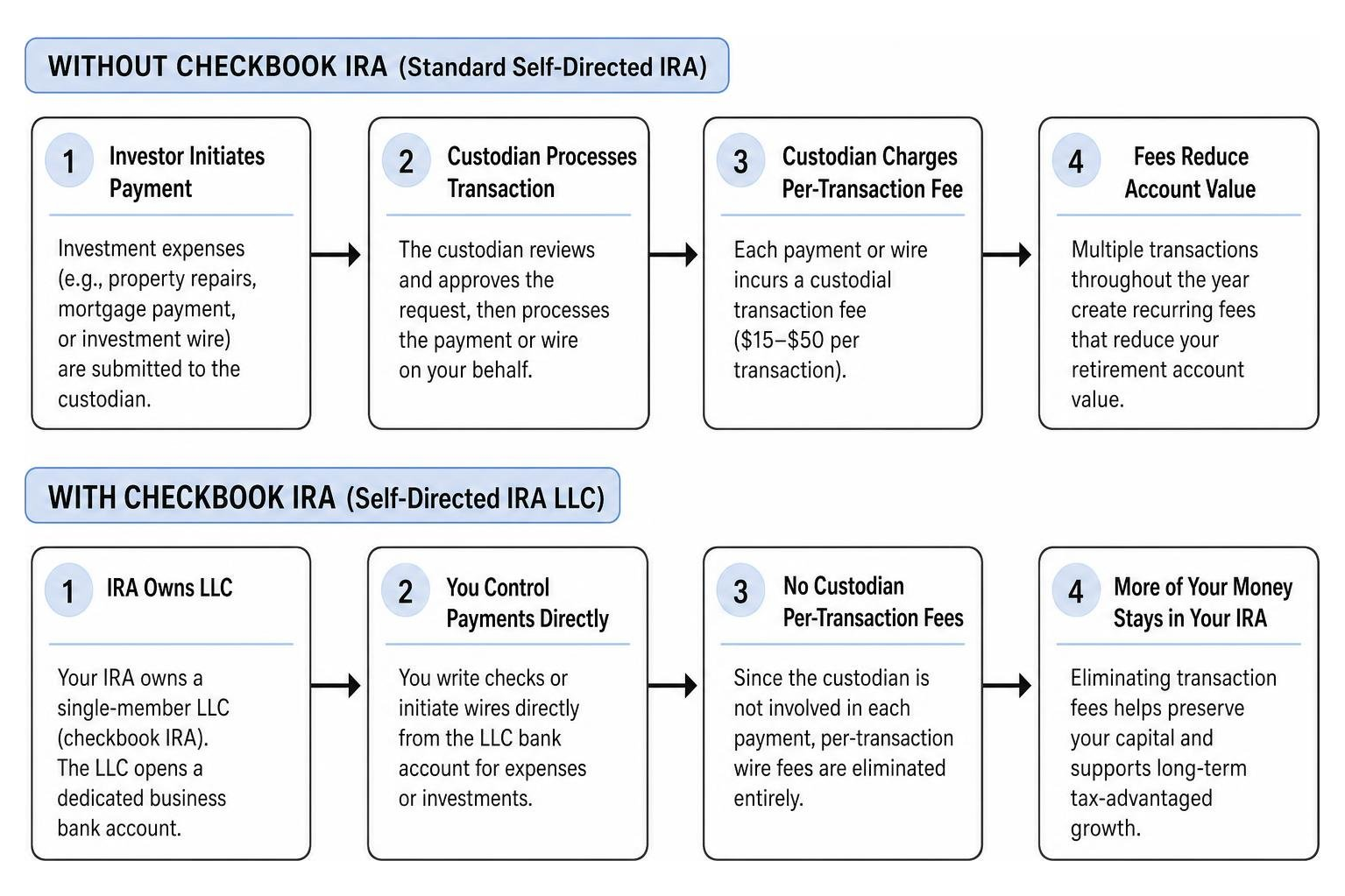
One of the most effective strategies for controlling alternative asset custodian fees is establishing checkbook control. Through a Checkbook IRA—where your IRA owns a single-member Limited Liability Company (LLC)—or a self-trusteed Solo 401(k), you eliminate custodial transaction fees entirely.
In a standard self-directed IRA, every property repair check, mortgage note payment, or investment wire must be processed directly by the custodian, costing $15 to $50 per transaction plus processing delays. With a dedicated checkbook structure, Independent IRA assists in creating the underlying entity, allowing you to write checks or initiate wires directly from a dedicated business checking account. To see how checkbook control simplifies administrative operations, explore our Step-by-Step Guide to Checkbook IRA.
Our team, including founder Brian Davis, regularly helps self-directed investors navigate these structural decisions to ensure your retirement strategy remains both compliant and cost-effective.
Hidden Charges, Revenue Sharing, and Indirect Costs in Private Market Custody

Beyond advertised annual custody fees lies a complex web of indirect expenses, manager revenue sharing, and pass-through operational costs that can severely degrade long-term performance.
Upfront Placement, Ongoing Servicing, and Redemption Surcharges
When investing in alternative funds through traditional broker-dealers or custodial marketplaces, fund managers and intermediaries frequently assess significant product-level fees:
- Upfront Placement Fees: These charges can reach as high as 5.5% of your initial investment capital, directly compensating financial advisors and selling agents before your money is even deployed.
- Ongoing Servicing Fees: Ongoing fund servicing fees can reach up to 4% annually of your total investment value, collected by fund managers and often shared with financial intermediaries.
- Redemption Fees: Exiting an alternative investment prior to a specified lock-up period can trigger redemption penalties assessed by managers as high as 5% of your investment balance.
Furthermore, full legal disclosures show that broker-dealers and financial advisors may share in up to 100% of the ongoing management fees and 100% of the incentive-based performance compensation collected by an alternative fund manager. Product sponsors may also provide financial support up to $35,000 per event to fund promotional activities and wholesaler conferences. These indirect compensation arrangements demonstrate why investors must look beyond basic account statements to evaluate total cost.
Out-of-Pocket Pass-Through Expenses and Legal Review Fees
Custodial contracts, such as the Law Insider Master Custody Agreement, explicitly grant custodians the right to bill out-of-pocket operational costs directly to client accounts. Key pass-through charges to watch out for include:
- Manual Wire and Check Fees: While automated wire requests may cost $10, manual email or faxed wire instructions frequently cost $25 or more per transfer.
- Legal and Document Review Charges: Submitting non-standard legal documentation, private placement memorandums, or multi-member LLC operating agreements for custodial approval often incurs mandatory legal review fees ranging from $150 to $500 per asset.
- SPV and Blocker Maintenance: Institutional fund structures holding assets through Cayman or Delaware blocker entities often incur separate annual sub-entity fees of $5,000 per entity.
- Inflation Clauses: Many custodial agreements embed automatic annual price escalation clauses tied directly to the Consumer Price Index (CPI), raising flat fees annually without requiring formal contract amendments.
How to Audit Custodial Fee Disclosures in Offering Documents

Evaluating the true cost of alternative market participation requires auditing the underlying offering documents, specifically the Private Placement Memorandum (PPM) and legal custody agreements. Maintaining true Self-Directed IRA Control means knowing how to spot buried fee structures before signing subscription paperwork.
Key Line Items to Inspect in Private Placement Memorandums
When reviewing a fund’s PPM or subscription agreement, pay close attention to the following sections:
- Fund Administration & Operating Expenses: Verify whether audit expenses, tax preparation (Form 1065 K-1s), and legal compliance costs are capped or passed through to fund limited partners without limit.
- Shareholder Servicing Fees: Identify whether the fund charges 12b-1 style servicing fees designed to offset intermediary custody platform costs.
- Transaction Settlement Surcharges: Check for specialized charges such as DWAC (Deposit/Withdrawal at Custodian) fees, SWIFT international message fees, or foreign tax reclamation surcharges.
- Dormant and Zero-Valued Account Fees: Review terms governing inactive accounts, as custodians frequently impose dormant account penalties if no transactions occur within a 12-month window.
Frequently Asked Questions About Alternative Asset Custody Costs
What is the average cost to hold alternative assets in a self-directed IRA?
Self-directed IRA custodians typically charge either a flat annual fee ranging between $200 and $500 per asset position or an asset-based fee between 10 and 50 basis points on the asset’s aggregate value.
How do checkbook IRAs help reduce transaction custody fees?
By establishing a Checkbook IRA LLC or self-trusteed Solo 401(k), investors execute transactions directly through a dedicated business checking account, completely bypassing custodian per-transaction processing and wire fees.
What hidden out-of-pocket fees should SDIRA investors watch out for?
Investors should monitor pass-through line items such as document legal review fees, manual wire charges ($25+ vs $10 automated), special entity maintenance fees ($200-$500/year for SPVs), and annual asset valuation processing fees.
Are alternative asset custody fees tax-deductible or payable from IRA funds?
Custodial fees can be paid directly using tax-advantaged IRA cash reserves without incurring penalties, though personal out-of-pocket tax deductions for investment expenses are subject to strict IRS regulations under current tax law.
Before You Move Retirement Funds
Navigating alternative asset custodian fees requires looking past promotional headlines to examine fee schedules, transactional surcharges, and offering document disclosures line by line. By selecting a custodian structure that prioritizes flat fees and investor control, you protect your retirement savings from unnecessary friction and surprise costs.
If you are evaluating self-directed structures, IRS-permitted assets, or private market positions, our team at Independent IRA is ready to assist. Explore our tailored solutions at Self-Directed IRA Solutions or Contact Independent IRA today to take full control of your financial future.
This content is for informational and educational purposes only and does not constitute legal, tax, or investment advice. Rules, limits, and requirements may change. Consult a qualified tax advisor, attorney, or financial professional before making retirement planning or investment decisions. Independent IRA is an Authorized Agent of Accuplan Benefits Services and is not a custodian or trust company.