

 GIVE US A CALL
How to Attract SDIRA Investors With a Repeatable Capital-Raising System
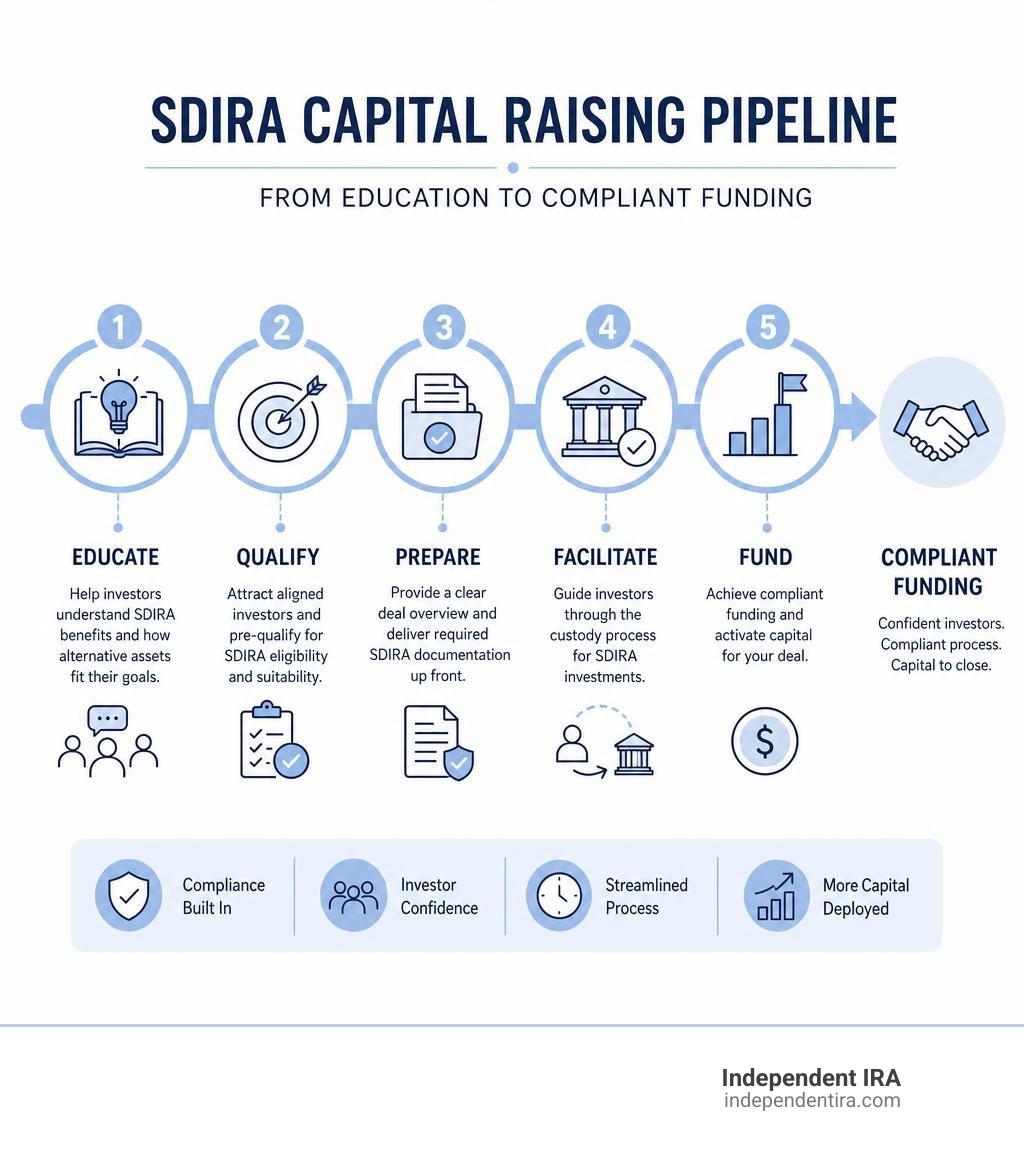
To attract SDIRA investors, build a clear process that explains the deal, makes retirement-account funding straightforward, and addresses compliance before investors have to ask. The opportunity is meaningful: self-directed retirement accounts give investors access to alternatives such as real estate, private lending, and private equity, while sponsors gain access to capital that may otherwise sit in traditional accounts. Independent IRA helps investors and deal sponsors navigate the account structure, custody steps, and documentation needed to move forward with confidence, including resources on raising private capital with IRAs. I am Brian Davis, and this guide will show how to turn SDIRA education and operational readiness into a repeatable investor pipeline.
Understanding the $600B SDIRA Market and Target Investor Profile
To effectively attract SDIRA investors, deal sponsors and real estate syndicators must first grasp the sheer scale and untapped potential of the self-directed retirement market. Total SDIRA assets under custody in the U.S. grew to over $30 billion in 2022, up from $15 billion in 2017—representing a compound annual growth rate (CAGR) of approximately 15%. Even with that steady expansion, self-directed accounts still represent only about 2% of the entire U.S. IRA ecosystem. That leaves an addressable market exceeding $600 billion in potential capital sitting in traditional Wall Street accounts waiting to be deployed into tangible assets.
SDIRA investors do not allocate capital like everyday retail stock pickers. They are deliberately stepping off the public equity roller coaster in search of predictable returns, inflation hedges, and cash flow. When we look at where SDIRA capital actually flows, the preferences are crystal clear:
- Real Estate (Over 50%): Multifamily syndications, single-family rentals, commercial properties, tax liens, and tax deeds dominate self-directed portfolios.
- Private Equity & Startups (20%): Growth equity, venture capital, and private company debt offerings appeal to experienced investors seeking high upside.
- Precious Metals & Alternatives (10%): Gold, silver, and alternative commodities serve as long-term wealth preservation anchors.
- Private Debt & Notes (10%): First-trust deeds, promissory notes, and private lending platforms provide reliable interest yields.
Understanding who holds these accounts is just as important as knowing where the money goes. Investors aged 45 to 64 represent 55% of all SDIRA account holders. These are seasoned mid-career professionals, business owners, and near-retirees. They have accumulated substantial account balances in previous employer 401(k)s or traditional IRAs, but they are increasingly frustrated by public market volatility and low-yielding fixed-income instruments.
When you frame your deal around their desire for wealth preservation and steady income, you speak directly to their core financial priorities.
How SDIRA Features Help Sponsors Attract SDIRA Investors
When pitching private deals, syndicators often highlight project IRRs, cap rates, or equity multiples. While those metrics matter, SDIRA investors care deeply about how their investment interacts with their tax strategy. To successfully attract SDIRA investors, your messaging should emphasize the inherent structural benefits of investing through a tax-advantaged account:
- Tax-Deferred and Tax-Free Potential: In a Traditional SDIRA, profits, rental income, and capital gains return to the account without triggering current-year tax liabilities. In a Roth SDIRA, qualified withdrawals in retirement may be completely tax-free. This tax shield accelerates long-term compounding dramatically compared to taxable investments.
- Asset Class Diversification: Traditional brokerages limit investors to stocks, bonds, and mutual funds. Self-directed structures empower investors to back private real estate deals, private lending funds, or private equity startups—creating true portfolio insulation against stock market shocks.
- Direct Investment Ownership: High-net-worth investors love tangibility. An SDIRA allows them to invest in real property or secured debt rather than a paper fund ticker.
- Hands-Off Yield Generation: Passive investors can earn competitive interest rates on private promissory notes or quarterly distributions from real estate syndications without taking on landlord duties.
By highlighting these structural perks alongside your deal terms, you provide a compelling reason for prospective capital partners to evaluate Self-Directed IRA Control as their preferred funding mechanism.
What SDIRA Account Holders Care About Most
While SDIRA account holders control substantial capital, they often move cautiously. If you do not proactively address their key concerns early in the relationship, friction will stall your deal.
- Capital Preservation: Older, higher-net-worth investors prioritize protecting their principle over taking wild speculative risks. They want to see clear collateral, conservative loan-to-value ratios, or proven cash-flowing assets.
- Custodian Friction and Delays: Moving funds out of a traditional brokerage into a self-directed custodian can feel bureaucratic. Investors worry about missing deal deadlines because of slow paperwork processing.
- Illiquidity and Lock-Up Periods: SDIRA funds are tied up until retirement age (unless the investor incurs penalties). When you lock up retirement funds in a 5-to-7-year real estate syndication, investors want clear expectations regarding hold periods and exit strategies.
- Deal Transparency and Compliance: SDIRA investors want to avoid accidental IRS penalties. They need reassurance that your deal structure respects IRS guidelines and that subscription documents are custodian-friendly.
When your capital-raising strategy directly answers these concerns, you differentiate yourself from sponsors who simply throw a pitch deck over the fence. For a deeper breakdown on framing your offerings for retirement capital, read our Beginners Guide to Raising Capital from IRA Investors.
Step-by-Step Framework to Attract SDIRA Investors for Your Deals
Attracting retirement capital isn’t about making high-pressure sales calls; it is about deploying an operational system that makes funding a deal simple, transparent, and seamless. If an investor has to figure out the rollover mechanics on their own, nine times out of ten they will give up and leave their funds in a standard index fund.
Below is our proven, step-by-step framework to convert curious prospects into active SDIRA capital partners.
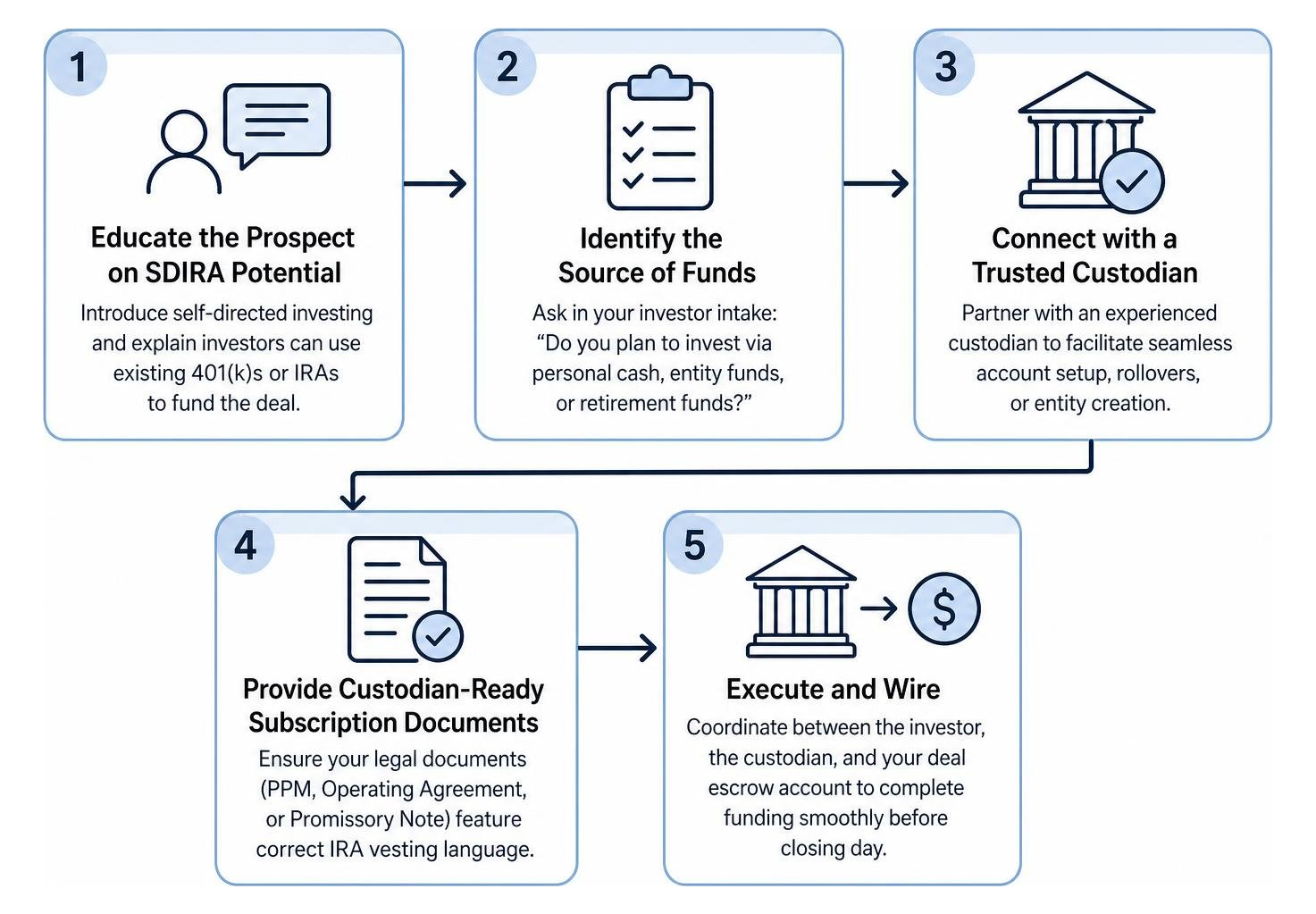
- Educate the Prospect on SDIRA Potential: Introduce self-directed investing during your initial webinars, podcasts, or pitch meetings. Explain that investors can use existing 401(k)s or IRAs to fund your deal.
- Identify the Source of Funds: Ask potential investors early in your investor intake questionnaire: “Do you plan to invest via personal cash, entity funds, or retirement funds?”
- Connect with a Trusted Provider: Partner with an experienced provider like Independent IRA, an Authorized Agent of Accuplan, to facilitate seamless account setup, rollovers, or entity creation with a qualified custodian.
- Provide Custodian-Ready Subscription Documents: Ensure your legal documents (PPM, Operating Agreement, or Promissory Note) feature correct IRA vesting language.
- Execute and Wire: Coordinate between the investor, the custodian, and your deal escrow account to complete funding smoothly before closing day.
Having an organized system establishes immediate trust and positions your firm as an experienced operator capable of handling institutional-grade capital raising.
Educating Prospective Lenders and Equity Partners
Most people simply do not realize they can buy real estate or fund private promissory notes using their retirement savings. As a deal sponsor, your first job is educator.
When speaking with prospective lenders or limited partners, explain the core operational mechanics in simple, non-jargon terms:
- The Custodian’s Role: Clarify that a qualified, IRS-permitted custodian holds the physical asset title on behalf of the IRA, ensuring all reporting and recordkeeping stay compliant.
- Rollovers vs. Transfers: Explain that moving money from a former employer’s 401(k) or traditional IRA into an SDIRA is a non-taxable event when executed properly as a direct trustee-to-trustee transfer.
- Checkbook Control Flexibility: For active investors or private lenders who need to fund multiple deals rapidly, introduce the concept of a Checkbook IRA. By placing a specialized LLC inside the SDIRA, the investor gains direct checkbook and wire authority, eliminating custodian transaction fees and approval delays.
- Realistic Timelines: Educate investors that establishing a new SDIRA and transferring funds from an old brokerage typically takes 10 to 15 business days. Encouraging investors to set up their accounts before your deal officially opens ensures they won’t miss subscription windows.
When you simplify this process, you eliminate hesitation and make prospective partners comfortable taking action. Our team at Independent IRA regularly assists deal sponsors by guiding their investors through these exact setup mechanics, ensuring a frictionless transition.
Streamlining Document Workflow to Attract SDIRA Investors
The fastest way to lose an SDIRA commitment is confusing legal paperwork. Custodians have strict guidelines regarding how investment documents must be drafted, titled, and signed. If your subscription agreements are filled out incorrectly, the custodian will reject them, sending you back to square one.
To ensure your document workflow runs without a hitch, pay attention to these critical items:
- Proper Vesting Name: An SDIRA investment is never owned by the individual personally. The owner line on your subscription agreement or LLC Operating Agreement must explicitly state: “[Custodian Name] Custodian FBO [Investor Name] IRA #XXXXX” (or the name of their Checkbook LLC).
- Signatures and Authorizations: In a standard custodial account, the investor signs as “Read and Approved,” but the custodian must execute the final document as the legal owner. In a Checkbook IRA, the investor signs directly as the Manager of the IRA-owned LLC.
- Promissory Note Mechanics: If you are raising private debt, reference The Real Estate Investors Guide to IRA Promissory Notes to ensure your interest payment schedules, maturity dates, and default provisions meet IRS self-dealing requirements.
- Pre-Vetted Legal Templates: Work with securities attorneys who understand self-directed IRA language so your Private Placement Memorandums (PPMs) are accepted by custodians on the first review.
When your document pipeline is organized, custodians process investments rapidly, allowing you to close deals on schedule. Brian Davis and our operations specialists at Independent IRA work directly with deal sponsors to review document vesting prior to wire requests, eliminating last-minute closing delays.
Navigating Compliance, Regulatory Rules, and Risk Mitigation

Capital raising with retirement dollars requires strict adherence to Internal Revenue Code regulations enforced by the IRS. While SDIRAs may offer valuable tax advantages, an accidental compliance violation can disqualify the entire account, subjecting the investor to immediate taxes and potential penalties.
To protect your investors and your reputation as a deal sponsor, you must understand three key regulatory boundaries:
1. Prohibited Transactions & Disqualified Persons (IRC Section 4975)
The IRS strictly prohibits an SDIRA from engaging in transactions that directly or indirectly benefit the account holder or their “disqualified persons” (which includes spouses, parents, grandparents, children, grandchildren, and any entities controlled by them).
- Example: An investor cannot use their SDIRA funds to invest in your private real estate deal if you are their son, daughter, or spouse.
- Example: An investor cannot personally perform paid repairs or act as the general contractor on a property owned by their SDIRA.
2. Unrelated Business Income Tax (UBIT) & Unrelated Debt-Financed Income (UDFI)
While SDIRA earnings grow on a tax-deferred or tax-free basis, there are two specific exceptions that every syndicator must understand when structuring deals:
- UBIT (IRC Section 512): Triggered when an SDIRA derives income from an active trade or business (such as operating a hotel, restaurant, or active property flipping enterprise) rather than passive investment income like rental distributions or capital gains.
- UDFI (IRC Section 514): Triggered when an SDIRA invests in a real estate deal that uses non-recourse debt financing (e.g., a syndication taking out an agency mortgage). The portion of profits attributable to the leveraged debt is subject to UDFI tax at trust tax rates.
Understanding these tax nuances—and educating your investors on how to report them—ensures there are no surprises at year-end. For updated analysis on regulatory shifts, see our review of the New IRC Tax Section IRA.
Comparing Private Capital Sources
To help you decide how to balance your capital stack, here is how traditional taxable private capital compares to self-directed retirement capital:
| Feature / Metric | Traditional Private Capital | SDIRA Retirement Capital |
|---|---|---|
| Primary Capital Source | Personal savings, taxable investment accounts | Rollover 401(k)s, Traditional IRAs, Roth IRAs |
| Tax Impact on Investor | Current-year capital gains & income taxes | Tax-deferred or potential tax-free growth |
| Investor Motivation | Liquidity, short-term gains, active wealth building | Long-term compounding, stability, passive yield |
| Document Complexity | Standard subscription agreement & personal wire | Custodian-approved vesting, rollover verification |
| Capital Availability | Dependent on personal cash flow & liquid reserves | Massive, stable reserves sitting in long-term accounts |
| Transaction Speed | Immediate (1-2 days via personal wire) | 5-15 business days (unless using Checkbook Control) |
By offering a compliant, repeatable pathway for retirement money, you open your deals to a massive pool of patient capital that cash-only syndicators completely overlook.
Frequently Asked Questions About How to Attract SDIRA Investors
What is the average minimum investment for SDIRA investors?
While minimum investment thresholds are set entirely by the deal sponsor, SDIRA investors typically deploy larger average checks than retail cash investors. Because SDIRA holders are often rolling over full employer 401(k) balances or consolidated traditional IRAs, average investment amounts generally range between $50,000 and $250,000 per deal. Setting a reasonable minimum (such as $25,000 or $50,000) keeps administrative overhead manageable while giving accredited and non-accredited retirement investors room to participate.
How long does it take for an investor to fund a deal with an SDIRA?
If an investor already has an active, funded SDIRA account, processing subscription paperwork and executing a wire transfer typically takes 3 to 5 business days. However, if the investor needs to open a new SDIRA account and transfer funds from an existing traditional brokerage, the full process takes between 10 and 15 business days. This is why deal sponsors should encourage investors to complete their account setup and transfer prior to deal launch.
What asset classes are most attractive to SDIRA investors?
Real estate remains a leading asset class, capturing over 50% of all self-directed IRA allocations. SDIRA investors favor cash-flowing multifamily syndications, single-family rental portfolios, commercial real estate, tax liens, and tax deeds. Private debt (first trust deeds and promissory notes) and private equity offerings (startups and mid-market business debt) are also highly sought after because they offer strong, predictable yields that compound seamlessly inside a tax-sheltered account.
Do SDIRA investors pay taxes on returns generated from syndications?
In most cases, returns generated inside an SDIRA compound tax-deferred (Traditional IRA) or may be tax-free upon qualified withdrawal (Roth IRA). However, if a syndication or real estate deal uses acquisition debt (such as a mortgage loan), the portion of income generated by the leverage may be subject to Unrelated Debt-Financed Income (UDFI) tax under IRC Section 514. Deal sponsors should advise SDIRA investors to consult their CPA to file IRS Form 990-T if UDFI tax thresholds are met.
Before You Move Retirement Funds: Scale Your Capital Raising With SDIRA Infrastructure

Learning how to attract SDIRA investors is one of the most profitable operational upgrades a real estate syndicator, private lender, or fund manager can make. By building an educated, compliant, and streamlined capital-raising pipeline, you turn passive retirement account holders into loyal long-term equity partners.
Rather than letting paperwork or compliance questions slow down your deal flow, establish a repeatable system that removes friction before it starts. At Independent IRA, an Authorized Agent of Accuplan Benefits Services, we assist with account administration, custom Checkbook IRA and Solo 401(k) entity creation, and dedicated support for deal sponsors nationwide. Whether you are launching your first real estate fund or scaling a multi-million-dollar private debt platform, our team ensures your investors experience a fast, compliant onboarding process from initial rollover to final wire.
Explore our full range of entity creation and agent Services today, or schedule a strategy consultation with Brian Davis and our retirement account specialists to start converting untapped SDIRA capital into your next successful closing.
This content is for informational and educational purposes only and does not constitute legal, tax, or investment advice. Rules, limits, and requirements may change. Consult a qualified tax advisor, attorney, or financial professional before making retirement planning or investment decisions. Independent IRA is an Authorized Agent of Accuplan Benefits Services and is not a custodian or trust company.