

 GIVE US A CALL
Making promissory notes IRA compliant is one of the most powerful — and most misunderstood — strategies available to self-directed IRA investors. Done right, your retirement account can act as a private lender, potentially collecting interest income on a tax-deferred or tax-free basis. Done wrong, a single misstep can trigger IRS penalties, affect your IRA’s tax-exempt status, or expose your account to unexpected tax liability.
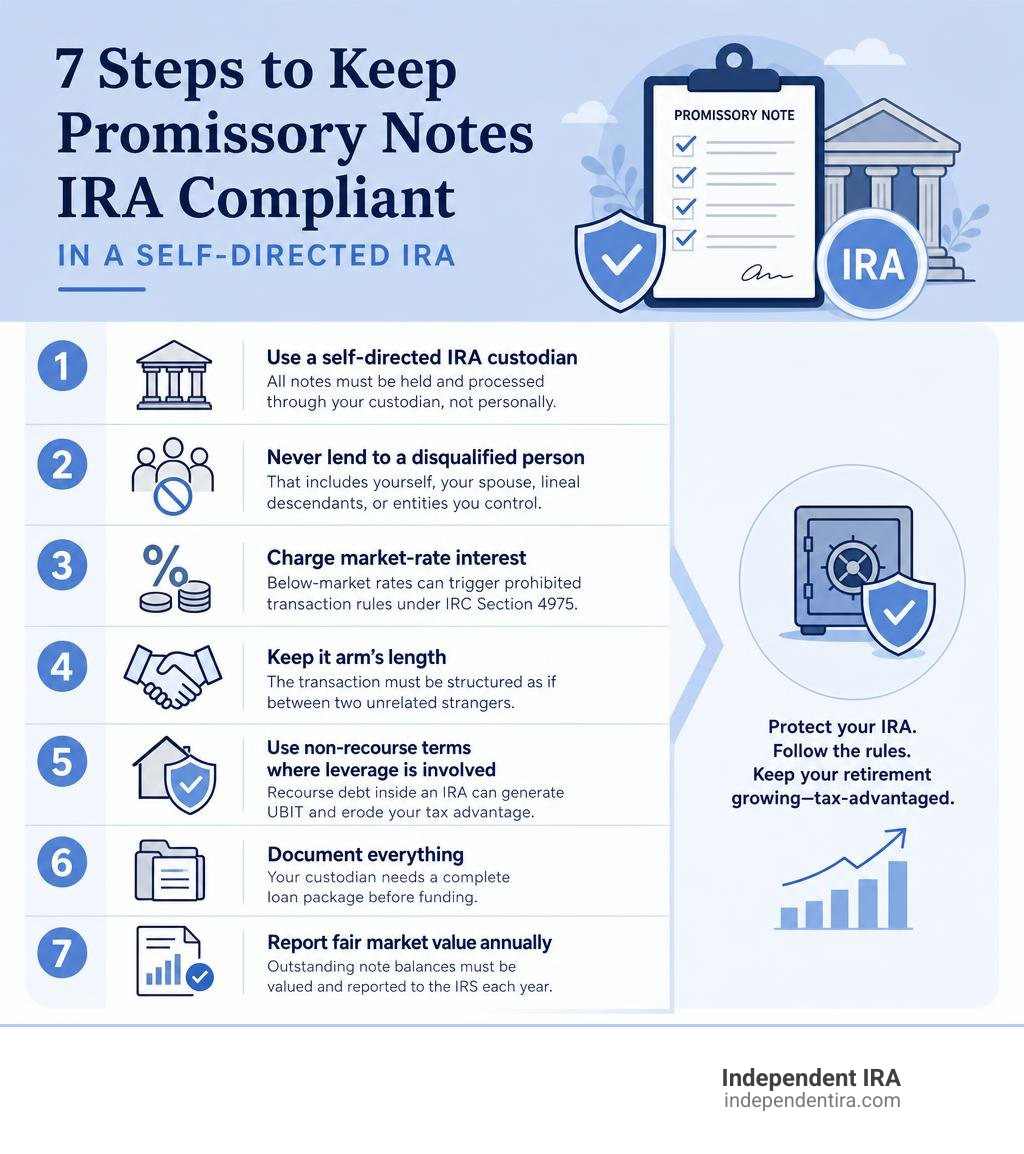
Here is a quick-reference checklist for keeping promissory notes IRA compliant:
- Use a self-directed IRA custodian — all notes must be held and processed through your custodian, not personally
- Never lend to a disqualified person — that includes yourself, your spouse, lineal descendants, or entities you control
- Charge market-rate interest — below-market rates can trigger prohibited transaction rules under IRC Section 4975
- Keep it arm’s length — the transaction must be structured as if between two unrelated strangers
- Use non-recourse terms where leverage is involved — recourse debt inside an IRA can generate UBIT and erode your tax advantage
- Document everything — your custodian needs a complete loan package before funding
- Report fair market value annually — outstanding note balances must be valued and reported to the IRS each year
Self-directed IRAs holding alternative assets like promissory notes represent over $339 billion in retirement savings, and private lending accounts for roughly 12% of all alternative assets in these accounts. That scale reflects real demand from investors who want their retirement dollars working harder than a mutual fund allows. But it also means more investors are navigating complex IRS rules without a clear roadmap.
This guide walks you through every layer of compliance — from prohibited transaction rules and UBIT exposure to default procedures and documentation requirements — so your IRA lending strategy stays protected. I’m Brian Davis, and throughout this guide I’ll show you exactly how Independent IRA, an Authorized Agent of Accuplan, helps real estate investors navigate the process of establishing private lending arrangements inside their retirement accounts.
The Mechanics of Private Lending with Retirement Funds
At its core, a promissory note is a legal debt instrument. It is a written, unconditional promise by one party (the borrower) to pay a specific sum of money to another party (the lender, which in this case is your self-directed IRA) under clearly defined terms.
When you engage in private lending through your retirement account, your IRA acts exactly like a traditional bank. The transaction requires several key components to function properly:
- The Principal: The exact amount of money your IRA is lending to the borrower.
- The Interest Rate: The cost of borrowing that capital, expressed as an annual percentage.
- The Maturity Date: The timeline and deadline by which the entire principal and outstanding interest must be fully repaid.
- The Payment Schedule: A structured timeline detailing when payments are due (e.g., monthly, quarterly, or as a balloon payment at maturity).
To dive deeper into how this process works from a state-specific and practical perspective, you can review our AZ Guide to Private Lending with IRA. The most critical mechanic to understand is that you do not personally own the note; your IRA owns it. All payments must flow directly back into your self-directed IRA account to preserve its tax-sheltered status.
Why Real Estate Investors Use IRA Debt Instruments
Real estate investors often prefer acting as the lender rather than the landlord. It is an exceptionally clean way to generate consistent passive income without the typical headaches of property management, tenant disputes, or unexpected maintenance costs.
Furthermore, private lending allows for portfolio diversification. Instead of tying up your entire retirement balance in a single physical property, you can split your capital across multiple secured loans. This strategy offers potential returns backed by real estate collateral, offering strong capital preservation.
By positioning your retirement funds as the lender, you can seek competitive returns on collateralized real estate assets. For those interested in exploring these strategies further, our resources on Private Equity Private Lending San Diego explain how local and national investors leverage debt instruments to scale their retirement portfolios.
Crucial IRS Rules to Keep Promissory Notes IRA Compliant
The IRS allows self-directed IRAs to invest in private debt, but they enforce strict boundaries. To ensure your investments remain compliant, you must understand the Internal Revenue Code (IRC) Section 4975, which outlines prohibited transactions and disqualified persons. A violation of these rules can result in severe tax penalties, including the immediate disqualification of your entire IRA.
For a comprehensive look at the legal framework, you can refer directly to the IRS Prohibited Transactions Rules.
Prohibited Transactions and Disqualified Persons
The IRS strictly forbids your self-directed IRA from engaging in transactions with “disqualified persons.” The rule is simple: your retirement account cannot buy from, sell to, lend to, or borrow from anyone who falls into this category.
Disqualified persons include:
- Yourself (the IRA owner) and your spouse.
- Your lineal ascendants (parents, grandparents) and lineal descendants (children, grandchildren) and their spouses.
- Fiduciaries of the IRA (including investment advisors or custodians).
- Any corporation, partnership, trust, or estate in which you or other disqualified persons own a 50% or greater interest.
This means you cannot use your IRA to lend money to your son for a home purchase, nor can you lend money to a real estate business that you personally own or manage. Doing so constitutes “self-dealing.”
If the IRS detects a prohibited transaction, the consequences are severe. The IRS can impose a 15% penalty tax on the amount involved, and if the transaction is not corrected within the taxable period, an additional 100% tax can apply. In many cases, the IRS will simply disqualify the entire IRA as of the first day of the year in which the transaction occurred, treating the entire value of the account as a fully taxable distribution.
Steps to Make Your Promissory Notes IRA Compliant
To help ensure your promissory notes remain compliant, you must treat every loan as an arm’s length transaction. This means the loan must be structured exactly as if you were dealing with an unrelated stranger in the open market.
- Establish Fair Market Value and Market Interest Rates: You cannot offer “sweetheart” deals. The interest rate, loan terms, and collateral requirements must reflect current market standards. If market rates for hard money loans are 10% to 12%, charging a borrower 2% could raise red flags with the IRS.
- Maintain Self-Directed IRA Control: To streamline this process and maintain direct oversight of your transactions, establishing Self-Directed IRA Control is highly valuable. This gives you the speed and flexibility to execute notes quickly while keeping everything within a compliant structure.
- Custodian Processing: You must never fund a note from your personal bank account. All paperwork must name your IRA as the lender (e.g., “Independent IRA FBO [Your Name] IRA”). Your self-directed IRA custodian must review the documents, sign them on behalf of the IRA, and wire the funds directly to the borrower or closing agent.
Structuring Your Note to Avoid UBIT and Penalties
While interest income generated from a promissory note is generally classified as passive income—and therefore exempt from regular income taxes inside an IRA—certain structures can trigger Unrelated Business Income Tax (UBIT) or Unrelated Business Taxable Income (UBTI).
Understanding how to structure these transactions properly is essential, especially when you are Raising Private Capital with IRAs to fund larger real estate projects.
Why Secured Promissory Notes IRA Compliant Structures Protect Your Retirement
An unsecured promissory note is simply a signature loan. If the borrower defaults, your IRA has no recourse other than to sue the borrower. To protect your retirement capital and maintain a clean regulatory profile, it is highly recommended to only issue secured promissory notes.
A secured note is backed by physical collateral, usually real estate, via a Deed of Trust or a Mortgage. If the borrower defaults, your IRA has the legal right to foreclose on the property to recover the outstanding debt. This secured structure is designed to help protect your retirement capital and support its tax-advantaged status.
Avoiding UBTI with Non-Recourse Loan Structures
Unrelated Debt-Financed Income (UDFI) is a subset of UBTI that occurs when your IRA uses leverage to purchase an asset. For example, if your IRA takes out a loan to buy a rental property, the portion of the income generated by that borrowed money may be subject to UBIT, which can be taxed at trust rates up to 37% for income over a relatively low threshold.
To avoid triggering UBIT when structuring debt instruments:
- Ensure your IRA is the lender, not the borrower. When your IRA lends money, the interest income it receives is tax-exempt passive interest.
- If your IRA must partner with another entity or use leverage, the loan must be structured as a non-recourse loan. This means the lender’s only recourse in the event of a default is the collateral itself; they cannot pursue the other assets of the IRA or you personally.
Key Risks, Due Diligence, and Default Procedures
Every investment carries risk, and private lending is no exception. Because your custodian does not perform due diligence on your behalf, you are solely responsible for vetting the borrower and the collateral.
Before any funds are released, you must compile and submit a rigorous loan package. You can review the necessary compliance paperwork and templates on our Documents page.
Performing Due Diligence on the Borrower
Do not let the passive nature of private lending lull you into a false sense of security. You should vet a borrower just as thoroughly as a commercial bank would:
- Creditworthiness: Pull credit reports and review financial statements to ensure the borrower has a track record of paying their debts.
- Loan-to-Value (LTV) Ratio: Never lend 100% of a property’s value. Keep your LTV below 70% to 75% of the property’s current appraised value. This ensures that if the borrower defaults, the property is worth significantly more than the loan balance.
- Property Appraisals and Title Searches: Always require an independent, professional appraisal of the underlying real estate. Run a title search to ensure there are no senior liens, unpaid taxes, or legal judgments against the property that could compromise your IRA’s position.
Handling Defaults and Foreclosures Within an IRA
What happens if a borrower stops paying? Because the note is owned by your IRA, you cannot personally take possession of the collateral or handle the foreclosure process in your own name.
If a default occurs, your IRA must initiate the foreclosure process through a qualified attorney. All legal fees and foreclosure expenses must be paid directly from your IRA account. Once the foreclosure is complete, the property title will be held in the name of your IRA. While this can be a complex process, working with an experienced custodian helps facilitate the administrative steps in accordance with IRS guidelines.
Comparing Promissory Notes to Other Alternative IRA Assets
To help you decide if private lending is the right path for your retirement strategy, let’s look at how promissory notes compare to physical real estate and private equity investments.
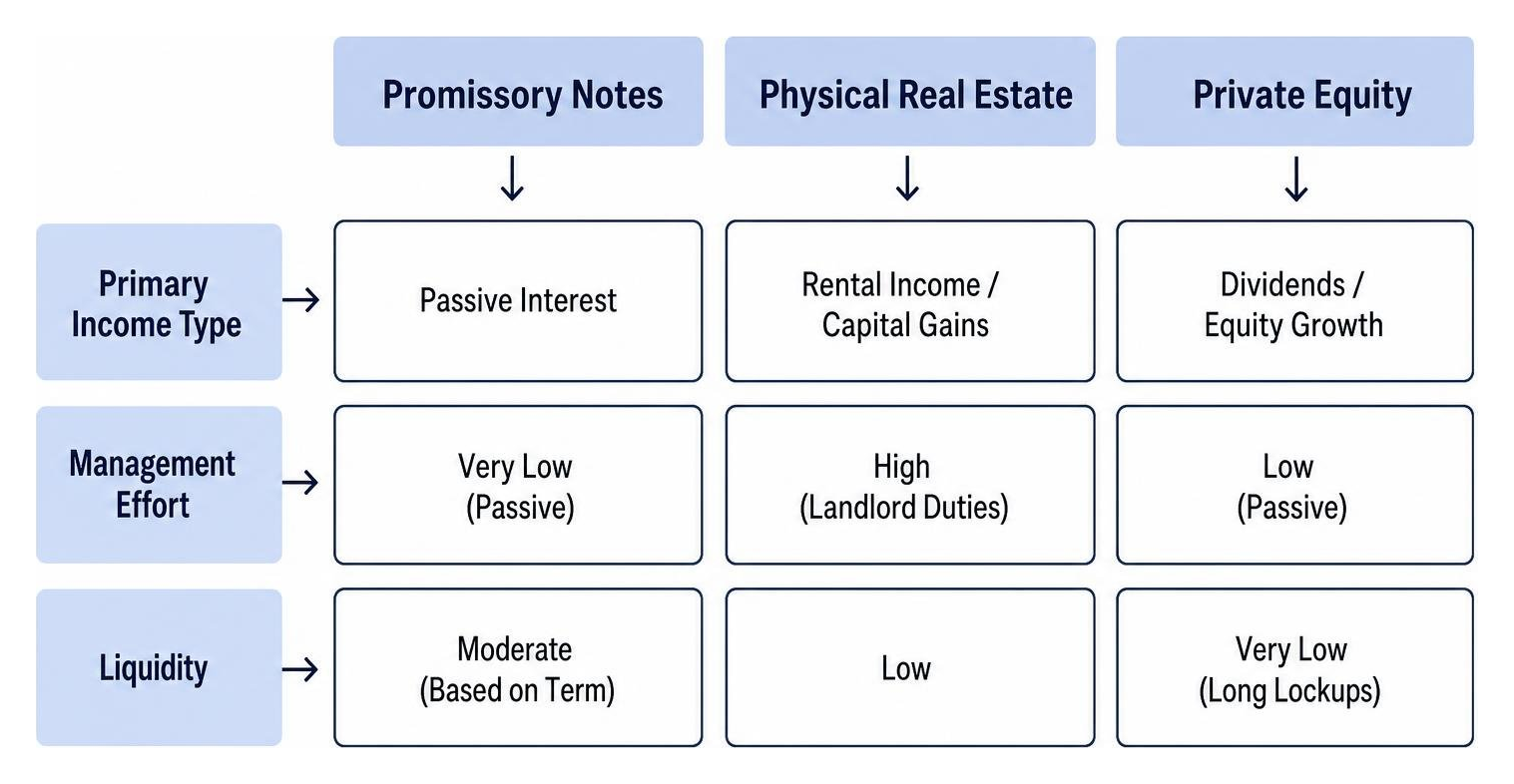
| Feature | Promissory Notes | Physical Real Estate | Private Equity |
|---|---|---|---|
| Primary Income Type | Passive Interest | Rental Income / Capital Gains | Dividends / Equity Growth |
| Management Effort | Very Low (Passive) | High (Landlord Duties) | Low (Passive) |
| Liquidity | Moderate (Based on Term) | Low | Very Low (Long Lockups) |
| UBIT Risk | Extremely Low | Moderate (If debt-financed) | High (If operating business) |
| Collateral Protection | High (Secured by Deed/Mortgage) | High (Direct Ownership) | Low (Equity Ownership) |
Promissory Notes vs. Physical Real Estate
While physical real estate offers direct ownership and potential tax deductions like depreciation, it also demands significant hands-on management. Landlords must deal with maintenance, vacancies, property taxes, and property management fees.
Promissory notes, by contrast, typically offer a fixed, scheduled rate of return with fewer active management responsibilities. You exchange the potential upside of property appreciation for the potential consistency of scheduled interest payments.
Promissory Notes vs. Private Equity
Private equity investments can yield significant returns, but they come with high risk, low liquidity, and long capital lockup periods. Valuation is often highly complex, making annual IRS reporting difficult. Promissory notes offer far greater cash flow predictability and a clear exit strategy via the maturity date, all while being secured by physical real estate.
Frequently Asked Questions About IRA Promissory Notes
Can my self-directed IRA lend money to my business?
Generally, no. Under IRS rules, your business is typically considered a disqualified entity if you or other disqualified persons own 50% or more of it. Lending money to your own business is generally a prohibited transaction and can result in the disqualification of your IRA and substantial tax penalties.
What is the maximum interest rate my IRA can charge on a note?
While the IRS requires you to charge a fair market rate, you must also comply with your state’s usury laws. Usury laws cap the maximum interest rate a lender can legally charge. Always consult with a local real estate attorney to ensure your note’s interest rate is both market-compliant and legally permissible in the borrower’s state.
How is the annual value of a promissory note reported to the IRS?
Every year, your self-directed IRA custodian must report the Fair Market Value (FMV) of your account assets to the IRS using Form 5498. For a promissory note, the value is typically the outstanding principal balance as of December 31st, provided the loan is performing. If the note is non-performing or has defaulted, a formal valuation or appraisal of the underlying collateral may be required.
Before You Move Retirement Funds
Before you deploy your retirement savings into private lending, you need the right structural foundation. Traditional custodians like Fidelity or Schwab do not allow alternative investments like promissory notes. You need a specialized self-directed custodian that understands the nuances of alternative asset compliance.
At Independent IRA, an Authorized Agent of Accuplan, we help facilitate self-directed retirement solutions. Whether you want to establish a Checkbook IRA or utilize a Solo 401(k), we provide the tools, entity creation, and administrative support you need.
To learn more about setting up your account, check out our Step by Step Guide to Checkbook IRA or explore our full suite of retirement services on our Services page.
Ready to take control of your retirement and start lending? Contact Brian Davis and our team of self-directed experts today to build a fully compliant, high-performing retirement portfolio.
This content is for informational and educational purposes only and does not constitute legal, tax, or investment advice. Rules, limits, and requirements may change. Consult a qualified tax advisor, attorney, or financial professional before making retirement planning or investment decisions. Independent IRA is an Authorized Agent of Accuplan Benefits Services and is not a custodian or trust company.