

 GIVE US A CALL
If you are wondering whether a cryptocurrency self directed IRA is a smart way to hold Bitcoin or other digital assets for retirement, the short answer is that it can be, but only if you understand the structure, tax treatment, and compliance rules first. A crypto self-directed IRA lets you invest retirement funds in digital assets through a specialized custodian rather than a standard brokerage. That may offer tax advantages, but it also adds fees, custody rules, and prohibited transaction risks that many beginners overlook. If you are new to this setup, start by understanding how Self-Directed IRA Control works before moving any retirement money.
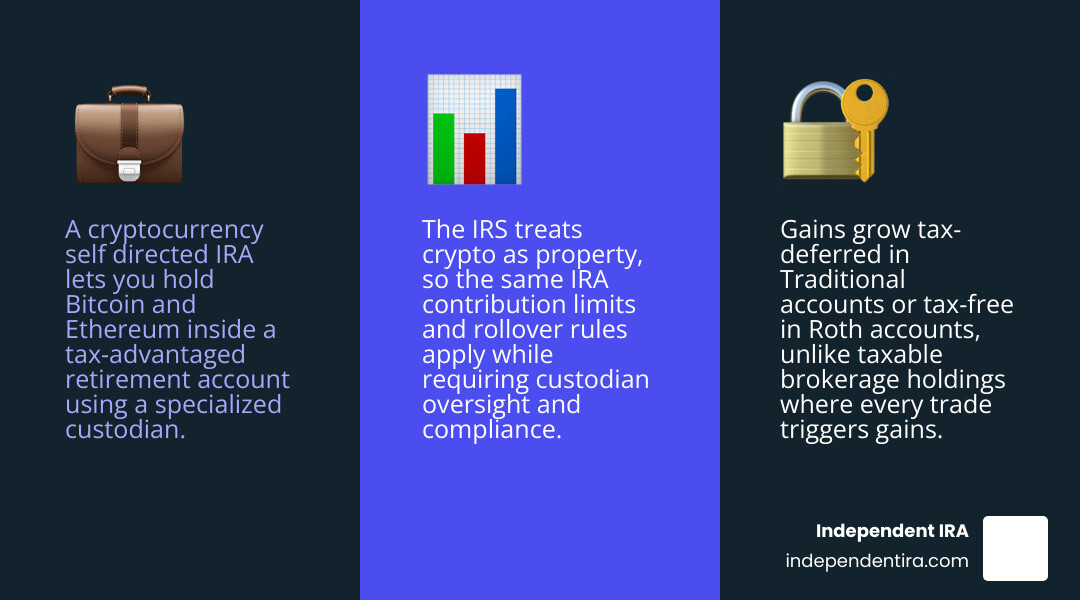
A cryptocurrency self directed IRA is a type of individual retirement account that lets you hold Bitcoin, Ethereum, and other digital assets directly inside a tax-advantaged retirement structure. Unlike a standard IRA at a traditional brokerage, this account type requires a specialized custodian and gives you the freedom to invest in alternative assets that most mainstream providers simply don’t allow.
Quick Answer: Cryptocurrency Self Directed IRA at a Glance
- What it is: A self-directed IRA (SDIRA) that holds cryptocurrency as the underlying investment instead of stocks or mutual funds
- Who holds the assets: A specialized IRA custodian holds the crypto on behalf of your retirement account – not you personally
- Tax treatment: Gains may grow tax-deferred in a Traditional SDIRA or potentially tax-free in a Roth SDIRA, depending on which account type you choose and whether distribution requirements are met
- How to fund it: Roll over an existing 401(k) or IRA, or make a new annual contribution up to IRS limits ($7,000 under age 50, $8,000 age 50+ in 2026)
- IRS classification: The IRS treats cryptocurrency as property under IRS Notice 2014-21, so capital gains rules apply rather than currency rules
For investors who already use self-directed accounts for real estate or private equity, adding cryptocurrency follows a familiar structure, but with some important differences in custody, security, and IRS compliance to understand before getting started.
Roughly 20% of Americans own some form of cryptocurrency, yet most hold it in taxable accounts where every trade can trigger a reportable gain. Moving that exposure inside a retirement account changes the tax picture significantly. Whether you’re exploring this for the first time or looking to expand an existing self-directed strategy, this guide walks you through the main concepts to understand.
Understanding the Cryptocurrency Self Directed IRA Structure
A crypto IRA is still an IRA first. The crypto part is the investment choice, not a separate tax code loophole or magic wrapper. In plain English, your account is governed by normal IRA rules, but the custodian permits nontraditional assets like digital currency.
With a self-directed structure, the custodian handles account administration and reporting, while you direct the investment decisions. That is the key distinction. You choose the asset. The custodian keeps the retirement account in compliance.
If you are new to self-direction, our guide to Self-Directed IRA Control is a helpful starting point.

A cryptocurrency self directed IRA can typically be set up as:
- Traditional IRA
- Roth IRA
- SEP IRA in some cases
- Rollover IRA funded from a former employer plan
In some structures, investors also use a checkbook-control LLC owned by the IRA for added flexibility. That can be useful when direct wallet control or broader platform access matters, but it also adds more setup work, documentation, and compliance responsibility. More control is great. More control plus sloppy paperwork is not great.
How a Cryptocurrency Self Directed IRA Differs from Traditional Accounts
A traditional brokerage IRA usually limits you to public-market investments such as:
- Stocks
- Bonds
- Mutual funds
- ETFs
A self-directed IRA opens the door to alternative assets, which may include:
- Cryptocurrency
- Real estate
- Private lending
- Private equity
- Precious metals in certain cases
That broader menu is the biggest difference. A crypto IRA is not better just because it is more flexible. It is simply more flexible. For some investors, that is valuable. For others, it is unnecessary complexity.
Here is what changes with self-direction:
- You have a wider range of asset choices
- You must do more due diligence
- Custody and security become more specialized
- Fees may be higher than a plain vanilla brokerage IRA
- Mistakes can be costlier if you ignore IRA rules
If you already understand self-direction from real estate investing, much of the framework will feel familiar. The same principles discussed in Self-Directed IRA Control apply here: the IRA owns the asset, not you personally, and all transactions must stay at arm’s length.
Steps to Open Your Cryptocurrency Self Directed IRA
Opening the account is usually straightforward, even if the asset class sounds futuristic.
-
Choose the IRA type
Decide whether Traditional or Roth makes more sense based on your tax situation. -
Open a self-directed account
Work with a custodian that allows crypto-related investing and understands alternative assets. -
Fund the account
You can typically fund it by:
- Annual contribution
- Trustee-to-trustee transfer from another IRA
- Direct rollover from an old 401(k) or similar plan
-
Complete compliance and account setup
This can include identity verification, beneficiary designations, transfer forms, and sometimes separate crypto platform paperwork. -
Direct the investment
Once funds arrive, you instruct the purchase through the approved custody or trading structure. -
Maintain records and valuation support
Your custodian still needs accurate account records and fair market value reporting.
One important rule: if you use a 60-day rollover instead of a direct transfer, the once-per-12-month rollover limit may apply. In practice, direct transfers and direct rollovers are usually cleaner and less risky.
If your strategy involves raising capital or combining retirement money with larger deal planning, Raising Private Capital with IRAs gives useful background. And if you want process support, Brian Davis can help you think through setup steps before funds move.
Tax Advantages of Roth vs. Traditional Crypto Accounts
The tax story is one of the biggest reasons investors look at crypto in an IRA at all.
In a taxable account, every sale or crypto-to-crypto swap may create a taxable event. In a retirement account, that frequent tax reporting generally disappears while assets remain inside the IRA, subject to applicable IRA rules.

Traditional self-directed IRA
With a Traditional crypto IRA:
- Contributions may be tax-deductible, depending on your income and plan coverage
- Growth is tax-deferred
- Withdrawals in retirement are generally taxed as ordinary income
- Required minimum distributions typically apply starting at age 73
This structure may be relevant for investors who expect to be in a lower tax bracket later, or who want to evaluate whether an upfront deduction is available today.
Roth self-directed IRA
With a Roth crypto IRA:
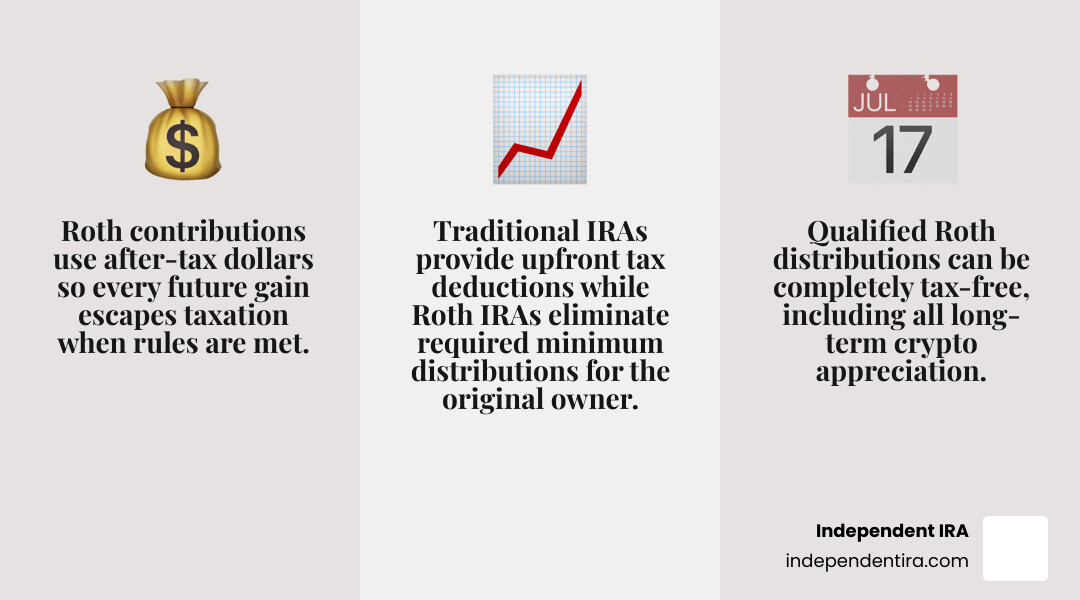
- Contributions are made with after-tax dollars
- Growth can be tax-free
- Qualified withdrawals can be tax-free
- There are no lifetime RMDs for the original owner
For assets with substantial appreciation potential, Roth treatment often gets attention because appreciation may escape future taxation if distribution rules are met. Generally, qualified Roth withdrawals require the account to satisfy the 5-year rule and the owner to be at least 59 1/2, disabled, or otherwise eligible.
For many long-term investors, that is the appeal of a Roth-based Bitcoin IRA: potential tax-free qualified distributions later.
Which is better?
There is no universal winner.
A Roth may be worth evaluating if:
- You believe the asset has significant long-term upside
- You can qualify to contribute or use an eligible Roth conversion strategy
- You value tax-free distributions more than a current deduction
A Traditional account may be worth evaluating if:
- You want the current-year tax deduction
- You expect lower income in retirement
- You are rolling pre-tax retirement funds and want to avoid a conversion tax bill now
Also keep the 2026 contribution rules in mind:
- $7,000 if under age 50
- $8,000 if age 50 or older
Roth IRAs also have income restrictions for direct contributions, so some higher-income earners may need to explore other funding paths.
For more on crypto retirement structures, see Bitcoin IRA.
Key Risks and IRS Rules for Digital Assets
Crypto in an IRA can be powerful, but it is not simple, and it is definitely not risk-free.
1. Volatility risk
Crypto is famously volatile. Large drawdowns are normal, not rare. Research in this area commonly cites prior bear markets with declines in the 70% to 80% range. That means a crypto allocation should be sized so a major drop does not wreck your retirement plan.
2. Custody and security risk
In an IRA, you generally cannot just move coins to your personal wallet and call it retirement planning. Assets need to remain under an IRA-compliant custody arrangement.
Custodians and platform partners commonly use controls such as:
- Offline or cold storage
- Multi-signature wallet processes
- Identity verification and KYC procedures
- Account-level authorization controls
- Audit trails and reporting
Some structures do not allow you to hold the private keys personally. In more advanced checkbook LLC setups, wallet control may be broader, but that flexibility comes with more compliance risk and recordkeeping responsibility.
3. Prohibited transactions
This is the big one.
Your IRA cannot transact with disqualified persons, including:
- You
- Your spouse
- Your parents or grandparents
- Your children or grandchildren and their spouses
- Certain entities those persons control
Practical examples of trouble:
- Using IRA-owned crypto for a personal purchase
- Sending IRA crypto to your personal exchange wallet
- Paying personal expenses from IRA assets
- Selling your personally owned crypto to your IRA
One prohibited transaction can disqualify the IRA and create serious tax consequences.
4. UBIT and active income issues
Simple buying and selling of crypto for investment purposes inside an IRA generally does not create UBIT. But some activities can.
Potential UBIT triggers may include:
- Certain staking arrangements
- Crypto lending or yield strategies
- Mining operations
- Leveraged structures
This is where investors should slow down and get tax guidance. Buy-and-hold is one thing. Running what looks like an operating business inside the IRA is another.
5. Recordkeeping and valuation
Even digital assets need paper trails. Your custodian still must report account values to the IRS, and your files should clearly show:
- When funds entered the account
- How assets were titled
- Where assets were held
- Transaction history
- Year-end fair market value support
If you need help evaluating account structure, custody, or compliance, review our Services.
Comparing Direct Crypto Ownership to Bitcoin ETFs
Many investors ask a fair question: why not just buy a Bitcoin ETF in a regular IRA and keep life simple?
That can absolutely be the better fit for some people. But it is not the same as direct crypto ownership in a self-directed account.
| Feature | Direct Crypto in SDIRA | Bitcoin ETF in Standard IRA |
|---|---|---|
| What you own | Actual cryptocurrency exposure through an approved IRA structure | Shares of a fund that tracks Bitcoin |
| Asset flexibility | May include multiple cryptocurrencies and broader structures | Limited to available ETFs |
| Trading venue | Through approved digital asset platform or structure | Traditional brokerage |
| Custody model | Specialized crypto custody | Standard securities custody |
| Private wallet options | Sometimes possible in advanced structures | No |
| Simplicity | Lower | Higher |
| Fee structure | May include setup, annual, trading, and custody-related fees | Usually fund expense ratio plus brokerage costs |
| Investor control | Higher, especially with self-directed planning | More limited |
An ETF may be a good fit if you want:
- Simplicity
- Lower administrative burden
- Exposure to Bitcoin only
- Familiar brokerage reporting
Direct ownership may be more appealing if you want:
- Exposure beyond one ETF
- The possibility of in-kind distribution
- Greater structural flexibility
- Access to checkbook-control planning
That is one reason many investors comparing structures start with Bitcoin IRA and then decide whether direct ownership or fund-style exposure better matches their goals.
Frequently Asked Questions about Crypto IRAs
Can I take in-kind distributions of cryptocurrency from my IRA?
Yes, in many cases you may be able to distribute the actual cryptocurrency instead of selling it for cash first. That means the asset leaves the IRA and becomes personally owned by you.
Tax treatment depends on the account type:
- Traditional IRA: the distributed value is generally taxable as ordinary income
- Roth IRA: qualified distributions are generally tax-free
The value on the distribution date is usually what matters for reporting.
What are the contribution limits for a crypto IRA?
For 2026, IRA contribution limits are:
- $7,000 if under age 50
- $8,000 if age 50 or older
These limits apply across your IRAs combined, not per account. So if you contribute to one IRA already, that affects what you can put into another. Eligibility also depends on having enough earned income, and Roth direct contributions may be limited by income.
Can I hold my own private keys in a self-directed account?
Sometimes, but not always.
In many custodian-platform crypto IRA arrangements, you do not control the private keys directly. In some checkbook IRA LLC structures, investors may have more control over wallet setup and storage. That added control can be useful, but it must be handled very carefully so you do not create a prohibited transaction or custody problem.
If your main goal is maximum control, it is worth reading about Self-Directed IRA Control before choosing a structure.
Is rolling over an old 401(k) into a cryptocurrency self directed ira taxable?
A properly completed direct rollover is generally not taxable when the funds move. The same is true for a trustee-to-trustee transfer between IRAs.
Problems usually arise when investors take possession of the funds personally and miss deadlines or mishandle the rollover mechanics. That is why we usually recommend planning the move before money leaves the old account.
Which cryptocurrencies can typically be held in a self-directed IRA?
It depends on the custodian and the approved trading or custody platform. Commonly available assets often include:
- Bitcoin
- Ethereum
- Solana
- Litecoin
- XRP
- Stablecoins on some platforms
Not every coin is available in every structure. Some platforms support only a short list, while others offer much broader menus. Also, not every digital asset is IRA-friendly. For example, assets treated as collectibles can create problems. For background on how digital assets are generally categorized for federal tax purposes, see the IRS Virtual Currencies page.
What fees should I expect?
Fees vary by structure, but common categories include:
- One-time account setup fee
- Annual account administration fee
- Trading fee or spread
- Entity setup cost if using an LLC
- Wire or transaction processing fees
- Possible exchange or storage-related charges
Always ask for the full fee schedule in writing. A low headline fee can hide other layers.
Before You Move Retirement Funds
Before opening a cryptocurrency self directed IRA, pause and ask a few practical questions.
- What percentage of our retirement portfolio should go into crypto?
- Do we want direct coin ownership or ETF exposure?
- Is Roth or Traditional treatment more valuable for our tax picture?
- Are we comfortable with the fees and complexity?
- Do we understand prohibited transaction rules before moving a dollar?
A crypto IRA strategy should fit your broader retirement plan, not replace it. That is why many investors pair higher-volatility assets with steadier strategies and diversify across asset classes. If you want a broader self-directed perspective, Crash Proof with a Self-Directed IRAs is a useful next read.
At Independent IRA, we help investors understand account structure, funding paths, and control options before avoidable mistakes happen. Independent IRA is an Authorized Agent of Accuplan Benefits Services and is not a custodian. If you are considering crypto alongside real estate, private lending, or other alternatives, explore our Services and reach out to discuss your setup. Brian Davis can help you understand the process, the paperwork, and the questions worth answering before retirement funds move.
For additional background on self-directed custodians and retirement account rules, review current IRS guidance and your account documents before finalizing any setup.
This content is for informational and educational purposes only and does not constitute legal, tax, or investment advice. Rules, limits, and requirements may change. Consult a qualified tax advisor, attorney, or financial professional before making retirement planning or investment decisions. Independent IRA is an Authorized Agent of Accuplan Benefits Services and is not a custodian or trust company.