

 GIVE US A CALL
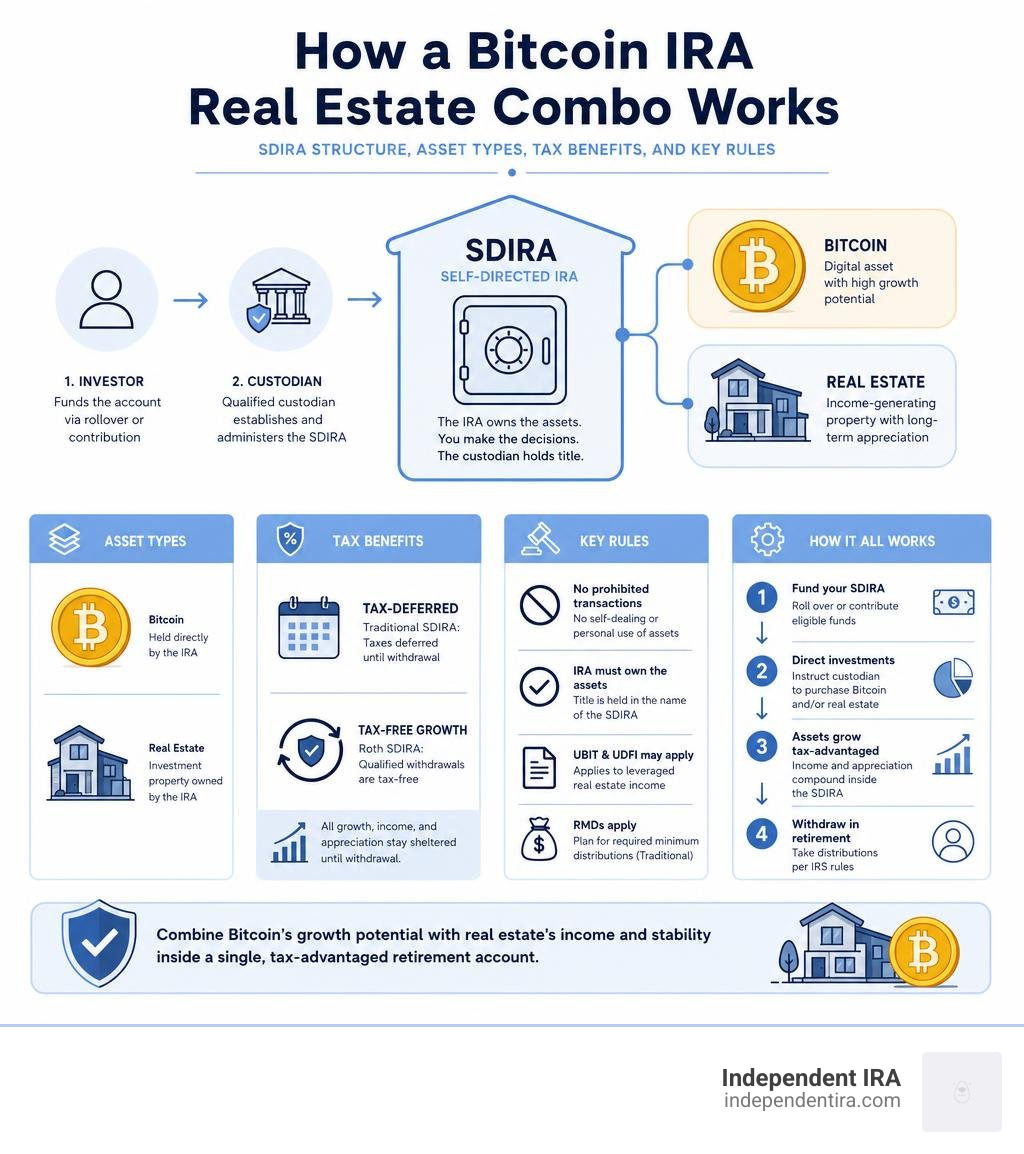
A Bitcoin IRA real estate combo is an investment strategy available to self-directed retirement investors. At its core, it involves using a single self-directed IRA (SDIRA) to hold both Bitcoin and investment property inside the same tax-advantaged account. The IRA owns the assets directly, meaning gains, rental income, and appreciation may stay sheltered from taxes until withdrawal (or permanently, in a Roth structure, subject to IRS rules).
Here is what this strategy involves in plain terms:
- What it is: A self-directed IRA that holds both cryptocurrency (such as Bitcoin) and real estate as retirement assets
- How it works: You open an SDIRA with a qualified custodian, fund it via rollover or contribution, then direct the custodian to acquire Bitcoin and investment property on the IRA’s behalf
- Why investors use it: To combine Bitcoin’s potential growth with real estate’s potential cash flow, within a tax-advantaged retirement account
- Key legal basis: The IRS classifies Bitcoin as personal property (IRS Notice 2014-21), and IRC Section 408 permits IRAs to hold alternative assets including real estate, making both asset classes IRS-permitted assets inside a properly structured SDIRA
- Who it suits: Investors who want more direct control over their retirement portfolio beyond traditional stocks, bonds, and mutual funds
Traditional retirement accounts at standard brokerages typically do not allow you to hold direct real estate or cryptocurrency. A self-directed IRA is a retirement account structure that allows this combination. The custodian does not manage your investments or tell you what to buy; you make the decisions, and the IRA holds title to the assets.
What makes this particularly compelling right now is the growing interest in pairing Bitcoin’s potential upside with real estate’s income-generating stability. Real estate has historically provided strong risk-adjusted returns when added to a diversified portfolio. Bitcoin, meanwhile, posted significant gains in 2023. Holding both inside a tax-advantaged account may allow those returns to compound without an annual tax drag.
The strategy involves real complexity, though. IRS prohibited transaction rules, custodian requirements, potential UBIT and UDFI taxes on leveraged property, and RMD planning for illiquid assets all require careful attention.
Understanding the Bitcoin IRA Real Estate Combo Structure

To build a Bitcoin IRA real estate combo, we must first understand how these two assets interact within a single tax-advantaged structure. Bitcoin is a liquid digital asset with growth potential, while real estate is a physical asset that can produce consistent yield. By combining them, investors seek to balance potential growth with potential cash flow.
Historically, investors had to choose between the digital frontier and physical brick-and-mortar. Today, institutional-grade infrastructure allows us to bridge this gap. If you want to learn more about transitioning digital wealth into physical assets, you can read about how investors Convert Digital Wealth to US CRE.
How a Bitcoin IRA Real Estate Combo Legally Holds Alternative Assets
The legal foundation of this strategy rests on two key pillars of tax law: IRS Notice 2014-21 and Internal Revenue Code (IRC) Section 408.
In 2014, the IRS issued Notice 2014-21, which classified cryptocurrency as “personal property” rather than fiat currency for federal tax purposes. Because the IRS treats Bitcoin as property, it is subject to the same general rules as other alternative assets held within a retirement account.
Meanwhile, IRC Section 408 outlines what a retirement account cannot hold. The list of prohibited assets is short: life insurance contracts and “collectibles” (such as art, rugs, antiques, and certain metals). Since neither Bitcoin nor real estate is on this prohibited list, they are IRS-permitted assets.
To hold these assets, you must use a Self-Directed IRA (SDIRA). Unlike a standard IRA, an SDIRA utilizes a qualified custodian authorized to hold alternative assets. The custodian maintains custody of the assets on behalf of the IRA, which helps facilitate IRS reporting requirements while maintaining the tax-deferred or tax-free status of your retirement funds.
The Power of a Barbell Portfolio: Growth Meets Cash Flow
In modern portfolio theory, a “barbell strategy” involves pairing two extreme asset classes, highly stable assets on one end and high-risk, high-reward assets on the other, while avoiding the middle. A Bitcoin IRA real estate combo is one way to execute this strategy.
On one side of the barbell, we have Bitcoin, which provides potential upside. On the other side, we have real estate, which provides potential cash flow, physical stability, and capital appreciation.
This hybrid approach has even caught the attention of institutional real estate syndicators. For instance, some firms have pioneered models that pair multifamily properties with Bitcoin reserves to bridge the gap between real estate acquisition discounts and long-term replacement costs. You can read more about this in Cardone’s Bold Hybrid Bet That’s Turning Heads and explore the math behind Targeting 22-32% Returns By Blending Cash-Flowing Properties And BTC Holdings.
To see how these two assets balance each other, consider their core characteristics:
| Investment Metric | Bitcoin (Digital Asset) | Real Estate (Physical Asset) |
|---|---|---|
| Primary Benefit | Potential capital appreciation | Potential rental income & stability |
| Volatility | High (frequent double-digit swings) | Low (slow, predictable cycles) |
| Liquidity | High (trades 24/7/365) | Low (requires weeks or months to sell) |
| Cash Flow | None (unless staked/lent) | Monthly rental income |
| Tax Advantages | May offer tax advantages in SDIRA | Depreciation may shield debt-financed income |
By holding both in a single SDIRA, investors may use the monthly rental income generated by the real estate to purchase Bitcoin, or liquidate a portion of the Bitcoin to fund property renovations or emergency repairs—typically without triggering an immediate taxable event.
Setting Up Your Self-Directed IRA for Crypto and Property
Setting up a combined SDIRA requires a clear sequence of steps. Because you are dealing with two distinct asset classes, your account must be structured to accommodate both real estate transactions (which require title companies, escrow, and deeds) and cryptocurrency transactions (which require digital exchanges and secure wallet storage).
To understand the broader landscape of digital assets in retirement, check out our Beginner’s Guide to Cryptocurrency Self-Directed IRA.
Choosing the Right Custodian for Your SDIRA
Your first step is selecting a qualified self-directed IRA custodian. Traditional custodians and standard brokerages typically do not support direct alternative assets. You need a specialized custodian that supports alternative assets.
When evaluating custodians for a combined crypto and real estate portfolio, look for the following:
- Flat-Fee Structure: Some custodians charge asset-based fees, meaning they take a percentage of your account’s total value. For a real estate portfolio, this can become expensive as your property appreciates. A flat-fee custodian charges a set annual fee regardless of your account balance.
- Multi-Asset Support: Some niche custodians only support cryptocurrency, while others only support real estate. You need a custodian that allows both asset classes under one account roof to avoid managing multiple custodians.
- Transaction Speed: Real estate deals often require fast earnest money deposits, and crypto markets move quickly. Your custodian must have efficient processing times for wire transfers and transaction approvals.
At Independent IRA, an Authorized Agent of Accuplan, we help facilitate the setup of multi-asset portfolios. You can explore how we assist with this process on Our Services page.
Establishing Checkbook Control with an IRA-LLC
If you plan to actively manage your real estate or trade Bitcoin frequently, relying on a custodian to approve and execute every single transaction can be impractical. Every time you need to pay a plumber or buy Bitcoin, you would have to submit paperwork to your custodian, pay a transaction fee, and wait for approval.
One approach to managing this is establishing “Checkbook Control” via an IRA-LLC.
Here is how the IRA-LLC structure works:
- LLC Formation: We set up a specialized, single-member LLC. Your SDIRA owns 100% of the LLC, and you are designated as the non-compensated manager of the LLC.
- Funding: Your SDIRA custodian purchases the LLC membership interest, moving your retirement funds into the LLC’s business bank account.
- Control: As the LLC manager, you have signing authority over the bank account. You can write checks or send wires directly to buy real estate, pay contractors, or fund an account on a cryptocurrency exchange.
This structure was addressed in the Tax Court case Swanson v. Commissioner (1996), which ruled that the formation of a newly established LLC by an IRA does not constitute a prohibited transaction.
For crypto investors, this structure allows you to link your LLC bank account directly to a cryptocurrency exchange and store your Bitcoin on a secure hardware wallet held in the name of the LLC. For a complete breakdown of this setup, read our Step-by-Step Guide to Checkbook IRA.
Navigating IRS Rules, Prohibited Transactions, and Taxes

While a Bitcoin IRA real estate combo offers investment flexibility, it also comes with strict IRS regulations. The IRS grants tax advantages to retirement accounts, but in exchange, it demands that these accounts be used strictly for retirement wealth building—not for your personal benefit today.
Before committing your funds, it is crucial to understand these boundaries. You can read more about the operational rules of property ownership in our guide: Is Your IRA Ready to Become a Landlord?.
Disqualified Persons and Prohibited Transactions to Avoid
Under IRC Section 4975, your IRA cannot engage in any direct or indirect transaction with a “disqualified person.” If you violate these rules, the IRS may disqualify your entire IRA, treating the account balance as a taxable distribution as of January 1st of the year the violation occurred, complete with income taxes and potential early withdrawal penalties.
Who is a Disqualified Person?
- You (the IRA owner) and your spouse
- Your lineal ascendants (parents, grandparents)
- Your lineal descendants (children, grandchildren) and their spouses
- Any entity (such as a corporation or trust) in which you or other disqualified persons hold a 50% or greater interest
- Investment advisors, fiduciaries, or custodians of the SDIRA
Note: Siblings, aunts, uncles, cousins, nieces, and nephews are generally not disqualified persons. You can legally buy property from or rent property to a sibling, though transactions must still be conducted strictly at arm’s length.
Common Prohibited Transactions to Avoid:
- Personal Use: You cannot live in, rent, or vacation in a property owned by your IRA. Your children or parents cannot live there either.
- Sweat Equity: You cannot perform physical labor on the property. If the rental needs repairs, you cannot do it yourself to save money. You must hire an unrelated, third-party contractor and pay them directly from the IRA or LLC bank account.
- Co-mingling Funds: You cannot pay for property expenses out of your personal pocket. All expenses must flow from the IRA. Likewise, all rental income must be deposited directly into the SDIRA or LLC account.
- Personal Crypto Transfers: You cannot transfer Bitcoin that you already own personally into your SDIRA. The IRA must purchase its Bitcoin directly on the open market using cash held within the SDIRA.
Understanding UBIT and UDFI on Leveraged Real Estate
One of the advantages of real estate is leverage—using a mortgage to buy a larger asset. You can use leverage inside an SDIRA, but it must be structured as a non-recourse loan. A non-recourse loan means the lender’s only recourse in the event of default is to foreclose on the property itself; they cannot pursue you personally or go after the other assets in your SDIRA.
However, using debt inside an SDIRA triggers a specific tax known as Unrelated Debt-Financed Income (UDFI), which is a subset of Unrelated Business Income Tax (UBIT) under IRC Sections 511–514.
How UDFI is Calculated: If your SDIRA buys a $300,000 rental property using $150,000 of its own cash and a $150,000 non-recourse loan, the property is 50% debt-financed. Consequently, 50% of the net rental income (and 50% of the capital gains when you sell) is subject to UDFI tax.
$$text{UDFI Taxable Income} = left( frac{text{Average Outstanding Debt}}{text{Average Property Cost Basis}} right) times text{Net Income}$$
If the property generates $18,000 in net income, $9,000 is subject to UDFI tax at trust tax rates.
The Depreciation Shield: Generally, UDFI is only levied on net debt-financed income. This means your SDIRA may claim its proportional share of standard real estate deductions—such as property management fees, interest, repairs, and depreciation—to offset the taxable income.
For example, if a $250,000 building portion of a property is depreciated over 27.5 years, it yields an annual depreciation deduction of roughly $9,091. This depreciation shield may reduce the actual UDFI tax liability, while allowing you to seek the potential returns of a leveraged investment.
Comparing Combined IRAs to Traditional Retirement Strategies
Most traditional investors rely on standard 401(k) plans or brokerage IRAs loaded with stocks, bonds, and mutual funds. If they want exposure to real estate, they buy public Real Estate Investment Trusts (REITs). If they want crypto, they buy spot Bitcoin ETFs.
While these paper assets are convenient, some investors prefer the direct control and potential hybrid advantages of a physical Bitcoin IRA real estate combo. For instance, traditional REITs are bound by tax laws requiring them to distribute 90% of their taxable income to shareholders, and they cannot legally hold Bitcoin on their balance sheets.
If you are located in Southern California and want to explore direct ownership structures, you can read more about how local investors leverage these accounts in our guide to Real Estate IRA San Diego.
Pros and Cons of the Hybrid SDIRA Approach
To help you decide if this strategy fits your financial goals, let’s weigh the pros and cons:
The Pros:
- Potential for Growth and Income: You pair the potential growth of Bitcoin with the potential cash flow of physical real estate.
- Diversification: You move a portion of your retirement wealth out of traditional financial assets.
- Tax-Advantaged Compounding: Rental income and Bitcoin trading gains may compound tax-free (in a Roth SDIRA) or tax-deferred (in a Traditional SDIRA).
- Direct Asset Control: You hold direct title to physical land and control your own private cryptographic keys, rather than relying on paper proxies.
The Cons:
- No Personal Use: You cannot enjoy the property personally or use it as a vacation home.
- Administrative Complexity: You must strictly adhere to IRS rules, manage property expenses through the SDIRA, and file annual tax returns (Form 990-T) if UDFI tax is owed.
- Illiquidity: Real estate cannot be liquidated quickly to meet sudden cash needs.
- Fee Overhead: Setting up an SDIRA and an IRA-LLC requires upfront legal and setup fees, along with ongoing annual maintenance fees.
Managing RMDs and Estate Planning with Illiquid Assets
If you use a Traditional SDIRA, you must begin taking Required Minimum Distributions (RMDs) starting at age 73 (per the SECURE Act 2.0). This presents a challenge when your retirement account holds highly illiquid assets like real estate. How do you distribute a fraction of a physical house to satisfy your annual RMD?
Fortunately, there are several strategic workarounds:
- Maintain Cash or Bitcoin Reserves: Because Bitcoin is liquid, you can sell a portion of your Bitcoin holdings inside the SDIRA for cash, and then distribute that cash to satisfy your RMD without touching the real estate.
- In-Kind Fractional Distributions: If you do not have enough cash or Bitcoin, you can take an “in-kind” distribution of a fractional interest in the property. This requires obtaining a qualified appraisal of the property and re-titling a percentage of the deed (e.g., 5%) from the SDIRA into your personal name.
- The Roth SDIRA Advantage: One strategy to address RMD requirements is using a Roth SDIRA. Roth IRAs have no required minimum distributions during the owner’s lifetime. Your Bitcoin and real estate can grow and compound tax-free indefinitely.
Estate Planning Considerations: Under current tax laws, if you pass away and leave a Roth SDIRA to a non-spouse beneficiary, they are subject to the “10-year rule.” This means they must fully distribute all assets from the inherited SDIRA by the end of the 10th year following your death. However, because it is a Roth account, those distributions—including a decade of further appreciation on your Bitcoin and property—will be completely tax-free to your heirs.
Frequently Asked Questions about Combined IRAs
Can I transfer my personally owned Bitcoin into my SDIRA?
No. The IRS generally prohibits transferring personally owned assets into an IRA. All contributions must typically be made in cash, or assets must be acquired directly using rollover funds already held within the SDIRA structure.
How do I pay for property expenses and property taxes?
Generally, all expenses, repairs, and property taxes must be paid directly from your SDIRA or your IRA-LLC bank account. Using personal funds to pay for any property-related expenses may constitute a prohibited transaction that could disqualify your account.
What happens to my real estate and Bitcoin when I reach RMD age?
At age 73, you must take Required Minimum Distributions (RMDs) from traditional SDIRAs. You can satisfy this by selling a portion of your Bitcoin for cash distributions, or by taking an “in-kind” distribution of a fractional interest in the real estate based on a qualified appraisal.
Can my SDIRA purchase foreign real estate?
Yes, SDIRAs can legally purchase real estate outside of the United States. However, the transaction must still comply with all standard SDIRA rules, and you must ensure the local country’s property laws accommodate ownership by a U.S. retirement entity.
Before You Move Retirement Funds
Combining Bitcoin and real estate inside a single self-directed retirement account is one way to build a diversified portfolio. However, because the IRS rules surrounding prohibited transactions and UDFI taxes are complex, careful execution is important. An administrative mistake can jeopardize the tax-advantaged status of your account.
Before you make any moves, you should consult with experienced professionals who understand both the digital asset landscape and the operational realities of real estate. At Independent IRA, an Authorized Agent of Accuplan, we assist with facilitating self-directed accounts, forming checkbook IRA-LLCs, and providing administrative support.
Whether you are looking to execute a rollover of an old 401(k) or establish a checkbook-controlled LLC, Brian Davis and our San Diego-based team are here to help you navigate the process.
To take the next step toward exploring your hybrid retirement portfolio options, explore Our Services or reach out directly via our Contact Us page to schedule a consultation.
This content is for informational and educational purposes only and does not constitute legal, tax, or investment advice. Rules, limits, and requirements may change. Consult a qualified tax advisor, attorney, or financial professional before making retirement planning or investment decisions. Independent IRA is an Authorized Agent of Accuplan Benefits Services and is not a custodian or trust company.