

 GIVE US A CALL
Yes, you can invest in private equity with ira funds through a self-directed IRA, provided the investment is permitted by your custodian and follows IRS prohibited-transaction rules. This can give retirement investors access to private companies, startup equity, and private funds that traditional IRA providers rarely offer. The decision point is not simply whether the company looks promising: it is whether the IRA can invest on arm’s-length terms without benefiting you, your family, or another disqualified person outside the account. Independent IRA helps investors understand the account structure and administrative requirements behind these alternative investments, including startup investing through an IRA.
| Quick answer | What it means |
|---|---|
| Can an IRA buy private equity? | Generally, yes, through a self-directed IRA that can hold private assets. |
| Can your IRA invest in your own company? | Usually no. Self-dealing and disqualified-person rules can make it a prohibited transaction. |
| Can an IRA own S-Corp stock? | No. An IRA is not an eligible S-Corporation shareholder. |
| Are private LLC or fund investments taxable? | They can be. Operating-business income or debt-financed income may create UBIT. |
| What is the biggest risk? | A prohibited transaction can cause the IRA to lose its tax-advantaged status as of the first day of the year. |
This guide explains the practical boundaries, from passive minority ownership and annual valuations to conflicts created by officer roles, family ownership, and future changes in the company. I am Brian Davis, and I will help you evaluate private-equity opportunities through the lens of compliant self-directed retirement investing.
How to Invest in Private Equity With IRA Funds: Account Setup and Rules
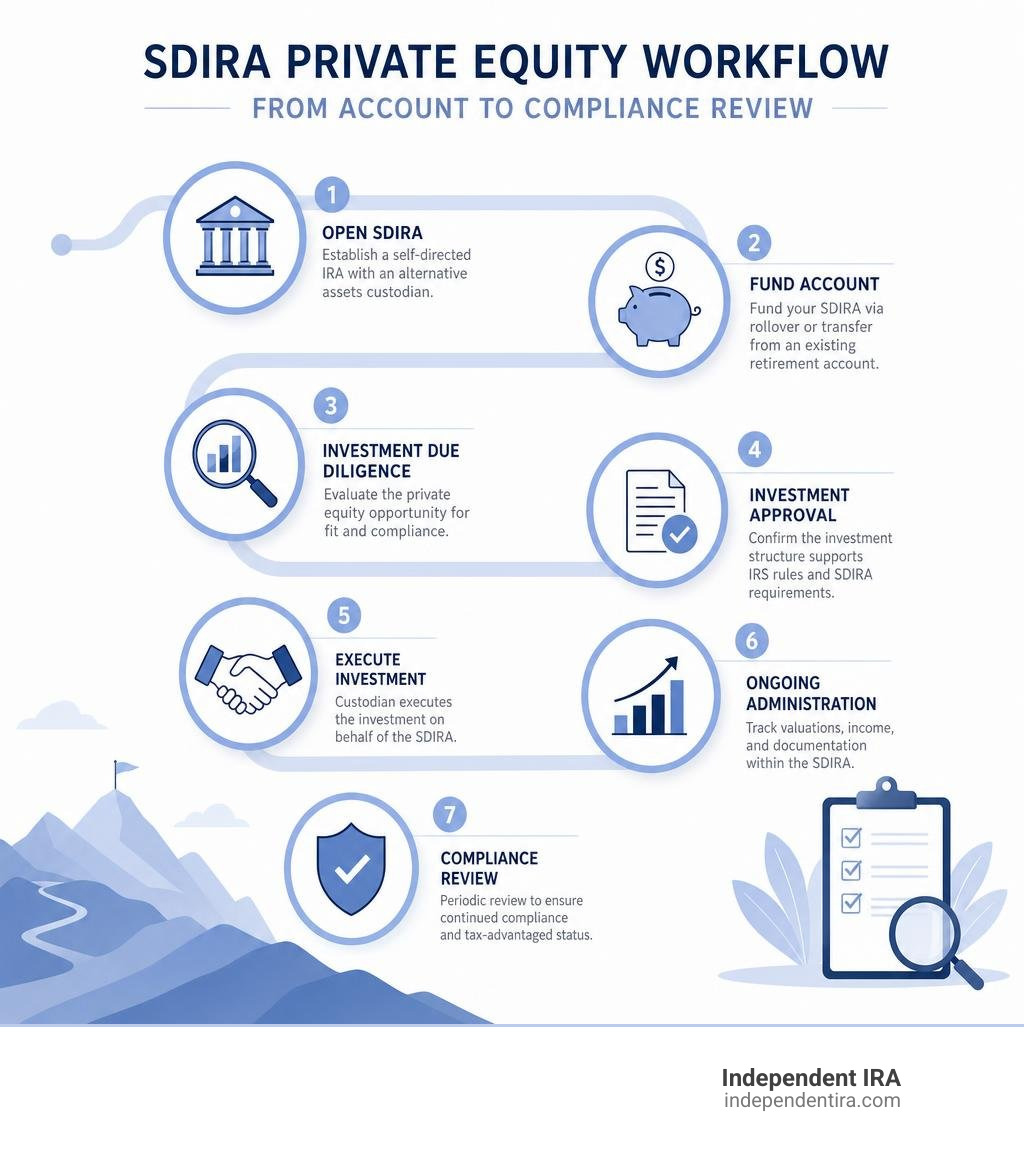
When you choose to invest in private equity with ira tax benefits, the process requires moving beyond standard Wall Street brokerages. Mainstream financial institutions typically limit retirement accounts to publicly traded stocks, bonds, and mutual funds. To hold non-publicly traded shares, angel investments, or venture capital funds, you need a Self-Directed IRA (SDIRA) administered by a qualified custodian equipped for alternative assets.
At Independent IRA, an Authorized Agent of Accuplan, we guide investors through every stage of account setup, ensuring that capital deployment adheres strictly to Internal Revenue Service (IRS) regulations. The mechanics of purchasing private equity involve opening an SDIRA, funding it via a tax-free rollover or transfer from an existing account, and directing the custodian to execute investment agreements on behalf of your IRA.
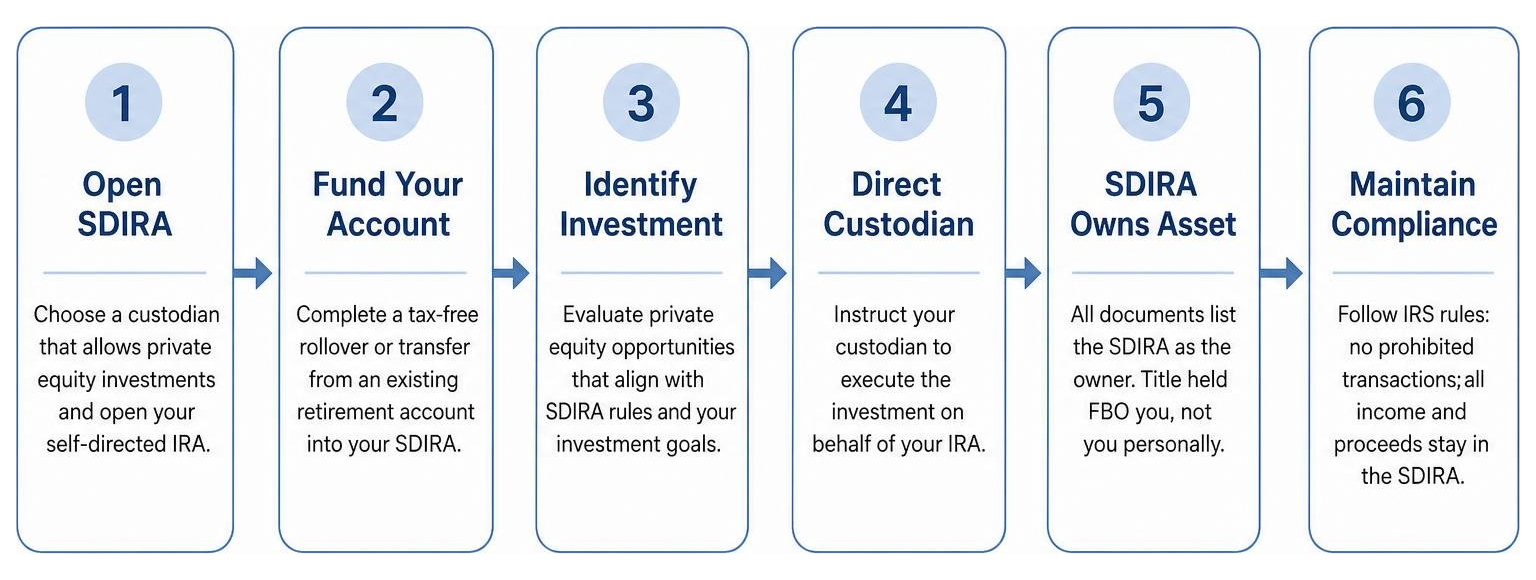
It is essential to understand that all documentation—subscription agreements, stock purchase agreements, and membership certificates—must list the SDIRA as the legal owner, not you personally. For instance, title is held as “Accuplan Benefits Services FBO [Your Name] IRA.” All purchase funds must originate directly from the IRA account, and any dividends, cash-out distributions, or proceeds upon exit must return directly to the IRA to preserve tax shelter status.
Why Investors Use Self-Directed IRAs to Invest in Private Equity With IRA Rules in Mind
Investing retirement funds in private equity offers strategic diversification benefits. Conventional assets often move in tandem with broader public market volatility. Private companies, early-stage startups, and mid-market private funds allow account holders to capture growth uncorrelated with public equities markets.
By holding these assets inside a tax-advantaged account, you may gain tax advantages on growth:
- Traditional SDIRA: Capital gains and dividends accrue tax-deferred until distributions begin in retirement.
- Roth SDIRA: Qualified distributions—including potential equity gains—are completely tax-free upon withdrawal.
Beyond tech startups and venture capital, many self-directed investors pair private equity with complementary strategies like private equity private lending san diego to balance growth equity with steady yield generation. However, achieving these benefits requires maintaining absolute alignment with IRS rules.
Choosing the Right SDIRA Structure to Invest in Private Equity With IRA Capital
When structuring your private equity investment, you generally choose between two core self-directed models:
- Direct Custodial Account: Under this classic arrangement, your self-directed custodian holds the private equity certificates or fund paperwork directly. When a funding round opens or a capital call is issued, you submit investment instructions to the custodian, who processes the paperwork and wires funds from your IRA account.
- Checkbook Control IRA LLC: For investors participating in fast-moving private placements or venture deals requiring immediate funding, a Checkbook IRA offers speed and efficiency. Under this setup, your SDIRA owns 100% of a newly formed Limited Liability Company (LLC). As the manager of this special-purpose LLC, you hold checkbook and wire authority through a dedicated bank account.
Regardless of which model you implement, the fundamental rule remains constant: the IRA is an independent legal entity. You cannot commingle personal funds with IRA funds or write personal checks to cover IRA investment commitments.
Prohibited Transactions and Disqualified Persons in Private Equity
While the IRS allows IRAs to hold almost any asset class—ranging from real estate to private corporate stock—it strictly regulates who the IRA can do business with and how transactions are executed. Under IRC Section 4975, the IRS defines specific rules to prevent self-dealing and personal enrichment at the expense of the tax-sheltered status of retirement accounts.
A prohibited transaction is any direct or indirect sale, exchange, leasing of property, lending of money, or extension of credit between an IRA and a “disqualified person.” Additionally, any act by a fiduciary where they deal with the income or assets of the IRA in their own interest or for their own account constitutes a severe violation.
Understanding these rules is non-negotiable when planning to invest in private equity with ira funds, as even unintentional non-compliance brings drastic tax consequences.
Who Qualifies as a Disqualified Person?
The statutory framework identifies specific individuals and entities as “disqualified persons” relative to your IRA. If a transaction touches any of these parties, it automatically triggers a prohibited transaction:
- The IRA Owner and Fiduciaries: You (the account owner), your designated beneficiaries, and anyone providing fiduciary oversight or investment management advice to the account.
- Direct Family Members: Your spouse, ancestors (parents, grandparents), and direct lineal descendants (children, grandchildren), as well as the spouses of your lineal descendants (daughters-in-law, sons-in-law). Note: Siblings, aunts, uncles, cousins, and step-relatives are generally not classified as disqualified persons under IRS guidelines.
- Service Providers: Account custodians, administrators, and advisors receiving compensation for managing the account.
- 50% Controlled Entities: Any corporation, partnership, LLC, trust, or estate in which disqualified persons combined hold 50% or more of the total combined voting power, capital interest, or profits interest.
- Major Partners and Key Executives: An officer, director, 10% or more shareholder, or 10% or more capital/profits partner in an entity that is 50% or more controlled by disqualified persons.
When entrepreneurs raise money for early-stage ventures, understanding these boundaries is critical; our resource on raising private capital iras highlights how fund managers can invite IRA capital without breaching rules.
Circumstances Triggering Prohibited Transactions in Startups
To illustrate how self-dealing violations can occur in venture capital and angel investing, consider these high-risk scenarios:
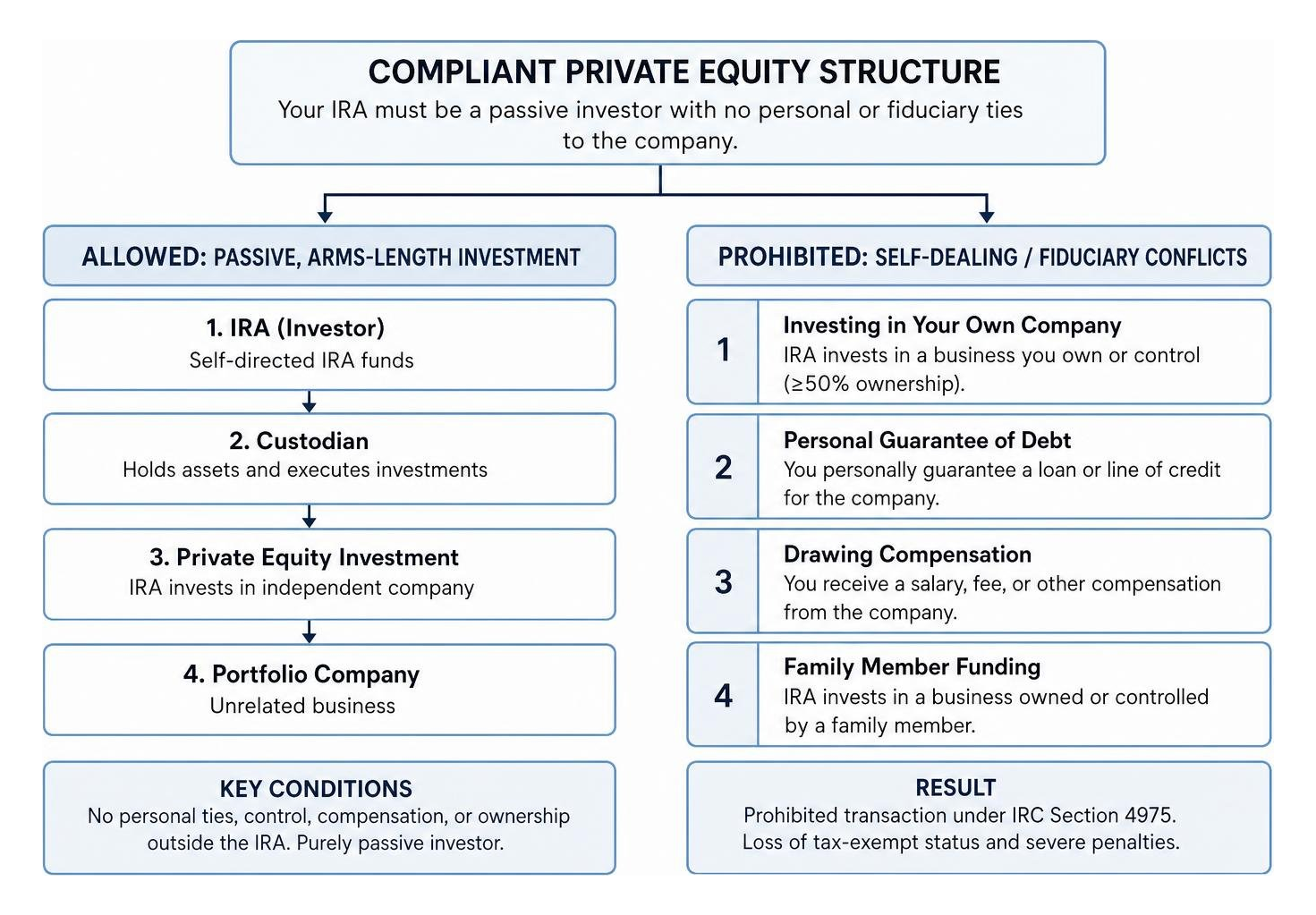
- Investing in Your Own Company: Using your SDIRA to purchase shares in a private startup that you founded or in which you currently own a 50% or greater equity stake.
- Personal Guarantee of Corporate Debt: If your IRA invests in a private business, and you personally guarantee a loan or line of credit for that business, you have extended personal credit to an IRA-backed entity, creating an illegal prohibited transaction.
- Drawing a Salary or Compensation: You cannot use IRA assets to fund a startup and subsequently draw a salary, consulting fee, or director’s compensation from that company.
- Family Member Funding: Directing your IRA to purchase equity in your daughter’s or father’s business enterprise.
Department of Labor (DOL) Advisory Opinions demonstrate that even low equity percentages can trigger fiduciary conflicts. For example, DOL guidance indicates that holding an executive officer position combined with as little as a 1.17% family equity interest in a business entity can prevent an IRA fiduciary from exercising completely neutral, uninfluenced judgment. In contrast, an employee holding less than 1% ownership without direct fiduciary or board authority over the venture is generally unlikely to face a conflict of interest.
Severe Tax Consequences of Prohibited Transactions
The tax penalties for breaching IRC Section 4975 are among the most severe in the federal tax code. If an IRA owner or beneficiary engages in a prohibited transaction at any point during a calendar year, the entire IRA loses its tax-exempt status, retroactively effective to January 1st of that tax year.
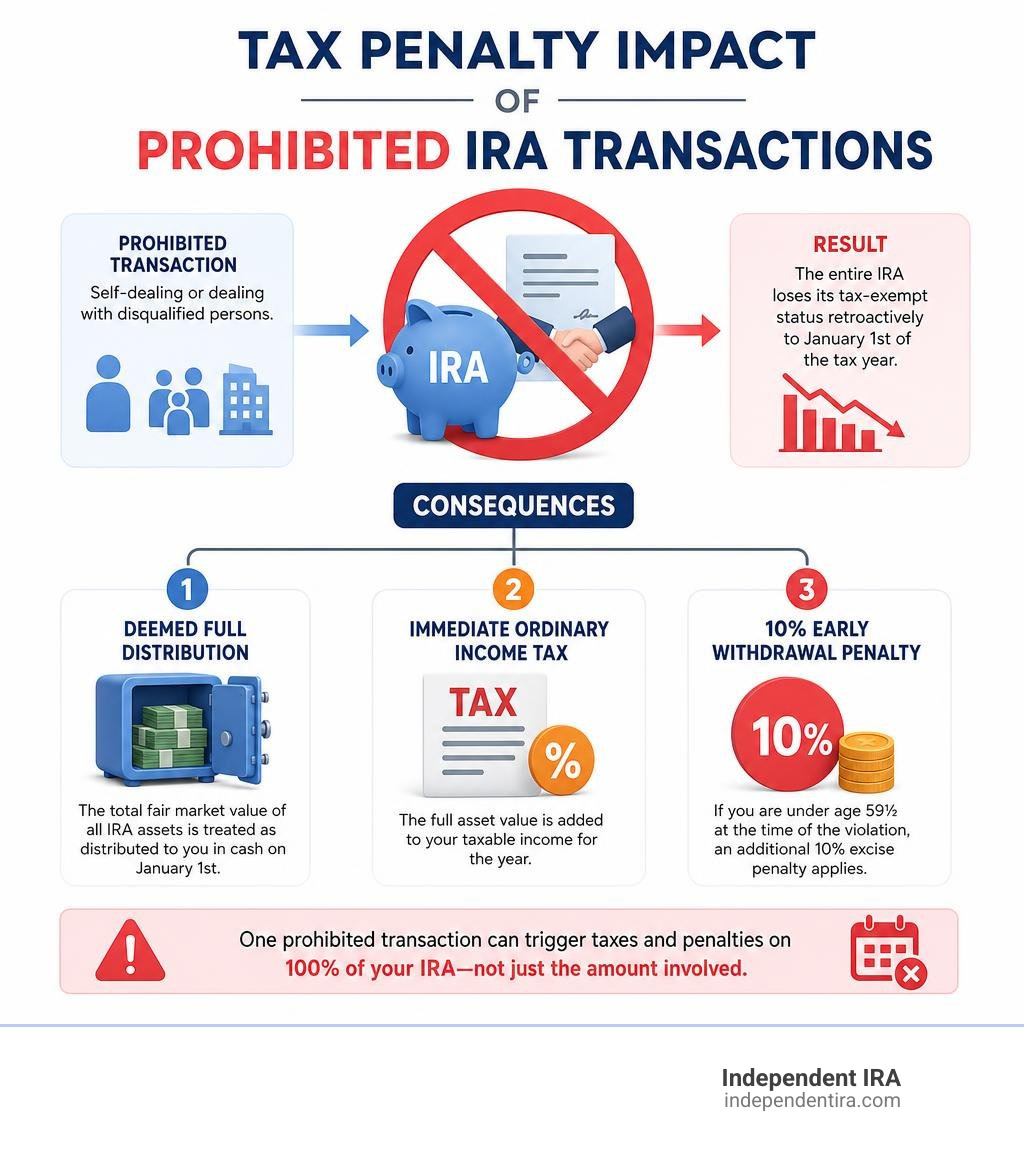
The tax consequences unfold rapidly:
- Deemed Full Distribution: The total Fair Market Value (FMV) of all assets in the IRA—not just the portion involved in the bad investment—is treated as if it were distributed to you in cash on January 1st.
- Immediate Ordinary Income Tax: The full asset value is added to your taxable income for the year, potentially pushing you into a higher income tax bracket.
- 10% Early Withdrawal Penalty: If you are under age 59½ at the time of the violation, an additional 10% excise penalty applies to the total distribution value.
- Loss of Future Growth: The account can never be restored to IRA status, ending prospective tax-free or tax-deferred growth.
Working with Independent IRA, an Authorized Agent of Accuplan, helps ensure investments undergo rigorous operational reviews before funds leave the account.
When Private Equity Investments Are Allowed vs. Prohibited Over Time
Understanding the line between compliant arm’s-length private equity investments and illegal self-dealing is essential for long-term success. A rule of thumb is that your IRA must operate as a purely passive investor in third-party enterprises where you hold no personal financial, employment, or managerial ties.
Passive Minority Stakes vs. Fiduciary Conflicts
When is an IRA private equity investment clearly allowed? It is allowed when you establish a completely passive minority position in an independent company.
Consider an angel investor acquiring a 2% equity position in an unrelated technology startup. The investor has no personal pre-existing relationship with the founders, takes no executive board seats, receives no personal advisory fees, and holds zero personal stock in the venture outside the IRA. In this scenario:
- The transaction is conducted strictly at arm’s length.
- The investor exercises fiduciary neutrality because no personal interest influences their choice to invest IRA funds.
- Neither the company nor its officers are disqualified persons.
- Voting power and share ownership are kept well below statutory thresholds (such as the 46.04% voting power combined with 48.14% equity stakes highlighted in landmark DOL advisory opinions as clearly breaching fiduciary limits).
In short, passive non-controlling investments in independent private ventures are fully compliant.
Ongoing Factors That Can Turn Allowed Investments Prohibited
A private equity deal that starts as fully compliant can evolve over time into a prohibited transaction if corporate dynamics shift. Account holders must monitor their portfolio companies throughout the life of the investment.
Key operational triggers that can compromise compliance include:
- Accepting an Executive Role: If you passively purchase private stock through your IRA and two years later accept an operational job as Chief Operating Officer (COO) or Chief Executive Officer (CEO) of that enterprise, your new position creates an ongoing conflict of interest.
- Dilution and Ownership Shifts: If co-investors exit or stock repurchases occur such that disqualified family members collectively come to control 50% or more of the corporate equity or voting stock, the entity becomes a disqualified person overnight.
- Capital Calls and Follow-On Rounds: If a startup requires a follow-on funding round and your IRA lacks sufficient cash to participate, you cannot write a personal check to satisfy the IRA’s pro-rata equity right. Commingling personal capital with your IRA’s pre-existing investment position violates IRS rules.
- Providing Personal Guarantees or Property: Allowing the company to utilize personal property (e.g., storing company equipment in your private facility free of charge or at non-market rates) creates an illegal indirect benefit between you and the IRA’s asset.
Regular monitoring ensures that changes in governance, capital structure, or management roles do not endanger your account.
Practical Considerations: S-Corps, UBIT, and Custodian Requirements
Beyond prohibited transactions, investors seeking to invest in private equity with ira capital must evaluate structural tax implications and administrative hurdles. Private equity entities are structured differently, and choosing the wrong entity type can generate unexpected tax bills or void corporate tax statuses.
| Entity Structure | SDIRA Investment Permitted? | Tax / Rule Implication | Key Considerations |
|---|---|---|---|
| S-Corporation | NO | Statutory Ban (IRC 1361) | An IRA holding S-Corp stock invalidates the company’s S-Election for all shareholders. |
| C-Corporation | YES | Corporate Level Tax Only | Dividends and capital gains flow back to SDIRA 100% tax-free / tax-deferred. No UBIT. |
| LLC / Partnership (Active Business) | YES | Subject to UBIT (IRC 512) | Active trade/business income over $1,000 generates Unrelated Business Income Tax paid by the IRA. |
| LLC / Fund (Passive Yield / Interest) | YES | Exempt from UBIT | Dividends, interest, royalties, and real property rents are generally exempt from UBIT. |
S-Corporation Restrictions and LLC UBIT Implications
One of the most frequent traps in private equity IRA investing involves S-Corporations. Under federal tax law (IRC Section 1361), an IRA (including both Traditional and Roth SDIRAs) is not an eligible shareholder of an S-Corporation. If an IRA attempts to acquire shares in an S-Corp, the IRS immediately terminates the corporation’s S-Corp election, converting the company into a standard C-Corporation. This results in severe tax headaches for all other corporate shareholders.
If the target startup operates as an S-Corp, it must convert to a C-Corporation or LLC structure before your SDIRA can participate.
Conversely, investing IRA funds in pass-through entities such as LLCs or partnerships is permissible, but it brings the potential for Unrelated Business Income Tax (UBIT).
IRAs were created to earn passive investment returns (such as stock dividends, capital gains, interest, and rental income) free from immediate taxation. However, if an IRA invests in a pass-through LLC that operates an active trade or business (such as a restaurant group, manufacturing business, or retail venture), the IRS views the IRA as actively engaging in trade or business activities.
- Threshold: If your IRA’s share of net active operating income from pass-through investments exceeds $1,000 in a tax year, the IRA must pay UBIT on the excess.
- Tax Rates: UBIT is calculated using trust tax brackets, which hit the top federal tax rate quickly (often at income thresholds under $16,000).
- Filing Obligation: The IRA must file Form 990-T (Exempt Organization Business Income Tax Return) under its own Employer Identification Number (EIN), and the tax bill must be paid directly using cash from the IRA account.
Passive private equity capital gains (e.g., selling your membership interest upon an enterprise exit) are typically exempt from UBIT, provided the LLC did not use debt financing to buy its assets.
Fair Market Valuation and Custodian Reporting
Because private equity stock is non-publicly traded, establishing its valuation requires ongoing compliance steps. IRS guidelines mandate that self-directed IRA custodians report the Fair Market Value (FMV) of every account asset annually on Form 5498.

This introduces key operational requirements for your target private equity venture:
- Annual FMV Submission: Every year (typically between January and April), the startup or private fund manager must provide an updated valuation statement confirming the current price per share or unit value.
- Qualified Appraisals: SDIRA custodians will not accept arbitrary figures or unverified estimates. Valuations must be supported by official documentation—such as recent priced funding rounds (409A valuations), audited financial statements, or formal appraisal reports signed by an independent qualified appraiser.
- Cost of Valuation: The IRA owner or target business must absorb the administrative cost of providing annual valuation updates.
Before investing, confirm that the startup’s executive team is willing and prepared to fulfill these annual reporting requirements for your custodian.
Frequently Asked Questions About IRA Private Equity Investing
Can my IRA invest in a company owned by a family member?
Generally, no. If a disqualified family member—such as your spouse, parents, children, or their spouses—owns 50% or more of the target company, the business entity itself becomes a disqualified person. Investing IRA funds in that business constitutes a prohibited transaction under IRC 4975. Even if direct family members own less than 50%, if their position coupled with your personal role allows you to derive personal financial benefits or exert fiduciary control, the IRS can deem the investment an illegal self-dealing arrangement.
What happens if my private equity investment generates UBIT?
If your private equity asset generates more than $1,000 in gross Unrelated Business Taxable Income (UBTI) through pass-through operating revenue, your IRA must file IRS Form 990-T. The custodian signs and submits the return on behalf of your IRA, and the tax liability is paid directly out of your SDIRA cash balance. Tax payments cannot be paid with personal funds, as doing so would trigger an illegal contribution or commingling violation.
Can an IRA invest directly in an S-Corporation?
No. Federal tax statutes strictly prohibit IRAs from holding stock in an S-Corporation. If an SDIRA acquires S-Corp shares, the company’s S-election is immediately invalidated, converting it to a C-Corporation for tax purposes. To accept IRA investment capital, the business must operate as a C-Corporation, LLC, or Limited Partnership.
How are annual valuations handled for private startup equity?
Self-directed IRA custodians require annual Fair Market Value updates for non-publicly traded stock to fulfill IRS reporting obligations on Form 5498. The startup or fund management must provide supporting documentation—such as a recent 409A valuation, a third-party independent appraisal, or financial statements reflecting the latest funding round—to verify the current value of the IRA’s equity holdings.
Before You Invest Your Retirement Funds in Private Equity
Using retirement capital to back private companies is a viable strategy for long-term wealth building, but it requires strict compliance. From vetting disqualified persons and managing executive roles to avoiding S-Corp pitfalls and planning for annual valuations, success hinges on meticulous operational execution.
At Independent IRA, an Authorized Agent of Accuplan, we provide account setup support, step-by-step guidance, and administration assistance to help you navigate alternative asset transactions smoothly. Whether you are building an angel investment portfolio or setting up a Checkbook IRA for rapid deal execution, our team helps ensure your account remains fully compliant with IRS standards.
Ready to explore how private equity fits into your retirement strategy? Contact our expert team at Independent IRA today to establish your account and take full control of your investment future.
This content is for informational and educational purposes only and does not constitute legal, tax, or investment advice. Rules, limits, and requirements may change. Consult a qualified tax advisor, attorney, or financial professional before making retirement planning or investment decisions. Independent IRA is an Authorized Agent of Accuplan Benefits Services and is not a custodian or trust company.