

 GIVE US A CALL
Understanding IRS rules for digital assets is no longer optional — it’s a core part of managing any portfolio that includes cryptocurrency, NFTs, or stablecoins. Whether you’re holding Bitcoin inside a self-directed IRA or trading Ethereum in a taxable brokerage account, the IRS has clear expectations about how those transactions are reported and taxed.
Here is a quick summary of the key IRS rules for digital assets:
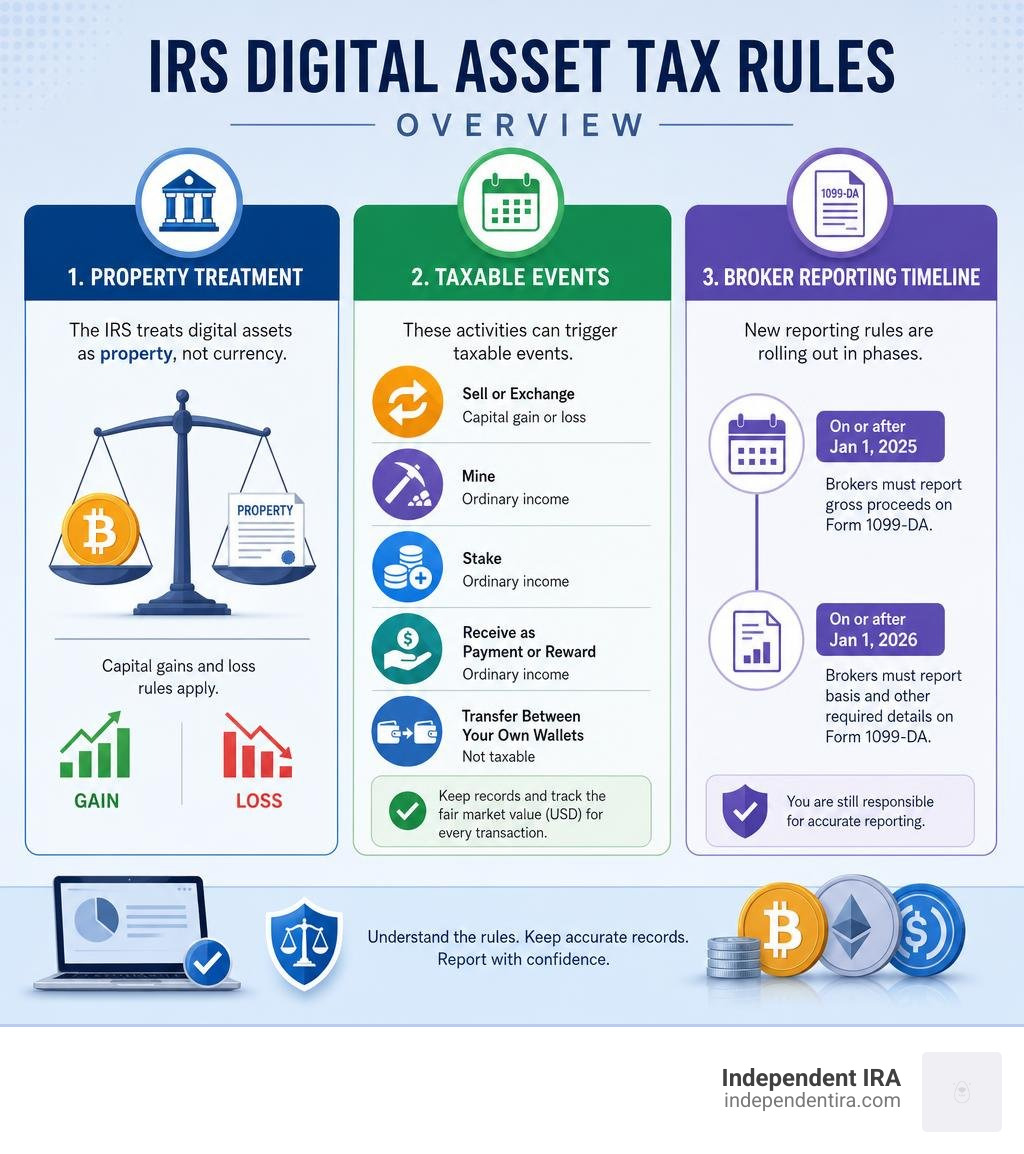
- Digital assets are property, not currency. The IRS treats cryptocurrency and other digital assets as property under general tax principles, meaning capital gains and loss rules apply.
- Every tax return asks about digital assets. Forms 1040, 1041, 1065, 1120, and 1120-S all include a mandatory yes/no question about digital asset activity.
- Selling, swapping, mining, and staking are all taxable events. Receiving digital assets as payment or rewards triggers ordinary income; selling or exchanging them triggers capital gains.
- Transfers between your own wallets are not taxable. Moving assets between wallets you own does not create a reportable gain or loss.
- New broker reporting rules are rolling out now. Starting with transactions on or after January 1, 2025, brokers must report gross proceeds on Form 1099-DA. Basis reporting follows for transactions on or after January 1, 2026.
- Records are your responsibility. You must track the fair market value in U.S. dollars at the time of every acquisition and disposition.
For real estate investors in their 50s who are exploring self-directed IRAs as a way to hold crypto with potential tax advantages, these rules carry serious weight. A misstep — like failing to report a staking reward or miscalculating basis on a coin exchange — can lead to interest, penalties, and unwanted IRS attention. This guide walks through every major rule, from how to answer the digital asset question on your return to how the new Form 1099-DA broker reporting requirements affect you.
How the IRS Rules Digital Assets and Property Transactions Work
To stay on the right side of the tax collector, we must first understand how the IRS views these modern, decentralized assets. The fundamental rule is simple but has massive implications: the IRS does not view cryptocurrency as actual currency. Instead, Uncle Sam treats digital assets as property.
Because digital assets are classified as property, general tax principles that apply to real estate, stocks, or physical goods also apply to your digital tokens. When you buy, sell, or exchange these assets, you are engaging in a property transaction. This means every single swap can trigger a taxable event, requiring you to calculate capital gains or losses.

This property classification applies directly to what the IRS calls “convertible virtual currency.” This is digital currency that has an equivalent value in real fiat currency (like the U.S. dollar) or acts as a substitute for real currency. The foundational framework for this treatment was first established in IRS Notice 2014-21, which made it clear that virtual currencies are property and that taxpayers must calculate their gains or losses in U.S. dollars for every transaction.
For more details on how the government defines these transactions, you can explore the official IRS Digital Assets Guidance.
Defining Cryptocurrency Under IRS Rules Digital Assets Guidelines
What exactly counts as a digital asset under the tax code? The definition is incredibly broad. The IRS defines a digital asset as any digital representation of value that is recorded on a cryptographically secured, distributed ledger or any similar technology.
This definition covers a wide umbrella of assets, including:
- Cryptocurrency: Native blockchain tokens like Bitcoin (BTC) and Ether (ETH) used as decentralized mediums of exchange.
- Stablecoins: Digital assets pegged to a fiat currency, such as the U.S. dollar, designed to maintain a stable value. Yes, even swapping one stablecoin for another is technically a property exchange that must be reported!
- Non-Fungible Tokens (NFTs): Unique digital identifiers that represent ownership of digital or physical items (such as digital art or virtual real estate).
The underlying engine for all of these is distributed ledger technology (such as blockchain). Because every transaction is permanently etched into a public ledger, the IRS has a highly visible audit trail. To help taxpayers navigate this complex landscape, the agency maintains a comprehensive list of IRS Digital Asset FAQs addressing common scenarios.
Taxable vs. Non-Taxable Crypto Transactions
Not every crypto movement triggers a tax bill, but many do. It is vital to distinguish between what will cause a taxable event and what is simply a quiet day in your digital wallet.
Taxable Events (Triggering Income or Capital Gains):
- Mining and Staking: If you run a mining rig or stake your tokens to secure a network, the new coins you receive are treated as ordinary income. You must report their fair market value in U.S. dollars at the exact time you receive custody of them.
- Airdrops and Hard Forks: If a blockchain splits (a hard fork) and you receive new tokens through an airdrop, this is considered an “accession to wealth.” You must recognize ordinary income equal to the fair market value of the new tokens when they are recorded on the ledger and you have dominion and control over them.
- Exchanging Crypto for Crypto: Swapping Bitcoin for Ethereum is treated as a sale of Bitcoin followed by a purchase of Ethereum. You must calculate the capital gain or loss on the Bitcoin you parted with.
- Paying for Goods or Services: If you buy a cup of coffee or pay a contractor using cryptocurrency, you are disposing of property. You must recognize a capital gain or loss based on the difference between your original cost basis in the crypto and its fair market value at the time of the purchase.
Non-Taxable Events:
- Wallet-to-Wallet Transfers: Moving your own cryptocurrency from your exchange account to your private hardware wallet is not a taxable event. You still own the same property; you’ve just moved it to a different shelf.
- Buying Crypto with Fiat: Purchasing Bitcoin with U.S. dollars is not taxable. It simply establishes your initial cost basis.
- Protocol Upgrades: Under Chief Counsel Advice 202316008, soft forks or protocol upgrades that merely change the consensus mechanism of a blockchain (such as Ethereum’s historical transition from proof-of-work to proof-of-stake) do not trigger taxable events for holders. Because the upgrade does not result in a material difference in your underlying holdings or provide you with new tokens, there is no realization of gain or loss and no accession to wealth.

How to Answer the Digital Asset Question on Your Tax Return
If you have looked at a federal tax return recently, you have likely noticed the prominent question sitting right near the top. The IRS has placed a binary yes/no question on almost every major income tax form. This includes Form 1040 (for individuals), Form 1041 (for estates and trusts), Form 1065 (for partnerships), Form 1120 (for C-corporations), and Form 1120-S (for S-corporations).
The question generally asks: “At any time during the year, did you: (a) receive (as a reward, award, or payment for property or services); or (b) sell, exchange, or otherwise dispose of a digital asset (or a financial interest in a digital asset)?”
You must answer this question under penalty of perjury. Checking the wrong box can be flagged as a red flag for an audit.
To help you determine how to answer, we have put together this straightforward comparison table:
| Scenario | Answer | Why? |
|---|---|---|
| You only bought digital assets with U.S. dollars and held them. | No | Simply purchasing and holding does not constitute a taxable disposition or receipt of income. |
| You transferred crypto between your own private wallets or exchange accounts. | No | Wallet-to-wallet transfers are non-taxable and do not change your financial interest. |
| You received digital assets as payment for services or sold some for cash. | Yes | This is a taxable receipt of income or a capital gains transaction. |
| You traded one type of cryptocurrency for another. | Yes | An exchange of one digital asset for another is a taxable property disposition. |
| You received new tokens from mining, staking, or a hard fork airdrop. | Yes | These are taxable events that generate ordinary income. |
| You received digital assets as a gift or gave them as a gift. | Yes | Gifting is a disposition that must be reported, even if no capital gains tax is immediately due. |
| You received digital asset rewards from a loyalty or credit card program. | Yes | Receiving digital assets as a reward or award triggers a “Yes” answer, even if the dollar amount is small. |
Having a “financial interest” in a digital asset means you are the beneficial owner of the asset, you hold the private keys, or you have a joint interest in an account that holds digital assets. If you are unsure about your specific transaction, it is always best to keep detailed records and consult with a professional.
Calculating Capital Gains, Losses, and Cost Basis for Crypto
When you engage in taxable digital asset transactions, you must report them on Form 8949 (Sales and Other Dispositions of Capital Assets) and carry the totals over to Schedule D of your Form 1040.
Because digital assets are capital assets, your tax liability is determined by your capital gain or loss. The formula is simple:
$$text{Capital Gain/Loss} = text{Amount Realized} – text{Adjusted Cost Basis}$$
- Amount Realized: This is the fair market value in U.S. dollars of what you received in the transaction (cash, services, or other property), minus any transaction costs.
- Adjusted Cost Basis: This is your original investment in the asset (the purchase price in USD), plus any transaction costs associated with acquiring it.
Transaction costs, such as “gas” fees, validator fees, and exchange commissions, play a key role here. Under the 26 CFR § 1.1001-7 Regulations, transaction costs must be properly allocated. When you buy an asset, the transaction fee is added to your cost basis. When you sell or dispose of an asset, the transaction fee reduces your amount realized.
Furthermore, if you pay your transaction fees using cryptocurrency itself, the IRS treats that payment as a separate taxable disposition of that cryptocurrency. You must calculate the gain or loss on the small fraction of a coin used to pay the fee!
Determining Cost Basis Under IRS Rules Digital Assets Framework
To calculate your gains accurately, you must first establish your cost basis. The method of acquisition determines how your basis is set:
- Purchase Basis: If you bought the asset, your basis is the amount you paid in U.S. dollars plus any acquisition fees.
- Gift Basis: If you received the digital asset as a gift, your basis depends on whether you sell it for a gain or a loss. Generally, your basis is the donor’s original cost basis (known as a “carryover basis”), plus any gift tax paid. If the fair market value at the time of the gift was lower than the donor’s basis, and you sell the asset at a loss, your basis is the fair market value at the time of the gift.
- Charitable Contributions: If you donate digital assets to a qualified charity, you can generally deduct the fair market value of the assets if you held them for more than one year. You do not have to recognize the capital gain. However, be aware that for donations valued over $5,000, the IRS requires you to obtain a qualified appraisal.
- Basis Reallocation: To clean up historical accounting, Revenue Procedure 2024-28 provided a safe harbor allowing taxpayers to allocate units of unused basis to remaining digital asset units in their wallets or accounts as of January 1, 2025. This was designed to help investors transition smoothly into the strict new broker reporting era.
If you want to understand how these rules apply inside a tax-sheltered environment, take a look at our Beginners Guide to Cryptocurrency Self Directed IRA.
Specific Identification vs. FIFO Methods
When you sell a portion of your cryptocurrency holdings, how do you know which specific coins you are selling? This choice has a huge impact on your tax bill.
The IRS default method is FIFO (First-In, First-Out). Under FIFO, the oldest coins you acquired are assumed to be the first ones sold.
However, the IRS allows you to use the Specific Identification method if you can specifically identify which units are being sold. This is highly beneficial because it allows you to choose high-basis coins to minimize your current-year tax liability.
To use Specific Identification (especially when dealing with unhosted wallets), you must have records that document:
- The exact date and time each unit was acquired.
- Your cost basis and the fair market value of each unit at the time of acquisition.
- The exact date and time each unit was sold, exchanged, or disposed of.
- The fair market value of each unit at the time of disposition, and the amount realized.
If you cannot provide this level of detail, you must fall back on FIFO. You can review these strict recordkeeping requirements in the IRS Virtual Currency FAQs.
The New Broker Reporting Rules: Form 1099-DA and Compliance Timelines
The landscape of digital asset taxation shifted dramatically with the passage of the Infrastructure Investment and Jobs Act. This legislation expanded the definition of a “broker” under Section 6045 of the tax code, bringing digital asset exchanges, hosted wallet providers, and certain other platforms under the same reporting umbrella as traditional stock brokerages.
These rules also impact real estate transactions. Real estate professionals treated as brokers must report the fair market value of digital assets paid by buyers and received by sellers in real estate transactions with closing dates on or after January 1, 2026.
To read the highly detailed regulatory framework, you can access the Federal Register Broker Regulations.
Form 1099-DA and the Phase-In Timeline
To ease the industry into these strict requirements, the IRS designed a phased rollout for the new information return: Form 1099-DA.
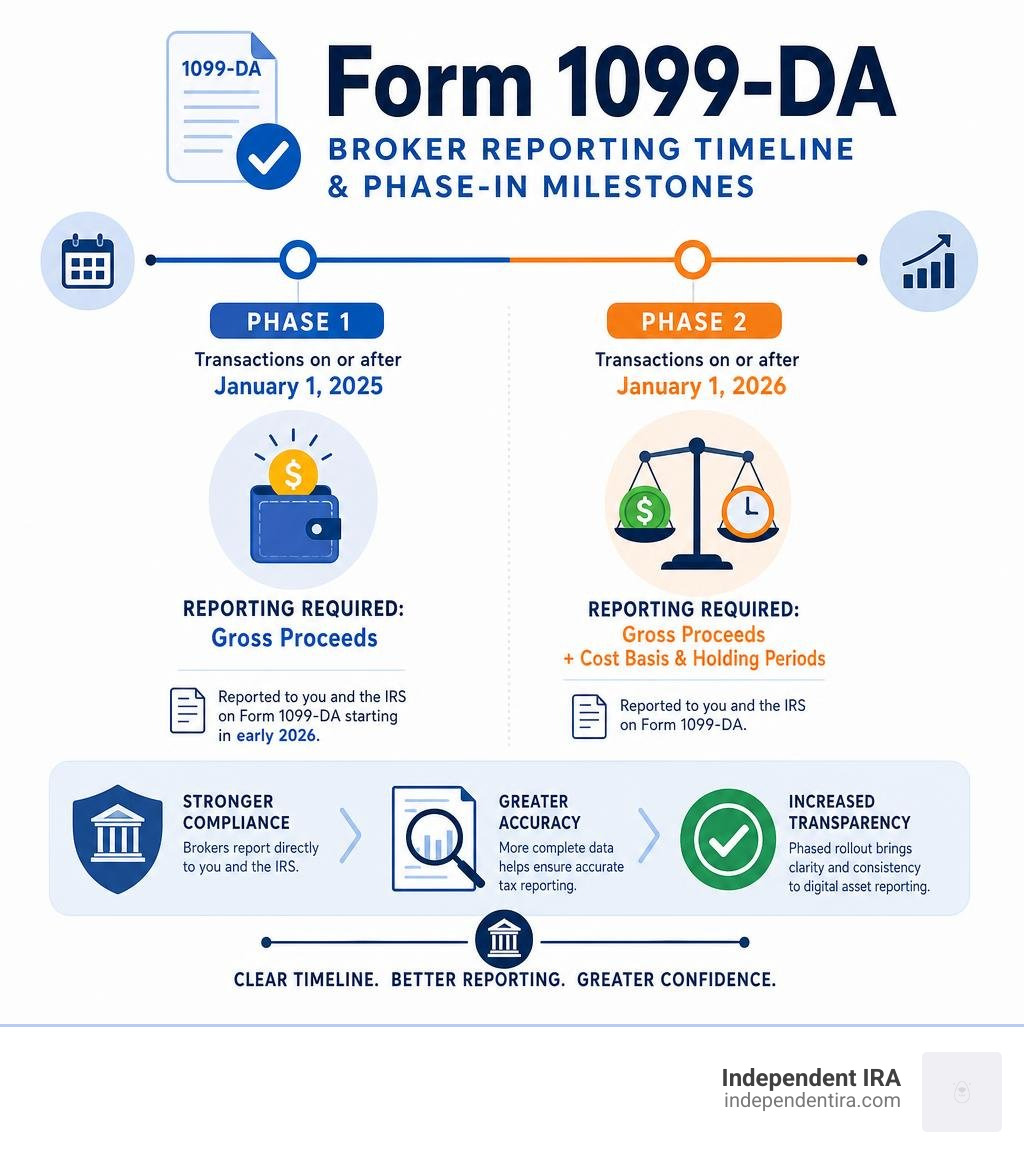
The rollout timeline is structured as follows:
- Phase 1 (Transactions on or after January 1, 2025): Brokers must track and report the gross proceeds of all digital asset sales and exchanges. This information is reported to both you and the IRS on Form 1099-DA starting in early 2026.
- Phase 2 (Transactions on or after January 1, 2026): Brokers must begin tracking and reporting your cost basis and holding periods for certain transactions, in addition to gross proceeds. This makes it much easier for the IRS to verify your capital gains calculations.
This means that for the current tax year, exchanges are actively tracking your transactions to report them to the government. The days of self-reporting with no third-party verification are officially over.
Penalty Relief and Good Faith Exceptions for Brokers
Because building the infrastructure to track and report these complex on-chain transactions is incredibly difficult, the IRS has offered some temporary breathing room.
For transactions occurring in calendar year 2025 (which are reported in 2026), the IRS will not impose penalties on brokers for failing to file or furnish Form 1099-DA, provided the broker makes a good faith effort to comply. This transition period is designed to help platforms iron out technical glitches without facing devastating financial penalties.
Additionally, transitional relief has been provided regarding backup withholding requirements, ensuring that taxpayers are not unfairly penalized while exchanges update their systems.
Before You Move Retirement Funds
If you are looking at your tax bill and feeling a bit of crypto-fatigue, you are not alone. Many investors in San Diego and across the country are turning to Self-Directed IRAs (SDIRAs) to hold cryptocurrency and other alternative assets.
By using a Self-Directed IRA, you may access potential tax advantages:
- Potential Tax-Deferred Growth (Traditional IRA): You generally do not pay immediate taxes on your trades, gains, or staking rewards inside the account. Taxes are typically deferred until you take distributions in retirement.
- Potential Tax-Free Growth (Roth IRA): You fund the account with post-tax dollars, and qualified retirement withdrawals may be entirely tax-free.
However, self-directing requires strict adherence to IRS rules. A critical trap to avoid is a prohibited transaction. Under IRC Section 4975, you cannot engage in self-dealing.
This means you cannot transfer cryptocurrency that you already personally own into your IRA. Doing so is a prohibited transaction that can disqualify your entire IRA, potentially triggering taxes and penalties. All assets in your Crypto IRA must be purchased directly by the IRA custody account using cash rolled over or contributed to the account.
At Independent IRA, we are an Authorized Agent of Accuplan Benefits Services, assisting clients with the setup of self-directed IRA and 401(k) accounts, entity creation for checkbook IRAs, and self-trusteed solo 401(k) plans. We help facilitate real estate IRAs and crypto IRAs, offering you greater investor control over your retirement planning.
If you want to explore how to set up a retirement structure for IRS-permitted assets like cryptocurrency or real estate, our experienced team — including process experts like Brian Davis — is here to assist you step-by-step.
To learn more about our dedicated crypto and alternative asset solutions, check out our Bitcoin IRA Services. When you are ready to take control of your financial future, Contact Independent IRA to schedule a consultation with our San Diego team.
Frequently Asked Questions about IRS Rules for Digital Assets
What is a digital asset according to the IRS?
The IRS defines a digital asset as any digital representation of value that is recorded on a cryptographically secured distributed ledger or any similar technology. This broad definition includes popular cryptocurrencies like Bitcoin and Ethereum, stablecoins, and non-fungible tokens (NFTs). For federal tax purposes, these assets are treated as property rather than fiat currency.
When do I have to check “Yes” to the digital asset question on my tax return?
You must check “Yes” if you engaged in any active transactions involving digital assets during the tax year. This includes receiving digital assets as payment for goods or services, receiving new assets through mining, staking, or hard forks, selling digital assets for fiat currency, exchanging one digital asset for another, or gifting digital assets. You can check “No” if you merely held digital assets in a wallet or transferred them between wallets that you own.
Are transfers between my own crypto wallets taxable?
No. Transferring digital assets from one wallet, address, or account belonging to you to another wallet, address, or account that also belongs to you is a non-taxable event. However, if any digital assets are used to pay transaction or “gas” fees during the transfer, that specific fee payment is treated as a taxable disposition of property and must be reported.
Can I buy physical real estate with the cryptocurrency held in my Self-Directed IRA?
Yes, but you must follow strict IRS guidelines. Your Self-Directed IRA can sell its cryptocurrency holdings for cash within the tax-sheltered account and use that cash to purchase investment real estate. Because the transaction occurs entirely within the IRA, you will not trigger a personal capital gains tax event. However, the title of the real estate must be held in the name of the IRA (or your IRA-owned LLC), and all income and expenses must flow directly through the IRA account. You cannot personally live in or use the property.
This content is for informational and educational purposes only and does not constitute legal, tax, or investment advice. Rules, limits, and requirements may change. Consult a qualified tax advisor, attorney, or financial professional before making retirement planning or investment decisions. Independent IRA is an Authorized Agent of Accuplan Benefits Services and is not a custodian or trust company.