

 GIVE US A CALL
Understanding the personal use IRA property rules is essential for any investor looking to hold real estate within a self-directed retirement account. These regulations mandate that you, your family, and other disqualified persons cannot personally use, occupy, or perform work on any property owned by the IRA. Failing to follow these guidelines can result in the immediate disqualification of your account and significant tax penalties. To navigate these complexities safely, many investors choose to partner with Independent IRA for expert guidance and custodial support.
Why Personal Use IRA Property Rules Can Make or Break Your Retirement Strategy
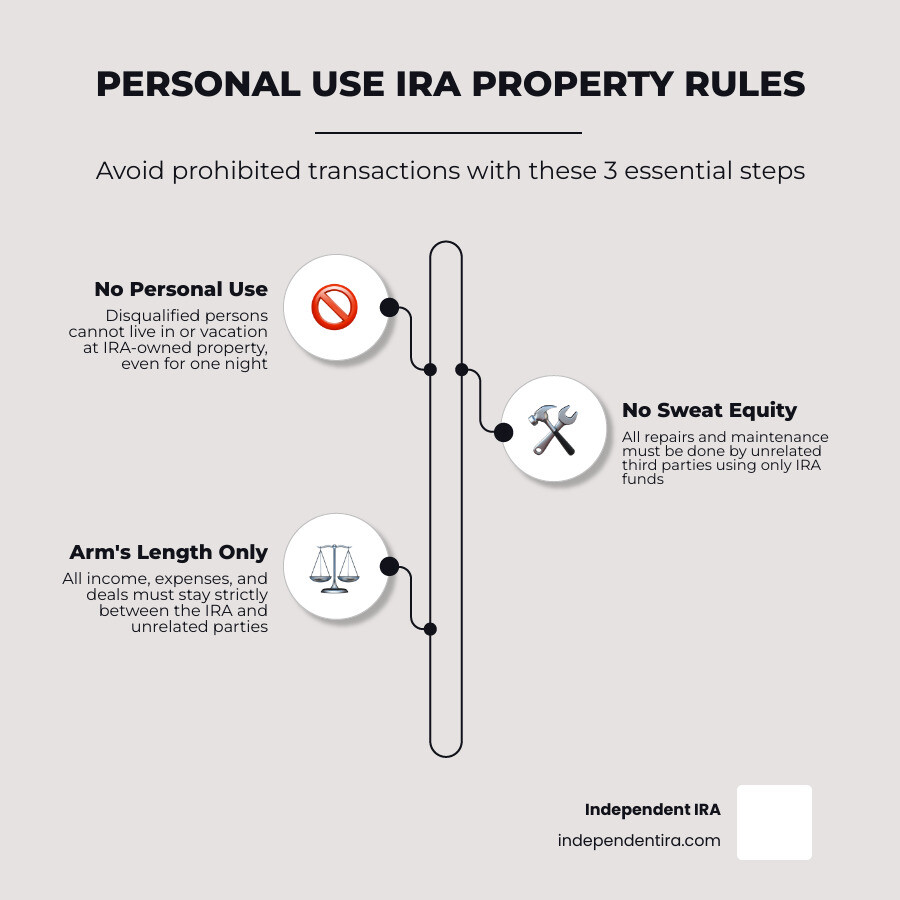
The core rule is simple: you cannot personally use, occupy, or benefit from any property your IRA owns. Here is what that means in practice:
- No personal use allowed – You, your spouse, parents, children, or grandchildren cannot live in, vacation at, or stay overnight in IRA-owned property, even temporarily
- No sweat equity – You cannot perform repairs, maintenance, or any services on the property yourself
- All income stays in the IRA – Rent payments and sale proceeds must flow directly back into the IRA account
- All expenses come from the IRA – Property taxes, repairs, and management fees must be paid using IRA funds only
- Transactions must be arm’s length – Any deal involving the property must be with unrelated third parties at fair market value
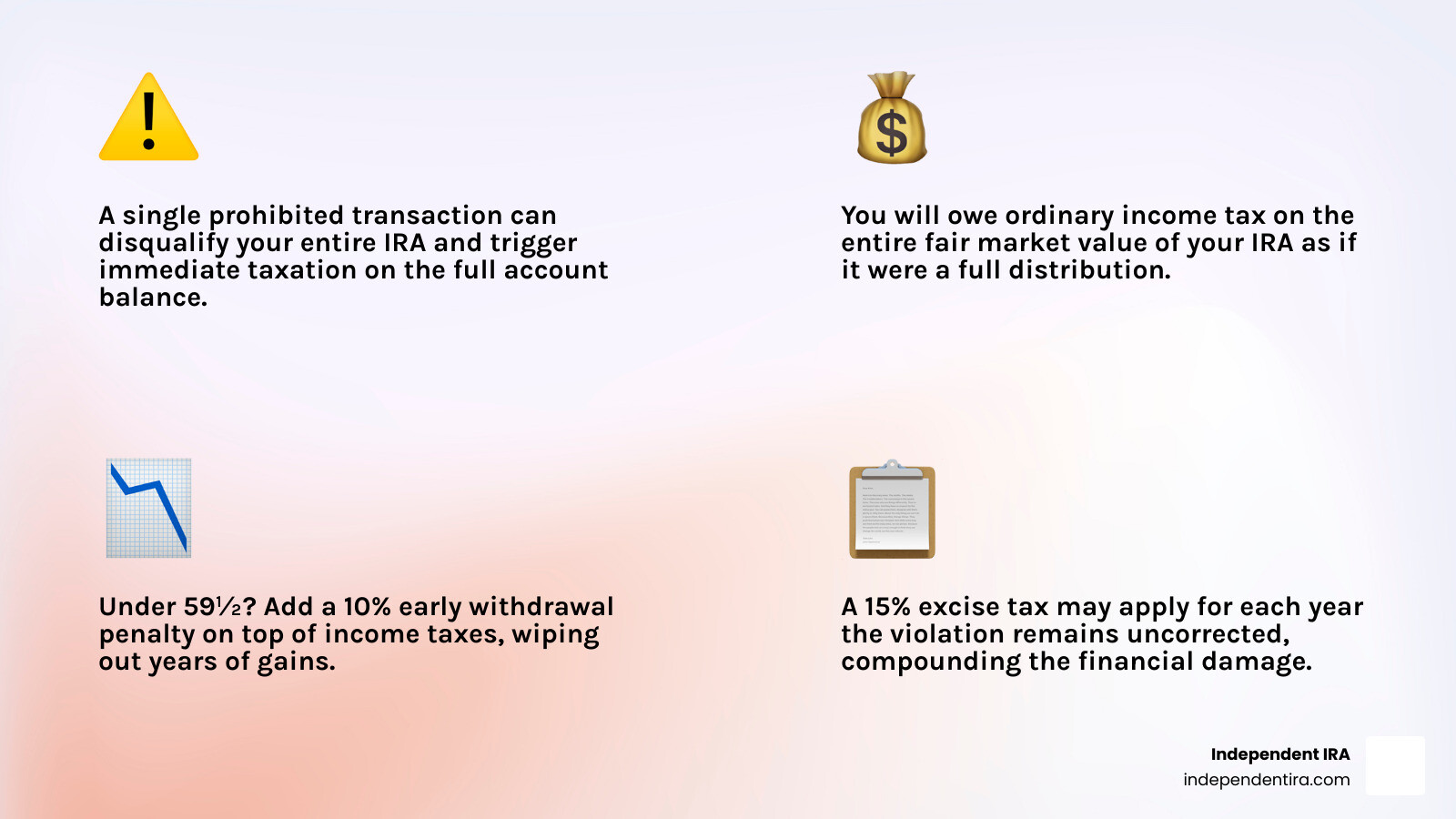
Violating any of these rules – even once, even unintentionally – can cause the IRS to disqualify your entire IRA. That means the full account balance gets treated as a taxable distribution in the year the violation occurred. For anyone under 59.5, that also triggers a 10% early withdrawal penalty on top of ordinary income taxes.
The rules come from Section 4975 of the Internal Revenue Code, which defines prohibited transactions and who counts as a “disqualified person.” What catches most investors off guard is that there is no de minimis exception. A single overnight stay in your IRA-owned rental property carries the same legal weight as moving in full-time. The IRS does not grade prohibited transactions on a curve.
If you are a real estate investor looking to move retirement funds into property, knowing these boundaries upfront is what separates a powerful tax-advantaged strategy from a costly mistake.
Understanding the Core Personal Use IRA Property Rules
When we talk about the IRS and real estate, it often feels like navigating a maze where the walls are made of tax code and the floor is lava. At Independent IRA, we want to make sure you stay on solid ground. The foundation of these regulations is IRS Section 4975, which outlines exactly what you can and cannot do with your retirement assets. You can review the statute directly in the Internal Revenue Code Section 4975.
The IRS views your Self-Directed IRA (SDIRA) as a completely separate legal entity from you as an individual. When your IRA buys a house, you aren’t buying a house – your IRA is. This means the property must be held with a strict investment intent. If you’ve ever asked yourself, “Is my IRA ready to become a landlord?” the answer depends entirely on your willingness to keep an arm’s length distance from the asset.
One of the most dangerous misconceptions is the idea of a “de minimis” exception. In many areas of law, minor infractions are overlooked. Not here. If you own a beach house in your IRA and decide to stay there for “just one afternoon” to check the light fixtures, you have technically committed a prohibited transaction. The IRS doesn’t care if you didn’t sleep there; the mere act of personal use by a disqualified person can trigger a total account distribution.
To remain compliant, every interaction with the property must be at fair market value and conducted with unrelated third parties. This ensures that the IRA – and only the IRA – receives the tax-advantaged benefits of the investment.

Identifying Disqualified Persons in Your Network
The IRS doesn’t just look at what you are doing; they look at who you are doing it with. A “disqualified person” is someone who is legally prohibited from transacting with your IRA or benefiting from its assets. Think of it as a “no-fly zone” for your retirement funds.
At the top of the list is you, the account owner. But the list extends much further than that. The IRS uses a “lineal” approach to define these individuals. This includes:
- Ancestors: Your parents and grandparents.
- Lineal Descendants: Your children and grandchildren (and their spouses).
- Spouses: Your legal husband or wife.
- Fiduciaries: Anyone who has discretionary authority over the IRA’s management or assets, such as investment advisors or the custodian.
It is also important to note the “50% rule.” Any business entity (LLC, corporation, or partnership) in which a disqualified person owns 50% or more of the voting power or equity is also considered a disqualified person. This prevents you from using your IRA to prop up your own business or your child’s startup.
| Relationship | Disqualified? | Can they live in the property? |
|---|---|---|
| Spouse | Yes | No |
| Parents / Grandparents | Yes | No |
| Children / Grandchildren | Yes | No |
| Siblings | No | Yes (at market rate) |
| Cousins | No | Yes (at market rate) |
| Aunts / Uncles | No | Yes (at market rate) |
Why Siblings and Cousins Bypass Personal Use IRA Property Rules
You might notice a “gap” in the lineal family tree: siblings and cousins. Under the current personal use IRA property rules, these relatives are not considered disqualified persons. This means your IRA could technically rent a property to your brother or buy a property from your cousin.
However, proceed with caution. While these transactions are not “per se” prohibited, they must still be “arm’s length.” This means you must charge your sibling the exact same market-rate rent you would charge a stranger. If you give your brother a “family discount,” the IRS might view this as you providing an indirect benefit to yourself or the family, which could lead to a self-dealing investigation. When in doubt, always document that the terms of the deal are consistent with local market standards.
Prohibited Transactions and the No Sweat Equity Trap
One of the biggest draws of real estate is the ability to add value through hard work. In SDIRAs, however, “sweat equity” is a fast track to a tax nightmare. Because you are a disqualified person, you cannot provide any services to the property owned by your IRA.
This means you cannot:
- Paint the walls.
- Mow the lawn.
- Fix a leaky faucet.
- Manage the renovations yourself.
Any work performed on the property must be done by an unrelated third-party contractor. Furthermore, that contractor must be paid directly from the IRA’s cash reserves. You cannot pay the plumber out of your personal pocket and ask the IRA to reimburse you later. That is considered an “extension of credit” to the IRA, which is a prohibited transaction.
Our team at Independent IRA provides a full suite of services to help you structure your account so that these payments are handled correctly. Brian Davis often works with our clients to ensure they have the proper “checkbook control” setup, allowing them to pay vendors quickly while keeping a clear paper trail that satisfies IRS auditors.
Avoiding Indirect Benefits Under Personal Use IRA Property Rules
The IRS is very good at spotting “indirect benefits.” This is when a disqualified person receives a benefit that isn’t necessarily a direct payment but still improves their financial or personal standing.
Common pitfalls include:
- Real Estate Commissions: If you are a licensed realtor, you cannot collect a commission on a property your IRA is buying or selling. That is considered self-dealing.
- Personal Guarantees: Most IRA loans must be “non-recourse.” If you personally guarantee a loan for your IRA, you are extending your personal credit to the IRA, which is a major violation.
- The Airbnb Loophole: You might think, “I’ll just list it on Airbnb and stay there when it’s vacant.” No. Even if you pay the full nightly rate, you are a disqualified person using the asset.
- Business Leasing: You cannot buy an office building with your IRA and then lease space to your own company.
To stay safe, always ask: “Does this transaction benefit me or a family member today, or does it only benefit the IRA for the future?” If the answer involves any current benefit to you, it’s likely a violation of the personal use IRA property rules.
The High Cost of Non-Compliance: Penalties and Taxes
The stakes for following personal use IRA property rules are incredibly high. According to IRS regulations, if you engage in a prohibited transaction, your account stops being an IRA as of the first day of the year in which the violation occurred.
The consequences are devastating:
- Immediate Distribution: The entire fair market value of the IRA is treated as a distribution. If you have $500,000 in your IRA and you stay one night in the property, the IRS views that as you withdrawing $500,000.
- Income Taxation: You will owe ordinary income tax on that entire “distribution.”
- Early Withdrawal Penalty: If you are under 59.5, you’ll be hit with an additional 10% penalty.
- Excise Taxes: In some cases, a 15% excise tax is applied to the amount involved in the prohibited transaction for each year it remains “uncorrected.”
A 2023 analysis showed that while real estate SDIRAs averaged 8.6% annual returns (outperforming stock-only portfolios by 1.5%), a single prohibited transaction can wipe out decades of gains in an instant. This is why we emphasize building a crash-proof strategy that prioritizes compliance above all else.
Best Practices for Maintaining a Compliant Real Estate IRA
So, how do you actually do this right? Success in real estate IRA investing requires a shift in mindset. You are the manager of the fund, not the “owner” of the house in the traditional sense.
1. Proper Titling is Non-Negotiable The property title must never be in your name. It should typically read: “Independent IRA FBO [Your Name] IRA.” If the title is wrong, the investment is wrong.
2. Use Non-Recourse Loans If you don’t have enough cash to buy a property outright, you can use leverage, but it must be a non-recourse loan. These loans usually require a 30-50% down payment and come with interest rates 1-3% higher than conventional mortgages because the lender has no recourse against you personally – only the property itself.
3. Watch Out for UDFI Tax When you use a loan to buy property in an IRA, the income generated by the “debt-financed” portion of the asset is subject to Unrelated Debt-Financed Income (UDFI) tax. This tax can reach rates as high as 37%. It’s a complex calculation, so we always recommend consulting with a tax professional.
4. Maintain Liquid Reserves Your IRA must always have enough cash to pay for taxes, insurance, and repairs. If the roof leaks and the IRA is out of money, you cannot use your personal savings to fix it. That would be an illegal contribution or an extension of credit. We recommend keeping at least 10-15% of the property’s value in liquid cash within the account.
5. Annual Valuations The IRS requires an annual report of the fair market value (FMV) of your IRA assets. For real estate, this often means getting a formal appraisal or a Broker Price Opinion (BPO) every year to ensure your reporting is accurate. This is especially critical if you are reaching the age for Required Minimum Distributions (RMDs).
For those in San Diego or anywhere across the country, our Self-Directed IRA services are designed to help you navigate these hurdles with ease.
Frequently Asked Questions about IRA Property Rules
Can I stay in my IRA-owned property for just one night?
No. The IRS does not recognize a “de minimis” or “insignificant” amount of personal use. Even a single night’s stay by a disqualified person constitutes a prohibited transaction that can disqualify the entire IRA and trigger immediate taxes on the full balance.
Can my son rent the property if he pays full market value?
No. Because your son is a lineal descendant, he is a disqualified person. Any transaction between the IRA and a disqualified person – even one at fair market value – is a per se prohibited transaction. This applies to children, parents, and spouses.
Can I perform minor repairs on the property myself to save money?
No. Providing services to your IRA-owned property is considered “sweat equity” and is a prohibited transaction. All maintenance and repairs must be performed by an unrelated third party and paid for exclusively with IRA funds to maintain the account’s tax-exempt status.
Can I buy a vacation home with my IRA and move into it when I retire?
You can buy a vacation home as an investment, but you cannot use it personally while it is in the IRA. If you want to move into it later, you must first take the property as a distribution from your IRA. This means you will owe taxes on the fair market value of the home at the time of the distribution. Only after it is legally out of the IRA can you use it for personal purposes.
Before You Move Retirement Funds
Independent IRA provides the custodial services and expertise needed to navigate complex real estate and crypto investments. Whether you are looking for more info about services or specific Self-Directed Real Estate IRA Services, our team helps you establish checkbook control and proper entity creation. Contact Brian Davis today to leverage our financial expertise and ensure your investment strategy remains fully compliant with all IRS regulations. We are here to help you take control of your future without falling into the traps of prohibited transactions.