

 GIVE US A CALL
 Essential Alternative Asset Custodian Considerations for SDIRA Investors
Choosing the right partner for your Self-Directed Individual Retirement Account (SDIRA) or Solo 401(k) is critical to protect your account’s tax-advantaged status against IRS disqualification and distribution penalties. The essential alternative asset custodian considerations include verifying the entity’s regulatory charter and bankruptcy remoteness, confirming institutional cryptographic security, choosing between direct custody and checkbook control, and reviewing third-party SOC 2 Type II audit reports. To evaluate potential partners thoroughly, review the ultimate guide to best alternative asset custodian features alongside the unique administrative demands of your target investments. Unlike standard brokerages that settle public equities through automated clearinghouses, an alternative custodian acts as a specialized institutional gatekeeper ensuring strict compliance with Internal Revenue Code (IRC) Sections 408 and 4975.
Regulatory Compliance and Alternative Asset Custodian Considerations
The regulatory charter of a custodian dictates its legal authority, operational transparency, and fiduciary responsibilities. Institutional investors, fund managers, and self-directed individuals must distinguish between three primary regulatory classifications:
- Federally Chartered National Trust Banks: Regulated by the Office of the Comptroller of the Currency (OCC), these institutions adhere to rigorous federal capital adequacy mandates, comprehensive continuous supervision, and standardized operational recovery rules.
- State-Chartered Trust Companies: Chartered under individual state banking departments (such as the California Department of Financial Protection and Innovation or the New York State Department of Financial Services). These entities provide dedicated trust services and are legally required to maintain strict asset segregation.
- IRS-Approved Non-Bank Trustees: Entities authorized directly under Treasury Regulation § 1.408-2(e) to act as custodians for retirement assets, subject to specific operational, net worth, and fiduciary bonding thresholds.
Recent legal developments have elevated the stakes for custodial compliance. The implementation of state-level standards—such as the California Digital Financial Assets Law (DFAL), which enforces strict 1:1 asset backing and empowers regulators to assess penalties of up to $100,000 per day for unauthorized custody activities—highlights the necessity of working with properly licensed entities. Concurrently, federal developments like the GENIUS Act have established clear statutory guardrails requiring payment stablecoins and backing reserves to be held in segregated accounts with qualified depository institutions.
Reviewing regulatory requirements for qualified custodians will help you confirm that your custodian maintains true bankruptcy remoteness. This legal structure ensures that in the unlikely event of custodial insolvency, your retirement assets cannot be commingled with corporate funds or claimed by general creditors.
Security Infrastructure and Alternative Asset Custodian Considerations
For retirement accounts holding digital alternative assets, tokenized real-world assets (RWAs), or private placement equity tracked via digital ledgers, physical vaulting must be paired with institutional-grade cryptographic security architecture.
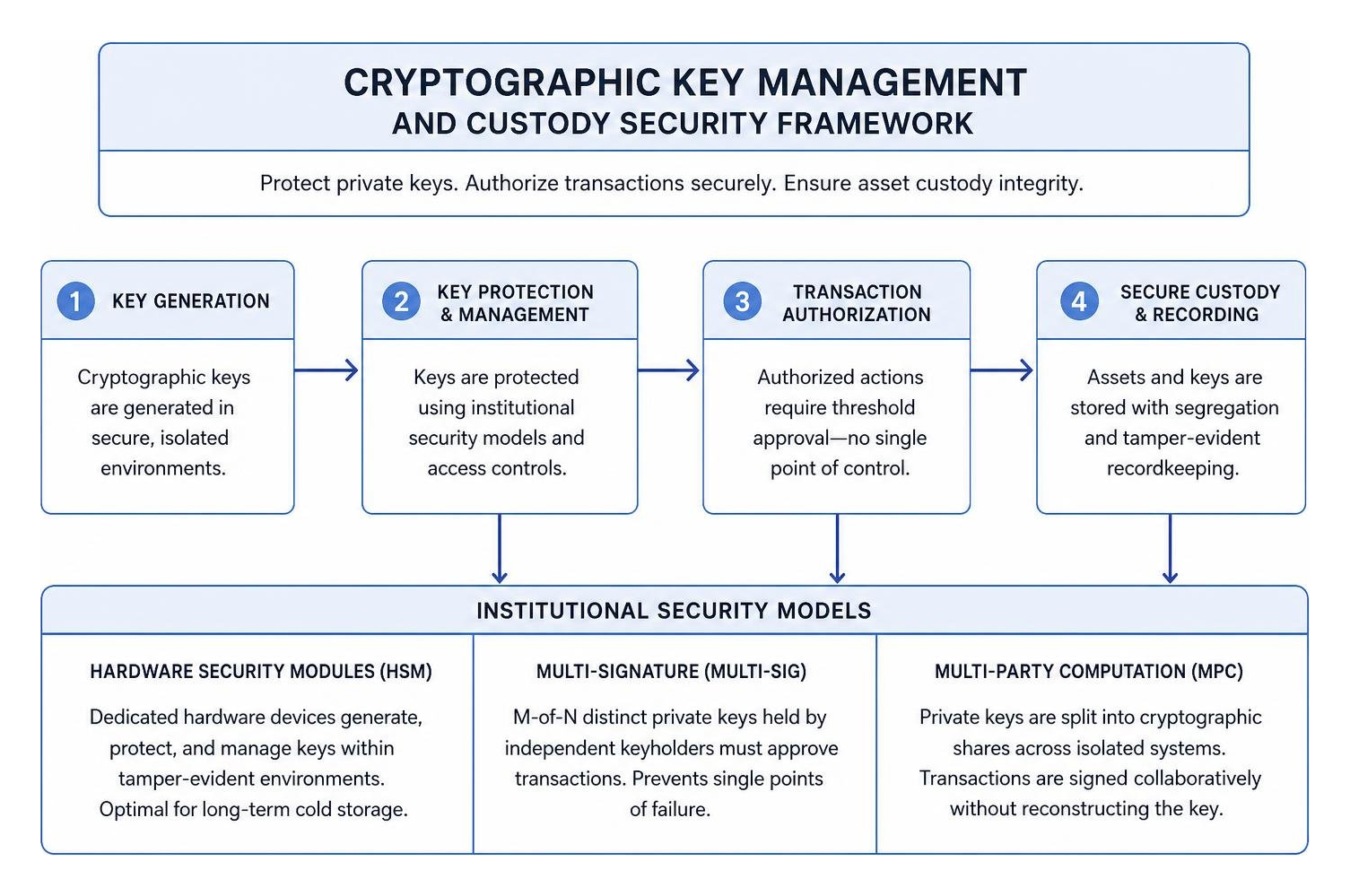
When evaluating modern custody infrastructure, three core security models dominate the institutional landscape:
- Hardware Security Modules (HSM): Dedicated physical computing devices designed to generate, protect, and manage cryptographic keys within a tamper-evident hardware environment. HSMs are optimal for static, long-term cold storage.
- Multi-Signature (Multi-Sig) Architectures: On-chain spending arrangements requiring $M$-of-$N$ distinct private keys (held across geographically dispersed keyholders) to authorize a transaction. Multi-sig prevents single points of failure but can introduce latency into execution.
- Multi-Party Computation (MPC): Advanced threshold cryptography that splits a single private key into mathematical “shares” (or shards) distributed across isolated environments. Transactions are signed collaboratively without ever reconstructing the complete key in any single memory location.
Adhering to comprehensive guidelines for digital asset custody requires validating that your custodian utilizes granular policy control engines. These include administrative quorums, time-locks, address whitelisting, and role-based access controls (RBAC) to ensure unauthorized transfers cannot occur without multi-party institutional validation.
Key Custody Models for Self-Directed Retirement Portfolios
Alternative asset investors have different structural paths available depending on the liquidity, transaction frequency, and operational overhead of their target investments.
| Custody Dimension | Direct Custodial Holding | Checkbook Control LLC / Trust | Multi-Tiered Hybrid Custody |
|---|---|---|---|
| Primary Account Structure | Titled directly in the name of the SDIRA Custodian FBO [Investor] | SDIRA owns 100% of an LLC / Trust; Investor acts as Non-Compensated Manager | Segregated Qualified Vault + Operational MPC Hot/Warm Sleeve |
| Transaction Execution Velocity | 2 to 5 business days per formal custodial funding request | Immediate real-time execution via dedicated business checking account | Real-time algorithmic API execution backed by vaulted cold reserve |
| Administrative Burden | High per-transaction paperwork; custodian signs all asset contracts | Moderate; investor handles local bookkeeping, operating agreements, and banking | Technical overhead managed via software interfaces and policy rules |
| Best Suited Asset Classes | Long-term private equity, single-property real estate, syndicated debt | Fix-and-flip properties, tax liens, private lending, multi-unit rentals | Tokenized RWAs, digital assets, high-velocity liquidity strategies |
| Prohibited Transaction Risk Points | Low; custodian provides passive administrative screening | High; investor must strictly avoid self-dealing and disqualified party interactions | Low to Moderate; programmatic smart contract restrictions prevent leakage |
Direct Custody vs. Checkbook Control LLCs
Under a Direct Custody framework, the SDIRA custodian holds direct legal title to the alternative asset on behalf of your retirement plan (e.g., “Custodian Name FBO Investor Name IRA #12345”). Every single disbursement, capital call payment, expense check, and purchase contract must be submitted to the custodian for administrative review, asset verification, and execution. This approach provides an institutional paper trail, but processing lead times can be cumbersome for dynamic real estate projects or active private lending note originations.
Conversely, establishing a Checkbook Control LLC—often referred to as a Single-Member LLC SDIRA—allows the retirement account to capitalize a specialized, newly formed legal entity. The SDIRA holds 100% of the membership interest in the LLC, while you, the retirement investor, serve as the non-compensated manager.
This model grants you checkbook authority through a dedicated corporate checking account, enabling instant settlement for time-sensitive deals like real estate foreclosure auctions or immediate private notes. However, managing this structure requires an unwavering understanding of IRS Section 4975 rules to avoid disqualified persons, self-dealing, or prohibited personal guarantees.
Multi-Tiered and Hybrid Custody Frameworks
For dynamic investment strategies—such as holding tokenized private credit or integrating a bitcoin IRA allocation alongside traditional private equity—hybrid custody models deliver an optimal balance of security and operational utility.
Under a hybrid architecture:
- The Reserve Layer (Cold Storage): 80% to 95% of aggregate fund capital remains locked in offline, air-gapped, qualified bank vaults protected by HSMs and strict multi-person authorization protocols.
- The Operational Layer (Warm/Hot MPC): A calibrated liquidity allocation is held within an institutional MPC environment, facilitating active smart contract interactions, real-world asset dividend distributions, and yield settlements.
Evaluating Asset Class Support, Fee Schedules, and Audit Integrity
Alternative assets span a wide range of administrative, titling, and liquidity characteristics. A one-size-fits-all custodian cannot adequately address the divergent demands of physical real property, venture capital syndications, and institutional digital assets.

Illiquid Private Markets and Real Estate Titling
Physical real estate and private debt investments require hands-on document review and precise title structuring. If you are learning the fundamentals of structuring equity placements through retirement plans, reviewing ira investment rules 101: invest in private equity is a practical starting point.
When deploying retirement capital into direct property holdings through our 401k services and real estate IRA solutions, the custodian must accurately record title deeds, process earnest money escrows, and execute ongoing property tax or insurance disbursements without administrative delays.
Furthermore, syndicators and deal sponsors looking into raising private capital with IRAs must ensure their custodian can manage fractional equity allocations, recurring distributions, and delayed Schedule K-1 tax filings.
For income-focused debt strategies—such as originating secured promissory notes via private equity and private lending or bidding on municipal assets through tax liens and tax deeds—transaction velocity and reliable payment tracking are the key operational differentiators.
SOC 2 Type II Audits and Institutional Insurance
Never rely solely on a custodian’s self-reported marketing materials. When executing due diligence on an alternative asset custodian, require and review independent third-party audit documentation.
A SOC 2 Type II Report evaluates the design and operating effectiveness of an organization’s security controls across a continuous evaluation period (typically 6 to 12 months), testing five core Trust Services Criteria:
- Security: Firewalls, cryptographic key access, and physical entry controls.
- Availability: System uptime, failover architecture, and disaster recovery execution.
- Processing Integrity: Error-free transaction execution and complete settlement logging.
- Confidentiality: Encryption of sensitive investor data and corporate documents.
- Privacy: Controlled handling of personally identifiable information (PII).
In your review, examine the independent auditor’s opinion (unqualified vs. qualified) and inspect Section IV for recorded control exceptions. A single exception regarding key reconstitution or administrative role segregation warrants direct inquiry.
Additionally, verify the custodian’s commercial insurance coverage. High-value custodians maintain structured policies comprising:
- Specie and Crime Insurance: Protecting assets against physical loss, theft, and damage within vaulting facilities (often up to $250M–$320M in aggregate limits).
- Cyber Liability: Defending against unauthorized network intrusion and data breaches.
- Errors & Omissions (E&O): Protecting client accounts against administrative processing failures.
Understanding the evolving SEC custody rule and possession standards will ensure your chosen custodian enforces full legal segregation and independent third-party reconciliation, keeping client assets completely off the custodian’s corporate balance sheet.
Step-by-Step Roadmap to Onboarding Your Retirement Custodian
Transitioning retirement capital to an alternative asset custodian follows an established sequence of regulatory and operational milestones.
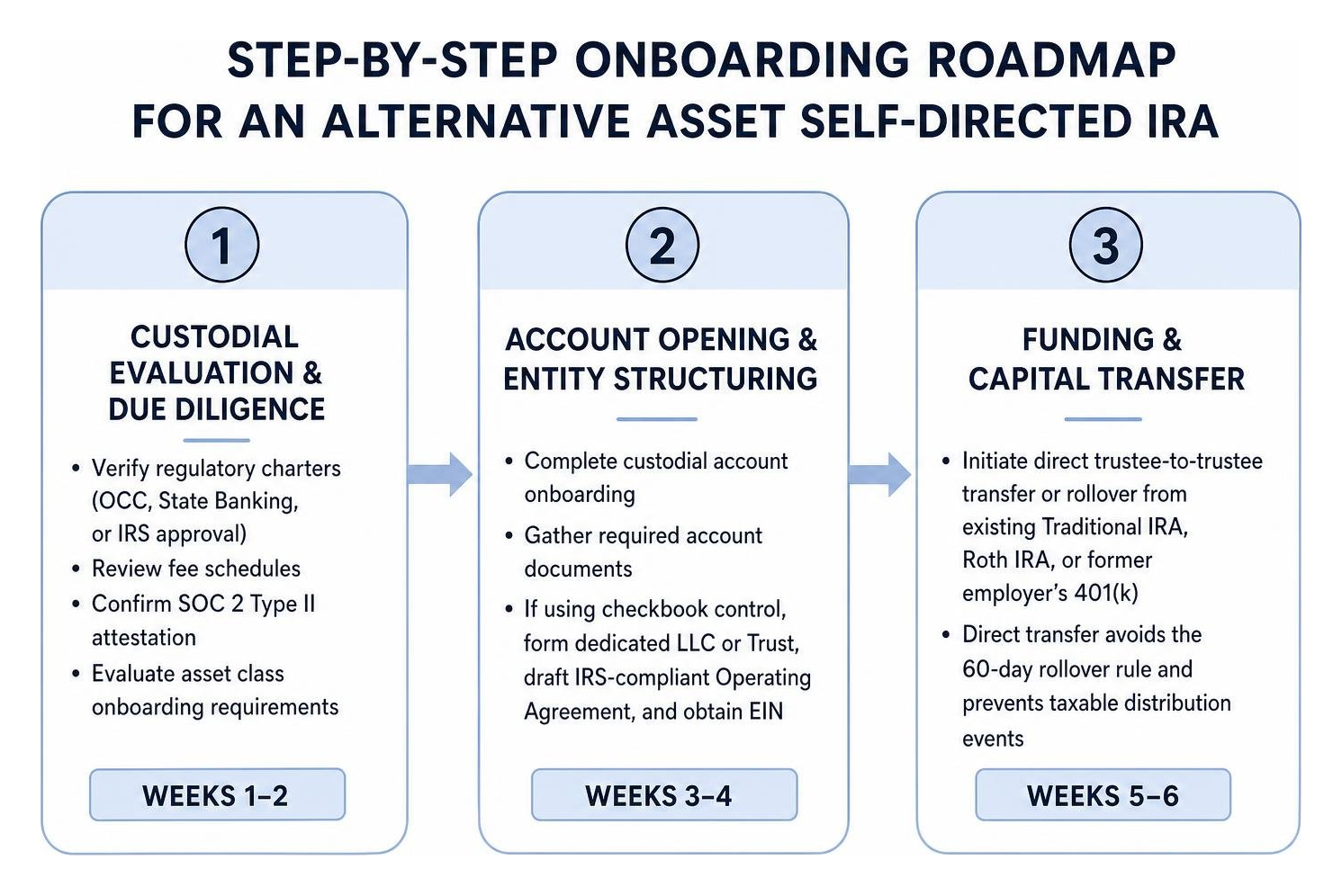
Due Diligence, Account Setup, and Funding Milestones
- Custodial Evaluation & Due Diligence (Weeks 1–2): Verify regulatory charters (OCC, State Banking, or IRS approval), review fee schedules, confirm SOC 2 Type II attestation, and evaluate specific asset class onboarding requirements. Our specialist Brian Davis is available to walk you through our operational workflows and help identify the best structure for your assets.
- Account Opening & Entity Structuring (Weeks 3–4): Complete custodial account onboarding and gather your required account documents. If you are utilizing a checkbook control structure, form the dedicated special-purpose LLC or Trust, draft an IRS-compliant Operating Agreement, and obtain a dedicated EIN.
- Funding & Capital Transfer (Weeks 5–6): Initiate a direct trustee-to-trustee transfer or rollover from your existing traditional IRA, Roth IRA, or former employer’s 401(k). This direct transfer avoids the 60-day rollover rule and prevents taxable distribution events.
- Investment Authorization & Direction (Weeks 7–8): Submit the formal Buy Direction Letter, private placement subscription documents, promissory note purchase agreements, or real estate purchase contracts to the custodian for final administrative verification and funding.
- Ongoing Administration & Annual Valuation (Continuous): Monitor recurring distributions, submit annual Fair Market Value (FMV) updates as mandated by IRS reporting guidelines (Form 5498), and reconcile all transactions on a periodic basis.
Frequently Asked Questions About Alternative Asset Custody
What qualifies an entity as a qualified custodian for alternative retirement assets?
Under federal and state statutes (including SEC Rule 206(4)-2 and IRC Section 408), a qualified custodian must be a federally chartered bank, a state-chartered trust company, a registered broker-dealer, or an entity specifically approved by the IRS as a non-bank trustee. These institutions are subject to regulatory supervision, mandatory capital adequacy minimums, recurring examination cycles, and strict legal asset segregation requirements.
How do checkbook control IRAs interact with custodial requirements?
A checkbook control IRA does not eliminate the need for a qualified custodian. Instead, the custodian acts as the passive recordkeeper holding legal title to the single-member LLC or Trust that owns your investment portfolio. The custodian manages annual IRS reporting (such as Form 5498), while you manage the daily operational flow through a dedicated entity bank account, operating strictly within IRS prohibited transaction guidelines.
What insurance policies should a self-directed custodian maintain?
A reputable alternative asset custodian should maintain comprehensive coverage, including Commercial Crime insurance (covering internal and external theft, employee dishonesty, and fraud), Cyber Liability insurance (covering system compromises), Depository Specie insurance (for vaulted physical and cryptographic assets), and Errors & Omissions (E&O) insurance (covering administrative mistakes). Ensure that you review policy sub-limits and exclusions directly.
How does the GENIUS Act affect digital asset custody in retirement plans?
The GENIUS Act enforces strict statutory requirements for payment stablecoin reserves and digital asset holdings. It mandates that reserves be fully segregated, backed 1:1 by high-quality liquid assets, and deposited exclusively with federally supervised or state-regulated qualified institutions. For retirement investors holding tokenized real-world assets or stablecoin-based yield instruments, this legislation ensures that custodial counterparties are subject to clear federal audit standards and statutory bankruptcy protections.
Before You Move Retirement Funds
Selecting the right alternative asset custodian is a foundational decision for your retirement account. Whether you are acquiring physical commercial real estate, investing in private equity funds, originating secured private loans, or incorporating digital assets, your custodial framework should support regulatory compliance and administrative efficiency.
As an Authorized Agent of Accuplan, Independent IRA helps facilitate self-directed account administration, checkbook control entity structures, and self-trusteed Solo 401(k) plan setups designed around IRS-permitted assets.
Take the next step in establishing your retirement framework: explore our self-directed retirement services to examine your account options, or contact our specialist team today to discuss your account setup.
This content is for informational and educational purposes only and does not constitute legal, tax, or investment advice. Rules, limits, and requirements may change. Consult a qualified tax advisor, attorney, or financial professional before making retirement planning or investment decisions. Independent IRA is an Authorized Agent of Accuplan Benefits Services and is not a custodian or trust company.