

 GIVE US A CALL
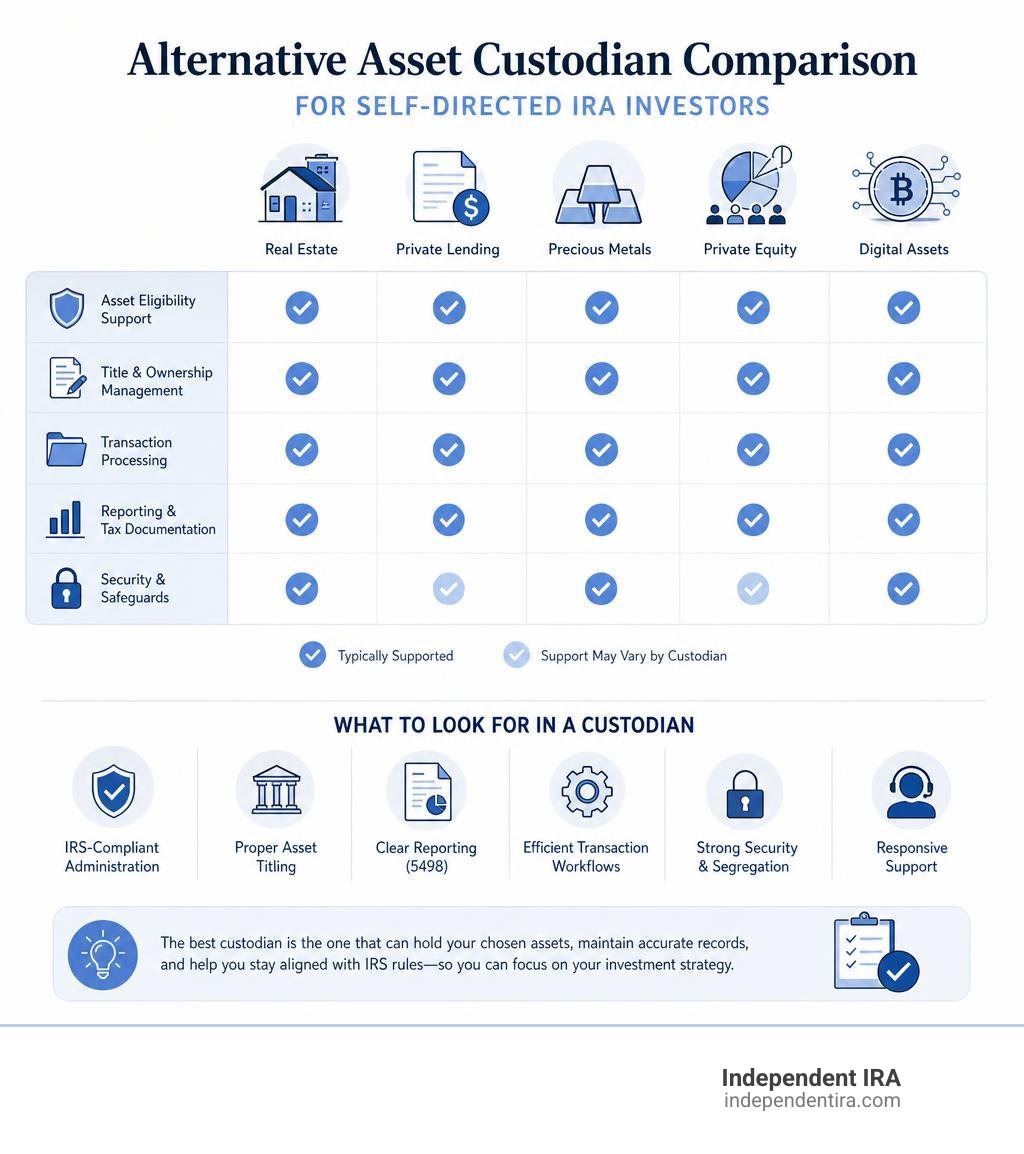
If you want retirement funds to buy real estate, private loans, precious metals, private equity, or digital assets, the key decision is not only what to invest in – it is who can custody the asset correctly without slowing down your strategy. The best alternative asset custodian for a self-directed IRA or Solo 401(k) can properly hold or administer your chosen assets, maintain retirement-account records, and help keep transactions aligned with IRS rules. For a real estate investor, that means balancing a familiar custodian name against support for property, private lending, precious metals, private equity, digital assets, or a self-directed IRA control structure that gives you more day-to-day flexibility.
A strong alternative-asset custody arrangement should make ownership clear, keep client assets separate where applicable, provide usable reporting, and establish reliable processes for investments, income, expenses, and distributions. For digital assets and metals, security architecture, insurance terms, and whether holdings are segregated or allocated can matter just as much as account fees. This guide explains how to compare those features through the practical lens of your retirement account, not simply a general investment account.
I am Brian Davis, and I will help you assess the custody and control options that can support a more flexible retirement investing strategy.
What Makes the Best Alternative Asset Custodian for Self-Directed IRAs?
When searching for the best alternative asset custodian, retirement account holders quickly realize that traditional brokerages are not equipped to hold non-publicly traded assets. Standard custodians excel at stocks, bonds, and mutual funds, but IRS regulations allow retirement funds to purchase real estate, private notes, physical bullion, and digital currencies—provided a qualified entity acts as the administrator or custodian.
The role of a self-directed IRA custodian is strictly administrative and custodial. They hold title to the asset on behalf of your account (e.g., “Accuplan Benefits Services FBO [Your Name] IRA”), record transactions, execute buy/sell directions upon your instructions, and report account values annually to the IRS via Form 5498. Because the custodian does not provide investment advice or conduct due diligence on your chosen deals, evaluating their operational features, fee structures, and administrative efficiency is crucial.
Finding the optimal custodian requires aligning your investment goals with the custodian’s specialized capabilities. If your strategy involves time-sensitive real estate closings or private equity capital calls, choosing a partner with streamlined document processing and dedicated support channels makes all the difference in executing transactions smoothly.
Key Selection Criteria for a SDIRA Custodian
Choosing a custodian to oversee your alternative investments requires a thorough review of their operational infrastructure. Key criteria include:
- Fee Schedules: Custodians generally charge either a flat fee per asset or an asset-based fee evaluated as a percentage of total portfolio value. For high-value assets like commercial real estate, flat-fee models are often far more cost-effective.
- Transaction Execution Speed: How fast can the custodian wire funds once paperwork is submitted? Delays in earnest money deposits can cause real estate deals to collapse.
- Administrative Reporting & IRS Compliance: Ensure the custodian generates comprehensive account statements and handles Form 5498 and Form 1099-R filings seamlessly.
- Audit Trails & Documentation: The provider should offer transparent online reporting tools to audit historical transactions, verify income deposits, and track expense disbursements.
At Independent IRA, an Authorized Agent of Accuplan Benefits Services, we emphasize transparent workflows and structured guidance so investors never feel stranded in administrative paperwork. To learn more about how our platform structures retirement accounts for non-traditional investments, Explore Custodial Services.
Evaluating Asset Coverage for Real Estate, Private Equity, and Digital Assets
Not all alternative custodians support every asset class. Some specialize exclusively in precious metals vaulting, while others focus solely on digital currencies or private placement offerings. The best alternative asset custodian offers either broad asset coverage or seamlessly supports flexible account architecture.
- Real Estate: Requires handling earnest money wires, rental income processing, property tax payments, and non-recourse debt administration. Learn more about Real Estate IRA Investing.
- Private Equity & Lending: Demands efficient processing of subscription agreements, convertible notes, trust deeds, and borrower interest repayments. Discover our support for Private Equity & Lending.
- Tax Liens & Tax Deeds: Requires rapid purchasing capabilities to win state auctions and process redemption payments. Read about Tax Liens & Deeds.
- Digital Assets & Bullion: Requires specialized technical custody, off-balance-sheet key management, and physical vault integration.
Core Security and Key Management Features in Custody Architecture

When an SDIRA holds digital currencies, tokenized real-world assets (RWAs), or blockchain-based securities, physical locks are replaced by cryptographic key management. Evaluating institutional key infrastructure is vital to ensure your retirement holdings remain completely secure against cyber threats, unauthorized transfers, and operational single points of failure.
Modern cryptographic custody relies on two primary frameworks: Multi-Signature (multi-sig) technology and Multi-Party Computation (MPC). Each approach offers specific operational benefits for holding digital retirement assets safely.
How to Choose the Best Alternative Asset Custodian for Crypto and Tokenized Assets
When evaluating digital asset custodians for retirement funds, security must be balanced with liquidity and operational responsiveness. Institutional custodians utilize varying infrastructure standards, ranging from 100% offline cold storage defaults to dynamic multi-party signing protocols.
For example, specialized digital asset platforms enforce 100% cold storage defaults backed by 3-of-5 multi-signature authorization architecture, delivering platform uptime SLAs of 99.99% and withdrawal completion SLAs under 4 hours. Similarly, enterprise institutional custodians support over 40 native blockchains and thousands of tokens, combining multi-party computation with hardware security modules (HSMs).
If you are exploring crypto allocations within your self-directed account, review our dedicated Bitcoin IRA Solutions and our step-by-step Beginners Guide to Crypto SDIRA.
Multi-Signature Architecture vs Multi-Party Computation (MPC)
Understanding how key management systems operate helps retirement investors evaluate custodial resilience:
- Multi-Signature (Multi-Sig): Multi-sig requires multiple independent private keys—generated on separate hardware devices—to sign off on a transaction before it is broadcast to the blockchain. A standard 3-of-5 setup requires three distinct key shards distributed across geographically separated, tamper-resistant environments. This structure eliminates single points of failure.
- Multi-Party Computation (MPC): MPC splits a single private key into multiple encrypted math secret shares distributed among different servers. The key is never assembled in a single location, even when signing a transaction.
| Feature | Multi-Signature (Multi-Sig) | Multi-Party Computation (MPC) |
|---|---|---|
| Key Assembly | Requires multiple actual keys to sign | Key is never fully assembled; relies on secret shares |
| On-Chain Footprint | Explicit on-chain signatures visible | Appears on-chain as a standard single-key signature |
| Blockchain Support | Limited to chains supporting smart/multi-sig wallets | Chain-agnostic (supports any blockchain protocol) |
| Flexibility | Highly rigid, strict institutional policies | Highly flexible, adaptable governance rules |
Institutions also utilize Hardware Security Modules (HSMs) certified to FIPS 140-3 Level 3 security standards to isolate cryptographic key generation within tamper-proof hardware vaults.
Cold Storage Protocols and Withdrawal SLAs
The trade-off between security and accessibility in digital asset custody revolves around cold storage versus hot storage:
- Cold Storage: Private keys are generated and stored completely offline on air-gapped devices. This provides maximum protection against remote cyberattacks, but requires manual signing workflows that can introduce delays.
- Hot Storage: Private keys reside on internet-connected servers, enabling instant automated withdrawals but exposing assets to online exploit vectors.
To protect retirement assets, leading custodians utilize cold storage defaults while engineering streamlined approval channels to maintain fast execution times. For instance, institutional digital asset funds frequently mandate cold storage protocols in their custodial frameworks to eliminate operational hazards. As noted in a public SEC Disclosure on Custodial Key Storage Protocols, major institutional trusts regularly contract secondary trust banks to ensure private keys remain strictly held in air-gapped cold storage.
Withdrawal Service Level Agreements (SLAs) vary across providers. While some custodians require 24 to 48 hours to complete out-of-band security verifications for cold storage withdrawals, institutional setups can process multi-sig approvals in under 4 hours without compromising air-gapped safety.
Regulatory Compliance, Insurance, and Bankruptcy Remoteness
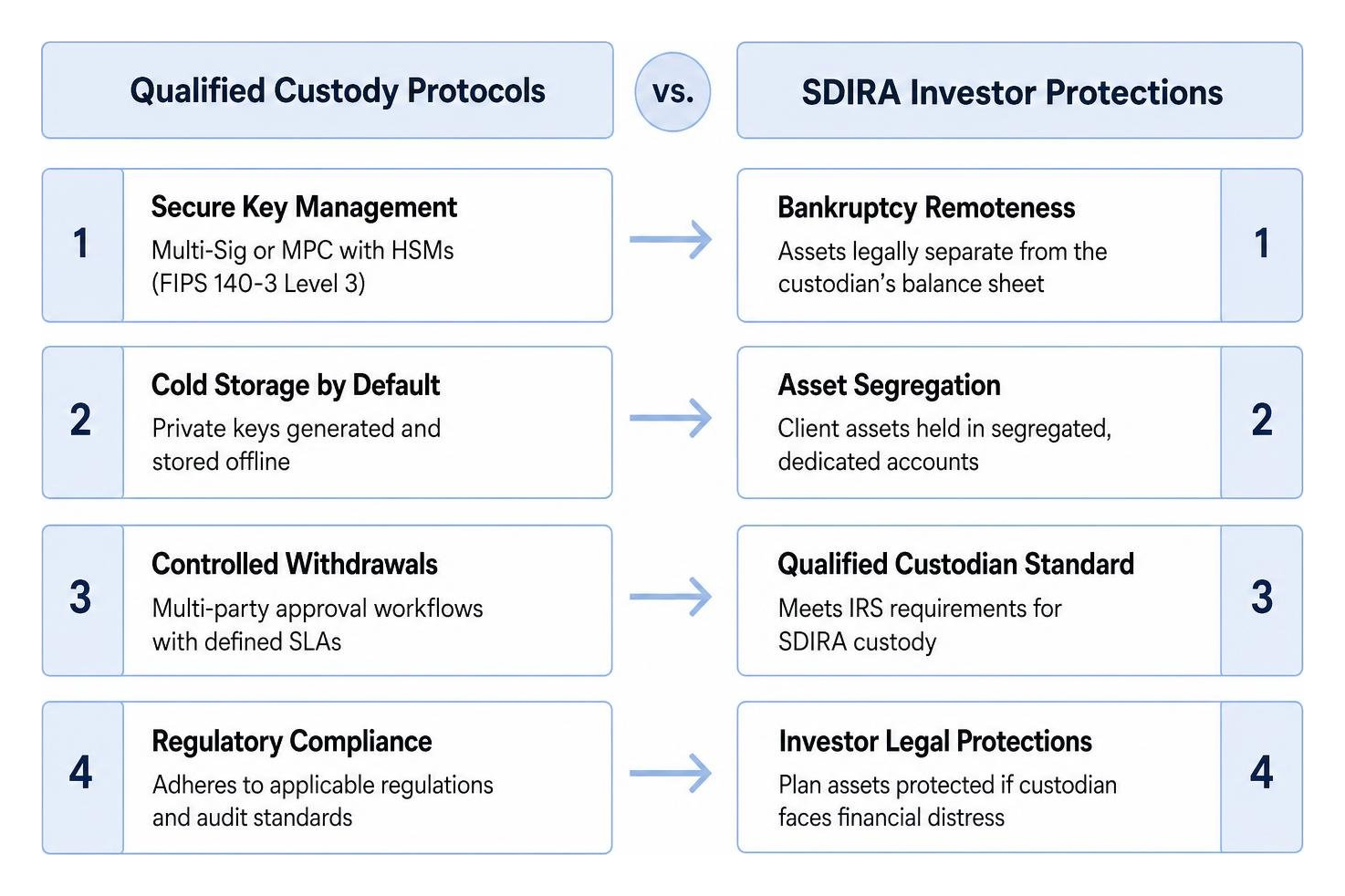
A critical factor when selecting the best alternative asset custodian is verifying that client holdings are legally protected if the custodial entity encounters financial distress or insolvency.
Bankruptcy Remoteness and Asset Segregation Standards
True qualified custodians structure client accounts so that assets remain legally separate from the custodian’s corporate balance sheet. This status is known as bankruptcy remoteness.
Under standard qualified custody frameworks (such as OCC-chartered trust banks or state-chartered trust companies), client holdings are held off-balance sheet in segregated wallets or designated trust accounts. If the custodial firm faces bankruptcy, its corporate creditors have zero legal claim over client assets. Client holdings are simply transferred to a replacement custodian without loss.
Conversely, holding assets with un-regulated platforms or omnibus pooling setups can reduce an investor to an unsecured creditor during insolvency—a disastrous outcome for a retirement portfolio.
Insurance Coverage Limits and Qualifying Criteria
While standard bank deposits are protected up to $250,000 by FDIC insurance, alternative assets require specialized third-party insurance policies underwritten by global insurers (such as Lloyd’s of London).
Key insurance features to review:
- Covered Events: Leading custodial policies protect against internal theft, employee dishonesty, physical destruction of offline key hardware, and cyber breaches.
- Exclusions: Most insurance policies explicitly exclude losses resulting from market volatility, smart contract code bugs, user negligence (loss of login credentials), or regulatory freezes.
- Policy Limits: Top custodians secure substantial coverage pools, often maintaining $25 million to $250 million or more in qualified custody insurance coverage.
Jurisdictional Oversight: OCC, CIMA, MAS, and VARA Regulations
Regulatory frameworks govern how custodians operate, handle audits, and protect client capital:
- Office of the Comptroller of the Currency (OCC): Charters national trust banks in the United States, enforcing rigorous federal oversight, capital adequacy rules, and regular examinations.
- Cayman Islands Monetary Authority (CIMA): Regulates Virtual Asset Service Providers (VASPs) under established digital currency legal codes.
- Monetary Authority of Singapore (MAS): Issues Major Payment Institution licenses and strict custodial segregation mandates.
- Virtual Assets Regulatory Authority (VARA): Oversees digital asset service providers operating in Dubai with strict governance protocols.
Choosing a custodian regulated under an established legal jurisdiction gives retirement investors recourse and peace of mind.
Checkbook Control vs Custodial Asset Holding

While standard custodial structures require submitting paperwork to your custodian every time you buy a property or pay a repair bill, many experienced investors prefer direct transactional authority. This is achieved through a Checkbook IRA or a self-trusteed Solo 401(k).
Under a Checkbook Control architecture:
- Your custodian establishes a dedicated Single-Member LLC owned entirely by your IRA.
- The IRA capital funds the LLC’s business checking account.
- You act as the non-compensated Manager of the LLC.
- You write checks or execute bank wires directly for investments, property maintenance, tax liens, or private loan funding without waiting for custodial review.
Choosing the Best Alternative Asset Custodian for Maximum Investor Control
For real estate rehabs, tax lien auctions, or private startup investments where speed is paramount, checkbook control removes operational friction. Brian Davis and our team at Independent IRA guide investors through establishing checkbook structures that preserve compliance while granting direct check-writing access.
To set up checkbook control for real estate or private lending, review our Checkbook IRA Setup instructions. If you plan to deploy capital into angel investments, see our guide on Startup Investing via IRA.
Allocated Physical Vaulting vs Unallocated Storage for Precious Metals
When using a self-directed IRA to invest in physical gold, silver, platinum, or palladium, IRS rules require that physical metal remain in the possession of an approved depository. However, how that metal is stored within the vault is critical.
- Allocated Storage: Specific physical bullion bars or coins are assigned directly to your IRA by serial number, weight, and purity, held entirely off the depository’s balance sheet. Your retirement account retains true title to those specific items. Specialized depositories maintain 100% reserve ratio attestations with serial-number tracking adhering to LBMA Good Delivery standards.
- Unallocated Storage: Your IRA holds a claim against a shared pool of metal owned by the depository. In an unallocated structure, you act as an unsecured creditor, exposing your retirement capital to counterparty insolvency risks.
For precious metals held in an SDIRA, allocated, segregated storage is essential to maintain full legal protection and bankruptcy remoteness.
Frequently Asked Questions About Alternative Asset Custodians
What is the role of an alternative asset custodian in a Self-Directed IRA?
An alternative asset custodian acts as an independent administrator for your retirement account. Their primary duties include holding title to non-publicly traded assets on behalf of your IRA, processing investment funding requests, receiving income generated by IRA investments, disbursing funds for property or asset expenses, maintaining legal records, and submitting annual value reports to the IRS (such as Form 5498).
How does bankruptcy remoteness protect my retirement investments?
Bankruptcy remoteness ensures that your alternative assets are held off the custodian’s corporate balance sheet in segregated accounts. If the custodian faces financial failure or insolvency, corporate creditors cannot claim your retirement investments. Your assets remain titled to your IRA and can be transferred seamlessly to a replacement qualified custodian.
Can I hold cryptocurrency and physical real estate with the same custodian?
Yes. Many broad-coverage self-directed IRA custodians allow you to hold real estate, private placement notes, precious metals, and digital currencies within a single master retirement account. Alternatively, investors can use a Checkbook IRA LLC structure funded by one custodian to hold real estate, private loans, and digital assets under a unified LLC operating framework.
What is the difference between custodial holdings and Checkbook IRA control?
Under standard custodial holding, the custodian reviews and approves every purchase order, earnest money wire, and expense payment, charging administrative processing fees for each request. Under Checkbook IRA control, your IRA owns a single-member LLC, and you act as the manager. You execute transactions instantly by writing checks or sending wires directly from the LLC’s bank account, eliminating processing delays and per-transaction fees.
Before You Move Retirement Funds
Selecting the best alternative asset custodian is the foundation of a successful self-directed retirement strategy. Whether you are acquiring commercial real estate, funding private loans, holding allocated precious metals, or diversifying into digital assets, your custodian must provide transparent pricing, robust security, and reliable administrative support.
At Independent IRA, an Authorized Agent of Accuplan Benefits Services, we bring clarity and freedom to self-directed retirement planning. We specialize in assisting with self-directed IRA and Solo 401(k) accounts, single-member LLC entity creation for Checkbook Control, and ongoing administrative support. We help you skip unnecessary delays, maintain complete IRS compliance, and keep full operational control over your investments.
To discuss your investment strategy and set up the ideal structure for your retirement capital, Get Started with Self-Directed IRA Solutions or contact our team today.
This content is for informational and educational purposes only and does not constitute legal, tax, or investment advice. Rules, limits, and requirements may change. Consult a qualified tax advisor, attorney, or financial professional before making retirement planning or investment decisions. Independent IRA is an Authorized Agent of Accuplan Benefits Services and is not a custodian or trust company.