

 GIVE US A CALL

To raise capital for real estate sdira investments, you can direct funds already held in a self-directed IRA into qualifying real estate, private real estate funds, syndications, tax liens, or carefully structured co-investments. The key decision is whether you want direct control over a property or passive exposure through a private placement, while keeping every dollar of income and expense inside the retirement account. A specialized custodian helps administer the account and transaction paperwork, while tools such as an SDIRA LLC can provide faster execution for eligible deals. This guide begins with the fundamentals of self-directed IRA control so you can assess the opportunity without treating retirement-account rules as an afterthought.
Real estate can offer retirement investors more choice than a conventional IRA menu, but it also requires disciplined deal structure, independent due diligence, and strict separation between personal and IRA funds. Your IRA generally cannot buy property from, sell property to, or provide personal benefit to you or other disqualified persons. Financing, renovation costs, liquidity needs, and potential debt-related taxes can also materially affect a deal’s return.
At Independent IRA, I am Brian Davs, and the sections ahead will help you evaluate practical ways to deploy self-directed retirement capital while keeping compliance and control in view.
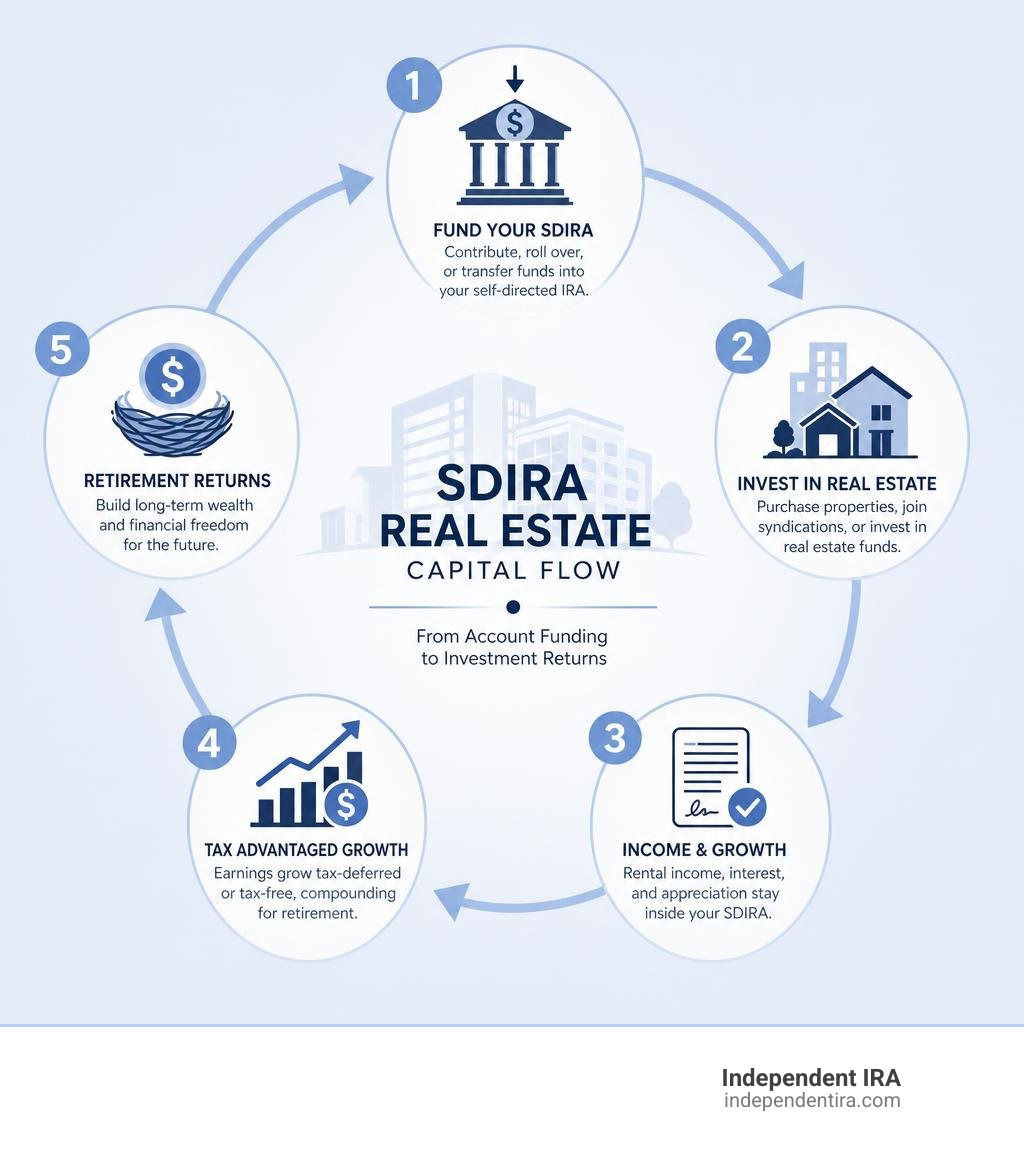
What Is a Self-Directed IRA and How Does It Unlock Real Estate Capital?
A self-directed IRA (SDIRA) is a tax-advantaged retirement account that grants you the legal authority to invest in alternative assets beyond standard stocks, bonds, and mutual funds. While traditional custodians restrict your portfolio to publicly traded equities, an SDIRA opens the door to tangible assets like single-family rentals, commercial properties, raw land, real estate debt, and tax certificates.
When you seek to raise capital for real estate sdira transactions, you are fundamentally mobilizing existing tax-sheltered wealth. Capital can be raised by aggregating capital from private investors using their SDIRAs, or by deploying your own accumulated retirement balances into strategic property investments. All title documentation, contract terms, rental income, and operating expenses flow directly through the IRA account. This structure ensures that earnings compound on a tax-deferred or tax-free basis, creating a powerful engine for long-term wealth accumulation.
At Independent IRA, we emphasize that custodial oversight remains essential throughout this process. The custodian acts as the administrative administrator, maintaining proper recordkeeping, filing tax returns when necessary, and holding the asset title for the benefit of your IRA. By working alongside our team, including Brian Davis, investors establish account structures that maintain strict administrative precision while maximizing asset flexibility.
Core Benefits of Using Retirement Funds for Alternative Investments
The primary advantage of deploying retirement capital into real estate lies in tax efficiency. In a traditional SDIRA, income and capital gains accumulate tax-deferred, meaning you pay no income or capital gains taxes on rental yields or sale profits until you take distributions in retirement. In a Roth SDIRA, contributions grow entirely tax-free, allowing qualified distributions in retirement to be withdrawn without paying a single dollar in income tax on decades of appreciation.
Beyond tax advantages, using retirement capital for real estate provides substantial portfolio diversification and inflation defense. Physical real estate historical trends demonstrate strong resilience against inflation, as property values and rental rates typically rise alongside general price indexes. Furthermore, SDIRAs allow you to leverage specialized market knowledge. If you understand local housing markets, debt instruments, or land development better than Wall Street equity analysts, an SDIRA empowers you to direct your retirement nest egg into opportunities where you hold a clear knowledge edge. For additional details on mobilizing private retirement funds, explore our guide on raising private capital IRAs.
Using Checkbook Control to Raise Capital for Real Estate SDIRA Accounts
While standard custodian-directed SDIRA accounts require the custodian to approve and sign every purchase agreement, write every earnest money check, and process every repair invoice, a checkbook control structure streamlines the process significantly. Checkbook control is achieved by creating a specialized Single-Member Limited Liability Company (LLC) owned entirely by your SDIRA.
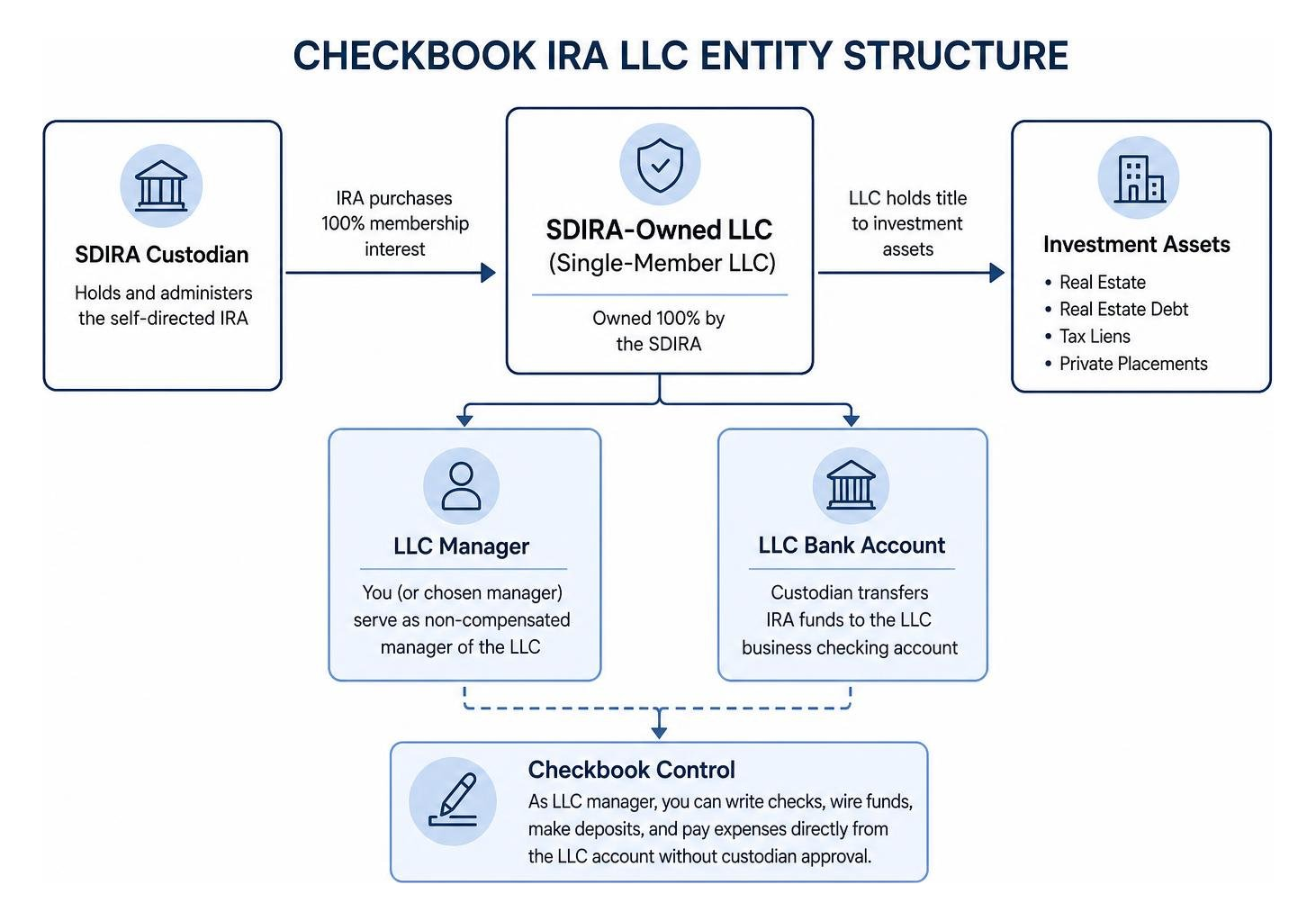
When establishing a checkbook IRA LLC, your IRA purchases 100% of the equity membership units in the newly formed LLC. You (or a chosen manager) serve as the non-compensated manager of the LLC. The IRA custodian transfers your investment funds directly into the LLC’s business checking account. As the LLC manager, you can write checks, wire funds, make earnest money deposits, and pay property expenses directly from the LLC account without waiting for custodial review or paying transaction processing fees for every check written.
This execution speed is critical when competing in fast-moving real estate markets where earnest money must be deposited immediately. However, asset titling must remain precise: the property title is held in the name of the LLC (e.g., “Summit Holdings LLC”), maintaining a strict operational shield that protects the tax status of your underlying SDIRA. Learn more about setting up this structure by viewing our detailed resource on self-directed IRA checkbook strategies.
Proven Strategies to Raise Capital for Real Estate SDIRA Deals
Deploying retirement funds into real estate is not a one-size-fits-all endeavor. Real estate capital can be deployed across multiple distinct asset categories, ranges of risk, and operational structures. Understanding these strategies allows you to match your capital raising goals with your investment horizon and liquidity requirements.
Leveraging Syndications to Raise Capital for Real Estate SDIRA Projects
For investors who want exposure to large-scale commercial real estate—such as 200-unit apartment complexes, self-storage facilities, or industrial parks—real estate syndications provide an ideal capital-pooling framework. A syndication brings together private investors (Limited Partners, or LPs) and an experienced sponsor (General Partner, or GP) who sources, negotiates, manages, and executes the business plan.
SDIRA holders can invest their retirement capital directly into private placement offerings, typically structured under SEC Regulation D (Rules 506(b) or 506(c)). The LP shares are issued directly to the investor’s SDIRA or checkbook LLC. This strategy allows SDIRA investors to participate in institutional-grade properties with professional management, generating passive quarterly cash distributions and capital appreciation returned directly to their SDIRA without day-to-day property management hassles. Capital raisers seeking private retirement dollars frequently look to SDIRA investors, as detailed in our guide on raising private capital with IRAs. Additionally, exploring specialized SDIRA real estate strategies provides valuable insight into structuring successful private placements.
Executing High-Yield Strategies: BRRRR, Rehabs, and Tax Sale Assets
Investors seeking active growth inside their retirement accounts can implement strategies ranging from single-family rehabilitation projects to specialized tax sales:
- The BRRRR Method (Buy, Rehabilitate, Rent, Refinance, Repeat): In an SDIRA context, an investor purchases a distressed property using IRA cash, uses IRA funds for renovations, rents the home to generate cash flow, and executes a non-recourse cash-out refinance. The refinanced equity returns tax-sheltered capital to the IRA to acquire the next property.
- Fix-and-Flip Rehabs: SDIRA capital can cover property acquisition and contractor repairs. Once sold, all net proceeds return directly into the account. For instance, Mark in North Carolina completed his first rehabilitation project entirely inside his IRA, generating a $45,000 net profit after 14 months. Similarly, Christine from New York acquired a distressed estate property through her retirement account, managed minor cleaning and minor repairs, and achieved a 151 percent return on investment (ROI).
- Tax Liens and Tax Sale Deeds: Purchasing delinquent tax certificates allows investors to collect high statutory interest rates or eventually acquire property title for pennies on the dollar. Brad from Indiana acquired a tax lien using just $800 of his IRA capital and ultimately took title to the parcel, later selling the land for an incredible 11,000% return on investment. Kay in California used $65,000 of her IRA funds to purchase a run-down home at a local tax sale, securing strong upside upon resale.
- Raw Land & Farmland Appreciation: Land investments carry minimal holding expenses and strong appreciation upside. Kurt used his Minnesota SDIRA to acquire Iowa farmland that appreciated 60 percent within its very first year.
Combining SDIRAs with Solo 401(k)s, HSAs, and Private Lending
You are not limited to using a single account when assembling real estate transactions. IRS guidelines allow co-investing, provided the ownership percentages are calculated based on initial capital contributions and remain fixed throughout the life of the asset.
- Pooling Health Savings Accounts (HSAs) and Coverdell ESAs: Investors can pair SDIRAs with tax-advantaged accounts like HSAs and Coverdell Education Savings Accounts. Mark and Alison leveraged equity crowdfunding through their HSA to expand their balance by $18,000 within two years. Brian combined his traditional IRA with his children’s Coverdell ESAs to fund two raw land acquisitions, returning $130,000 directly to the combined accounts.
- Co-Investing with Solo 401(k)s: Self-employed individuals can pair SDIRA funds with a Solo 401(k) plan to acquire larger properties while maintaining separate tax-reporting paths.
- Private Lending via Promissory Notes: If you prefer acting as the bank rather than managing physical real estate, your SDIRA can fund real estate loans secured by mortgages or deeds of trust. For a step-by-step breakdown of private mortgage structures, consult our real estate investors guide to IRA promissory notes.
Navigating IRS Rules, Custodians, and Deal Structure
While raising and deploying capital through SDIRAs unlocks extraordinary flexibility, remaining in full compliance with Internal Revenue Code (IRC) rules is mandatory. A single technical error can trigger an accidental account distribution, subjecting the entire IRA value to immediate taxes and severe penalties.
Understanding Disqualified Persons and Prohibited Transactions
Under IRS Code Section 4975, your retirement account is intended to benefit your future self, not your current self or immediate family members today. Consequently, the IRS explicitly prohibits direct or indirect self-dealing transactions between an IRA and disqualified persons.
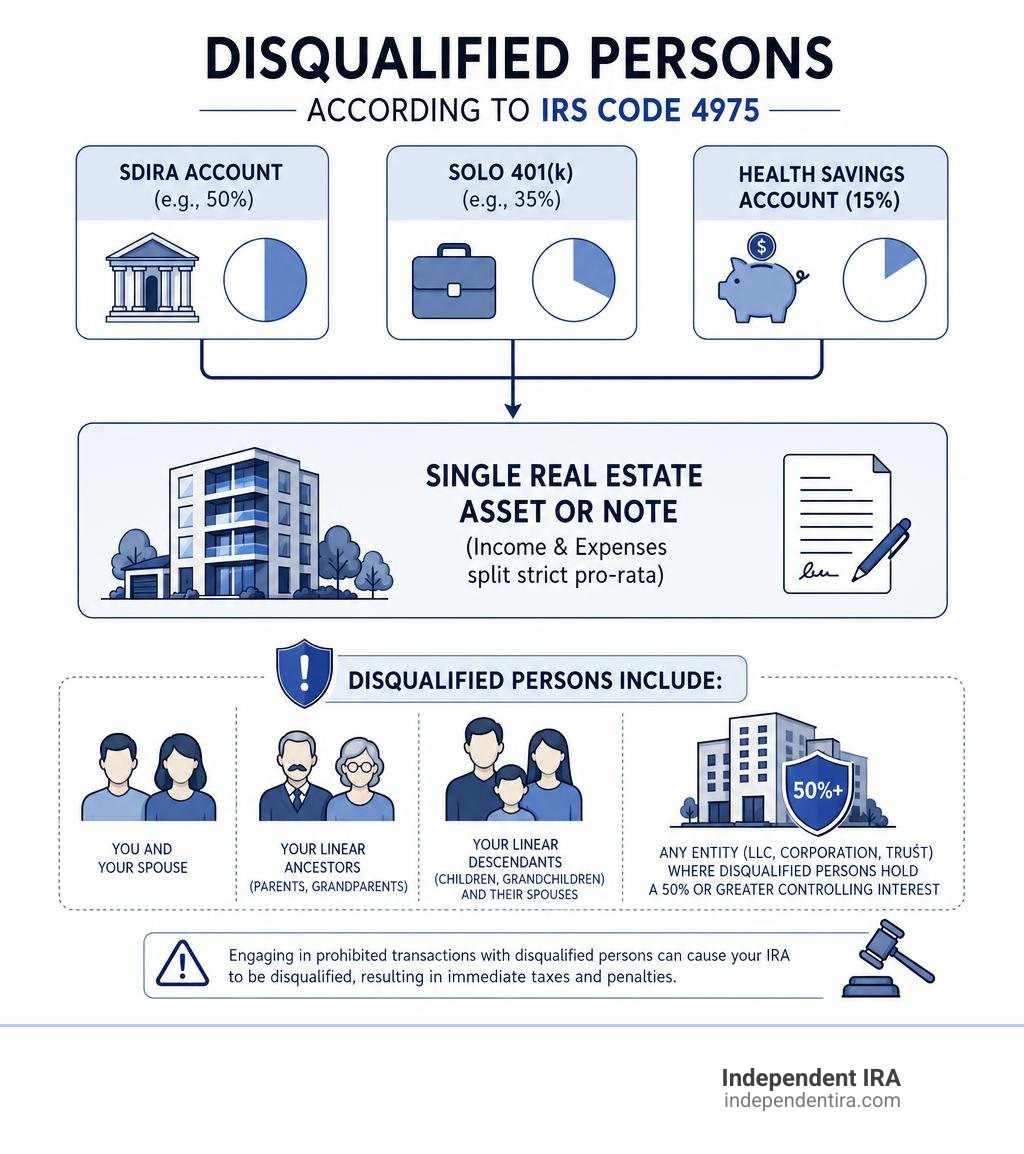
Disqualified persons include:
- You (the IRA owner) and your spouse.
- Your linear ancestors (parents, grandparents).
- Your linear descendants (children, grandchildren) and their spouses.
- Any entity (LLC, corporation, trust) where disqualified persons hold a 50% or greater controlling interest.
- Investment advisors, fiduciaries, or managers servicing the IRA.
Note: Siblings, aunts, uncles, cousins, and non-related business partners are generally NOT considered disqualified persons under federal tax law.
Prohibited transactions include:
- Buying or selling real estate between your SDIRA and a disqualified person.
- Living in or using property owned by your SDIRA (even for a weekend).
- Hiring yourself, your parents, or your children to perform repairs, painting, or contractor services on IRA property (“sweat equity”).
- Providing personal guarantees on loans taken out by the IRA.
Choosing the Right SDIRA Custodian and Managing Fees
Because regular banks do not administer alternative assets, selecting a qualified SDIRA custodian specializing in real estate is crucial. Key factors to evaluate when selecting a custodian include:
- Fee Structure Transparency: Custodians generally charge either a flat annual fee per asset or an asset-value-based fee scale. For large real estate assets, flat-fee structures save thousands over time.
- Transaction Speed and Turnaround: In competitive real estate, waiting weeks for contract review can kill deals. Look for custodians with streamlined processing windows.
- Private Placement Capabilities: Ensure the custodian is experienced in processing real estate syndications, private placement memorandums (PPMs), and checkbook LLC structures.
To explore how Independent IRA helps you setup and navigate custodial requirements, see our comprehensive AZ guide to private lending with IRA as well as our A-Z guide to private lending with IRA.
Overcoming Hurdles: Non-Recourse Financing, UDFI, and Liquidity
When your SDIRA requires leverage to purchase property, standard conventional mortgages are completely prohibited because they require personal repayment guarantees. Instead, your SDIRA must secure a non-recourse loan. In a non-recourse loan, the lender’s sole remedy in default is seizing the property pledged as collateral; they have no recourse against you personally or against other cash assets inside your IRA.
| Feature | Standard Commercial / Conventional Loan | SDIRA Non-Recourse Loan |
|---|---|---|
| Borrower Liability | Personal guarantee required from borrower | Asset-only recourse; no personal guarantee permitted |
| Required Down Payment | Typically 10% – 20% | Typically 30% – 40% |
| Reserve Requirements | Standard personal liquidity checks | Strict liquid cash reserves required inside IRA |
| Tax Implications | Standard interest deduction on personal tax return | Triggers Unrelated Debt-Financed Income (UDFI) tax |
| Underwriting Focus | Personal debt-to-income (DTI) & credit score | Property cash flow (DSCR) & IRA cash reserves |
When an IRA buys property using non-recourse debt leverage, the proportion of income generated by the debt portion is subject to Unrelated Debt-Financed Income (UDFI) taxation under IRC Section 514. UDFI is a subset of Unrelated Business Income Tax (UBIT). For example, if your IRA funds 40% of a property purchase with cash and borrows 60% via a non-recourse loan, 60% of the net income is subject to UDFI taxes at trust tax rates.
To report UDFI, the SDIRA must file IRS Form 990-T. However, because expenses, depreciation, and interest payments offset gross income, net UDFI liabilities are often lower than anticipated. Maintaining liquid reserve cash inside your SDIRA ensures your account smoothly handles property taxes, unexpected maintenance, and potential UDFI obligations. For private debt strategies, check our overview of private equity private lending San Diego.
Frequently Asked Questions About Raising Real Estate Capital with SDIRAs
What is a self-directed IRA and how is it used to raise capital for real estate?
A self-directed IRA is a tax-sheltered retirement account that allows you to direct investment funds into non-traditional assets such as real estate, private notes, tax liens, and syndications. To raise capital for real estate sdira projects, developers or real estate sponsors present private placement offerings to SDIRA investors. Alternatively, individual investors move existing 401(k) or traditional IRA capital into an SDIRA to directly acquire properties or fund real estate loans.
Can I pool SDIRA funds with other accounts like Solo 401(k)s or HSAs?
Yes. IRS regulations permit multi-account co-investments between your SDIRA, Solo 401(k), Health Savings Accounts (HSAs), or Coverdell Education Savings Accounts. However, equity ownership percentages must be calculated at the initial acquisition based strictly on capital contributed by each account. All ongoing income and property expenses must be allocated pro-rata according to those exact ownership percentages.
How do non-recourse loans and UDFI taxes affect SDIRA real estate returns?
A non-recourse loan allows an SDIRA to leverage property purchases without making the account owner personally liable. Because debt leverage introduces non-retirement funds into the deal, the portion of net profits generated by the debt is subject to Unrelated Debt-Financed Income (UDFI) tax. While UDFI requires filing IRS Form 990-T, property depreciation and interest expense deductions help reduce the net tax burden, often preserving the overall return advantages of leverage.
Before You Move Retirement Funds
Deploying retirement account balances to raise capital and acquire real estate may offer potential tax advantages and asset diversification. Whether you leverage syndications, rehab properties, tax liens, or co-investments, success depends on adhering strictly to IRS rules and maintaining full administrative integrity.
At Independent IRA, an Authorized Agent of Accuplan Benefits Services, we assist with entity creation for checkbook control IRAs and provide comprehensive support for real estate retirement investors. Before moving funds or committing to a private placement, make sure your account structures, LLC entities, and custodial relationships are fully aligned. Explore our full array of offerings on our services page to start building your self-directed real estate portfolio today.
This content is for informational and educational purposes only and does not constitute legal, tax, or investment advice. Rules, limits, and requirements may change. Consult a qualified tax advisor, attorney, or financial professional before making retirement planning or investment decisions. Independent IRA is an Authorized Agent of Accuplan Benefits Services and is not a custodian or trust company.