

 GIVE US A CALL
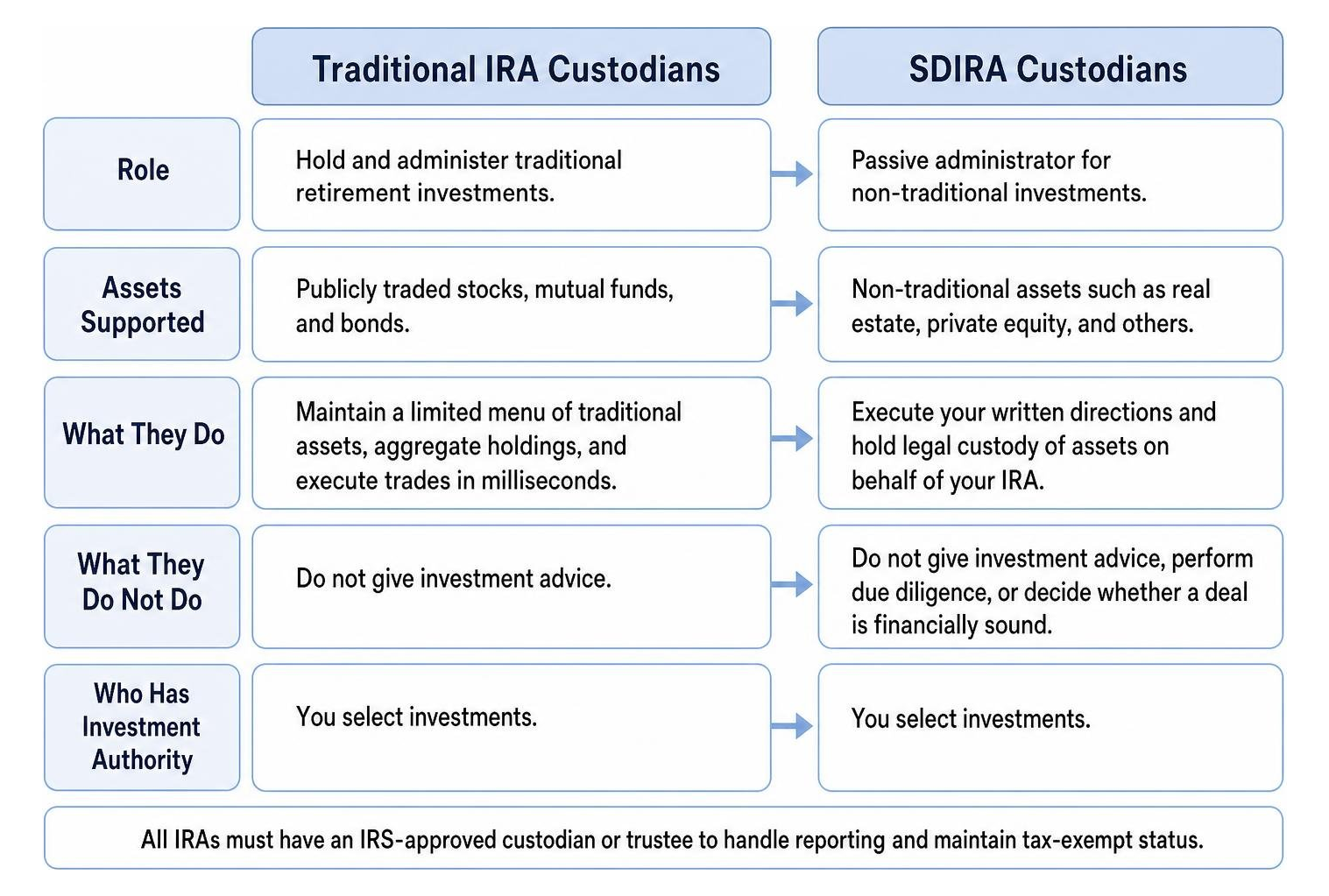
When choosing an SDIRA custodian, deciding who holds your alternative investment capital and handles account administration is a critical decision for every investor. An SDIRA custodian acts as a passive administrative entity responsible for executing your directions and reporting to the IRS, rather than providing financial advice or selecting investments. Evaluating fee structures, transaction processing speed, and asset capabilities ensures you keep full Self-Directed IRA Control while managing your retirement assets.
In a standard IRA, your custodian is typically a mainstream brokerage firm. They hold publicly traded stocks, mutual funds, and bonds. They maintain a limited menu of traditional assets, automatically aggregate your holdings, and execute trades in milliseconds at the click of a button.
An SDIRA custodian, by contrast, acts as a passive administrator for non-traditional investments. Under Section 408 of the Internal Revenue Code, all IRAs must have an IRS-approved custodian or trustee to handle reporting and maintain tax-exempt status. However, an SDIRA custodian does not give investment advice, perform due diligence on your deals, or decide whether a deal is financially sound. You select the assets; the custodian simply executes your written directions and holds legal custody of the asset on behalf of your IRA.
Custodial Role and Account Holder Control
The division of labor between you and your custodian is straightforward: you hold 100% of the investment authority, while the custodian handles regulatory administration.
Specifically, your custodian is responsible for:
- Issuing tax documents like Form 5498 (reporting fair market value) and Form 1099-R (reporting distributions).
- Holding physical or legal title to your alternative assets on behalf of your account (e.g., “[Custodian Name] FBO [Your Name] IRA”).
- Processing asset purchases, sales, and income receipts in strict accordance with your written instructions.
Because the custodian takes a passive role, you retain direct decision-making power. However, standard custodian processing times can sometimes slow down time-sensitive real estate transactions or private placements. To eliminate these delays, many investors utilize an LLC structure to gain direct checkbook access. To learn how this setup allows you to write checks or wire funds directly from a dedicated bank account, read our Step by Step Guide to Checkbook IRA.
Traditional vs. Alternative Asset Support
The fundamental difference between traditional custodians and self-directed IRA custodians lies in asset flexibility and operational structure.
| Feature / Capability | Traditional Brokerage Custodian | Self-Directed IRA (SDIRA) Custodian |
|---|---|---|
| Supported Assets | Stocks, Bonds, ETFs, Mutual Funds | Real Estate, Private Equity, Crypto, Promissory Notes |
| Investment Advice | Often provided via advisors or automated systems | None; strictly passive administration |
| Transaction Execution | Instant digital trading | Document-based execution per direction |
| Fee Structure | Low/Zero trade commissions; management percentages | Flat annual fees, per-transaction fees, or asset-based fees |
| Due Diligence | Vets public equities listed on exchanges | Investor is 100% responsible for due diligence |
| Checkbook Control Support | Not available | Supported via specialized IRA/LLC entity setups |
Key Factors in Choosing an SDIRA Custodian
Choosing an SDIRA custodian requires evaluating how a provider’s operational model aligns with your portfolio strategy. Over 70% of SDIRA investors cite custodian fees as the most important factor when choosing a provider. However, focusing solely on pricing can cause investors to overlook critical service and compliance gaps.
Fee Structures and Account Costs
Custodians generate revenue through administrative fees, setup charges, and transaction processing. Custodian fees for SDIRAs typically range from $50 to $500 annually, with average setup costs around $100.
Fee models generally fall into two categories:
- Asset-Value Fee Structure: The custodian charges a percentage based on the total valuation of your account. As your portfolio appreciates, your annual fee increases—even if the custodian performs no extra work.
- Flat-Fee Structure: The custodian charges a fixed annual fee regardless of your account balance or portfolio value.
Additionally, pay close attention to ancillary fees. Some custodians bill separately for incoming/outgoing wires, check processing, document reviews, quarterly statements, or fair market value updates.
Why Choosing an SDIRA Custodian with Flat Fees Matters
For growing portfolios, asset-value fee models act as a drag on growth. If your real estate IRA holds a property that appreciates from $200,000 to $600,000, an asset-based fee scale will continuously bite into your yield.
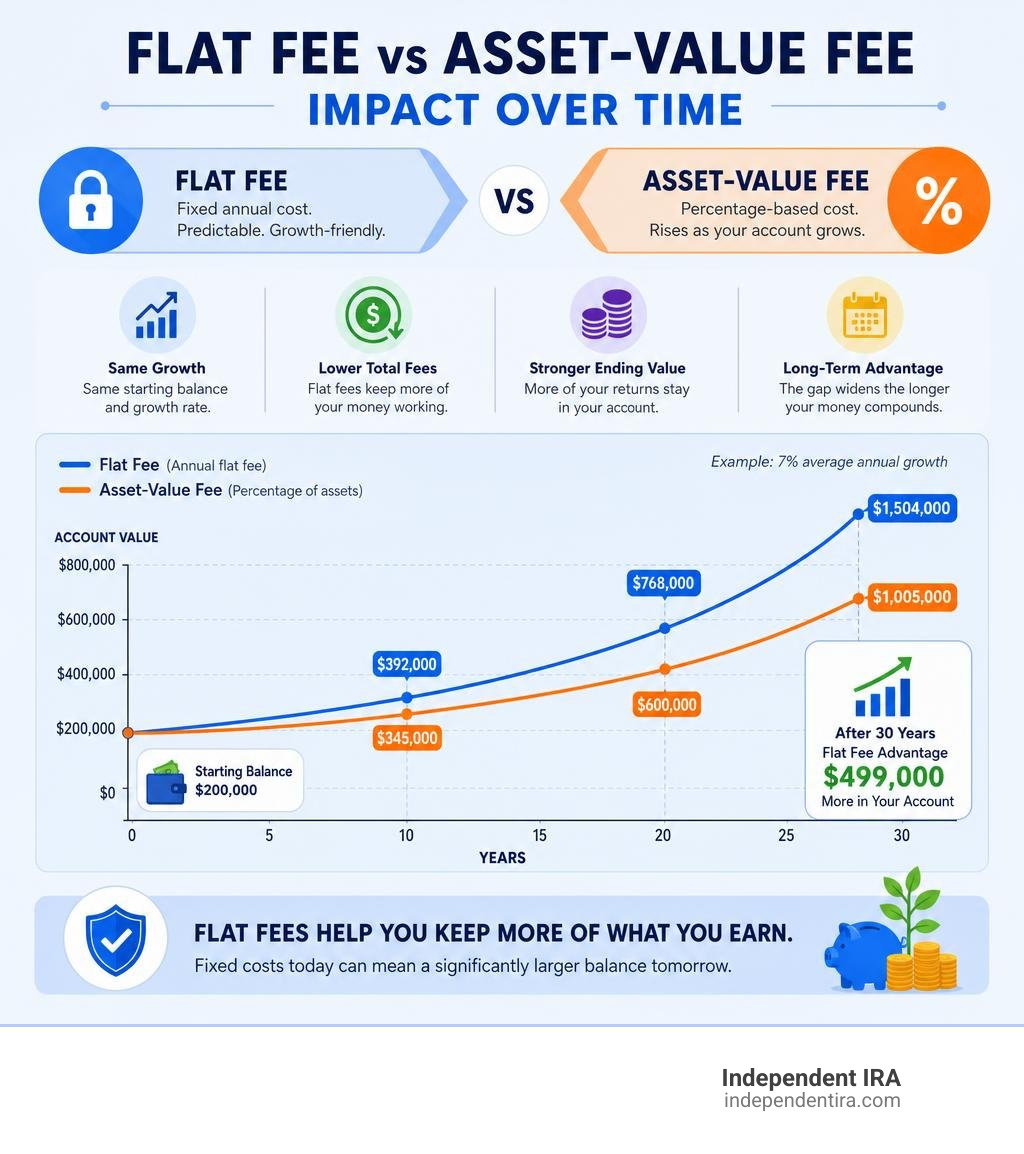
By choosing a flat-fee model, your overhead remains predictable whether your account holds $50,000 or $5,000,000. This structure keeps your operational costs fixed, allowing your account earnings to compound inside the tax-advantaged structure. If you want to maximize your compounding potential in tax-advantaged accounts, check out our guide on How to Make Your Roth IRA Work Harder Than You Do.
Reputation, Service, and Educational Support
Fee transparency is only part of the equation. Only 25% of SDIRA custodians provide comprehensive educational resources, yet 80% of investors consider this a key factor in their decision.
When evaluating potential providers, use this checklist:
- Service Responsiveness: Can you speak to a knowledgeable specialist when real estate escrow closes in 48 hours?
- Transaction Speed: What is the average turnaround time for processing investment direction forms?
- Educational Tools: Do they offer clear guides, investor paperwork, and clear compliance walkthroughs?
- Technology Platform: Can you track account balances, review transaction status, and submit digital forms through a secure portal?
As an Authorized Agent of Accuplan, Independent IRA, along with process experts like Brian Davis, focuses on responsive, personalized support to ensure your transactions proceed smoothly without unnecessary administrative delay.
Alternative Assets and Investment Restrictions
Approximately 60% of SDIRA holders prefer custodians that offer alternative asset support like real estate and cryptocurrency. However, not every custodian supports every type of non-traditional asset.
Real Estate, Crypto, and Private Equity Support
Alternative assets require different levels of administrative oversight and legal documentation:
- Real Estate: Includes residential rentals, commercial property, raw land, and tax deeds. The custodian must manage deeds, title documentation, and property expenses if you do not use a checkbook LLC structure. For deeper strategies on alternative structures, review our Beginners Guide to Self-Directed IRA Hedge Funds.
- Private Equity & Loans: Includes private placement memorandums (PPMs), start-up equity, private lending notes, and trust deeds.
- Cryptocurrency: Requires specialized digital asset storage solutions or direct integration with institutional crypto exchanges. If digital currency forms part of your strategy, read our page on Bitcoin IRA solutions or explore our Beginners Guide to Cryptocurrency Self-Directed IRA.
Account Minimums and Asset Limitations
While the IRS places few restrictions on what an IRA can own (excluding life insurance, collectables, and certain derivative contracts), individual custodians often impose their own internal rules.

Some custodians enforce minimum account balances (e.g., $10,000 to open) or refuse to custody specific high-risk assets like foreign real estate, physical precious metals, or unlisted private notes. Always confirm that your custodian accepts your target asset class before transferring funds.
Regulatory Compliance and Pitfalls to Avoid
Maintaining your IRA’s tax-deferred or tax-free status requires absolute adherence to Internal Revenue Code rules. A custodian will monitor basic documentation, but they will not act as your legal counsel.
Prohibited Transactions and IRS Compliance
The IRS strictly forbids self-dealing and transactions involving “disqualified persons.” Disqualified persons include:
- You (the account owner)
- Your spouse
- Your lineal ancestors (parents, grandparents)
- Your lineal descendants (children, grandchildren) and their spouses
- Entities (LLCs, corporations, trusts) in which any of the above hold a 50% or greater voting interest
Common prohibited transactions include buying a rental property using IRA funds and living in it, paying yourself a management fee for managing your IRA’s real estate, or selling personal assets to your IRA. Engaging in a prohibited transaction can invalidate your entire account as of January 1st of that tax year, triggering immediate income taxes and potential early withdrawal penalties.
Red Flags to Avoid When Choosing an SDIRA Custodian

Protect your retirement capital by avoiding providers that exhibit these warning signs:
- Vague or Complex Fee Schedules: Be cautious of providers that mask transaction fees behind confusing fine print.
- Unregulated Promoters Posing as Custodians: Third-party administrators (TPAs) can facilitate documentation, but your capital must ultimately reside with a licensed trust company or bank custodian.
- Unusually Slow Processing Windows: Delays in processing wire transfers can cause investors to miss real estate purchase windows or private equity funding deadlines.
- Promises of Guaranteed Yields: Custodians are administrative bodies. Any custodian or provider promising fixed returns is overstepping their legal bounds.
Verifying Licensing, Audits, and FDIC Insurance
To confirm that a custodian is legitimate and regulated:
- Verify Banking/Trust Charters: Ensure the custodian is chartered as a bank or trust company by a state banking authority or the Office of the Comptroller of the Currency (OCC). You can check the IRS list of Approved Nonbank Trustees.
- Review Insurance Coverage: Confirm the provider maintains adequate errors and omissions (E&O) insurance and fidelity bonding.
- Confirm Cash FDIC Protection: Uninvested cash awaiting deployment should be held in an FDIC-insured sweep account at a partner bank, protecting up to $250,000 per depositor.
Frequently Asked Questions About SDIRA Custodians
What is the average cost of an SDIRA custodian?
Average setup fees range from $50 to $150, while annual maintenance fees generally fall between $150 and $500. Depending on the provider, you may also encounter individual transaction fees (such as $25–$50 per wire or purchase execution). Choosing a flat-fee provider helps keep your administrative costs fixed as your account balance grows.
Can an SDIRA custodian offer checkbook control?
Yes. An SDIRA custodian can facilitate checkbook control by establishing a specialized single-member LLC owned by your IRA. The custodian transfers your account funds into the LLC’s bank account. You act as the manager of the LLC, allowing you to write checks and initiate wires directly for investments without needing individual custodian approval for each transaction.
How do I check if an SDIRA custodian is legitimate?
You can check if a provider is an approved nonbank trustee by consulting the official IRS list of nonbank trustees published on IRS.gov. You can also verify their financial license through the appropriate state banking commission or regulatory agency, and review their registration details on public state registers.
Before You Move Retirement Funds
Choosing an SDIRA custodian is the foundational step in taking control of your financial future. Selecting a provider with transparent flat fees, robust administrative support, and responsive service ensures that your focus remains where it belongs: evaluating prospective investment opportunities.
As an Authorized Agent of Accuplan, Independent IRA simplifies self-directed account setup and administration. Whether you are funding private notes, building a real estate portfolio, or setting up checkbook control, our team—along with process specialists like Brian Davis—provides the administrative foundation and support you need to execute your strategy seamlessly.
Ready to explore your options or transition away from restrictive brokerage accounts? Learn more about our complete account options on our Services page, explore the resources on our Blog, download necessary forms from our Documents section, or visit our About page to see how we empower account owners. If you have specific questions about your upcoming deal, Contact us today to discuss your goals with our team.
This content is for informational and educational purposes only and does not constitute legal, tax, or investment advice. Rules, limits, and requirements may change. Consult a qualified tax advisor, attorney, or financial professional before making retirement planning or investment decisions. Independent IRA is an Authorized Agent of Accuplan Benefits Services and is not a custodian or trust company.