

 GIVE US A CALL
Choosing the right private equity SDIRA custodian is crucial when you want to deploy retirement capital into private companies, real estate funds, or startup placements without violating strict IRS rules. A specialized SDIRA custodian acts as a non-discretionary, regulated institution that handles transaction processing, legal titling, document administration, and annual tax reporting for non-public assets. Working with a provider experienced in private placements helps support timely transaction funding and tax compliance administration. Take time to evaluate your self-directed IRA control options before committing retirement funds to an alternative asset.
Private equity can add diversification to a self-directed IRA, but it also introduces real compliance concerns: prohibited transactions, disqualified-person rules, valuation uncertainty, capital calls, and potential unrelated business taxable income. A capable custodian does not provide investment advice or eliminate those risks, but it provides the custodial framework needed to execute investments and maintain the account’s records.
Brian Davis and our team at Independent IRA provide this guide to explain how to evaluate custodial support for private equity while keeping your self-directed retirement strategy at the center of the decision.
What Is a Private Equity SDIRA Custodian and How Does It Work?
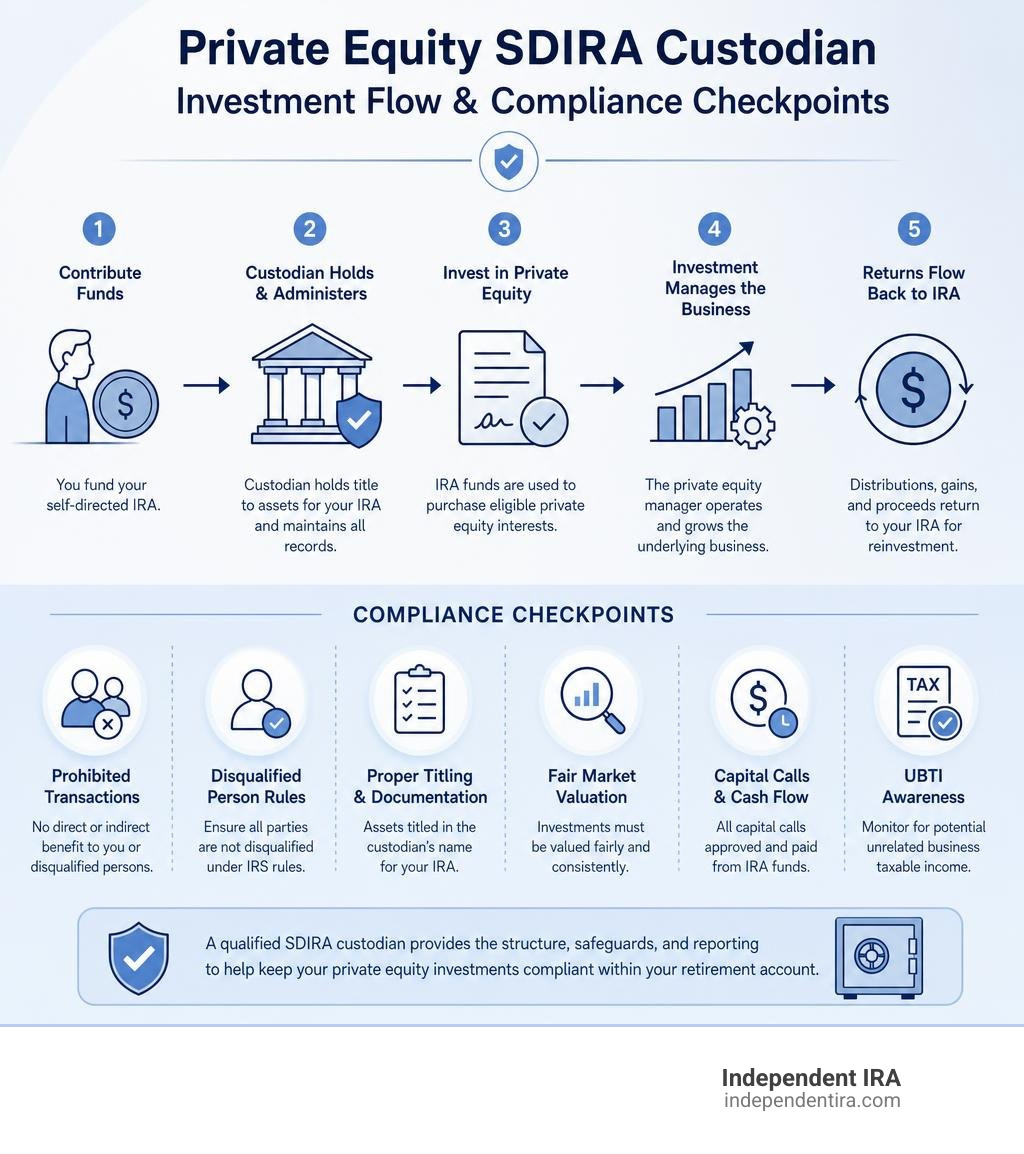
A private equity sdira custodian is a passive, non-discretionary financial institution chartered under state or federal banking laws to hold title to tax-advantaged retirement assets. Unlike wealth managers or standard brokerages, a self-directed IRA custodian does not manage your portfolio, evaluate the quality of a deal, or offer financial advice. Instead, at Independent IRA, an Authorized Agent of Accuplan Benefits Services, we focus on providing the essential structural framework, administrative recordkeeping, and IRS reporting that allow account holders to invest IRA dollars into IRS-permitted assets like private equity.
Under Internal Revenue Code Section 408, retirement funds must be held by a qualified trustee or custodian to maintain their tax-advantaged status. When you invest in private equity, the legal title of the share or membership unit is held in the name of the custodian for your account’s benefit (for example, Accuplan Benefits Services FBO [Your Name] IRA). This setup helps ensure that the line between personal wealth and tax-sheltered retirement capital stays legally distinct.
As of 2023, total assets in self-directed IRAs exceeded $1.2 trillion, with an increasing portion directed toward private markets. Industry surveys from the Retirement Industry Trust Association (RITA) show that approximately 5% to 10% of SDIRA holders now allocate capital to private equity investments. Furthermore, between 2020 and 2023, the number of SDIRA custodians supporting private equity transactions surged by 30% to meet this expanding investor appetite.
Traditional Custodians vs. SDIRA Custodians
The fundamental difference between a traditional brokerage custodian and a specialized SDIRA custodian boils down to asset permissible limits and administrative execution. Traditional custodians—such as retail brokerages—are optimized for liquid, exchange-traded paper securities like stocks, bonds, ETFs, and mutual funds. Their platforms rely on electronic settlement networks (like DTCC) that clear transactions in seconds.
By contrast, an SDIRA custodian specializes in alternative, non-exchange-traded illiquid assets. Investing in a private placement or venture startup requires handling customized operating agreements, subscription documentation, accredited investor verifications, and private capital call mechanics.
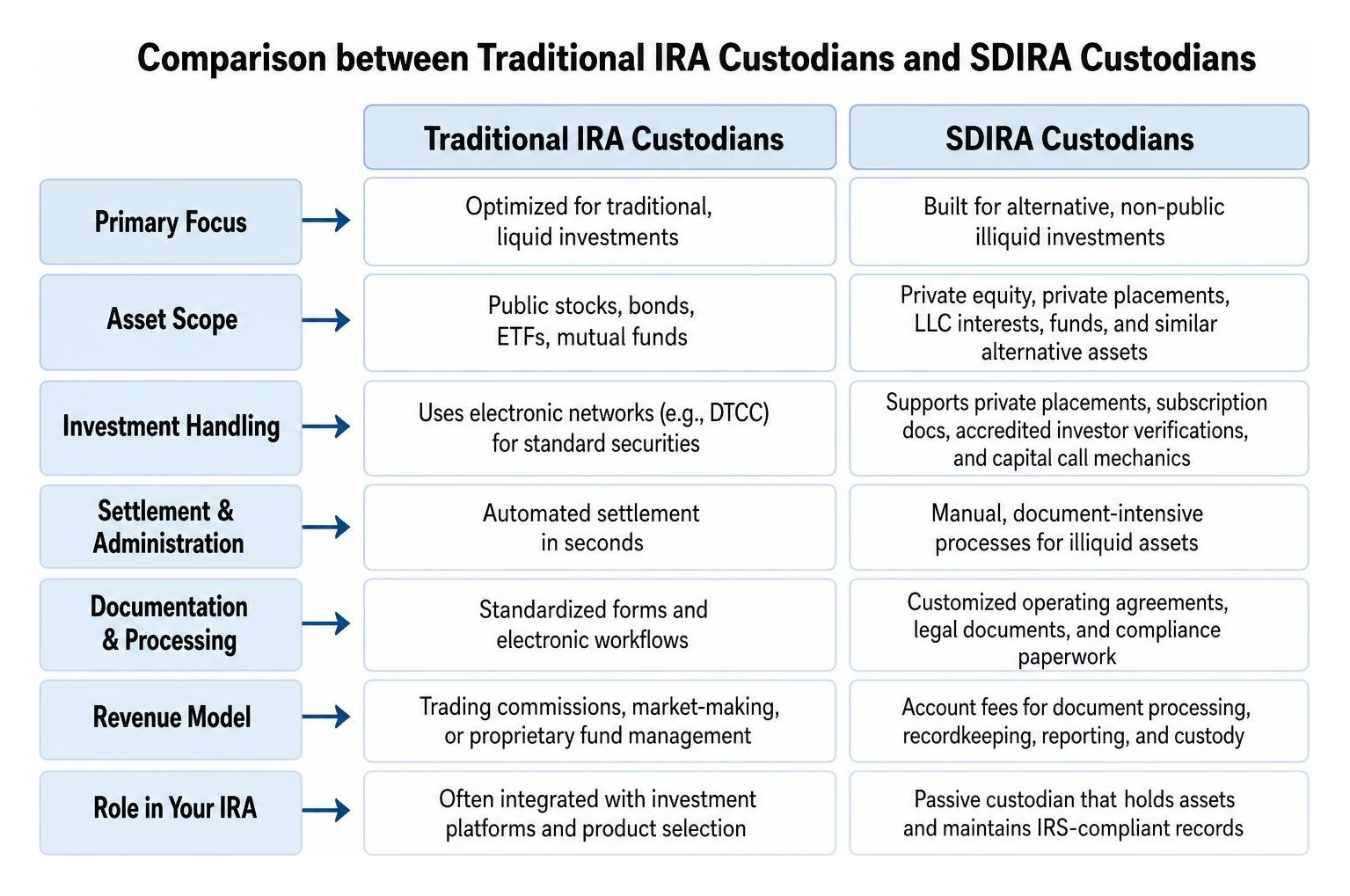
While traditional brokerages generate revenue through trading commissions, market-making, or managing proprietary funds, SDIRA custodians act strictly as administrative facilitators charging account fees for document processing, reporting, and asset custody. To dive deeper into taking ownership of your retirement choices, explore our overview of self-directed IRA control.
Key Responsibilities of a Private Equity SDIRA Custodian
While an SDIRA custodian never makes investment decisions for you, its operational execution is vital to keeping your account compliant with federal tax laws. The core duties include:
- Asset Titling and Document Execution: Ensuring all investment documents, subscription agreements, and stock certificates are properly drafted under the IRA’s official legal title.
- Transaction Execution & Wire Transfers: Disbursing retirement capital directly to private equity fund sponsors or companies upon receiving signed direction of investment (DOI) forms from the account owner.
- Recordkeeping & Account Administration: Documenting all income, distribution, capital calls, and corporate actions originating from the private equity entity.
- IRS Tax Reporting: Preparing and filing annual tax forms, specifically IRS Form 5498 (reporting the Fair Market Value and contributions) and IRS Form 1099-R (reporting distributions).
- Prohibited Transaction Safeguards: Performing basic administrative reviews of deal documentation to ensure no obvious self-dealing or disqualified parties are involved, though the ultimate legal responsibility remains with the account owner.
To see how specialized custody allows early-stage deal structuring, check out our insights on how to turn your ira into a startup investing machine.
Types of Private Equity Assets Held in a Self-Directed IRA
Private equity encompasses a wide spectrum of non-public investments, ranging from pre-seed tech companies to established private debt syndications. A 2022 survey revealed that 68% of SDIRA investors consider private equity a key strategy for diversifying their retirement portfolios beyond volatile public markets. While target return profiles and liquidity timelines vary across private equity asset classes, evaluating compliance rules is critical for every account holder.
The table below outlines the primary private equity asset classes, their general characteristics, and crucial SDIRA compliance rules:
| Private Equity Asset Class | Typical Target Return Profile | Liquidity Timeline | Key SDIRA Compliance Requirements |
|---|---|---|---|
| Venture Capital (VC) & Angel Investments | High risk / High growth potential | Long-term (7–10+ years) | Accredited status, valuation verification, zero self-dealing (disqualified parties) |
| Real Estate Syndications & Private Funds | Moderate growth & income potential | Medium-term (3–7 years) | UBTI tracking if debt-leveraged, strict distribution routing to IRA |
| Private Debt & Promissory Notes | Fixed income yield targets | Short to medium-term (1–5 years) | Promissory note titling, borrower independence, avoiding personal guarantees |
| LLC Membership Units / Growth Equity | Capital growth potential | Medium-term (5–8 years) | Form 990-T filing if active operating business, annual Fair Market Value (FMV) |
Venture Capital and Angel Investments
Venture capital and early-stage startup investing offer growth upside for Roth SDIRAs, where capital gains may compound and be withdrawn tax-free in retirement if qualifying distribution requirements are met. When participating in seed or Series A capital raises, the IRA purchases preferred equity or convertible notes directly from the startup.
However, angel investments come with strict regulatory guidelines. Issuers often require investors to meet “accredited investor” thresholds. Because the IRA is the purchasing entity, the IRA’s owner must meet accredited investor requirements, or the entity itself must qualify. Furthermore, IRA account holders cannot sit on the board of directors as a compensated officer or own a controlling interest (generally 50% or more) in the startup while holding shares through an IRA. For a broader look at private fund strategies, read our beginners guide to self-directed ira hedge funds.
Real Estate Funds and Private Lending Syndications
Real estate private equity (REPE) syndications and private debt funds are popular vehicles for SDIRA investors seeking cash flow and asset-backed equity potential. In a real estate syndication, the SDIRA buys class A or class B passive membership units in an LLC that owns multifamily, commercial, or industrial real estate.
Similarly, private lending involves using SDIRA funds to issue private mortgages or bridge loans to real estate investors. Yields generated from loan interest or cash flow distributions flow directly back into the tax-sheltered SDIRA account without triggering immediate personal tax obligations, provided all IRS rules are followed. For those interested in regional deal flow and note structuring, review our guide on private equity private lending san diego.
How to Evaluate and Select the Best Private Equity SDIRA Custodian

Selecting the right private equity sdira custodian requires looking far beyond marketing promises. Because private equity transactions involve tight funding deadlines, subscription agreements, and strict annual valuations, partner selection directly impacts your investment success.
Evaluating Fee Structures and Asset Servicing
Custodians generally charge for their services using one of two primary fee models: flat-rate pricing or asset-value pricing. Understanding how these fee structures interact with your private equity portfolio can save your IRA thousands of dollars over time.
- Flat-Rate Fee Model: The custodian charges a fixed annual fee per asset holding regardless of how much that asset appreciates. For example, whether your private equity stake is worth $20,000 or $500,000, the fee remains constant (e.g., $300–$400/year). This structure is ideal for high-value, high-growth private equity deals.
- Asset-Based Fee Model: The custodian charges a percentage sliding scale based on the overall value of your portfolio. While this can be cost-effective for small account balances (e.g., under $25,000), it penalizes high-performing private equity holdings as they appreciate.

In addition to annual maintenance fees, ask about transactional processing charges, wire fees, capital call processing fees, and document review costs. Transparent pricing ensures your investment yield stays inside your retirement account rather than getting chipped away by hidden costs.
Questions to Ask Before Choosing a Private Equity SDIRA Custodian
Before signing account creation forms or transferring funds, conduct diligence on potential custodians by asking these targeted questions:
- What is your turnaround time for subscription document reviews and wire disbursements? (Private equity deals often have strict capital closing windows; slow processing can cause you to miss deal allocations.)
- How do you handle capital call notices for private equity funds? (Ensure the custodian has a streamlined mechanism for processing secondary capital requests without unreasonable delays.)
- What are your exact requirements for annual Fair Market Value (FMV) updates? (Find out if they accept fund-issued K-1s or require expensive external valuation appraisals.)
- Do you provide dedicated account support or a generalized call center? (Having a single point of contact familiar with your deal documentation prevents repeated friction.)
Our team at Independent IRA provides full administrative transparency and responsive support to ensure your private asset transactions are executed smoothly. Explore our comprehensive services to see how we assist investors.
Navigating Tax Implications, UBTI, and Prohibited Transactions

While SDIRAs offer tax-deferred or tax-free growth, placing private equity inside an IRA does not grant complete immunity from all taxation or compliance regulations. Failing to structure a deal properly can result in unexpected tax liabilities or catastrophic disqualification of your entire IRA account.
Understanding Unrelated Business Taxable Income (UBTI)
Many investors mistakenly believe that income earned within an SDIRA is always completely tax-exempt. However, if your IRA invests in a private equity entity that generates Unrelated Business Taxable Income (UBTI) or uses debt financing (Unrelated Debt Financed Income – UDFI), the IRA itself may owe tax.
UBTI applies when an IRA earns active, non-passive income from an operating business held through a pass-through entity (such as an LLC or partnership operating a restaurant, retail business, or manufacturing firm). Pass-through passive income like interest, dividends, royalties, and real estate rents are generally exempt from UBTI.
If your private equity investment generates over $1,000 in gross UBTI in a tax year:
- The SDIRA must file IRS Form 990-T (Exempt Organization Business Income Tax Return).
- Tax must be paid directly out of the SDIRA’s cash funds (never from personal bank accounts).
- Rates for UBTI follow trust tax brackets, which reach top federal tax percentages quickly.
Understanding these tax rules allows you to model real net returns accurately before allocating capital.
Steering Clear of Prohibited Transactions
The IRS enforces Internal Revenue Code Section 4975 to prevent investors from using tax-advantaged accounts for personal, present-day benefit. A prohibited transaction occurs whenever there is a direct or indirect exchange of goods, services, money, or property between the SDIRA and a disqualified person.
Disqualified persons include:
- The IRA owner and their spouse
- Lineal descendants (children, grandchildren) and lineal ascendants (parents, grandparents) and their spouses
- Investment advisors, fiduciaries, or custodians servicing the account
- Entities (LLCs, corporations, trusts) where any of the above individuals own 50% or more of voting power or equity
Common private equity prohibited transaction traps include:
- Buying shares in your personal startup business using SDIRA capital.
- Receiving personal compensation or management fees from an LLC funded by your SDIRA.
- Personally guaranteeing a debt or loan taken out by a private equity entity owned by your IRA.
- Selling personally owned shares of a private company into your own SDIRA.
If a prohibited transaction takes place, the IRS deems the entire IRA distributed as of January 1st of that tax year. This triggers immediate income taxes and potential early withdrawal penalties across the entire account balance. To understand defensive account structures, explore our guide on how to stay crash proof with a self-directed iras.
Process for Funding, Valuations, and Managing Liquidity
Executing a private equity deal through an SDIRA requires precise administrative timing and coordination between you, the private equity fund manager, and our processing team at Independent IRA.
Step-by-Step Investment Execution Process
Below is the standard operational roadmap for directing your retirement funds into a private equity asset:
- Establish and Fund Your Account: Open a self-directed IRA through Independent IRA, an Authorized Agent of Accuplan Benefits Services, and initiate a tax-free trustee-to-trustee transfer or rollover from an existing traditional IRA, Roth IRA, or former 401(k).
- Review Deal Subscription Documents: Obtain the private placement memorandum (PPM), operating agreement, and subscription agreement from the private equity fund manager. Ensure the subscriber name is listed under your SDIRA’s full legal title.
- Submit Direction of Investment (DOI): Submit the completed deal documentation alongside our Direction of Investment form, explicitly instructing the processing team to facilitate the transaction.
- Administrative Review and Disbursement: Our processing team reviews the paperwork for proper titling and compliance formatting, then routes funds directly from your SDIRA account to the private equity deal’s escrow account.
- Asset Safekeeping and Archiving: The finalized stock certificate, LLC membership certificate, or signed operating agreement is maintained within your SDIRA administrative records.
When navigating deal structures, Brian Davis is available to support account holders through the operational setup process, ensuring documentation adheres to proper titling requirements. Learn how deal sponsors use these mechanisms by reviewing our guide on raising private capital iras.
Managing Valuations, Reporting, and Liquidity Constraints
Unlike publicly traded stocks with live market prices, private equity assets are inherently illiquid. However, the IRS requires your custodian to report the Fair Market Value (FMV) of your SDIRA every year on Form 5498.
- Annual FMV Requirements: The account owner must provide updated asset valuation documentation annually. For private equity funds, this is typically satisfied by submitting the end-of-year Schedule K-1, a certified letter from the fund’s chief financial officer, or an independent third-party valuation report.
- Managing Liquidity and Capital Calls: Many private equity vehicles utilize structured capital call schedules, requiring investors to supply committed capital over several years. Because you cannot write a personal check to satisfy a capital call without causing a prohibited transaction, your SDIRA must hold sufficient uninvested cash reserves to cover incoming calls.
- Required Minimum Distributions (RMDs): Traditional SDIRA holders reaching age 73 (or applicable legal age) must take annual RMDs. Holding illiquid private equity can make RMD compliance challenging if there is insufficient liquid cash in the account. Potential solutions include taking in-kind asset distributions or using cash flow generated from other holdings to satisfy the RMD.
Frequently Asked Questions
What is UBTI and how does it affect private equity in an SDIRA?
Unrelated Business Taxable Income (UBTI) is tax imposed on exempt organizations and IRAs when they earn income from an active trade or business conducted through pass-through entities (like an active LLC), or through debt-financed investments (UDFI). If your SDIRA earns more than $1,000 in gross UBTI in a tax year, the IRA must file IRS Form 990-T and pay tax using trust rates directly out of account cash reserves.
Can I use a checkbook control LLC for private equity investments?
Yes. By establishing a specialized single-member LLC owned by your SDIRA (often called a “Checkbook Control IRA”), the IRA invests capital into the LLC, and you serve as the non-compensated manager. This arrangement allows you to write checks or wire funds directly from the LLC bank account to participate in private placements without waiting for custodian document reviews for every capital call. However, strict adherence to prohibited transaction rules remains fully applicable.
How are capital calls handled by an SDIRA custodian?
When a private equity fund issues a capital call, the notice must be forwarded to your SDIRA custodian alongside a formal funding request (unless using a Checkbook LLC setup). The custodian then processes the wire out of the uninvested cash sitting in your SDIRA account. It is critical to keep a cash cushion inside your SDIRA so capital calls can be funded promptly without defaulting on deal commitments.
Before You Move Retirement Funds into Private Equity
Directing self-directed retirement funds into private equity offers a strategy for building tax-advantaged wealth, but it demands precise operational execution and strict regulatory adherence. Choosing an experienced, transparent, and responsive partner ensures that your account paperwork is handled accurately, fees are predictable, and account administration is maintained properly at every turn.
Whether you are evaluating angel investments, venture funds, or real estate syndications, Independent IRA provides the robust administrative framework and dedicated support you need to maintain control over your financial future.
Ready to expand your retirement options? Contact us today to speak with our specialists and learn how to position your self-directed account for private market opportunities.
This content is for informational and educational purposes only and does not constitute legal, tax, or investment advice. Rules, limits, and requirements may change. Consult a qualified tax advisor, attorney, or financial professional before making retirement planning or investment decisions. Independent IRA is an Authorized Agent of Accuplan Benefits Services and is not a custodian or trust company.