

 GIVE US A CALL
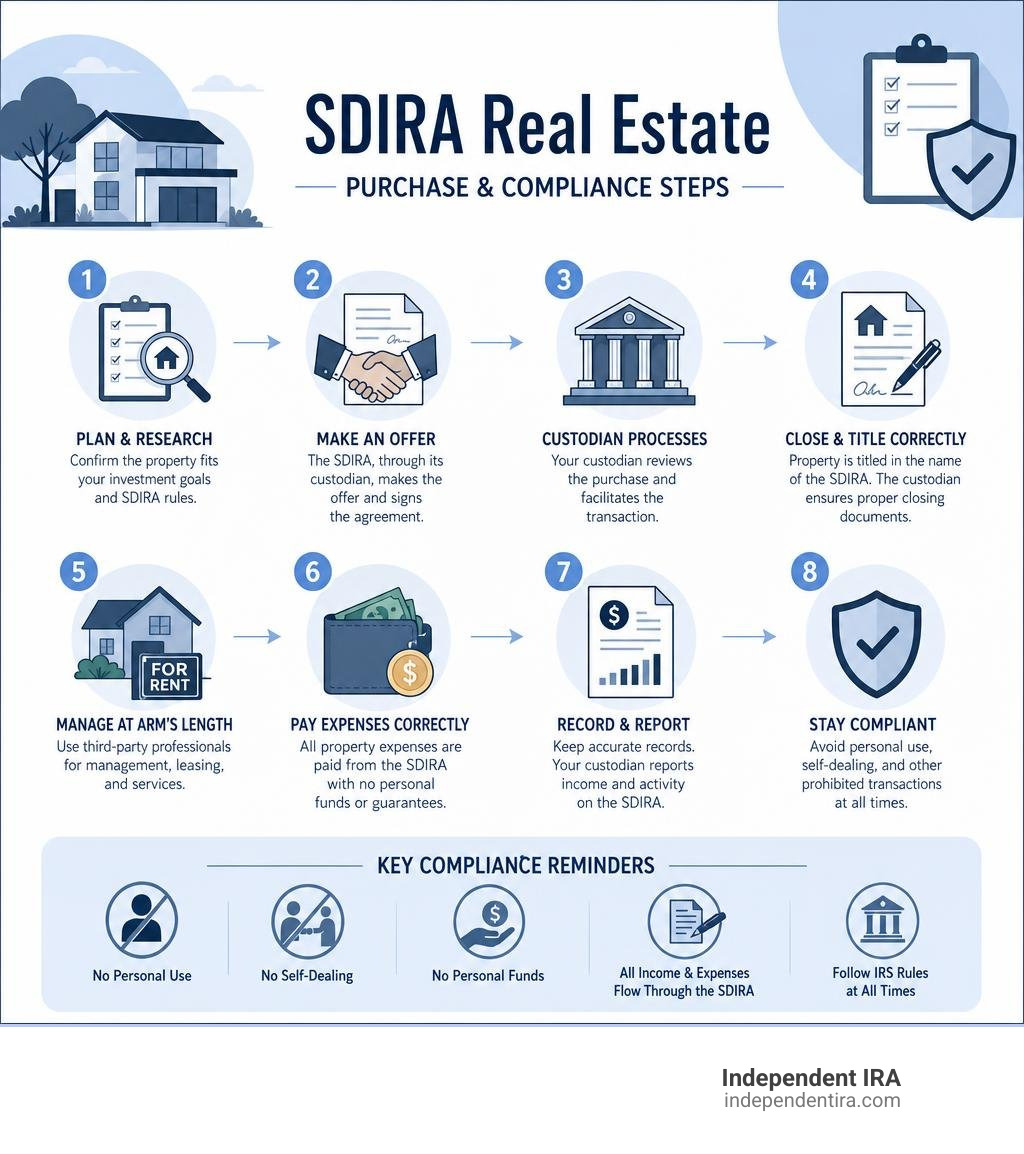
SDIRA real estate investments let you use retirement funds to buy and hold investment property, but the IRA – not you personally – must own the asset and pay every related expense. For investors who want more control than a standard brokerage IRA provides, a self-directed IRA can hold eligible rentals, commercial property, land, and other alternative real estate assets. The tradeoff is strict compliance: personal use, self-dealing, incorrect titling, or paying a property bill from personal funds can put the IRA’s tax treatment at risk. This guide from Independent IRA explains the essential rules, starting with how self-directed IRA control works in practice.
I am Brian Davis, and next we will look at how a self-directed IRA differs from a traditional IRA and what that difference means for real estate ownership.
What is an SDIRA and How Does It Fuel SDIRA Real Estate Investments?
Most investors think of Individual Retirement Accounts (IRAs) purely as vehicles for Wall Street assets like mutual funds, exchange-traded funds (ETFs), and stocks. Standard custodians, such as large brokerages or traditional banks, limit account holders to these publicly traded options because their infrastructure is designed for liquid securities. However, IRS regulations do not restrict IRAs to paper assets.
A Self-Directed IRA (SDIRA) is legally structured under the exact same Internal Revenue Code rules as a standard IRA—whether structured as a Traditional tax-deferred IRA or a Roth IRA. As an Authorized Agent of Accuplan Benefits Services, Independent IRA assists account holders who wish to direct capital into non-traditional IRS-permitted assets, with real estate being a common choice among self-directed investors.
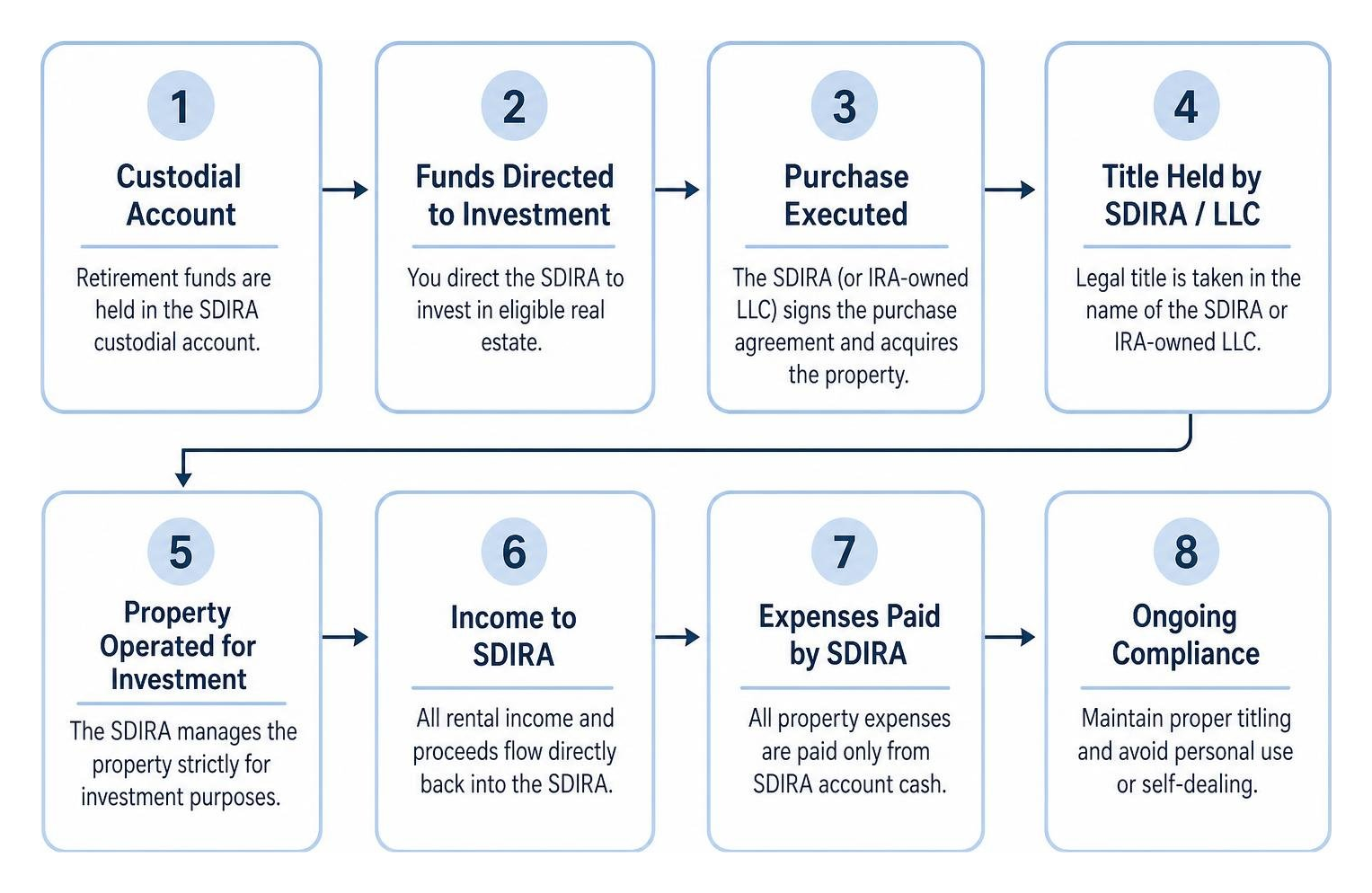
When you engage in sdira real estate investments, your self-directed account serves as the legal investor. The financial mechanics change significantly from traditional property ownership:
- Purchasing Power: Capital is transferred or rolled over penalty-free from existing retirement accounts into the SDIRA.
- Asset Ownership: The SDIRA holds legal title to the real estate, not you individually.
- Cash Flow Direction: Rental payments, dividend distributions, or sales proceeds flow directly back into the tax-sheltered SDIRA.
- Expense Funding: Every bill (property taxes, maintenance, contractor bills, insurance) must be paid exclusively out of SDIRA account cash.
To streamline transactions and avoid transaction delay fees from direct custodian sign-offs, many real estate investors utilize a Checkbook Control IRA structure (often organized as an SDIRA-owned Single-Member LLC). Under this model, the IRA purchases 100% membership interest in an LLC, opening an LLC checking account that allows the investor to execute contracts and write checks immediately for earnest money or urgent property upkeep.
Eligible Property Types for SDIRA Real Estate Investments
The scope of real estate holdings allowed inside a self-directed retirement account is exceptionally broad. So long as the property is held strictly for investment purposes and avoids prohibited personal benefit, the IRS permits a vast spectrum of real estate structures:
- Single-Family and Multi-Family Rentals: Single-family residential homes, duplexes, triplexes, and apartment complexes generating recurring rental income.
- Commercial Real Estate: Strip malls, office buildings, industrial warehouses, and self-storage facilities leased to commercial tenants.
- Raw Land and Farmland: Undeveloped parcels, agricultural land, timberland, or residential lots held for long-term land appreciation or development.
- Alternative Real Estate Assets: Boat slips, mobile home parks, and specialized agricultural real estate.
- Tax Liens and Mortgage Debt: Purchasing tax certificates, trust deeds, or private notes. Investors interested in local tax certificate opportunities can explore our resource on Tax Liens Tax Deeds San Diego.
Whether acquiring a suburban rental or commercial industrial space, the fundamental rule remains standard across all asset classes: the property must function solely as a passive investment yielding returns to the retirement account.
Financing Options and Loans for SDIRA Real Estate Investments
While acquiring property outright with 100% cash from your retirement account is the simplest path, investors can also leverage their purchase using debt financing inside an SDIRA. However, traditional conventional mortgages are completely prohibited because IRS rules strictly forbid an account holder from personally guaranteeing a loan tied to their retirement account.
To finance sdira real estate investments, the IRA must use a non-recourse loan.
- How Non-Recourse Mortgages Function: A non-recourse loan is secured strictly by the property itself. In the event of default, the lender’s only remedy is foreclosing on the real estate asset; they have no legal right to seek personal liability from the IRA owner or seize other assets within the IRA.
- Loan-to-Value (LTV) Requirements: Because non-recourse loans carry higher risk for lenders, expected loan-to-value ratios are typically conservative, usually requiring down payments between 30% and 50% from the IRA’s liquid balances.
- Debt Instruments: Investors can also structure private debt instruments or promissory notes directly. To understand debt mechanics in detail, consult The Real Estate Investors Guide to IRA Promissory Notes.
Leveraging property within an SDIRA introduces specific tax considerations, such as Unrelated Debt-Financed Income (UDFI), which we analyze in depth later in this guide.
Essential Rules, Restrictions, and Prohibited Transactions

The tax advantages offered by an SDIRA are governed by strict federal compliance rules defined in Internal Revenue Code Section 4975 and Section 4.72.11.2.1 of the Internal Revenue Manual. Failing to maintain absolute separation between personal finances and retirement assets can result in the disqualification of the entire IRA, subjecting the full balance to immediate income taxes and applicable early withdrawal penalties.
The foundation of IRS compliance revolves around avoiding self-dealing and interactions with disqualified persons.
The IRS defines disqualified persons to include:
- The IRA account holder and their spouse.
- Lineal ancestors (parents, grandparents).
- Lineal descendants (children, grandchildren) and their spouses.
- Investment advisors, custodians, managers, or entities where any of these individuals own or control 50% or more of voting equity.
Crucially, brothers, sisters, aunts, uncles, and cousins are not considered disqualified persons under tax code rules, though transactions involving family members should always be evaluated carefully for potential indirect self-dealing.
Prohibited transactions occur whenever an SDIRA interacts directly or indirectly with a disqualified person. Examples include:
- Selling an existing personal rental property to your SDIRA.
- Buying a property using SDIRA capital and leasing it to your daughter or parents.
- Staying at a vacation rental property owned by your SDIRA, even for a single weekend. To review property use limits, read Why Your IRA Property Isn’t Your Vacation Home.
- Borrowing money from or extending credit to your SDIRA.
Property Titling and Account Ownership Mechanics
To preserve legal separation between the individual and the tax-advantaged account, real estate deeds and titling documents must never feature your personal name as the direct owner. The legal owner on record must explicitly state the custodial relationship.
Standard custodial titling formatting appears as follows: [Name of Custodian] Custodian FBO [Your Name] IRA
For instance, an account established through Accuplan Benefits Services on behalf of investor Jane Doe would be titled: Accuplan Benefits Services Custodian FBO Jane Doe IRA
When executing contracts, purchase agreements, and closing deeds, the account holder signs purely as an authorized representative for the custodial account rather than as an individual buyer.
| Feature / Execution Method | Direct Custodian SDIRA Purchase | Checkbook Control SDIRA LLC |
|---|---|---|
| Legal Title Holder | Accuplan Benefits Services Custodian FBO [Name] IRA | [LLC Name], a Single-Member LLC |
| Transaction Approval | Custodian processes and approves every wire/check | Account holder writes checks or wires funds directly |
| Closing Speed | Subject to custodial review processing times | Immediate closing capacity via local LLC bank account |
| Administrative Fee Overhead | Per-transaction custodial transaction fees | Initial setup fee + minimal recurring state maintenance fees |
| Checkbook Control | No (Custodian signs all purchase documents) | Yes (Manager executes purchase agreements directly) |
Managing, Maintaining, and Selling Property Inside an IRA

Operating a physical real estate asset inside a retirement account requires diligent accounting and operational oversight. Because you cannot mix personal funds with IRA funds, every single expense incurred by the property—annual property taxes, structural repairs, property management fees, homeowners association (HOA) dues, and insurance premiums—must be paid directly from funds residing within the SDIRA.
Similarly, all income generated by the real estate must be deposited directly into the SDIRA bank account without passing through personal accounts.
Key management considerations include:
- No Sweat Equity: Account holders cannot perform physical repairs, painting, roof maintenance, or construction work on an SDIRA property. All labor must be hired out to third-party, arms-length contractors paid directly from IRA funds.
- Property Management: While an investor can perform administrative tasks like screening third-party contractors or selecting tenants, employing a professional property management company is common to keep operation hands-off and fully compliant.
- Maintaining Liquidity Buffers: One of the most dangerous operational hazards in sdira real estate investments is unexpected capital expenditures (such as a roof failure) when the SDIRA holds insufficient liquid cash. If account holders pay for repairs using out-of-pocket personal money, the IRS views this as an illegal excess contribution or prohibited self-dealing transaction.
To ensure your account maintains adequate cash reserves for capital maintenance, assess your readiness using our guide: Is Your IRA Ready to Become a Landlord?.
Tax Implications: UBTI, UDFI, and Sale Distribution Protocols
While SDIRAs offer tax-deferred or tax-free growth (in Roth accounts), certain real estate scenarios trigger internal tax obligations governed by Section 511 of the IRS Internal Revenue Code:
- Unrelated Business Taxable Income (UBTI): UBTI applies if an IRA conducts an active trade or business, such as buying land to construct new housing subdivisions or running a hotel. Passive real estate rentals are generally exempt from UBTI.
- Unrelated Debt-Financed Income (UDFI): If an SDIRA uses non-recourse debt financing to purchase property, the portion of profits attributable to the leveraged debt is subject to UDFI tax. For instance, if an IRA funds 40% of a property purchase with cash and 60% with a non-recourse mortgage, 60% of the net rental income and 60% of capital gains upon sale are subject to tax at trust tax rates.
When an SDIRA sells real estate, proceeds flow tax-sheltered directly back to the custodian account balance:
- Traditional SDIRA: Capital gains and accumulated rental income remain tax-deferred until distributions begin in retirement.
- Roth SDIRA: Capital gains and earnings grow completely tax-free, and distributions after age 59½ (with account age rules met) are drawn entirely tax-free.
Weighing the Advantages and Disadvantages of Real Estate in Retirement
Holding physical real estate inside an SDIRA offers unique diversification benefits, but it also alters some traditional tax advantages of property ownership.
Key Advantages Explained:
- True Asset Diversification: Real estate provides direct insulation against stock market volatility. Market fluctuations can impact paper portfolios, and alternative assets act as a tangible hedge. Learn more about navigating market corrections in Crash Proof with a Self-Directed IRAs.
- Potential Tax Advantages: Instead of paying immediate state and federal capital gains taxes on rental dispositions, returns may compound on a tax-deferred or tax-free basis inside the account.
- Inflation Protection: Rental rates and property values historically rise with broader inflation, which may help protect long-term purchasing power.
Key Disadvantages Explained:
- Forfeiture of Personal Tax Deductions: Standard real estate investors rely heavily on mortgage interest deductions, property tax write-offs, and depreciation offsets against active personal income. Properties held inside an SDIRA forfeit all personal tax deductions.
- Illiquidity and Market Timing: Physical real estate cannot be converted to cash instantly. If an investor reaches Required Minimum Distribution (RMD) age and holds illiquid real estate, they must either sell property or distribute fractional property ownership in-kind, which involves complex valuations.
Frequently Asked Questions About SDIRA Real Estate
Who qualifies as a disqualified person under IRS SDIRA rules?
A disqualified person includes the SDIRA account holder, their spouse, lineal ancestors (parents, grandparents), lineal descendants (children, grandchildren) and their spouses, as well as any fiduciaries or entities where these individuals maintain a controlling 50% or greater ownership interest.
Can account holders perform sweat equity on an SDIRA property?
No. Account holders and disqualified family members cannot perform direct physical labor, construction, renovations, or maintenance work on an SDIRA property. Doing so constitutes a prohibited transaction under IRS rules. All repairs and maintenance must be performed by independent third-party contractors paid directly from SDIRA account funds.
What happens when an SDIRA sells a real estate holding?
When an SDIRA sells real estate, all sale proceeds—including principal return and capital gains—are wired directly into the SDIRA custodial account. No personal taxes are owed at the time of sale. The capital can immediately be reinvested into other real estate assets, private debt, or standard securities within the tax shelter.
Before You Move Retirement Funds
Investing in real estate through a Self-Directed IRA can transform your retirement strategy by unlocking high-performing real estate markets while retaining tax advantages. However, navigating disqualified person rules, non-recourse loan requirements, and proper custodial titling demands absolute compliance and attention to detail.
As an Authorized Agent of Accuplan Benefits Services, Independent IRA helps you navigate self-directed IRA structures and specialized legal entity setups for checkbook control.
To explore setting up a self-directed structure tailored to your strategy, learn more about our local services at Self-Directed IRA San Diego or contact our team today to establish your account.
This content is for informational and educational purposes only and does not constitute legal, tax, or investment advice. Rules, limits, and requirements may change. Consult a qualified tax advisor, attorney, or financial professional before making retirement planning or investment decisions. Independent IRA is an Authorized Agent of Accuplan Benefits Services and is not a custodian or trust company.