

 GIVE US A CALL

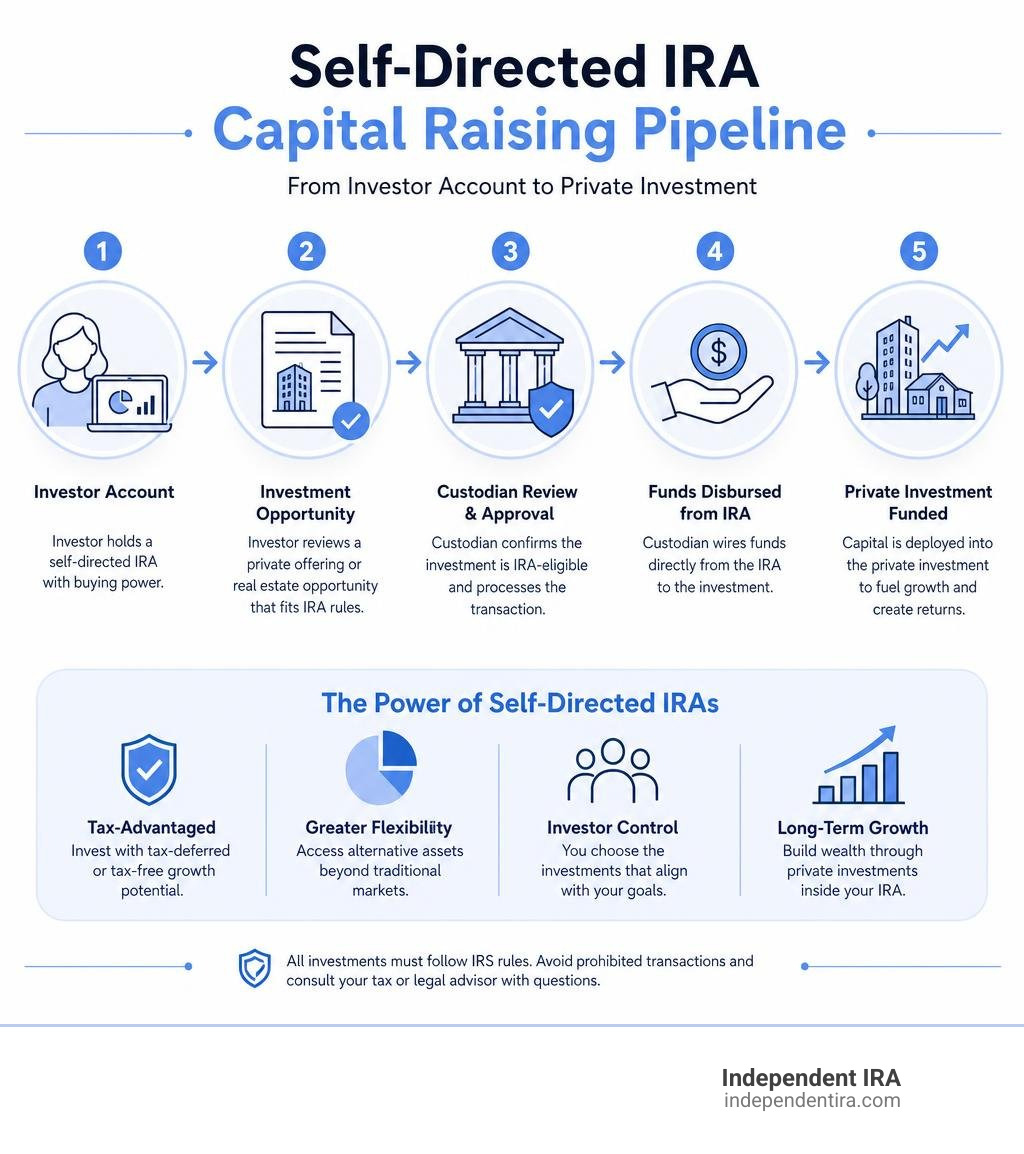
Raising capital with self-directed IRAs lets businesses, real estate sponsors, and private funds access retirement dollars that investors can direct beyond the limited menu of public stocks and mutual funds. For investors, it can mean placing retirement funds into a private offering, real estate deal, or lending opportunity, provided the structure follows IRA rules and the account custodian processes the investment correctly. Self-directed IRAs represent a substantial alternative-investment capital pool, with industry estimates placing assets above $1 trillion; learn more about raising private capital with IRAs before accepting retirement-account funds.
The opportunity comes with real responsibilities. Sponsors need an IRA-compatible subscription and funding process, while investors must avoid prohibited transactions, evaluate illiquid assets carefully, and maintain supportable annual valuations. This guide explains the practical path from investment offer to custodian-funded capital, including the compliance issues that can determine whether a deal remains retirement-account eligible.
I am Brian Davis, and I will walk you through how Independent IRA, an Authorized Agent of Accuplan Benefits Services, helps investors and capital raisers navigate this process with clarity.
Fundamentals of SDIRA Capital Raising
Understanding Self-Directed IRAs vs Traditional IRAs
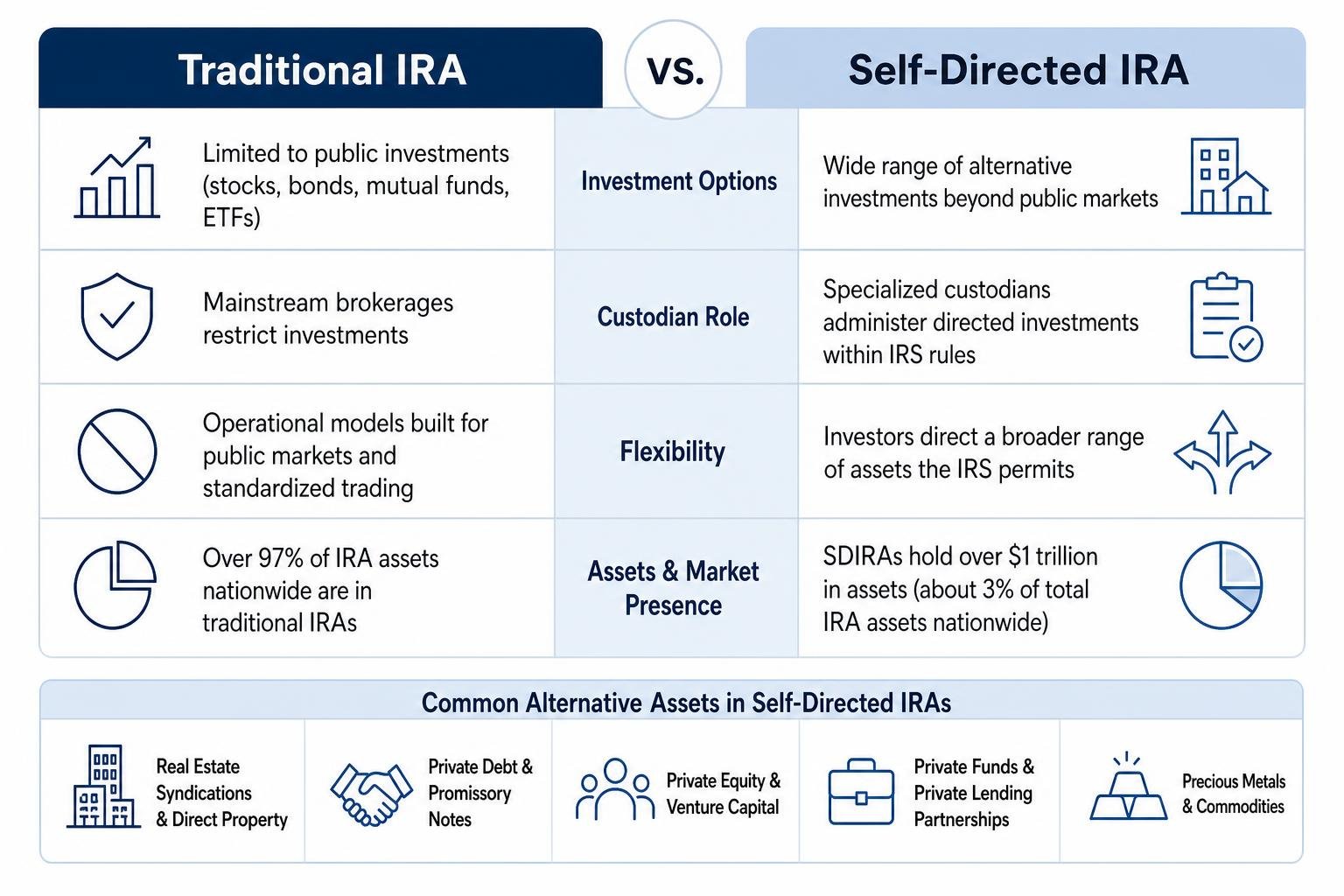
When capital raisers begin exploring retirement money, they often ask why standard brokerage accounts cannot easily participate in private offerings. The primary difference lies in administrative permission, not tax code fundamentals. Both traditional IRAs and Roth IRAs are tax-advantaged accounts governed by Internal Revenue Code Section 408. However, mainstream custodians—such as large commercial brokerages—restrict account holders to publicly traded stocks, bonds, mutual funds, and ETFs. Their operational business models rely on standardized automated clearing houses and high-volume trading desks.
In contrast, a self-directed IRA (SDIRA) is held by a specialized qualified custodian or administrator that permits a wide spectrum of alternative investments. Industry data indicates that SDIRA accounts have grown by more than 20% annually in recent years as investors seek portfolio diversification away from public markets. While self-directed IRAs hold over $1 trillion in total assets, this still represents approximately 3% of all total IRA funds nationwide. This gap represents a vast capital reserve for fund managers and syndicators.
At Independent IRA, an Authorized Agent of Accuplan Benefits Services, we emphasize that the legal tax wrapper remains the same whether an account is traditional or self-directed. What changes is administrative control and investment eligibility. In a traditional brokerage IRA, the custodian acts as a gatekeeper limiting investment types. In a self-directed IRA, the custodian acts as an administrator processing the specific directed instructions of the account holder, as long as those instructions adhere to federal tax law. For sponsors, tapping into this market requires recognizing that investors hold purchasing power, but transactions require specific administrative workflows. To understand how to structure your fund to attract these investors, explore our dedicated resource on raising private capital IRAs.
Eligible Alternative Assets for Raising Capital with Self-Directed IRAs
The IRS does not actually maintain a master list of IRS-permitted assets for IRAs. Instead, federal tax law outlines what IRAs cannot hold (specifically life insurance policies and collectibles such as artwork, rugs, or certain stamps). Consequently, almost any legitimate investment vehicle structured through proper legal entities can accept capital from a self-directed IRA.
When raising capital with self-directed IRAs, fund managers and deal sponsors commonly utilize the following asset classes:
- Real Estate Syndications and Direct Property: Real estate accounts for a major portion of self-directed IRA assets. SDIRAs can buy commercial buildings, single-family residential rentals, multi-family syndications, tax deeds, and raw land.
- Private Debt and Promissory Notes: Account holders frequently act as direct private lenders. They fund secured trust deeds, mortgages, corporate notes, or unsecured private debt. To learn how private debt deals are executed through retirement accounts, see our AZ Guide to Private Lending with IRA.
- Private Equity and Venture Capital: Startup founders and growth-stage companies can accept seed investments, convertible notes, or preferred equity directly from SDIRA investors. For step-by-step detail on early-stage equity funding, review our guide on how to turn your IRA into a startup investing machine.
- Private Funds and Private Lending Partnerships: Hedge funds, private equity funds, and specialized debt funds can structure subscription documents for IRA capital. You can explore private debt capital structures with our resource on private equity private lending San Diego.
- Precious Metals and Commodities: SDIRAs can hold physical gold, silver, platinum, or palladium bullion meeting specific fineness standards, stored in approved IRS depositories.
By widening your capital search to include these asset categories, deal syndicators open their offerings to high-net-worth investors whose liquid reserves are sitting inside retirement accounts.
Key Rules, Custodians, and Due Diligence when Raising Capital with Self-Directed IRAs
The Crucial Role of Qualified Custodians
A common misconception among capital raisers is that an investor can simply write a personal check from their IRA to a fund. Under federal law, IRA assets must be held by a qualified custodian—a bank, trust company, or IRS-approved non-bank custodian.
The qualified custodian performs essential operational and legal functions:
- Asset Custody and Holding Title: The asset is legally titled in the name of the custodian for the benefit of (FBO) the investor’s IRA (for example, “Custodians Name FBO John Doe IRA #12345”).
- Transaction Execution: The custodian executes buy-and-sell orders, transfers wires to private placement escrow accounts, and receives returns or dividends back into the account.
- Tax Reporting: The custodian files annual IRS reports, including Form 5498 (fair market value and contributions) and Form 1099-R (distributions).
- Regulatory Compliance: Custodians perform basic administrative checks to ensure transaction documentation satisfies custodial requirements before dispersing funds.
Capital raisers must realize that custodians do not offer financial advice, endorse offerings, or conduct investment due diligence. The custodian’s role is strictly administrative. Independent IRA is an Authorized Agent of Accuplan Benefits Services and is not a custodian or trust company. Our team works directly with sponsors and account holders to ensure document packages meet custodial standards without administrative friction. You can review our full suite of account administration capabilities on our services page.
Navigating Prohibited Transactions and Disqualified Persons
The single greatest threat to an SDIRA investment is IRC Section 4975, which outlines prohibited transactions. A prohibited transaction occurs when an IRA engages in a direct or indirect transaction with a “disqualified person.”
If a prohibited transaction occurs, the IRA loses its tax-exempt status as of January 1st of that tax year. The entire account is deemed distributed, triggering immediate income tax and potential early withdrawal penalties for the investor.

Disqualified persons include:
- The IRA owner and their spouse.
- Direct ancestors (parents, grandparents) and direct lineal descendants (children, grandchildren) and their spouses.
- Investment advisors, managers, or custodians servicing the account.
- Entities (Corporations, LLCs, Partnerships) where disqualified persons own 50% or more of voting power or equity.
- Officers, directors, or 10% or greater shareholders of such entities.
Key prohibited transactions to avoid when raising capital with self-directed IRAs:
- Self-Dealing: An IRA owner cannot invest IRA funds into a business or deal where they or a disqualified relative own 50% or more, or where they receive personal compensation.
- Direct Benefits: The IRA owner cannot receive immediate personal benefit from an IRA asset (e.g., staying in a rental property owned by their IRA).
- Personal Guarantees: An IRA owner cannot personally guarantee a loan for an IRA investment. Any debt must be strictly non-recourse.
- Sweat Equity: The IRA owner cannot perform uncompensated physical labor or personal services for an asset owned by the IRA.
For capital raisers, ensuring that your investors are not disqualified persons relative to your entity is critical to preserving their capital.
Valuations and Investor Due Diligence
Unlike publicly traded stocks, private assets do not have live ticker symbols. However, the IRS requires qualified custodians to report the Fair Market Value (FMV) of all IRA assets annually on Form 5498.
Sponsors accepting SDIRA capital must be prepared to supply annual valuation updates to their investors. This typically requires:
- Independent Appraisals or Certified Valuations: For real estate or complex operating companies, an annual valuation provided by a qualified independent party.
- K-1 or Manager Valuation Statements: For LLCs or private equity funds, a certified statement from the fund manager outlining the net asset value (NAV) per unit as of December 31st.
Additionally, because custodians do not review deals for financial viability, investor due diligence falls entirely on the account holder. Independent IRA assists account holders by reviewing account control mechanics so that investors retain direct visibility over their capital commitments. Learn more about maintaining account oversight through our resource on self-directed IRA control.
Step-by-Step Process and Tax Structure for Capital Raisers
Structuring Offers and Onboarding SDIRA Investors
To efficiently accept capital from self-directed IRAs, sponsors should establish a streamlined onboarding process. Converting a prospective retirement investor requires coordination between the sponsor, the investor, and the IRA administrator.

Here is the standard step-by-step workflow:
- Offering Memorandum Alignment: Ensure your Private Placement Memorandum (PPM), Operating Agreement, or Subscription Agreement contains standard language allowing entity ownership by retirement trust custodians.
- Custodian Account Setup: The investor opens and funds an account with a qualified custodian. If transferring funds from a standard IRA or rolling over an old 401(k), this step can take 1 to 3 weeks.
- Checkbook IRA Entity Setup (Optional): Investors who want real-time funding control often utilize a Checkbook IRA setup. In this structure, the IRA owns 100% of a newly formed LLC, and the investor serves as the manager of that LLC. When you present an investment opportunity, the Checkbook IRA LLC writes a check or wires funds directly from its business bank account, skipping individual custodian approval delays for every trade. To explore setup options, review our dedicated Checkbook IRA services.
- Document Execution: Subscription documents are signed. For standard SDIRAs, the custodian signs the documents on behalf of the IRA. For Checkbook IRAs, the investor signs as the Manager of the IRA-owned LLC.
- Funding the Deal: The custodian or Checkbook LLC wires funds to the deal’s escrow or corporate bank account. Detailed instructions on managing these workflows can be found in our comprehensive resource on raising private capital with IRAs.
Our team, supported by process expertise from specialists like Brian Davis, guides sponsors through configuring subscription documents to prevent administrative rejections at the custodian level.
Managing UBIT and UDFI Tax Implications
While IRAs may offer tax advantages such as tax-deferred or tax-free growth potential, two federal tax provisions can create tax liabilities inside an SDIRA: Unrelated Business Income Tax (UBIT) and Unrelated Debt-Financed Income (UDFI).
- Unrelated Business Income Tax (UBIT): If an IRA invests in an active trade or business through a pass-through entity (such as an LLC or partnership operating a service firm or manufacturing business), the profit generated is considered active business income rather than passive investment income. The earnings above the annual threshold are subject to UBIT, taxed at trust tax rates.
- Unrelated Debt-Financed Income (UDFI): When an IRA uses leverage (debt) to acquire an asset—such as securing a non-recourse loan for a multi-family property syndication—the portion of income generated by the leveraged capital is subject to UDFI under IRC Section 514.
For example, if an IRA purchases a $1,000,000 property using $500,000 in IRA equity and $500,000 from a non-recourse loan, 50% of the net taxable income generated by that property is subject to UDFI.
When UBIT or UDFI applies, the IRA must obtain its own Employer Identification Number (EIN) and file IRS Form 990-T. Taxes are paid directly from the IRA funds, not from the investor’s personal bank account. Understanding these distinctions is vital when structuring specialized investment structures, as detailed in our beginners guide to self-directed IRA hedge funds.
Common Pitfalls when Raising Capital with Self-Directed IRAs
Sponsors who have not previously accepted SDIRA investments often run into preventable delays and tax complications. Being aware of these common traps ensures a smoother fundraising cycle:
- Funding Timing Misalignments: Transferring funds from an existing brokerage IRA to an SDIRA custodian can take anywhere from 10 business days to 4 weeks. Capital raisers with short escrow deadlines must advise prospective investors to initiate account transfers early.
- Improper Document Titling: Custodians will reject subscription agreements if the buyer’s legal name is written incorrectly. The buyer must be titled as the IRA custodian FBO the investor, not the individual personally.
- Personal Guarantee Triggers: In leveraged real estate deals, sponsors sometimes require investors to personally guarantee debt. If an SDIRA owner personally guarantees debt for an IRA asset, it constitutes an immediate prohibited transaction under IRC Section 4975. Debt must always be 100% non-recourse to both the investor and the IRA.
- Failure to Account for Illiquidity: Private offerings are inherently illiquid. SDIRA holders reaching Required Minimum Distribution (RMD) age must have sufficient liquid cash or in-kind distribution strategies to satisfy federal distribution mandates.
Frequently Asked Questions About SDIRA Capital Raising
Can a Self-Directed IRA invest directly in a private company or real estate syndication?
Yes. A self-directed IRA can invest directly in private equities, private C-corporations, limited liability companies (LLCs), private placement memorandums (PPMs), and real estate syndications. The investment is made by directing the qualified SDIRA custodian to execute subscription agreements and transfer capital directly from the retirement account to the issuer’s escrow or business account. The issuing entity must ensure it complies with applicable federal and state securities laws regarding accredited or sophisticated investors.
How long does it take to process an SDIRA capital contribution?
The capital contribution timeline generally spans 2 to 4 weeks for standard accounts. Opening a new self-directed IRA account takes 1 to 3 business days. Transferring funds from an existing traditional IRA or rolling over an old employer 401(k) typically takes 7 to 14 business days depending on the speed of the delivering custodian. Once funds land in the SDIRA, custodian processing and wire disbursement for completed private placement documents takes 2 to 5 business days. Investors using a Checkbook IRA LLC structure can fund opportunities in as little as 24 to 48 hours once their LLC bank account is funded.
Does leverage in a private real estate transaction trigger taxes for SDIRA investors?
Yes, if a self-directed IRA invests in a leveraged real estate transaction, the portion of net income attributable to debt financing is subject to Unrelated Debt-Financed Income (UDFI) tax. The loan used must be strictly non-recourse to comply with IRS rules. If net debt-financed income exceeds the annual IRS threshold (typically $1,000), the IRA must file IRS Form 990-T and pay tax out of the IRA account assets at trust tax rates. However, depreciation and expense deductions may reduce UDFI tax liabilities in real estate syndications.
Before You Raise Retirement Capital
Unlocking the $1 trillion self-directed retirement capital pool offers private funds, real estate syndicators, and growing businesses a resilient source of expansion capital. Because individual retirement account holders are focused on long-term wealth preservation and compounding growth, they often represent stable capital partners for well-structured private offerings.
Navigating custodial requirements, prohibited transaction boundaries, UBIT/UDFI tax mechanics, and timing schedules requires technical clarity. Independent IRA, an Authorized Agent of Accuplan Benefits Services, provides self-directed account administration support, Checkbook IRA onboarding assistance, and capital workflow support designed to help investors and deal sponsors transact with confidence.
To streamline your retirement capital strategy, consult our specialists or reach out directly through our contact page today.
This content is for informational and educational purposes only and does not constitute legal, tax, or investment advice. Rules, limits, and requirements may change. Consult a qualified tax advisor, attorney, or financial professional before making retirement planning or investment decisions. Independent IRA is an Authorized Agent of Accuplan Benefits Services and is not a custodian or trust company.