

 GIVE US A CALL
Roth IRA real estate investing lets you use a self-directed retirement account to acquire rental property, land, commercial real estate, tax liens, or real estate notes while eligible gains and income may offer tax advantages. The primary challenge is strict IRS compliance: the property must be owned and funded by the Roth IRA, cannot be used or managed personally, and must avoid prohibited transactions with disqualified persons. Structuring the account properly through self-directed IRA control gives investors greater transaction flexibility beyond traditional brokerage options.
For an investor deciding whether to put retirement dollars into direct property, this guide focuses on the practical questions that matter most: what an account can buy, how title and cash flow must work, when financing creates UBTI exposure, and how an avoidable mistake can put account status at risk. Real estate is an IRS-permitted asset in self-directed accounts, but it is less liquid than stocks and requires enough IRA cash to cover repairs, taxes, insurance, and other property expenses.
I am Brian Davis, and next we will look at how a self-directed Roth IRA differs from the Roth IRA held at a conventional brokerage.
Understanding Self-Directed Roth IRA Real Estate Investing
When most people think of a Roth IRA, they imagine a brokerage account filled with stocks, mutual funds, exchange-traded funds (ETFs), and certificates of deposit. Standard custodians like traditional banks and Wall Street brokerages restrict investments to these publicly traded securities because their business models rely on trading fees and asset management fees. They simply are not structured to hold physical real estate titles or process monthly rent checks.
To harness roth ira real estate investing, you can open a self-directed Roth IRA with a specialized custodian or through an authorized administrator equipped to handle alternative assets. Real estate is a widely utilized investment held within self-directed IRAs, offering physical asset ownership, cash flow potential, and a potential hedge against inflation.
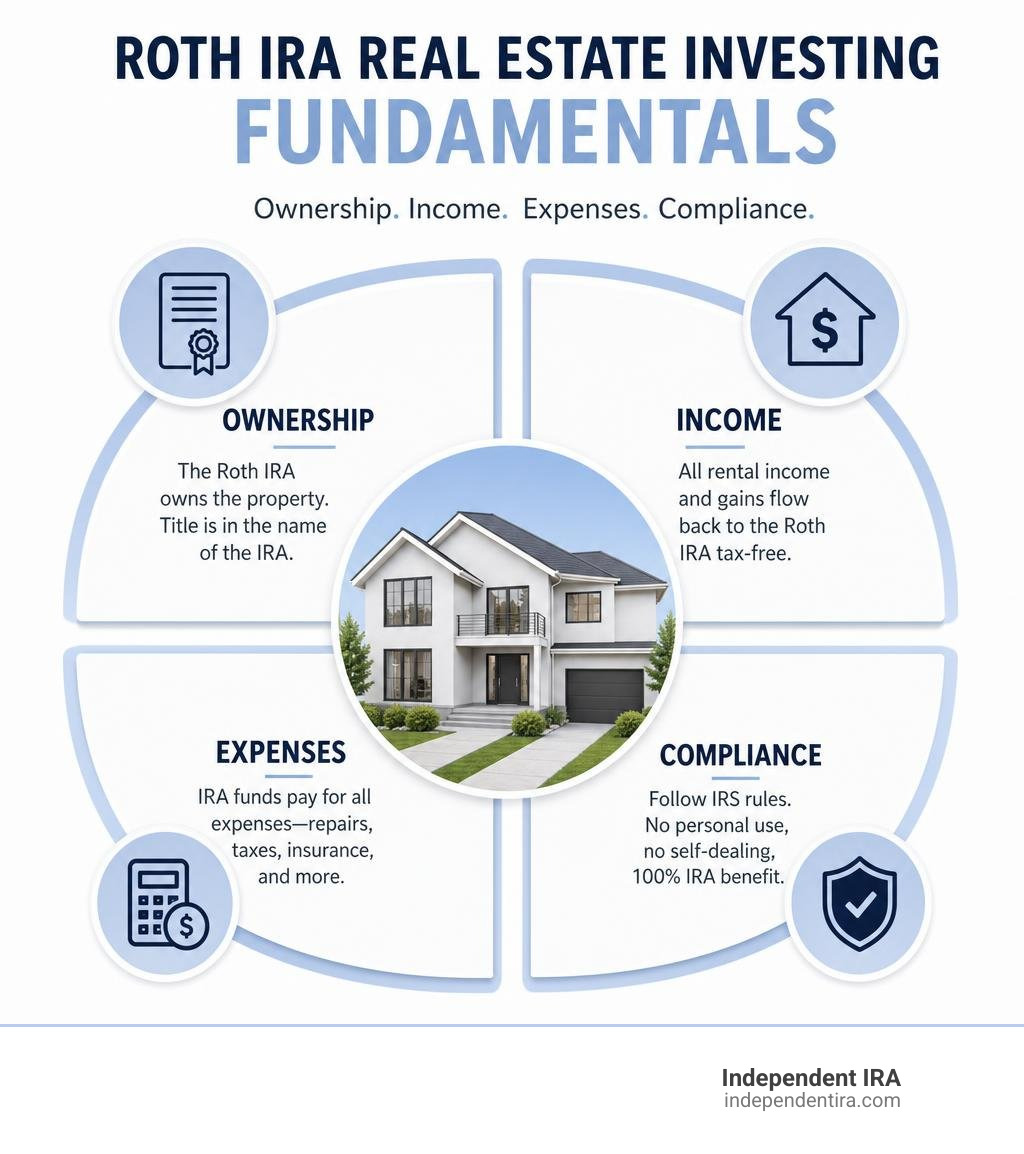
The essential legal distinction between personal real estate investing and IRA real estate investing comes down to legal ownership. When you buy real estate in a Roth IRA, you personally do not buy or own the property. Instead, your Roth IRA owns the asset. Purchase contracts, titles, deeds, and closing documents must explicitly list the IRA as the buyer and owner. For example, the title will typically be formatted as: Accuplan Benefits Services FBO [Your Name] Roth IRA.
If you want enhanced agility without waiting for custodian execution on every single property repair check or earnest money deposit, you can utilize a Checkbook Control LLC. Under this arrangement, your self-directed Roth IRA purchases 100% of a newly formed Limited Liability Company (LLC), and you act as the manager. You can then write checks or wire funds directly from a dedicated business checking account to purchase properties, pay contractors, or collect rental payments. You can explore how this operational structure works through our guide on self-directed IRA control.
Beyond physical structures, self-directed Roth IRAs can also capture yield through tax-defaulted property investments. If you want to explore these specific strategies, take a look at our specialized resource on Tax Liens Tax Deeds San Diego.
Allowed Property Types in Roth IRA Real Estate Investing
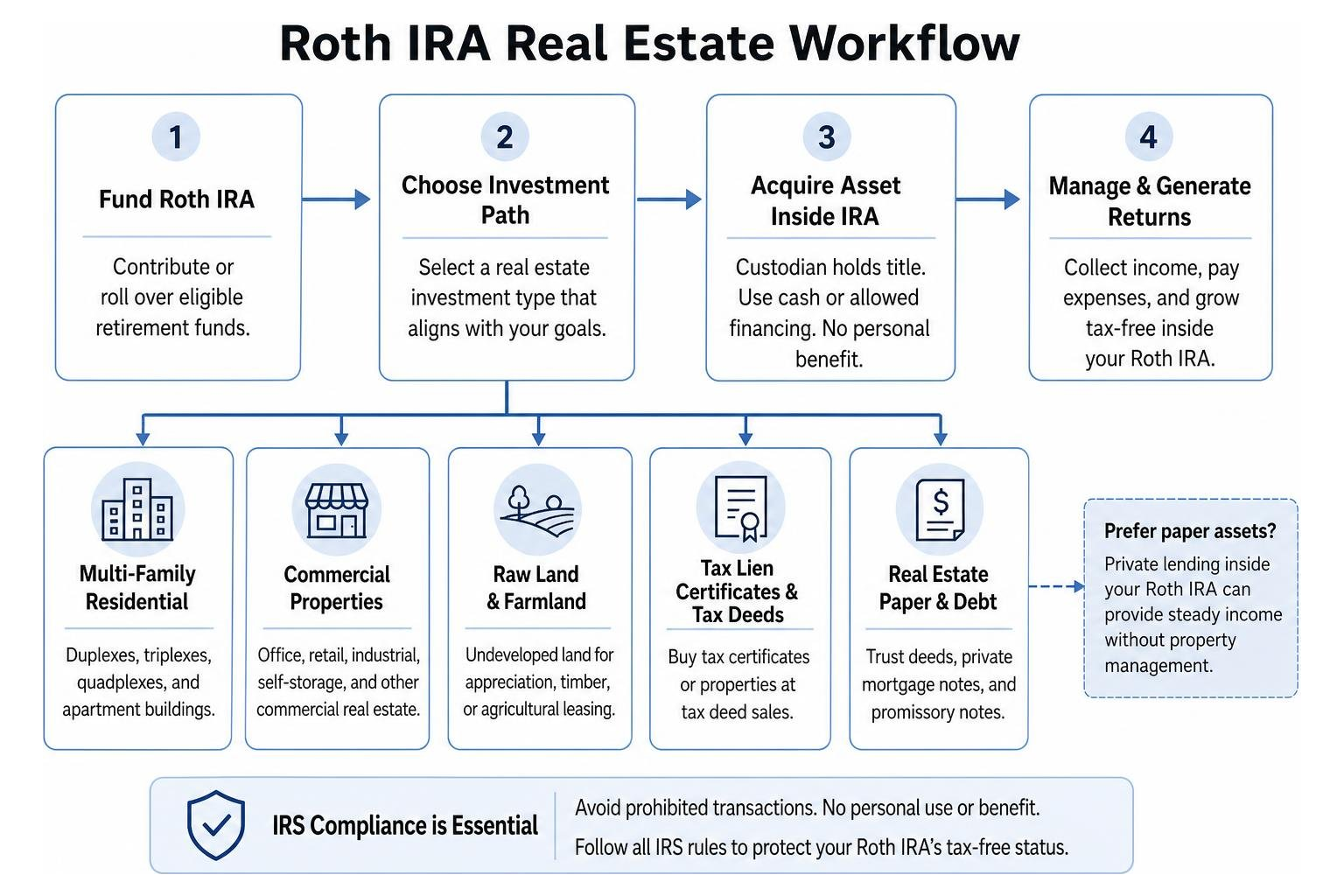
The IRS grants broad flexibility regarding the specific types of real estate assets you can acquire within a self-directed Roth IRA. As long as the acquisition does not violate prohibited transaction rules, your account can invest in:
- Single-Family Residential Homes: Single-family rentals remain a popular strategy for building rental yield and potential equity growth.
- Multi-Family Residential Units: Duplexes, triplexes, quadplexes, and apartment buildings allow your account to scale rental income streams.
- Commercial Properties: Office buildings, retail strip centers, industrial warehouses, and self-storage facilities offer commercial lease opportunities.
- Raw Land and Farmland: Undeveloped land held for potential capital appreciation, timber production, or agricultural leasing.
- Tax Lien Certificates and Tax Deeds: Purchasing government tax certificates or purchasing properties directly at tax deed sales.
- Real Estate Paper and Debt: Investing in trust deeds, private mortgage notes, and promissory notes secured by real estate.
If paper assets interest you more than physical landlord duties, private lending inside a Roth IRA provides income without property management responsibilities. To understand how private debt works inside retirement plans, review The Real Estate Investors Guide to IRA Promissory Notes.
Evaluating the Pros and Cons of Roth IRA Real Estate Investing
Before committing retirement capital to direct property acquisitions, it is vital to balance the tax features against the operational challenges.
A key benefit of holding real estate inside a Roth IRA is potential tax-free growth. In a standard taxable account, rental income is taxed at ordinary income rates, and property sales trigger capital gains taxes. Inside a qualified Roth IRA, rental income collected and profit made when selling property flow back into your account without immediate taxation. Furthermore, once you reach age 59½ and satisfy the 5-year holding rule, qualified distributions taken from your Roth IRA are tax-free and penalty-free under current tax laws.
However, real estate is fundamentally an illiquid asset. Unlike stocks, which can be liquidated quickly, property takes weeks or months to sell. Additionally, real estate requires ongoing liquidity inside the IRA to pay property taxes, property insurance, HOA dues, emergency repairs, and maintenance. If your IRA runs out of cash, you cannot simply write a personal check to fix a broken roof without running afoul of strict IRS contribution rules.
The table below summarizes key differences between traditional stock market investing and real estate investing inside a Roth IRA:
| Feature | Stock Market Roth IRA | Real Estate Roth IRA |
|---|---|---|
| Primary Investments | Stocks, ETFs, Mutual Funds, Bonds | Rental Homes, Commercial, Land, Notes |
| Custodial Model | Standard Brokerage | Specialized Self-Directed Custodian / Administrator |
| Transaction Control | Instant online trading | Custodian approval or Checkbook LLC |
| Tax Treatment | Potential tax-free growth & distributions | Potential tax-free growth & distributions |
| Liquidity | High | Moderate to Low (Illiquid asset) |
| Ongoing Maintenance | None | Property taxes, insurance, repairs, leasing |
| Debt & Financing | Margin trading (rare in IRAs) | Non-recourse loans (may trigger UDFI tax) |
To evaluate the performance of your retirement portfolio, learning how to combine these asset classes strategically is helpful. Read more in our guide on How to Make Your Roth IRA Work Harder Than You Do.
IRS Compliance: Prohibited Transactions and Disqualified Persons
The Internal Revenue Code (IRC Section 4975) grants tax advantages to Roth IRAs, but it enforces stringent rules to prevent account holders from misusing retirement accounts for immediate personal benefit. The underlying mandate is clear: your Roth IRA exists strictly to provide for future retirement, not to benefit you or your family today.
If your Roth IRA engages in a “prohibited transaction,” the consequences are immediate. If the IRS determines that a prohibited transaction occurred, the entire IRA loses its tax-exempt status. The account is treated as if it distributed its total market value to you on the very first day of the tax year in which the violation took place. For a Roth IRA, non-qualified distributions or disqualified structures can result in penalties, loss of tax-advantaged growth, and potential tax exposure on earnings.
To keep your account compliant, you must understand two core concepts: Disqualified Persons and Self-Dealing.
Who Qualifies as a Disqualified Person?
The IRS explicitly defines who cannot conduct business directly or indirectly with your Roth IRA. A disqualified person includes:
- You (the IRA account holder).
- Your Spouse.
- Your Lineal Ancestors (parents, grandparents, great-grandparents).
- Your Lineal Descendants (children, grandchildren, great-grandchildren) and their spouses.
- Investment Advisors, Custodians, and Service Providers managing the IRA.
- Entities (LLCs, Corporations, Trusts) in which any of the individuals listed above own 50% or more of the voting rights or stock.
Notice who is not on this list: brothers, sisters, aunts, uncles, cousins, and step-relatives are generally not classified as disqualified persons under IRC 4975, provided no indirect benefit flows back to a disqualified person.
An IRA property cannot be rented to your daughter, sold to your father, or purchased from your spouse. Furthermore, you cannot use IRA property personally. If you buy a beachfront rental home through your Roth IRA, neither you nor your children can stay there—even if you pay market rent. For an expanded analysis on personal usage restrictions, read our article Why Your IRA Property Isn’t Your Vacation Home.
Strict Rules on Sweat Equity and Financing Personal Land
One of the most frequent traps in roth ira real estate investing involves “sweat equity.” Account holders often assume that since they own the IRA, they can save money by painting the walls, fixing the plumbing, installing carpet, or acting as the property manager for their IRA-owned rental.
This is a direct violation of IRS self-dealing rules. Performing physical labor or providing uncompensated services to an IRA property is considered an improper contribution of personal services (“sweat equity”) to the IRA. All maintenance work, property management, and repair labor must be executed by unrelated third-party contractors and paid for exclusively with funds coming out of the Roth IRA account.
Another common pitfall involves mixing personally owned land with IRA capital. Investors frequently ask whether their Roth IRA can fund the construction of a commercial building or residential house on land that they already own personally.
According to tax guidelines and IRS regulations, using IRA money to build structures on land owned personally by a disqualified person constitutes a prohibited transaction. As explained in this breakdown on Ask an Advisor: Can I Invest in a Real Estate Project Within My Roth IRA? Will the Future Growth and Income Be Tax-Free? , funding construction on personally held property creates a co-mingling of personal and IRA assets unless the personal ownership of the land is entirely surrendered or legally transferred into the IRA under strict arm’s-length standards before development begins.
How to Purchase, Finance, and Manage Property in a Roth IRA
Executing a real estate purchase through a Roth IRA requires careful administrative steps to maintain clear legal separation between your personal finances and your retirement account.
Here is the standard process for completing a cash property purchase through a self-directed Roth IRA:
- Establish and Fund the Account: Open a self-directed Roth IRA through Independent IRA, an Authorized Agent of Accuplan Benefits Services. Transfer or rollover funds from an existing Roth IRA or perform a Roth conversion from a traditional IRA or 401(k).
- Identify the Property: Select an investment property. Ensure the contract buyer is explicitly named as the IRA (e.g., Accuplan Benefits Services FBO [Your Name] Roth IRA).
- Submit Earnest Money via the IRA: Purchase deposit checks or wire transfers must come directly from your Roth IRA account or Checkbook LLC account—never from personal accounts.
- Complete Administrative Review: Submit purchase agreements, title commitments, and closing disclosures through Independent IRA to the custodian for review and signature.
- Close and Title the Property: The purchase funds are wired directly from the IRA or LLC checking account to the escrow officer, and the deed is recorded in the official name of the IRA.
Before taking on tenant operations, evaluate whether your account cash reserves and operational knowledge are ready.
Financing Real Estate and Checkbook Control
Can you use mortgage financing to purchase real estate inside a Roth IRA? Yes, but you cannot obtain a conventional personal bank mortgage.
Standard mortgage loans require personal debt liability and personal guarantees. If you personally guarantee a mortgage loan for a property owned by your Roth IRA, the IRS deems that guarantee an extension of personal credit to the IRA, which disqualifies the account.
Therefore, any mortgage loan taken out by a Roth IRA must be a non-recourse loan. A non-recourse loan is secured solely by the physical real estate property itself. In the event of default, the lender’s recourse is limited to foreclosing on the property; they cannot touch other assets inside your IRA, nor can they seek deficiency judgments against you personally.
Because non-recourse lenders face higher risk, they typically require:
- Down payments between 30% and 40%.
- Substantial cash reserves remaining inside the Roth IRA post-closing.
- Higher interest rates compared to traditional personal mortgages.
To streamline acquisitions and minimize transaction delays, many real estate investors utilize a Checkbook Control LLC. By establishing a dedicated single-member LLC owned 100% by the Roth IRA, you can write checks to participate in auctions, acquire tax deeds, or execute real estate closing contracts.
Utilizing these flexible self-directed structures helps protect your retirement portfolio against broader market movements, a concept detailed in Crash Proof With a Self-Directed IRAs.
Managing Rental Income, Ongoing Repairs, and Selling Assets
Once your Roth IRA acquires real estate, strict rules govern all ongoing operational income and expenses:
- Rental Income Flow: All tenant rent checks must be made payable to the IRA or the IRA-owned LLC and deposited directly into the IRA checking account. Depositing rent into a personal checking account—even temporarily—violates IRS regulations.
- Expense Payments: Property taxes, insurance premiums, HOA dues, water bills, and contractor invoices must be paid directly from IRA funds.
- Handling Repairs: If a water heater breaks, hire an independent plumber and pay them from the IRA account balance. You cannot pay out of pocket and reimburse yourself later.
- Selling Property: When you sell an IRA-owned property, the sales buyer wires purchase funds directly into your self-directed Roth IRA. Capital gains and proceeds return to the account under qualifying Roth rules.
Tax Implications: Navigating UBTI and UDFI
While Roth IRAs may offer tax advantages, introducing leveraged debt or operating active business enterprises inside an account can trigger specialized IRS taxes: Unrelated Business Taxable Income (UBTI) and Unrelated Debt-Financed Income (UDFI).
UBTI applies when a tax-exempt entity (like an IRA) earns income from an active trade or business rather than passive investment returns. While rental income from physical real estate is normally classified as passive income exempt from UBTI, running an active business inside the property—such as operating a hotel, a full-service bed and breakfast, or an active fix-and-flip construction business—can trigger UBTI taxation at trust tax rates.
UDFI is a subset of UBTI that applies whenever your Roth IRA uses debt financing (such as a non-recourse loan) to acquire property. The IRS taxes the portion of income produced by the property that is attributable to leverage.
For example, if your Roth IRA purchases a $400,000 duplex using $200,000 in IRA cash and a $200,000 non-recourse loan, the property is 50% debt-financed. Consequently, 50% of the net rental income (and 50% of the net capital gains upon sale) is subject to UDFI tax rules.
Key tax compliance factors for debt-financed real estate in a Roth IRA include:
- The IRA must obtain its own Employer Identification Number (EIN) for tax filings.
- IRS Form 990-T must be filed if gross debt-financed income exceeds $1,000 in a tax year.
- Taxes due under UDFI must be paid out of the Roth IRA’s cash reserves, not from your personal funds.
Understanding tax planning strategy is critical when evaluating leveraged property returns. For guidance on navigating retirement tax considerations, consult professional tax advisors or review resources like Retirement Tax Planning in San Diego, CA .
Frequently Asked Questions About Roth IRA Real Estate
Can my Roth IRA fund construction on land I already own personally?
No. Using your self-directed Roth IRA to fund construction or improvements on raw land or real estate that you currently own in your personal name is a prohibited transaction under IRC Section 4975. The IRS views this as a self-dealing transaction between a retirement account and a disqualified person. To keep your account compliant, any real estate funded by your Roth IRA must be acquired, owned, and titled strictly by the IRA itself from an unrelated third party.
What are the penalties for violating self-directed Roth IRA rules?
If you engage in a prohibited transaction, your Roth IRA loses its tax-exempt status entirely as of January 1st of the year the violation occurred. The fair market value of the account is treated as a deemed distribution. For traditional IRAs, this results in immediate ordinary income tax and potential early withdrawal penalties. For a Roth IRA, you face administrative penalties, loss of tax-advantaged status, and potential taxes on non-qualified earnings. Furthermore, you lose the ability to compound those assets within the tax-sheltered IRA structure.
Do I pay taxes when selling real estate inside a Roth IRA?
As long as the property was purchased entirely with cash from the Roth IRA (without leverage) and you comply with IRS operational rules, capital gains generated from the sale flow directly back into your Roth IRA without immediate taxation. When you reach age 59½ and have satisfied the 5-year Roth holding requirement, qualified distributions of gains and profits are tax-free and penalty-free. If the property was purchased using a non-recourse loan, the portion of gain tied to debt leverage may be subject to UDFI tax via IRS Form 990-T upon sale.
Before You Move Retirement Funds

Investing in real estate through a self-directed Roth IRA offers a distinct wealth-building model under current tax law. Rental income, potential capital appreciation, and physical asset ownership provide a alternative to conventional paper investments.
However, real estate IRAs demand administrative precision. A misplaced rental deposit check, an illegal personal maintenance job, or a personal loan guarantee can jeopardize your retirement account’s tax status.
Whether you are looking to acquire single-family rental units, buy trust deeds, or establish Checkbook Control LLCs, working with experienced self-directed specialists is essential. Our team at Independent IRA, an Authorized Agent of Accuplan Benefits Services, provides administrative account setup, entity formation guidance, and transaction support to help maintain account compliance.
If you are ready to explore your options or want dedicated account guidance, visit our Self-Directed IRA San Diego hub or contact Independent IRA today to learn more about self-directed retirement options.
This content is for informational and educational purposes only and does not constitute legal, tax, or investment advice. Rules, limits, and requirements may change. Consult a qualified tax advisor, attorney, or financial professional before making retirement planning or investment decisions. Independent IRA is an Authorized Agent of Accuplan Benefits Services and is not a custodian or trust company.