

 GIVE US A CALL
Why a Real Estate Self Directed IRA Requires Careful Planning
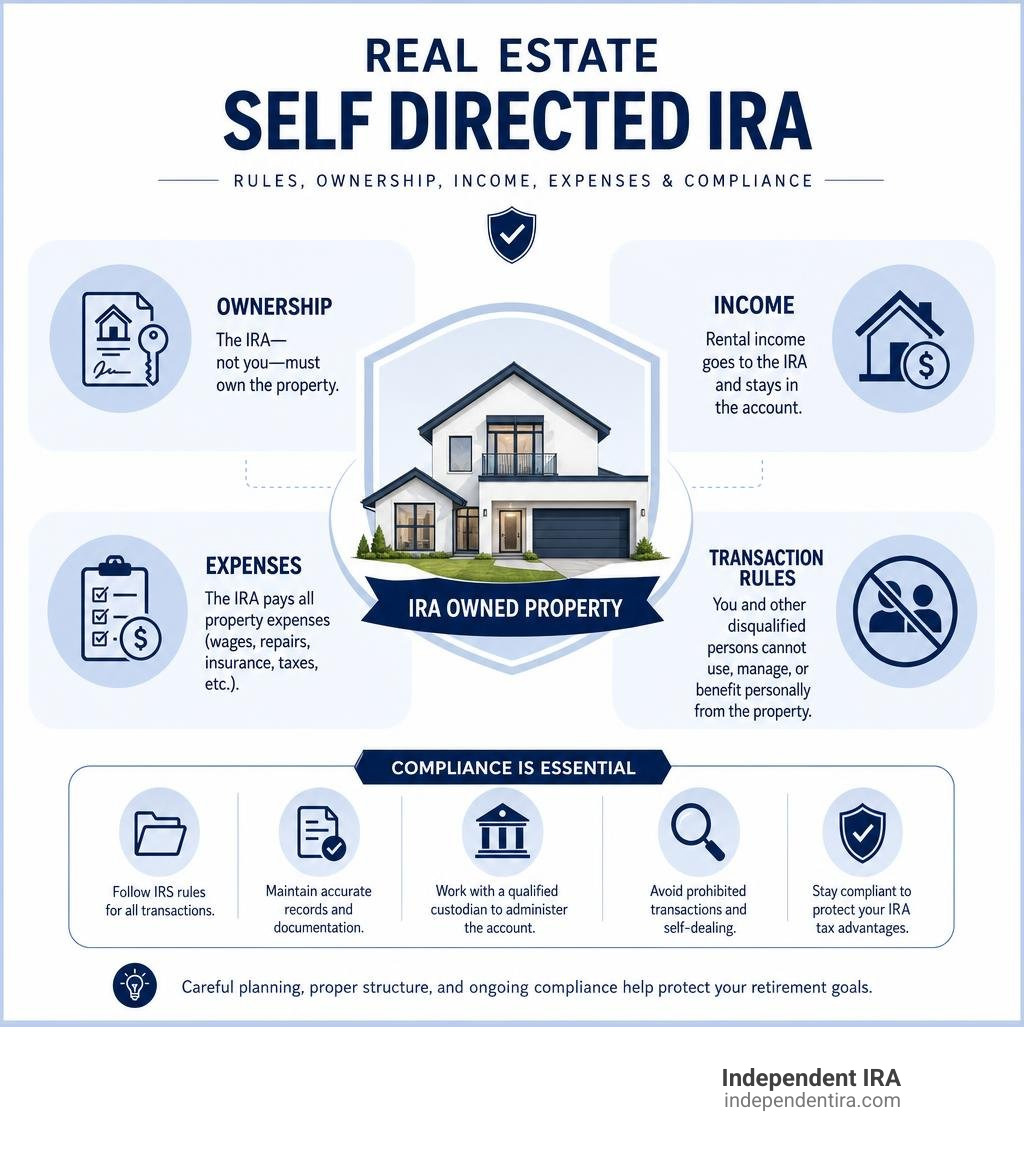
A real estate self directed IRA lets you use retirement funds to buy and hold qualifying real estate, rather than limiting your choices to the stocks, bonds, and mutual funds offered by a typical brokerage IRA. It can give experienced investors more authority over their retirement strategy, but the account – not you personally – must own the property, pay its expenses, and receive its income. That distinction makes custodian support, recordkeeping, and IRS compliance essential from the first offer through a future sale. This guide explains how account ownership, transaction rules, and checkbook-control structures shape your options through Self-Directed IRA Control so you can decide whether direct property ownership fits your self-directed retirement plan.
| Quick answer | What it means |
|---|---|
| What it is | A self-directed IRA that can hold direct real estate, subject to IRS rules and custodian administration. |
| What it can buy | Potentially rental homes, commercial property, land, and other eligible real estate investments. |
| Biggest restriction | You and other disqualified persons cannot use, manage through personal labor, or benefit personally from IRA-owned property. |
| Core decision | Consider the account fees, liquidity needs, lost real-estate tax deductions, and compliance burden before investing. |
I am Brian Davis, and I will walk you through the practical questions that matter before placing retirement capital into property.
Basic real estate self directed IRA terms:
- IRA for rental properties
- self directed roth
Understanding the Real Estate Self Directed IRA Framework
When setting up a real estate self directed IRA, the foundation rests on understanding that a self-directed IRA is governed by the same tax codes as traditional IRAs, but it grants you the ability to invest in IRS-permitted alternative asset classes. At Independent IRA, an Authorized Agent of Accuplan, we empower account holders by providing the administrative structure and compliance support required to hold non-traditional investments like tangible property.
Unlike conventional retirement accounts tied strictly to Wall Street products, a self-directed platform allows your retirement funds to purchase residential rental units, multi-family units, commercial buildings, raw land, and tax liens. However, because the IRA acts as an independent legal entity, every purchase agreement, title document, deed, and closing statement must reflect the account—not you as an individual—as the owner.
How a Real Estate Self Directed IRA Differs from Traditional Brokerage Accounts
Standard financial institutions and brokerage platforms restrict investment selections to liquid public securities like stocks, exchange-traded funds (ETFs), and mutual funds. These mainstream brokerages are not equipped to handle the legal, administrative, and custodial complexities associated with property deeds, title insurance, and property tax payments inside a retirement account.

In contrast, a specialized self-directed IRA custodian allows you to move capital into real estate. While standard brokerage IRAs provide standardized online trading, buying real estate requires customized execution, specialized custodial administration, and strict adherence to IRS guidelines. When you purchase property through a real estate self directed IRA, you direct Independent IRA to transfer funds from your account to escrow, taking title in the name of your custodian for the benefit of your IRA.
Achieving Direct Investor Authority with Checkbook Control
For investors who want increased transaction velocity and direct management authority, establishing a Checkbook IRA structure using a dedicated Limited Liability Company (LLC) is often an effective strategy. Under this structure, your IRA establishes a single-member LLC, and your IRA funds purchase 100% of the membership units in that entity.
Through our Step-by-Step Guide to Checkbook IRA, we guide investors through setting up a self-directed account with full checkbook control. With checkbook control, you serve as the manager of the LLC. When an earnest money deposit or property repair payment is due, you write a check or initiate a wire transfer directly from the dedicated LLC checking account, bypassing individual custodial processing delays while remaining strictly compliant with IRS rules.
IRS Rules, Disqualified Persons, and Prohibited Transactions
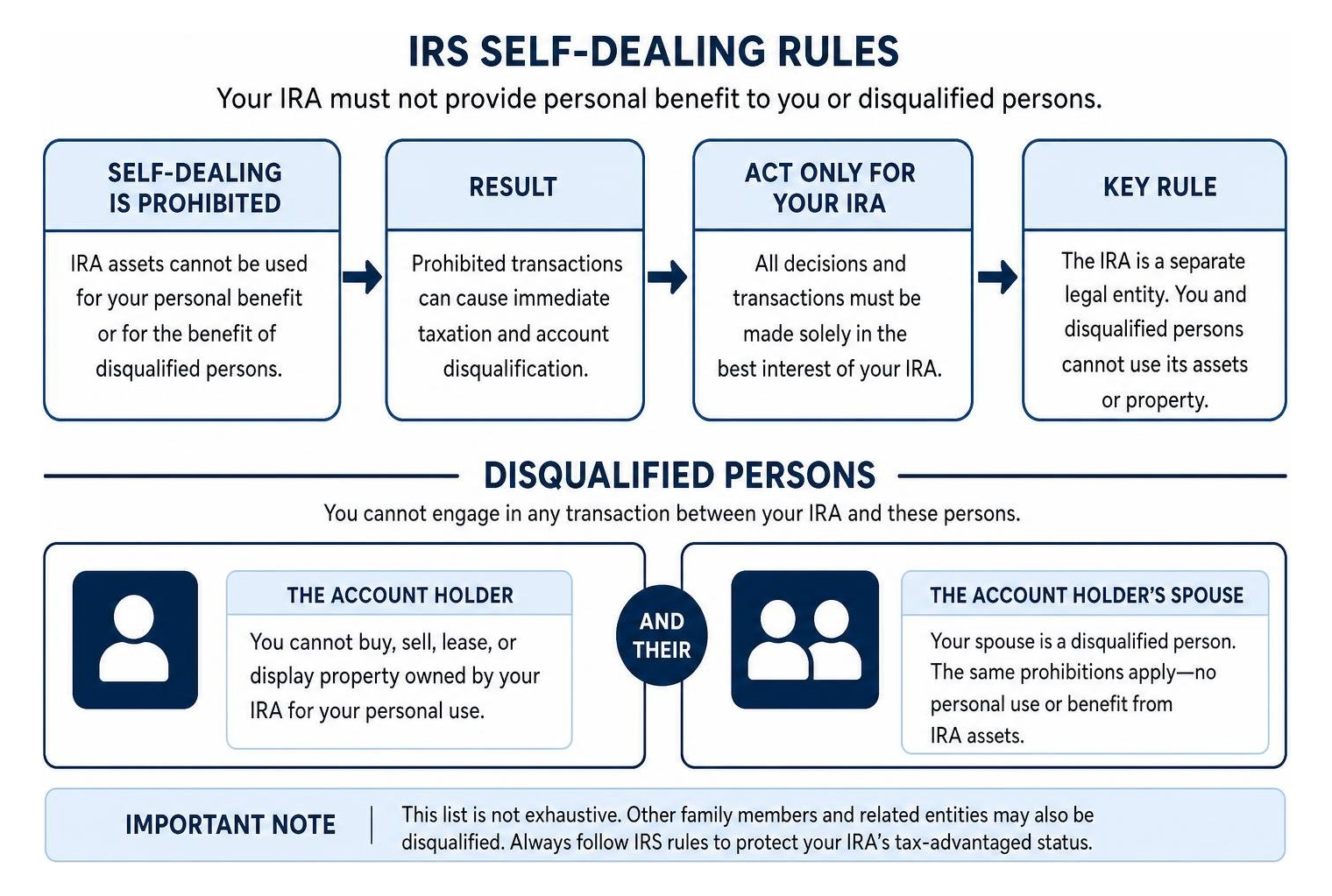
The IRS offers tax advantages to retirement accounts, but in exchange, it enforces strict regulations governed by IRS prohibited transaction rules to ensure these accounts build wealth strictly for future retirement—not current personal benefit. Failing to comply with these regulations can trigger serious financial consequences, including account disqualification and immediate taxation.
Disqualified Persons and Sweat Equity Pitfalls
IRS rules prohibit self-dealing and transactions involving “disqualified persons.” Disqualified persons include:
- The account holder and their spouse.
- Ancestors (parents, grandparents).
- Linear descendants (children, grandchildren) and their spouses.
- Fiduciaries, investment advisors, or entities in which a disqualified person holds a controlling interest (50% or more).
Crucially, you cannot perform personal physical labor—often called “sweat equity”—on property owned by your IRA. Even fixing a leaky faucet, painting a room, or hanging drywall personally violates IRS self-dealing prohibitions. Every repair, renovation, and maintenance job must be performed by third-party contractors paid directly with IRA funds.
Additionally, personal property usage is strictly forbidden. You cannot use an IRA-owned home as a primary residence, vacation rental, or temporary stay. For a deeper breakdown of personal use restrictions, explore Why Your IRA Property Isn’t Your Vacation Home.
Managing Rental Property Operations and Expenses
Operating a property inside an IRA requires maintaining an operational barrier between personal wealth and IRA funds. All rental income generated by the property must flow directly back into the IRA (or IRA-owned LLC) checking account.

Likewise, every expense—including property taxes, insurance premiums, HOA dues, and contractor invoices—must be paid exclusively out of account capital. If an urgent repair arises and the account lacks adequate cash reserves, you cannot pay for the invoice out of your personal pocketbook. Doing so is treated as an unallowed contribution or prohibited self-dealing transaction. At Independent IRA, specialists like Brian Davis help clients navigate administrative requirements and plan for proper liquidity buffers so unexpected repairs do not endanger account compliance.
To evaluate whether your strategy aligns with operational demands, review Is Your IRA Ready to Become a Landlord?.
Financial Trade-Offs: Tax Advantages, Fees, and Historical Returns
While holding property inside a self-directed retirement account offers distinct tax shelter benefits, investors must weigh these benefits against the tax write-offs they give up and the administrative overhead involved.
Lost Tax Deductions vs Tax-Sheltered Growth
When you own real estate individually, the tax code offers write-offs, including non-cash depreciation deductions and mortgage interest deductions. Inside a real estate self directed IRA, these personal deductions are eliminated because the IRA is already a tax-exempt entity.
| Personal Ownership Tax Features | Self-Directed IRA Tax Features |
|---|---|
| Annual depreciation write-offs lower income taxes | Tax-deferred growth (Traditional) or tax-free growth (Roth) |
| Mortgage interest tax deductions | Depreciation write-offs are not usable |
| Personal capital gains tax treatment upon sale | Income and capital gains flow tax-sheltered into IRA |
| Personal liability exposure | Asset protection built into IRA trust structure |
For Roth IRAs, the tradeoff may offer tax advantages: while current depreciation deductions are not available, qualified distributions in retirement may be tax-free.
If leverage or financing is used to purchase IRA real estate through non-recourse loans, investors must also account for Unrelated Debt-Financed Income (UDFI) taxes, which apply to the percentage of net earnings generated by leveraged capital.
Hidden Custodial Costs, RMD Challenges, and Asset Liquidity
Direct property ownership presents unique liquidity dynamics. Real estate is inherently illiquid compared to publicly traded equities. When investors reach the age requiring Required Minimum Distributions (RMDs), illiquid assets require deliberate planning.
To satisfy RMD obligations without selling property, account owners must either maintain sufficient liquid cash reserves within the IRA or execute in-kind asset distributions, transferring fractional ownership percentages of the property to themselves personally. Doing so requires updated annual valuations and appraisals.
Additionally, self-directed real estate accounts incur operational costs, including custodian asset administration fees, annual property valuations, legal setup costs for checkbook LLC entities, and local property management expenses.
Comparing Historical Real Estate Returns to Stocks and Bonds
Before committing retirement capital exclusively to tangible real estate, evaluate long-term asset performance metrics. Real estate provides potential inflation protection and cash flow, but historic broad-market stock indexes have delivered higher annualized nominal returns over extended periods.
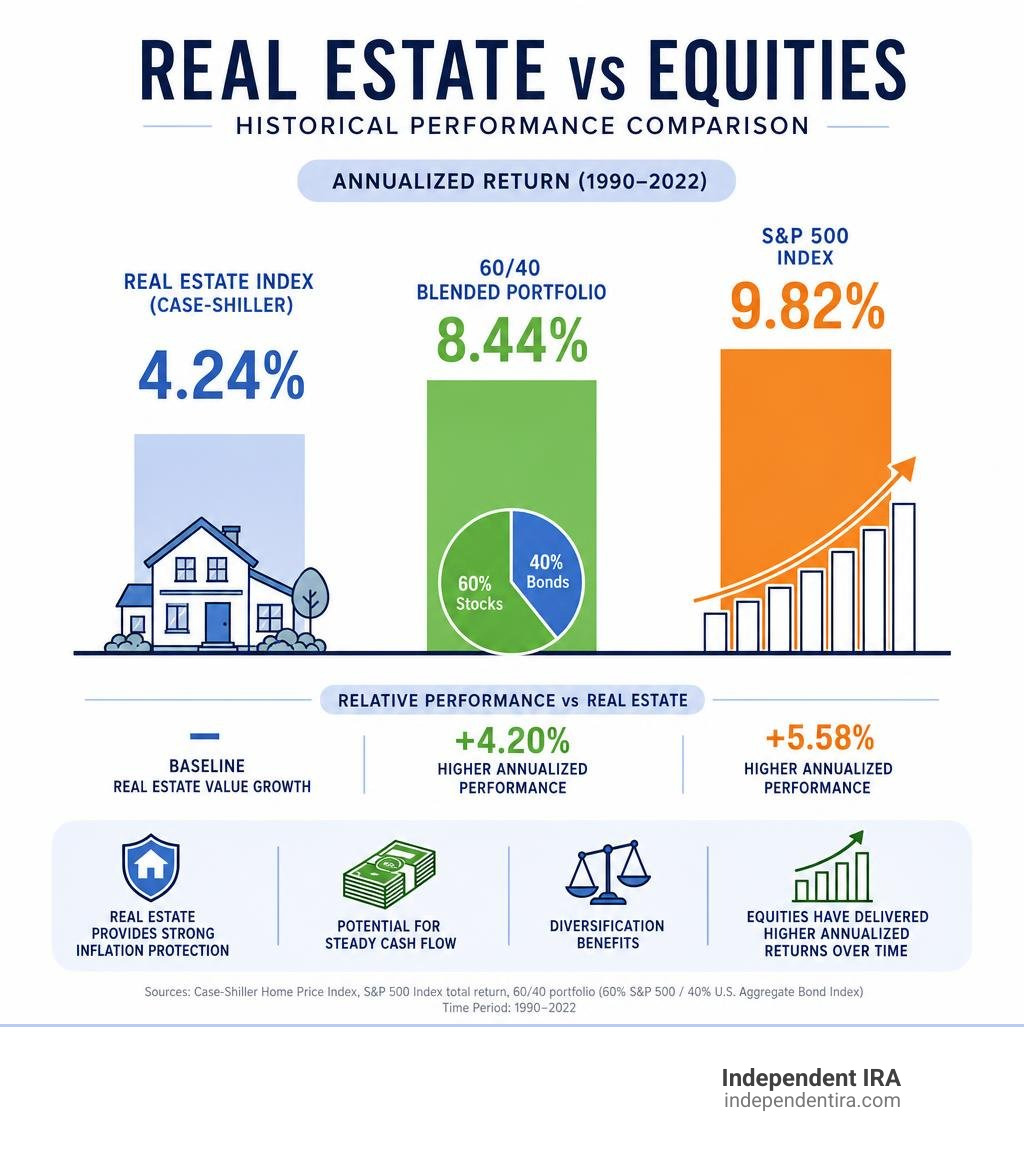
| Asset Class / Index | Historical Annualized Return (1990–2022) | Relative Performance |
|---|---|---|
| Real Estate Index (Case-Shiller) | 4.24% | Baseline real estate value growth |
| Traditional 60/40 Blended Portfolio | 8.44% | +4.20% higher annualized performance |
| S&P 500 Index | 9.82% | +5.58% higher annualized performance |
Between 2010 and 2022, the S&P 500 outperformed general real estate index returns by 6.68% annually. While individual real estate projects utilizing targeted value-add management or favorable market conditions may generate strong returns, holding a real estate IRA should be evaluated as part of a diversified retirement strategy.
Evaluating Custodians and Structuring Your Real Estate Self Directed IRA
Choosing the right custodian and administration partner is a critical step in building a compliant self-directed retirement plan. Independent IRA, an Authorized Agent of Accuplan, delivers administrative account support, flexible investment capability, and dedicated service.
Key Questions to Ask SDIRA Custodians Before Investing
Before opening an account with any specialized trust company or custodian, ask the following crucial questions:
- What is your fee schedule? Ask whether fees are calculated as a flat transaction rate or as an asset-value percentage that grows as your property appreciates.
- How are asset valuations handled? Clarify annual asset pricing requirements and documentation needed for ongoing IRS reporting.
- What is your transaction processing timeline? Ensure your provider can process earnest money checks, closing disbursements, and property expenses rapidly.
- Where are cash reserves maintained? Confirm that uninvested cash reserves are held in FDIC-insured institutional accounts.
- What fees or penalties apply upon exit? Review any administrative fees for selling property, transferring assets, or closing accounts.
Structuring Alternatives Within a Real Estate Self Directed IRA
Direct property titles are not the only way to build real estate exposure inside a self-directed plan. Many account holders prefer alternative strategies that generate consistent yield without landlord responsibilities.

At Independent IRA, we support a wide range of alternative structures, including:
- Private Lending & Promissory Notes: Explore private lending options through The Real Estate Investor’s Guide to IRA Promissory Notes and Private Equity Private Lending.
- Tax Liens & Tax Deeds: Learn more about purchasing tax certificates with Tax Liens Tax Deeds.
- Hybrid Asset Strategies: Combine property investments with dynamic modern assets. Read about Building Your Future with a Bitcoin IRA Real Estate Combo.
- Account Customization: Compare self-directed options through our guide on Self-Directed IRAs and specialized employer retirement options like 401k Services and Real Estate IRAs.
Frequently Asked Questions About Real Estate IRAs
Can I perform my own repairs on property owned by my self-directed IRA?
No. IRS regulations strictly forbid account owners from performing personal labor, maintenance, or property improvements on IRA-owned assets. Any physical work—even minor tasks like fixing faucets, changing locks, or painting—is classified as prohibited “sweat equity” and constitutes self-dealing under tax code rules. All maintenance work must be performed by independent third-party contractors and paid for using account capital.
What happens if my self-directed IRA does not have enough liquidity for Required Minimum Distributions?
If an IRA holds illiquid real estate and lacks cash reserves to meet mandatory RMD amounts, account owners have two main choices. You can sell the property inside the account to generate liquid cash, or you can perform an “in-kind” distribution. An in-kind distribution transfers a partial interest in the property deed from the IRA to you personally, which satisfies the RMD value but triggers income taxes on the distributed portion and requires an updated formal property appraisal.
How do I handle mortgages or leveraged financing when buying property with an IRA?
An IRA can use mortgage financing to acquire real estate, provided the loan is structured strictly as a non-recourse loan. A non-recourse loan prohibits the lender from taking action against you personally or reaching other non-IRA assets in the event of default; the real property itself serves as the sole collateral. Income derived from leveraged capital is subject to Unrelated Debt-Financed Income (UDFI) taxes, requiring the IRA to file IRS Form 990-T.
Before You Move Retirement Funds
Establishing a real estate self directed IRA opens doors to physical asset ownership, passive rental income, and direct control over your retirement wealth. However, success requires managing transaction mechanics, maintaining compliance barriers, avoiding self-dealing traps, and establishing proper account structures.
At Independent IRA, we provide administrative setup assistance, legal entity creation support for checkbook control, and clear account guidance every step of the way. Whether you are seeking direct property investments, private promissory note lending, or tax lien acquisitions, our team is here to help you navigate alternative asset administration.
Ready to explore your retirement account strategy? Explore Self-Directed IRA Solutions or Learn More About Us today to discuss your retirement account goals.
This content is for informational and educational purposes only and does not constitute legal, tax, or investment advice. Rules, limits, and requirements may change. Consult a qualified tax advisor, attorney, or financial professional before making retirement planning or investment decisions. Independent IRA is an Authorized Agent of Accuplan Benefits Services and is not a custodian or trust company.