

 GIVE US A CALL

When investors look beyond volatile public stock markets, choosing how to safely diversify retirement capital into high-growth private businesses becomes a crucial decision point. Self-directed IRA private equity involves placing tax-advantaged retirement dollars directly into private companies, venture capital funds, or private debt placements. By utilizing a self-directed IRA, account owners gain the freedom to direct their retirement dollars into non-public assets.
In a standard IRA, custodians typically restrict holdings to publicly traded equities and fixed-income assets. By contrast, specialized custodians allow investors to tap into private markets. This expanded choice offers significant upside: private equity has historically delivered strong growth potential and low correlation to public market volatility. Across the country, self-directed IRAs hold an estimated $1.2 trillion in assets, with 3% to 5% of all IRA capital sitting in more than 1.2 million self-directed accounts. Furthermore, private equity allocations within SDIRAs have expanded by roughly 12% annually in recent years, with an average private equity holding of around $150,000 per account.
The primary benefit of utilizing self-directed IRA private equity is tax-advantaged growth. Whether held in a Traditional SDIRA (tax-deferred) or a Roth SDIRA (tax-free growth and distributions), capital gains and investment yields flow directly back into your retirement account without immediate taxation. However, gaining this flexibility requires an understanding of self-directed IRA rules, asset custody, and fair market valuations. To learn more about how asset control functions, explore our detailed resource on Self-Directed IRA Control.
Types of Private Equity in Retirement Accounts
Private equity covers a broad range of investment vehicles outside public equity markets. When using self-directed retirement funds, we see account owners deploy capital across several main categories:
- Startup Capital and Seed Funding: Providing direct equity capital to early-stage startups or local private businesses in exchange for company shares. Discover how to execute this in our guide on How to Turn Your IRA Into a Startup Investing Machine.
- Venture Capital Funds: Investing as a limited partner (LP) in structured venture funds that back high-growth technological or commercial enterprises.
- Private Equity Funds: Participating in buyout funds, growth equity funds, or middle-market private equity syndications designed to acquire or expand established private entities.
- Private Debt and Promissory Notes: Lending funds directly to operating companies, real estate developers, or private businesses via structured private debt or convertible notes.
Self-Directed IRA Private Equity vs Other Alternatives
Investors expanding beyond conventional stock portfolios often evaluate private equity alongside other alternative asset classes, such as real estate, cryptocurrency, or hedge funds. Each asset class brings distinct risk-return profiles, liquidity constraints, and management demands.
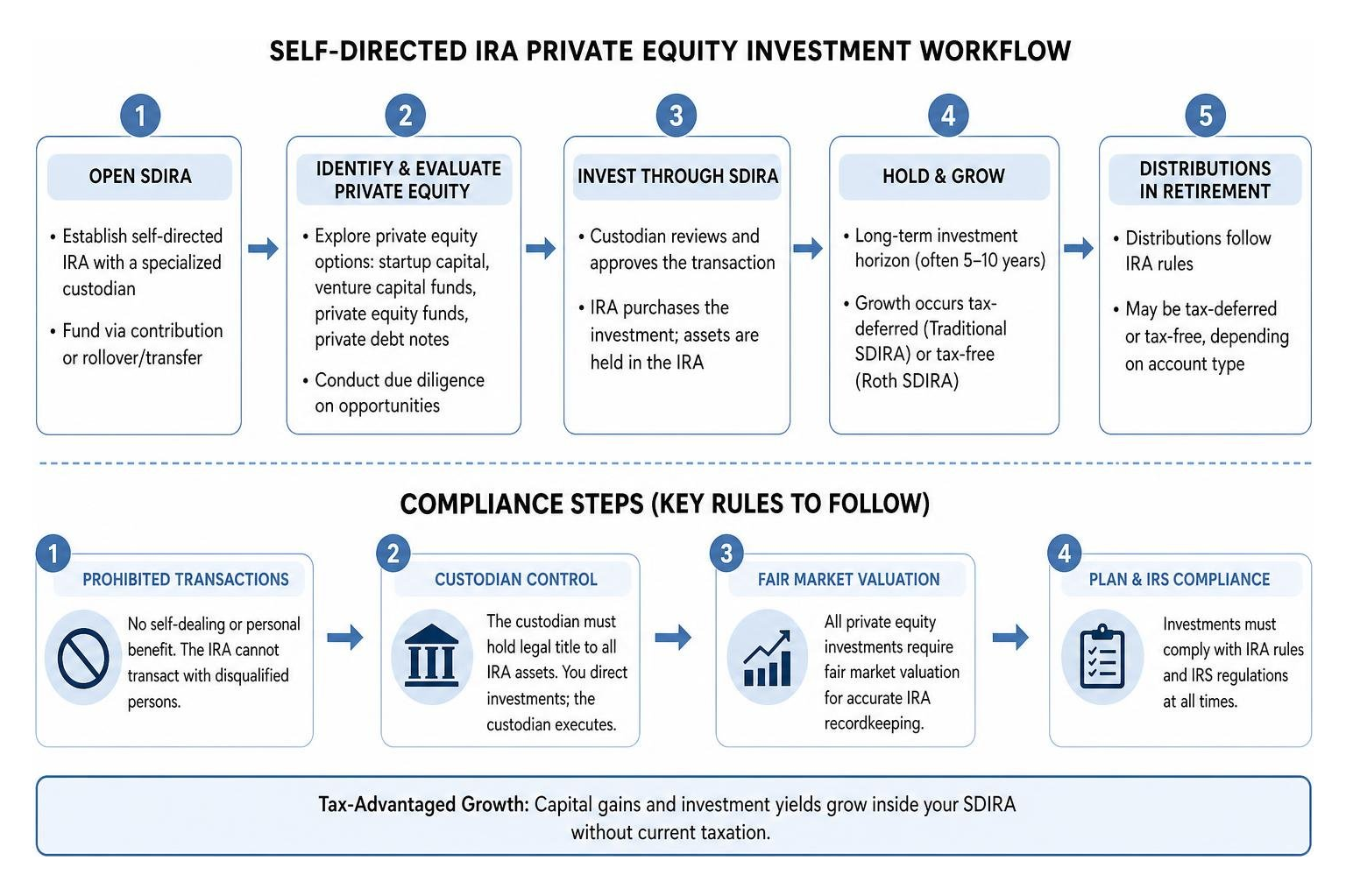
Private equity investments typically require a multi-year horizon (often 5 to 10 years) with low liquidity, but they offer substantial growth potential. Real estate, while also illiquid, provides steady cash flow and tangible asset backing. Cryptocurrency offers maximum liquidity and round-the-clock trading but experiences higher volatility. Hedge funds often employ dynamic trading tactics, which we break down in our Beginners Guide to Self-Directed IRA Hedge Funds.
Here is a side-by-side comparison of how private equity compares to other common alternative assets in a self-directed IRA:
| Feature | Private Equity | Real Estate | Cryptocurrency |
|---|---|---|---|
| Typical Liquidity | Very Low (5-10 year lockup) | Low (Quarterly/Annual or Sale) | High (24/7 Market Access) |
| Primary Income Type | Capital Growth / Dividends | Rental Income / Appreciation | Capital Growth |
| Active Overhead | Low (Passive LP Role) | Moderate to High | Low |
| Leverage Risk | Low (Unless fund uses debt) | High (Mortgage/UDFI risk) | None to Moderate |
| UBIT / UDFI Potential | High if fund operates active business | Moderate (Debt-financed income) | None |
Rules, Taxes, and Compliance Requirements
While the Internal Revenue Service (IRS) permits IRAs to hold private equity, it enforces strict statutory framework rules. Failure to adhere to these rules can endanger the tax-advantaged status of your entire IRA account.
Self-Directed IRA Private Equity Rules and Restrictions
The core compliance pillar surrounding self-directed IRA private equity revolves around IRS Section 4975, which outlines prohibited transactions and disqualified persons. The purpose of an IRA is to yield benefits strictly for your future retirement, not to provide present-day personal benefits to you or your family.
Disqualified Persons Include:
- The IRA account owner and their spouse.
- Direct lineal ancestors (parents, grandparents) and direct lineal descendants (children, grandchildren) and their spouses.
- Investment advisors, managers, or custodians handling the account.
- Any entity (corporation, LLC, trust) in which disqualified persons hold a 50% or greater voting interest or ownership share.
Prohibited Transactions Include:
- Self-Dealing: Buying shares in a company you currently own or manage using your IRA capital.
- Indirect Benefits: Using IRA funds to back a startup that pays you, your spouse, or your children a salary or consultation fee.
- Personal Guarantees: Personally guaranteeing a commercial loan or line of credit for an entity in which your IRA holds an equity stake.
- Co-Investing Violations: Structure co-investment deals between your personal funds and your IRA funds in a manner that creates a conflict of interest or provides personal liquidity.
Additionally, self-directed private equity assets require an annual Fair Market Valuation (FMV). Because private shares do not trade on public exchanges, the IRA owner must provide the custodian with independent valuation documentation (such as an audited financial statement, formal appraisal, or signed declaration from the company’s chief financial officer) every year for IRS tax reporting. If you are lending funds through private notes, review The Real Estate Investors Guide to IRA Promissory Notes.
Navigating UBIT and UDFI Tax Obligations
A widespread misconception among alternative asset investors is that investments inside an IRA are completely tax-exempt under all conditions. In reality, certain private equity structures generate taxable income inside an IRA through Unrelated Business Income Tax (UBIT) and Unrelated Debt-Financed Income (UDFI).
- Unrelated Business Income Tax (UBIT): If your SDIRA invests in an operating pass-through entity (such as a limited partnership or LLC engaged in active trade or business, like a restaurant chain, manufacturing plant, or retail business), the income generated is treated as active trade or business income rather than passive investment income. Active profits passing through to an IRA are subject to UBIT under IRS Code Section 512. Tax rates for UBIT follow trust tax brackets, which reach top marginal tax rates quickly.
- Unrelated Debt-Financed Income (UDFI): If the private company or fund leverages borrowed funds to purchase income-generating assets, the proportion of income attributable to leverage is subject to UDFI taxes under IRS Section 514.
When UBIT or UDFI liability exceeds $1,000 in a calendar year, the IRA itself must file IRS Form 990-T and pay the tax directly from IRA cash reserves. At Independent IRA, an Authorized Agent of Accuplan Benefits Services, our team and process guides, supported by specialists like Brian Davis, help investors structure their account setups cleanly to monitor and manage potential UBIT/UDFI exposure before funding private equity commitments.
Setting Up and Executing Private Equity Deals
Investing retirement capital into private placements requires an established sequence of account setup, compliance reviews, and deal execution.
Setting Up a Self-Directed IRA Private Equity Account
Executing a private equity transaction efficiently requires having the correct legal structure in place. For investors seeking direct execution without manual administrative delays for every capital allocation, establishing a Checkbook IRA LLC is often the preferred strategy.
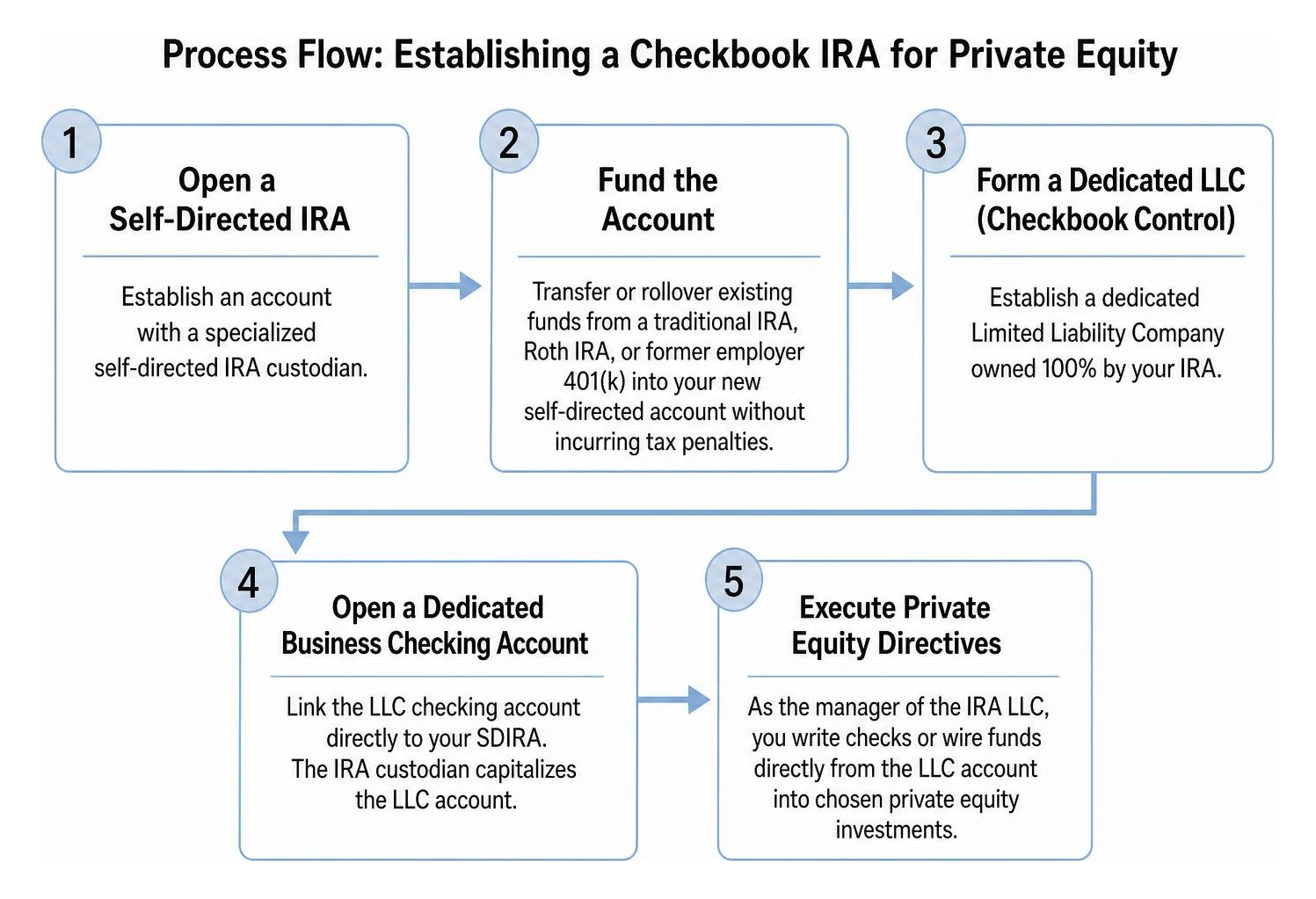
- Open a Self-Directed IRA: Establish an account with a specialized self-directed IRA custodian.
- Fund the Account: Transfer or rollover existing funds from a traditional IRA, Roth IRA, or former employer 401(k) into your new self-directed account without incurring tax penalties.
- Form a Dedicated LLC (Checkbook Control): Establish a dedicated Limited Liability Company owned 100% by your IRA.
- Open a Dedicated Business Checking Account: Link the LLC checking account directly to your SDIRA. The IRA custodian capitalizes the LLC account.
- Execute Private Equity Directives: As the manager of the IRA LLC, you write checks or wire funds directly from the LLC account into chosen private equity investments.
Using checkbook control accelerates transaction timing, eliminates recurring custodian processing fees for individual deal wires, and simplifies managing capital calls. Learn more about setting up this structure in our Step by Step Guide to Checkbook IRA.
Due Diligence and Capital Raising Strategies
Thorough due diligence is essential when allocating retirement savings into private equities. Unlike public equity markets, where financial regulatory bodies enforce standard disclosure rules, private offerings rely heavily on independent investor vetting.
Due Diligence Framework:
- Management Vetting: Review the background, track record, and integrity of fund managers or corporate executives.
- Operating Agreements and Offering Memorandums: Read the Private Placement Memorandum (PPM), subscription agreement, and operating terms carefully. Pay close attention to fee structures, valuation methods, exit timelines, and liquidation preferences.
- Liquidity and Capital Calls: Ensure your IRA retains sufficient liquid reserves to cover potential future capital calls or ongoing operating costs without requiring prohibited personal fund injections.
- Exit Strategy: Evaluate how and when the fund or business intends to return capital to investors (e.g., initial public offerings, strategic acquisitions, secondary market sales).
For founders or sponsors looking to attract capital from retirement account holders, our resource on Raising Private Capital with IRAs covers how to structure compliant opportunities for self-directed investors.
Frequently Asked Questions About Private Equity SDIRAs
Can I invest in any private equity fund using a self-directed IRA?
While IRS rules permit IRAs to hold private equity, individual fund managers set their own admission policies. Many private equity funds require investors to meet accredited investor standards (e.g., specific net worth or income thresholds). Furthermore, the fund sponsor must accept IRA investors and sign the necessary custodian documentation. Finally, the custodian must review the offering documents to ensure the asset can be held within an IRA without administrative conflicts.
How are capital calls handled within a self-directed IRA?
Capital calls occur when a private equity fund calls upon investors to transfer committed funds. All capital call payments must come directly from your IRA or your IRA-owned LLC checking account. You cannot pay capital calls using personal, non-IRA funds, as doing so constitutes a prohibited transaction under IRS rules. To avoid missing capital calls or risking default penalties, account owners should maintain adequate cash reserves inside their self-directed IRA.
What taxes apply to private equity earnings in a Roth SDIRA?
Investments held within a Roth SDIRA grow tax-free, and qualified distributions taken in retirement are completely tax-free. However, if the private equity firm generates active business income (subject to UBIT) or uses leverage to generate returns (subject to UDFI), the IRA itself may still owe UBIT tax on Form 990-T, even inside a Roth account. Tax-exempt status applies to regular investment returns like dividends, interest, and capital gains, but active operating profit remains subject to UBIT rules.
Before You Move Retirement Funds
Investing in self-directed IRA private equity offers a powerful path to diversify beyond traditional assets, build long-term capital, and capture tax-advantaged growth in non-public markets. However, the unique mechanics of private offerings, fair market valuations, prohibited transactions, and UBIT taxes mean compliance must always remain your top priority.
At Independent IRA, an Authorized Agent of Accuplan Benefits Services, we focus on providing account setup coordination and entity structures so you retain control over your alternative assets. Whether you are looking to invest in early-stage startups, join private equity syndications, or structure private lending deals, our team is here to assist you at every step.
Ready to explore how private equity fits into your self-directed portfolio? Explore Self-Directed IRA Services today or reach out to our team to get your account set up for checkbook control and alternative asset investing.
This content is for informational and educational purposes only and does not constitute legal, tax, or investment advice. Rules, limits, and requirements may change. Consult a qualified tax advisor, attorney, or financial professional before making retirement planning or investment decisions. Independent IRA is an Authorized Agent of Accuplan Benefits Services and is not a custodian or trust company.