

 GIVE US A CALL

Looking for private equity firms in San Diego that might fit your retirement investing goals? Start with StepStone Group, Seaside Equity Partners, Tide Rock, Bridgewest Group, and Castle Creek Capital, then compare their investment approaches with the other firms in this guide. If you hope to invest through a self-directed IRA or solo 401(k), the firm’s reputation is only part of the decision: you also need to understand the investment terms, fees, and access to your money. Independent IRA’s guide to private equity in a self-directed IRA explains the account considerations to review first. I’m Brian Davis, and I’ll help you sort through the local options with those retirement-account questions in mind.
The Rise of Private Equity Firms in San Diego
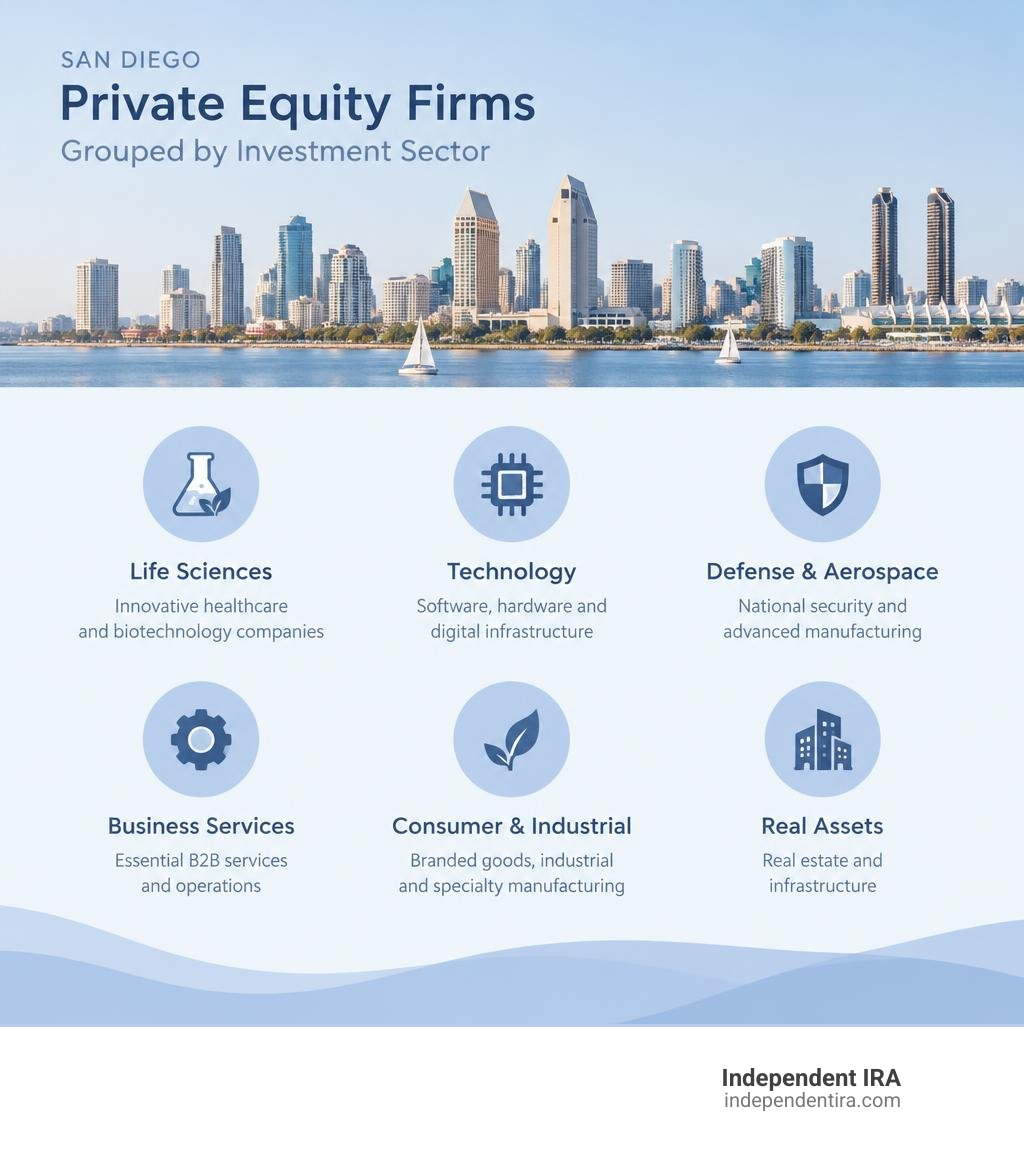
San Diego has evolved far beyond its reputation as just a sunny coastal haven. Over the past decade, America’s Finest City has developed into a premier hub for middle-market buyouts, lower-middle-market growth, and alternative asset creation. Anchored by world-renowned research institutions, thriving defense technology clusters, and the Torrey Pines life sciences corridor, the local ecosystem naturally cultivates resilient, profitable enterprises.
While institutional capital historically flowed through New York or San Francisco, major investors and fund managers have migrated south. Local dealmakers have capitalized on fragmented regional markets by acquiring essential business-to-business (B2B) services and proprietary technologies. For example, PE Firm Seaside Equity Partners Assets Surpass $1B as ‘Mission Critical’ Strategy Pays Off, showing how focused regional strategies can outperform broader national indices.
For retirement investors, this regional expansion offers attractive direct investment possibilities. Navigating this landscape requires careful vetting, which is why A Practical Guide to Finding a Reliable San Diego Investment Firm serves as a helpful baseline when aligning local private placements with tax-advantaged accounts.
Top 10 Private Equity Firms San Diego Investors Should Know

The leading private equity firms in San Diego represent a broad spectrum of strategies—ranging from global multi-billion-dollar secondaries and debt platforms to debt-free operational buyouts and niche lower-middle-market equity recapitalizations.
| Firm Name | Primary Investment Focus | Target Deal Strategy & Criteria | Estimated AUM / Capital Base |
|---|---|---|---|
| StepStone Group | Multi-asset, Secondaries, Private Credit | Global fund-of-funds, direct co-investments | $245B AUM ($913B total responsibility) |
| Seaside Equity Partners | Mission-Critical Services | Control buyouts, $3M–$15M EBITDA | $1.35B AUM |
| Tide Rock | B2B Manufacturing & Distribution | Unlevered buyout model, permanent capital | $1B+ Acquisition Capital |
| Bridgewest Group | Deep Tech, Life Sciences, Software | Global incubation, operational turnarounds | $3B+ Private Capital |
| LLJ Ventures | Real Estate, Value-Add Multifamily | Direct property acquisitions, joint ventures | Multi-Billion Platform Base |
| Sweetwater Private Equity | Tech-Enabled Services, Healthcare | Secondary direct transactions, co-investments | Boutique Institutional Growth |
| Castle Creek Capital | Community Banking, Financial Services | Non-auction growth equity, recapitalizations | $500M+ Middle Market Focus |
| HCAP Partners | Healthcare, Technology, Services | Mezzanine debt & equity, $10M–$75M revenue | $92M+ Active Fund Platforms |
| Verde Equity Partners | Commercial Landscaping, Route Services | Micro-buyouts, $300k–$5M EBITDA | Niche Regional Platform |
| Momentum Capital Investments | Construction, Local Commercial Services | Process improvement, founder succession | Regional Lower-Middle Market |
1. StepStone Group
StepStone Group is a global private markets powerhouse headquartered right here in San Diego. Managing $245 billion in assets under management with over $913 billion in total capital responsibility as of mid-2026, StepStone operates across 31 offices worldwide. The firm specializes in customized private equity portfolios, secondaries, co-investments, and private credit solutions for institutional and high-net-worth investors.
2. Seaside Equity Partners
Founded in 2017, Seaside Equity Partners has built an exceptional track record by focusing on control investments in mission-critical service providers throughout the Western United States. Seaside holds approximately $1.35 billion in AUM, having raised more than $1.2 billion in equity commitments and completed over 65 acquisitions across industries such as environmental services, compliance, and commercial facilities.
3. Tide Rock
Tide Rock utilizes a distinct unlevered buyout model that eliminates traditional bank acquisition debt. The firm surpassed $1 billion in acquisition capital and generated more than $250 million in profit in 2025, while maintaining an average 24% annual organic growth rate since 2013. By avoiding heavy leverage, Tide Rock Reaches $1B in Acquisition Capital – San Diego Business Journal highlights how the firm provides stability for founder-led B2B manufacturers and distributors.
4. Bridgewest Group
Bridgewest Group manages over $3 billion in private capital, specializing in long-term investments in biotech innovation, deep tech, software, and semiconductor manufacturing. Bridgewest operates as an incubator and hands-on operational partner, scaling complex enterprises globally through its deep technical expertise and corporate infrastructure.
5. LLJ Ventures
Serving as the private equity real estate arm of the LM Group, LLJ Ventures focuses on value-add acquisitions across multifamily, commercial, and hospitality properties throughout the Western US. Their strategy relies on disciplined underwriting and physical asset repositioning to generate durable cash flow streams.
6. Sweetwater Private Equity
Sweetwater Private Equity targets bespoke secondary direct transactions and direct co-investments in lower-middle-market companies. By acquiring partial or full ownership stakes from early-stage venture investors and founders, Sweetwater unlocks liquidity in mature tech-enabled and healthcare service firms.
7. Castle Creek Capital
Based in North County San Diego, Castle Creek Capital specializes in community banking and regional financial institutions. By sourcing non-auction equity recapitalizations, Castle Creek helps small-to-midsize commercial banks consolidate balance sheets, update technology stacks, and execute regional mergers.
8. HCAP Partners
HCAP Partners provides structured mezzanine debt and equity solutions to lower-middle-market companies generating $10 million to $75 million in annual revenue. With typical investment checks ranging from $2 million to $9 million, HCAP emphasizes workplace quality initiatives and measurable community impact alongside financial performance across healthcare, manufacturing, and tech-enabled services.
9. Verde Equity Partners
Verde Equity Partners operates a targeted niche strategy by acquiring and modernizing commercial landscaping and route-based exterior maintenance businesses. Verde targets enterprises generating between $300,000 and $5 million in EBITDA located within a short flight radius of Southern California, driving organic growth through operational consolidation.
10. Momentum Capital Investments
Momentum Capital Investments focuses on established local commercial service and construction enterprises with stable cash flow histories. By stepping in during founder retirements, Momentum optimizes corporate cultures, updates operational workflows, and scales margins without sacrificing core local brand equity.
How to Invest in Private Equity Using a Self-Directed IRA
Most investors assume that private equity investments are limited to institutional balance sheets or taxable personal capital. However, using a self-directed individual retirement account (SDIRA) or a self-trusteed Solo 401(k), you can deploy tax-deferred or tax-free retirement capital directly into alternative assets like private equity funds, real estate syndications, and private debt placements.
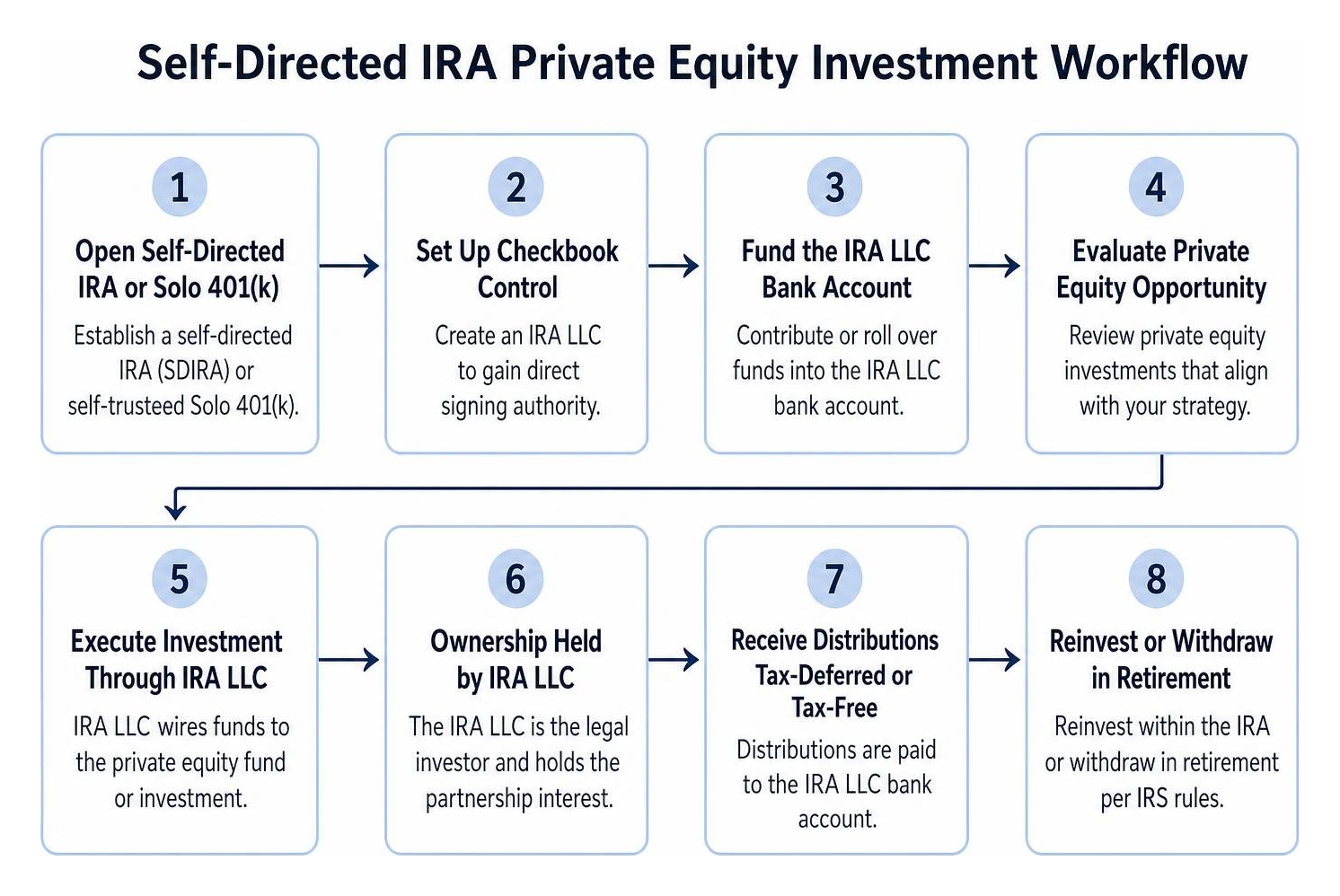
When partnering with private equity funds, understanding IRA Investment Rules 101: Invest in Private Equity is essential. Unlike public equities traded on brokerage apps, private placements require specialized custodial oversight to keep the account compliant with Internal Revenue Code regulations.
Our team at Independent IRA helps clients establish checkbook-controlled IRA LLCs or Solo 401(k) structures. This setup gives you direct signing authority to wire funds into private placements and receive partnership distributions directly into your dedicated retirement bank account without administrative delays. Brian Davis often assists investors through this process to ensure all subscription documents and titling properly reflect the self-directed entity.
IRA Investment Strategies for Private Equity Firms in San Diego
Investors utilizing retirement funds have multiple strategic routes when collaborating with private equity sponsors:
- Limited Partnership (LP) Allocations: Investing retirement capital into multi-year closed-end private equity funds to benefit from capital appreciation upon portfolio exits.
- Direct Private Debt and Mezzanine Lending: Providing private loans or structured mezzanine financing directly to portfolio companies. You can review debt structures in our guide to Private Equity Private Lending San Diego.
- Equity Co-Investments: Participating directly in single-asset special purpose vehicles (SPVs) alongside lead fund managers to avoid double-layer fee models.
A vital tax consideration is Unrelated Business Taxable Income (UBTI). If a private equity fund utilizes leveraged debt to acquire companies, that debt-financed portion of income inside an IRA could trigger Unrelated Debt-Financed Income (UDFI) tax under IRC Section 514. Unlevered funds (such as Tide Rock) or properly structured Solo 401(k) real estate platforms offer built-in structural advantages against certain forms of acquisition leverage taxation.
Key Due Diligence Steps for Private Equity Firms San Diego Deals
Before committing retirement capital to any private equity sponsor, execute rigorous due diligence:
- Examine the Waterfall and Fee Hurdle: Review management fees (commonly 1.5% to 2.0%) and carried interest hurdles (typically an 8% preferred return before the sponsor participates in profits).
- Evaluate Capital Call Timelines: Private equity commitments require staged funding over several years. Ensure your SDIRA maintains liquid cash to meet mandatory capital calls without violating IRA contribution limits.
- Confirm IRS Non-Disqualified Party Compliance: You, your spouse, your ascendants (parents), and direct descendants (children) cannot buy, sell, or receive personal compensation from the businesses owned by your IRA’s private equity investment.
- Understand Capital Raising Mechanics: If you are a deal sponsor, learning about raising private capital with IRAs allows you to accept retirement investments from accredited partners smoothly.
Frequently Asked Questions About San Diego Private Equity
What makes San Diego an attractive hub for private equity?
San Diego combines leading research institutions (UC San Diego, Scripps), extensive defense contracting clusters, and a deep talent base in biotechnology and software. These elements create a high concentration of resilient, lower-middle-market B2B companies ripe for operational modernization.
Can I invest retirement funds directly into private equity deals?
Yes. By using a self-directed IRA or a checkbook-controlled Solo 401(k) from Independent IRA, you can legally fund private equity limited partnerships, pre-IPO equity, and private debt, as long as all transactions follow IRS rules against disqualified person dealings.
What is the typical investment size for middle-market PE firms in San Diego?
Lower-middle-market firms in the region generally write initial equity checks ranging from $2 million to $15 million for companies generating $10 million to $50 million in revenue. Larger institutions like StepStone participate in global multi-million and multi-billion-dollar syndications.
How does Unrelated Business Income Tax (UBIT) apply to private equity IRAs?
When an IRA invests in an operating partnership (such as an LLC or LP) that generates active business income or uses portfolio leverage, the earnings attributable to that debt may be subject to UBTI. Structuring deals through C-corporation blocker entities or utilizing unlevered models can help manage this tax liability.
Before You Move Retirement Funds

San Diego’s private equity sector continues to expand, offering dynamic opportunities across mission-critical services, software platforms, and specialized commercial operations. When you take control of your retirement investing, you are no longer limited to standard Wall Street products.
As an Authorized Agent of Accuplan, Independent IRA helps you navigate checkbook IRA entity creation, self-trusteed Solo 401(k) plans, and alternative asset setups right here in San Diego, CA. We facilitate checkbook control so you can deploy retirement funds into IRS-permitted private placements on your timeline.
To learn more about deploying retirement funds into local private equity opportunities, explore our regional guide to Self-Directed IRA San Diego or contact our team to set up your account structure today.
This content is for informational and educational purposes only and does not constitute legal, tax, or investment advice. Rules, limits, and requirements may change. Consult a qualified tax advisor, attorney, or financial professional before making retirement planning or investment decisions. Independent IRA is an Authorized Agent of Accuplan Benefits Services and is not a custodian or trust company.