

 GIVE US A CALL
Founders seeking new equity sources often overlook the trillions of dollars locked in traditional retirement accounts. Learning how to raise capital from ira investors requires pitching accredited account holders, ensuring IRS compliance, and coordinating with qualified custodians to complete private placements. By demonstrating how to turn your IRA into a startup investing machine, entrepreneurs can unlock patient, tax-advantaged capital to fuel company growth. This strategy bridges the gap between self-directed investors seeking non-public diversification and founders syndicating capital for operating businesses.
Why Raising Capital from IRAs is a Game-Changer for Founders
Raising funds through self-directed accounts provides unique benefits for early-stage companies:
- Patient, Long-Term Capital: Retirement account assets are inherently intended for long-term growth. Because investors face tax penalties for early withdrawals prior to age 59½, IRA investors are typically aligned with longer holding periods and exit timelines.
- Tax-Deferred and Tax-Advantaged Potential Growth: Investors using traditional SDIRAs may enjoy tax-deferred gains, while those utilizing Roth SDIRAs may compound their startup equity tax-free. Demonstrating how to make your Roth IRA work harder than you do is a compelling value proposition when pitching high-growth opportunities.
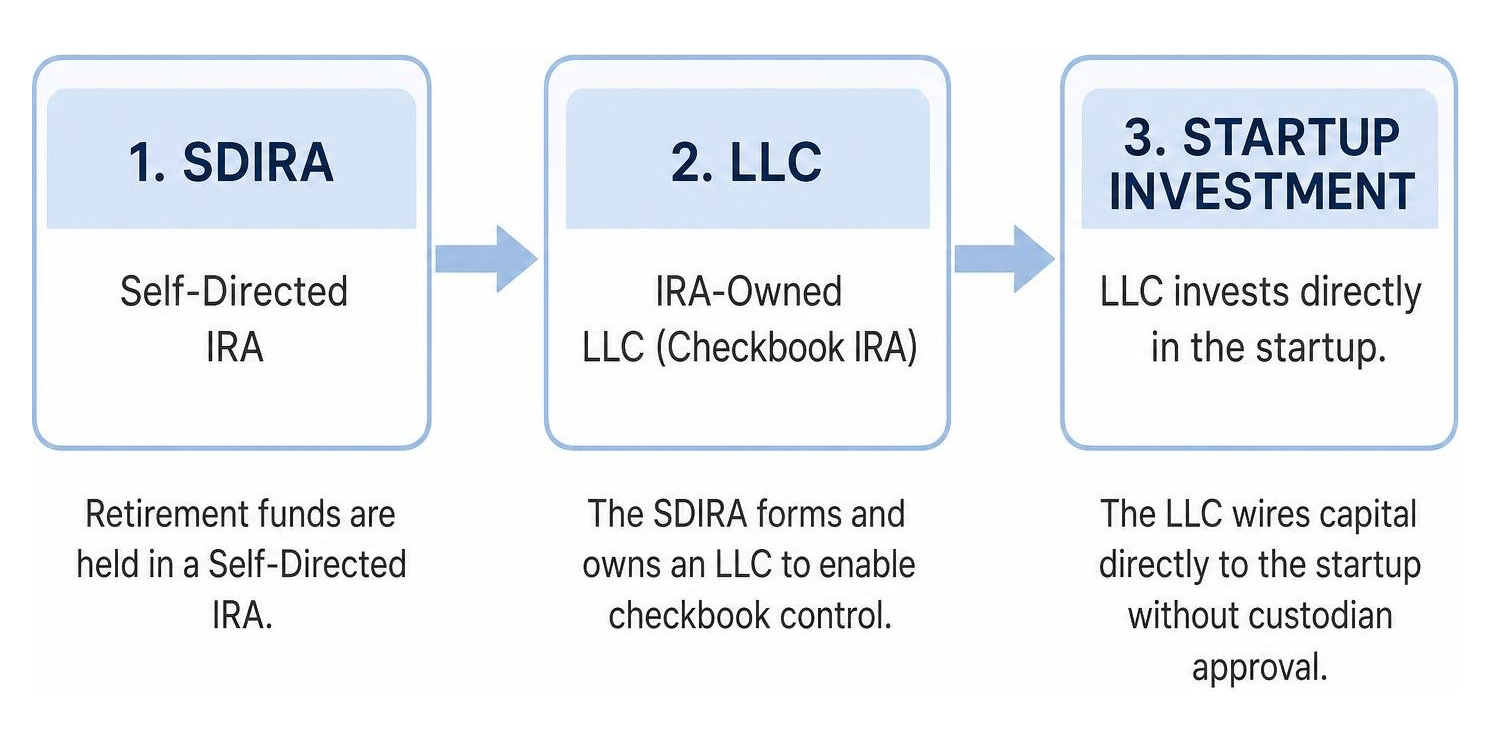
- Speed and Agility via Checkbook Control: Investors operating through a Checkbook IRA (typically structured via an IRA-owned LLC) can wire investment capital directly to your company without waiting for custodian transaction approvals.
Navigating IRS Rules: Prohibited Transactions and Disqualified Persons
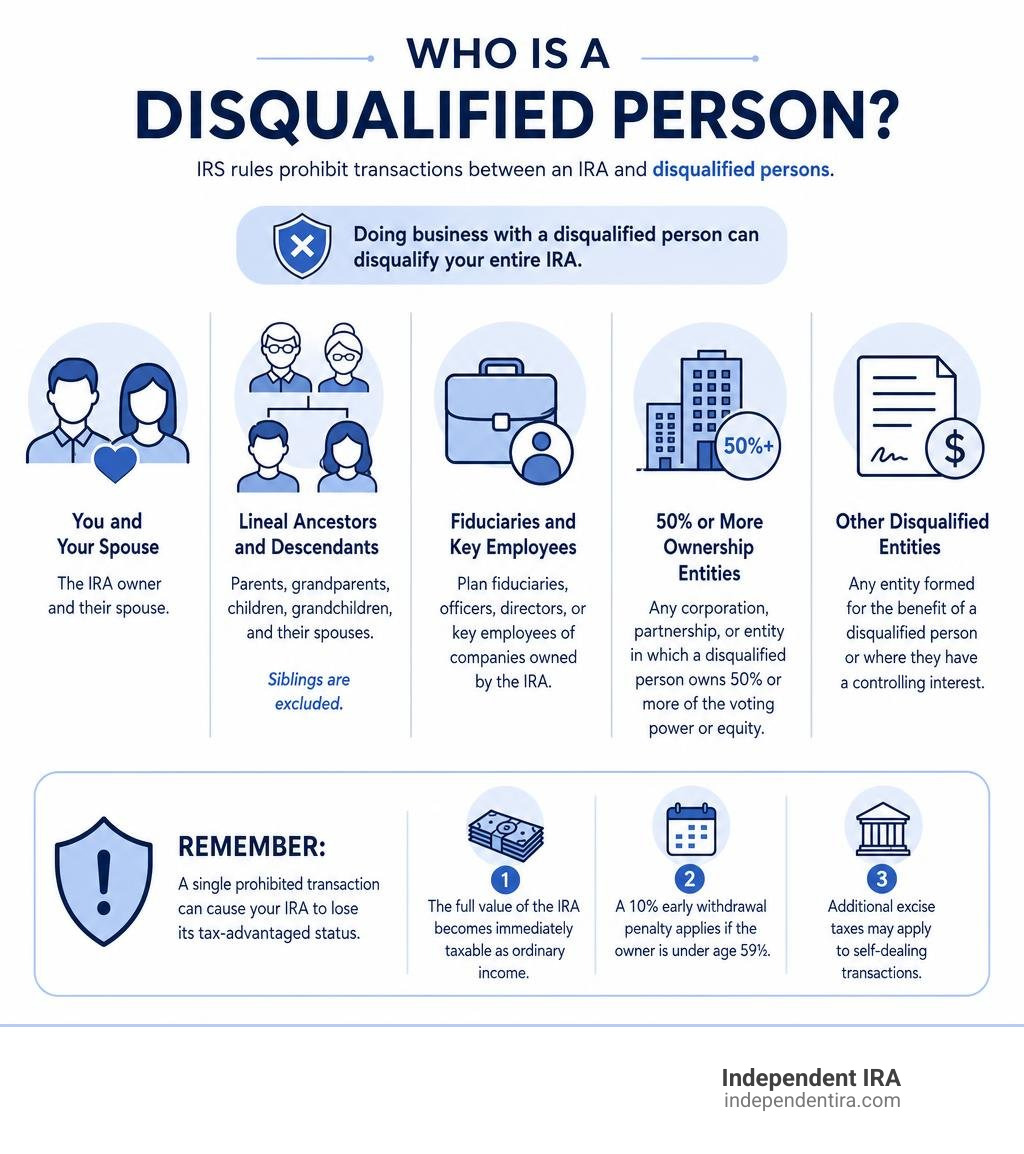
While retirement capital is abundant, strict federal tax laws govern how IRAs interact with private businesses. The IRS strictly prohibits self-dealing under Internal Revenue Code (IRC) Section 4975. A prohibited transaction occurs whenever an IRA engages in a direct or indirect exchange of property, service, or lending with a disqualified person.
If an IRA engages in a single prohibited transaction, the entire tax-advantaged status of the account is revoked. The IRS treats the account as fully distributed on the first day of the tax year in which the violation occurred.
The consequences are severe:
- The full fair market value of the IRA becomes immediately taxable as ordinary income.
- A 10 percent early withdrawal penalty applies if the IRA owner is under age 59½.
- Additional excise taxes may apply to self-dealing transactions.
For detailed guidance, founders and investors should review the official IRS Prohibited Transactions Guidance.
Identifying Disqualified Persons and Conflicts of Interest
To prevent illegal transactions, founders must identify who qualifies as a “disqualified person” in relation to the investor’s IRA. Disqualified persons include:
- The IRA owner and their spouse.
- Lineal descendants and ancestors (parents, grandparents, children, grandchildren) and their spouses. Note: Siblings are excluded from this rule.
- Plan fiduciaries, officers, directors, or key employees of companies owned by the IRA.
- Any corporation, partnership, or entity in which a disqualified person holds 50 percent or more of total voting power or ownership equity.
Conflicts of interest can also compromise fiduciary judgment under Department of Labor (DOL) standards. For instance, DOL advisory opinions indicate that if an IRA owner serves as a corporate officer—even with a tiny individual ownership stake (e.g., 1.17%)—or holds substantial voting power (such as 46.04% voting control or 48.14% share ownership), their ability to make unbiased fiduciary decisions on behalf of the IRA is legally compromised.
However, an employee holding less than 1% ownership who holds no fiduciary control or executive decision-making power can generally invest their IRA capital into the company without triggering prohibited transaction rules.
Entity Selection and Tax Traps: S-Corps vs. LLCs and C-Corps
Selecting the correct corporate entity is vital when accepting retirement capital.
| Entity Type | Eligible for Direct IRA Investment? | Primary Tax & Regulatory Considerations |
|---|---|---|
| S-Corporation | NO | IRAs are ineligible tax-exempt shareholders under Subchapter S rules. An S-Corp that issues shares to an IRA risks losing its S-Corp status entirely. |
| Limited Liability Company (LLC) | YES | Permitted, but operating profits or debt-financed income may trigger Unrelated Business Income Tax (UBTI/UDFI). |
| C-Corporation | YES | Ideal for high-growth ventures. Corporate tax is paid at the entity level, eliminating UBTI for the IRA investor. |
When accepting capital from an IRA into a partnership or LLC, founders must evaluate Unrelated Business Taxable Income (UBTI). If an LLC generates active business income (rather than passive investment income like dividends or interest), the tax-exempt IRA may owe UBTI at trust tax rates on earnings above $1,000. Additionally, if the LLC utilizes leverage, Unrelated Debt-Financed Income (UDFI) rules apply.
Strategic Steps on How to Raise Capital from IRA Investors
Knowing how to raise capital from ira investors requires a clear, systematic process that accommodates both legal regulations and administrative workflows.
Pitching and Education: How to Raise Capital from IRA Investors
Many accredited investors hold substantial retirement savings in former employer 401(k)s or traditional IRAs without realizing they can move those funds into self-directed accounts.
When pitching IRA investors:
- Educate them on the mechanics of rolling funds over to an SDIRA custodian without tax penalties.
- Provide transparent legal offerings through standard Private Placement Memorandums (PPM) and Subscription Agreements.
- Provide clear disclosure regarding entity choice, illiquidity risks, and custodian requirements.
- Direct investors to educational resources on raising private capital with IRAs to streamline their onboarding.
Onboarding and Custodial Workflow for How to Raise Capital from IRA Investors
Because an IRA—not the individual—is buying the shares, paperwork must accurately name the IRA entity. For founders seeking operational guidance through this multi-step setup, Brian Davis provides practical support.
- Account Setup: The investor opens a self-directed account with a qualified custodian through Independent IRA (an Authorized Agent of Accuplan Benefits Services) or transfers funds from an existing provider.
- Document Drafting: Corporate subscription agreements must list the investor name as: [Custodian Name] FBO [Investor Name] IRA.
- Direction of Investment: The investor signs a Direction of Investment (DOI) form instructing the custodian to purchase the company’s private equity or debt instruments.
- Funding execution: The custodian reviews the transaction documents for operational compliance and wires the investment funds directly to the startup’s bank account.
If you are structuring private debt or notes instead of equity, review our AZ guide to private lending with IRA, the real estate investors guide to IRA promissory notes, or our beginners guide to self-directed IRA hedge funds.
Post-Investment Compliance: Annual Valuations and Ongoing Monitoring
Accepting IRA capital creates an ongoing operational relationship between your startup and the investor’s custodian.

IRS regulations require SDIRA custodians to report the Fair Market Value (FMV) of all non-publicly traded holdings annually on Form 5498. Startups must provide written documentation—such as a CPA valuation letter, recent funding round pricing, or an independent appraisal—confirming the per-share value of the investment every year.
Communicating Risks and Requirements to IRA Capital Providers
To maintain compliance after the deal closes, monitor these key factors:
- Avoid Post-Investment Board Roles: An investor who was compliant at funding could trigger a prohibited transaction later if they accept an officer position or key executive role in your startup.
- Prevent Equity Ownership Traps: Ensure that future funding rounds do not cause a disqualified investor group to cross the 50 percent total equity ownership threshold.
- Mitigate Capital Call Issues: If your business requires additional capital calls, an IRA investor must fund their pro-rata contribution directly from their IRA account, not personal out-of-pocket funds.
Frequently Asked Questions
Can an IRA invest directly in an S-Corporation startup?
No. Internal Revenue Code rules prohibit IRAs from holding stock in an S-Corporation. If an S-Corp issues shares to an IRA, the business risks losing its tax-exempt S-Corporation election status, subjecting all shareholders to corporate tax liabilities.
What are the tax penalties if an IRA investment triggers a prohibited transaction?
If an investment is deemed a prohibited transaction under IRC Section 4975, the IRA loses its tax-exempt status as of January 1st of that tax year. The entire fair market value of the account is treated as a taxable distribution, subjected to income tax, and hit with an additional 10% early withdrawal penalty if the owner is under age 59½.
How do startups handle annual valuations required by IRA custodians?
Startups must provide an annual Fair Market Valuation (FMV) statement to the investor’s IRA custodian. This can be established using the per-share price of a recent equity financing round, a valuation letter from an independent CPA, or an official 409A appraisal.
Does an IRA investor pay tax on profits from an LLC investment?
If the startup is structured as a pass-through entity (LLC or partnership) operating an active trade or business, profits passed through to the IRA may be subject to Unrelated Business Income Tax (UBTI) if net earnings exceed $1,000. Passive income, such as interest from promissory notes or dividends from C-Corps, is generally exempt from UBTI.
Before You Move Retirement Funds
Raising capital from self-directed IRAs provides startup founders with access to a substantial pool of long-term capital. However, success depends on maintaining strict legal separation between IRA owners and company management, choosing compatible legal entities, and complying with IRS prohibited transaction rules.
At Independent IRA, an Authorized Agent of Accuplan Benefits Services, we guide investors, issuers, and entrepreneurs through the process of structuring compliant self-directed accounts and checkbook structures. To learn how we can help support your capital raising process, explore our range of services and contact our team for capital raising support.
This content is for informational and educational purposes only and does not constitute legal, tax, or investment advice. Rules, limits, and requirements may change. Consult a qualified tax advisor, attorney, or financial professional before making retirement planning or investment decisions. Independent IRA is an Authorized Agent of Accuplan Benefits Services and is not a custodian or trust company.