

 GIVE US A CALL
Finding the right bitcoin solo 401k custodian is crucial for self-employed investors who want direct control over crypto assets without running afoul of IRS rules. Unlike standard financial institutions that hold assets directly, a specialized self-directed plan provider establishes the compliant legal structure while granting you full checkbook control as plan trustee. Understanding how to set up a 401k for self-employed in less than an hour begins with choosing an administrative structure that ensures maximum asset protection and compliance. By separating personal holdings from retirement trust assets, you eliminate third-party risk while benefiting from tax-advantaged growth.
Difference Between a Custodian and a Trustee in a Solo 401(k)
The legal mechanics of a Solo 401(k) differ significantly from a standard individual retirement account (IRA). In a typical IRA, a institutional custodian holds the assets for your benefit. In a self-directed Solo 401(k), the plan itself owns the assets, and you—the business owner—can serve as the designated trustee of the plan.
- The Custodian / Plan Provider: Provides non-discretionary recordkeeping, IRS reporting (such as filing Form 5500-EZ when assets exceed $250,000), and plan documents.
- The Plan Trustee (You): Exercises direct administrative authority, opens checking accounts, selects investments, and manages key access for plan assets.
This arrangement provides what is commonly known as checkbook control. Instead of requesting custodial approval for every Bitcoin trade or wallet transfer, the trustee acts directly on behalf of the trust. If you want to dive deeper into how checkbook structures compare across different accounts, explore our step by step guide to checkbook IRA frameworks.
Legal Compliance and IRS Rules for Bitcoin Self-Custody
The IRS treats cryptocurrency as property for federal income tax purposes according to IRS Notice 2014-21. While holding Bitcoin inside a retirement account offers immense tax-deferred or tax-free growth potential, trustee authority comes with strict legal boundaries.
To stay compliant:
- No Personal Commingling: Plan Bitcoin must never enter a personal hardware wallet or software wallet alongside your personal holdings.
- No Personal Benefit: You cannot use plan Bitcoin as collateral for a personal loan, nor can you purchase Bitcoin from yourself or a disqualified person (such as a spouse, parent, or linear descendant).
- Proper Titling: Any wallet, exchange account, or storage vault must be titled directly in the name of the Solo 401(k) trust (e.g., Main Street LLC 401(k) Trust).
Failing to respect these boundaries brings severe tax penalties. To stay fully informed on regulatory updates and potential traps, read our full breakdown on how the taxman cometh for your crypto retirement.
Solo 401(k) vs. IRA: Key Benefits for Bitcoin Investors
For self-employed professionals, small business owners, and independent contractors, choosing between a self-directed IRA and a self-directed Solo 401(k) is a foundational decision. While a Bitcoin IRA is an excellent tool for many investors, the Solo 401(k) provides distinct structural advantages for those with eligible self-employment income.
How Self-Employed Individuals Benefit from Higher Contribution Limits
The primary advantage of a Solo 401(k) is its immense contribution capacity. Because you act as both the employee and the employer, you can contribute from both sides:
- Employee Elective Deferral: Up to 100% of earned income up to the annual limit ($23,000 for 2024, plus catch-up contributions for those 50 and older).
- Employer Profit Sharing: An additional contribution of up to 20% to 25% of net self-employment earnings.
This dual structure allows self-employed individuals to accumulate real Bitcoin inside a tax-sheltered vehicle far faster than standard IRA limits allow. Over time, compounding growth without annual tax drag can dramatically increase your total retirement wealth.
True Self-Custody vs. Custodial Limitations
When holding Bitcoin in a conventional retirement account, you typically hold an IOU—a paper claim on a centralized platform’s balance sheet. If that exchange or custodian faces insolvency, security breaches, or regulatory freezes, your retirement savings are exposed to third-party counterparty risk.
True self-custody shifts the equation. By taking responsibility for private key management, you eliminate third-party risk. However, full personal self-custody in a standard personal wallet lacks the legal and administrative documentation required by the IRS for retirement assets. This brings us to the ultimate solution: collaborative security structures designed specifically for retirement accounts.
Implementing Collaborative Security with a Bitcoin Solo 401k Custodian
Holding private keys to a retirement account shouldn’t mean taking on total exposure to single-point-of-failure risks. If you store your retirement keys on a single thumb drive in a home safe, a lost seed phrase, physical theft, or house fire could wipe out your nest egg instantly.
That is why top-tier self-directed planning relies on collaborative security using a 2-of-3 multisig (multi-signature) protocol.
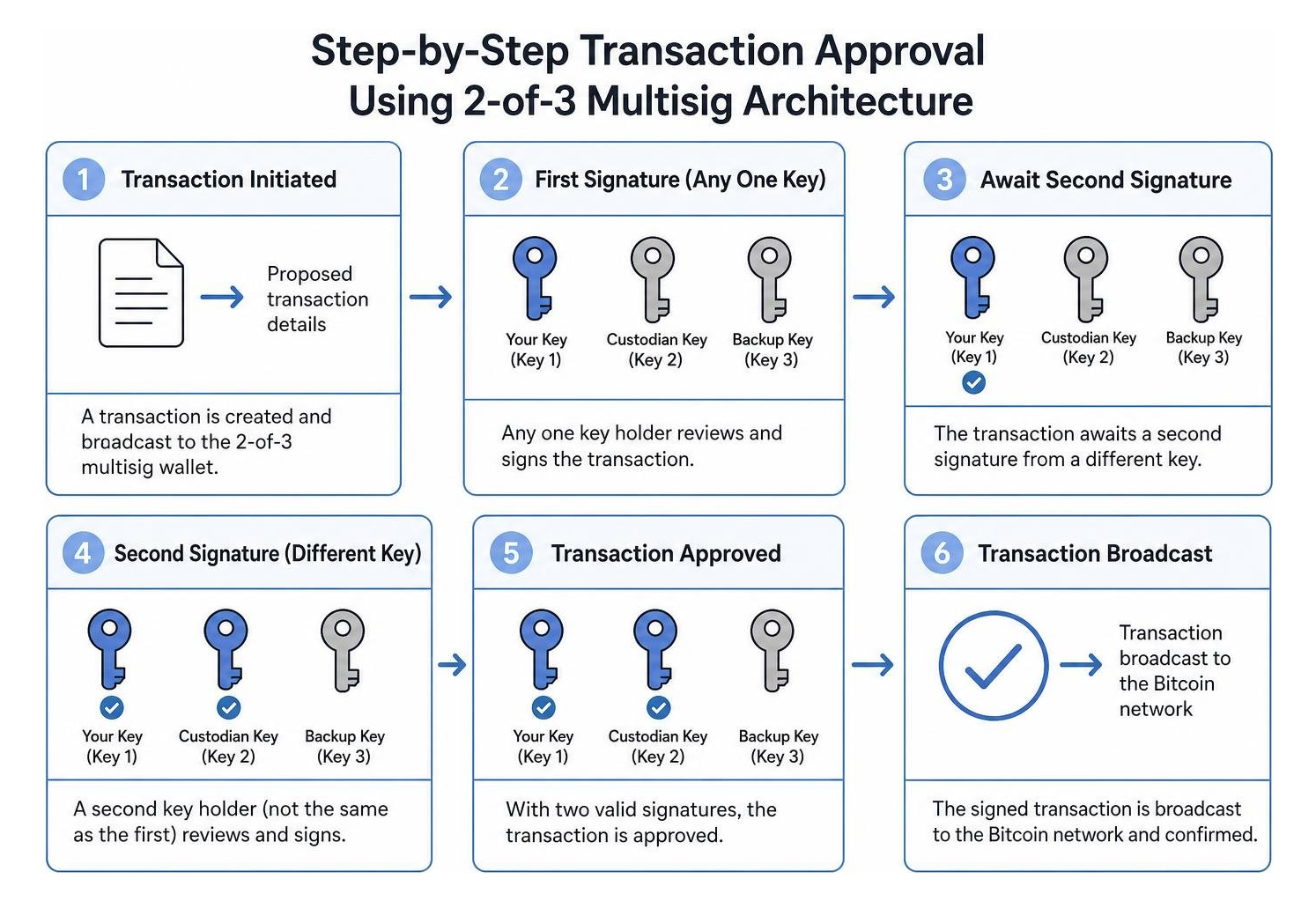
Working with a Bitcoin Solo 401k Custodian Using 2-of-3 Multisig
In a 2-of-3 collaborative multisig setup, three private keys are generated to secure the plan’s Bitcoin vault. Any transaction moving funds out of the vault requires signatures from at least two of those three keys:
- Key 1 (Your Primary Key): Controlled directly by you as the plan trustee.
- Key 2 (Collaborative Security Key): Held by a secure setup service or institution.
- Key 3 (Backup / Recovery Key): Held offsite or with an independent key agent.
Under this model, no single party has unilateral control over your retirement coins:
- You cannot move funds alone without co-signing or accessing your backup key, preventing impulse errors or coercion risks.
- No custodian or third party can spend your coins alone because they only hold one key. Your coins cannot be rehypothecated, lent out, or frozen by a third party.
Since operating starting in 2018, collaborative security frameworks designed around this model have achieved a track record of $0 in lost Bitcoin across all client retirement accounts.
Estate Planning, Inheritance, and Vault Recoverability
For low time-preference Bitcoin holders, long-term survival and inheritance are key priorities. If something happens to you, can your family access the Solo 401(k) assets without technical friction or regulatory delays?
With a collaborative security framework:
- Clear, documented transaction signing policies guide your designated beneficiaries.
- If one key is destroyed or lost, the remaining two keys can be used to recover the vault and migrate the Bitcoin to a new secure setup.
- Legal plan documents specify how a successor trustee steps in, ensuring your heirs inherit real Bitcoin rather than getting tied up in probate or trapped behind custodial red tape.
How to Choose and Setup a Bitcoin Solo 401k Custodian Structure
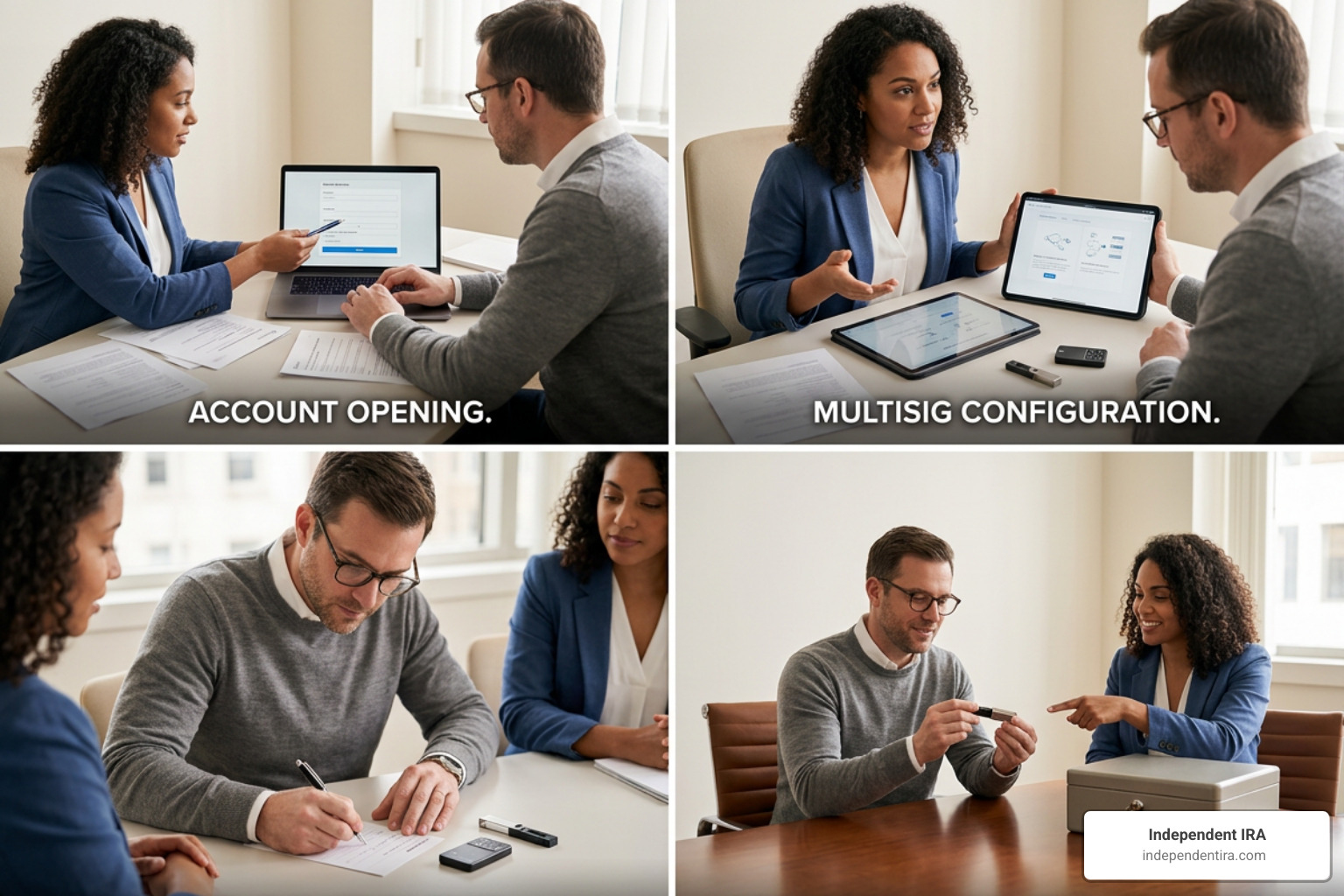
Establishing a self-directed Solo 401(k) for Bitcoin requires careful setup to ensure your plan documents are compliant, your trust accounts are structured correctly, and your keys are generated securely.
Selecting the Right Bitcoin Solo 401k Custodian and Plan Provider
Not all plan providers are equipped for alternative asset integration. When reviewing partners, look for the following criteria:
- Non-Proprietary Security: Ensure the setup uses open standards and hardware wallets rather than locking your private keys into a proprietary closed system.
- Documented IRS Compliance: The provider must supply recognized plan adoption agreements, trust agreements, and annual tax reporting support.
- Direct Support: Navigating key generation and transfer logistics requires experienced professionals. Brian Davis and our specialized team at Independent IRA assist you throughout the entire onboarding and execution phase.
Step-by-Step Setup Process: From Rollover to Multisig Storage
- Plan Adoption: Establish your self-trusteed Solo 401(k) using approved plan documentation that explicitly permits alternative digital assets.
- Open Plan Bank Account: Set up a dedicated checking account titled in the name of your new Solo 401(k) trust.
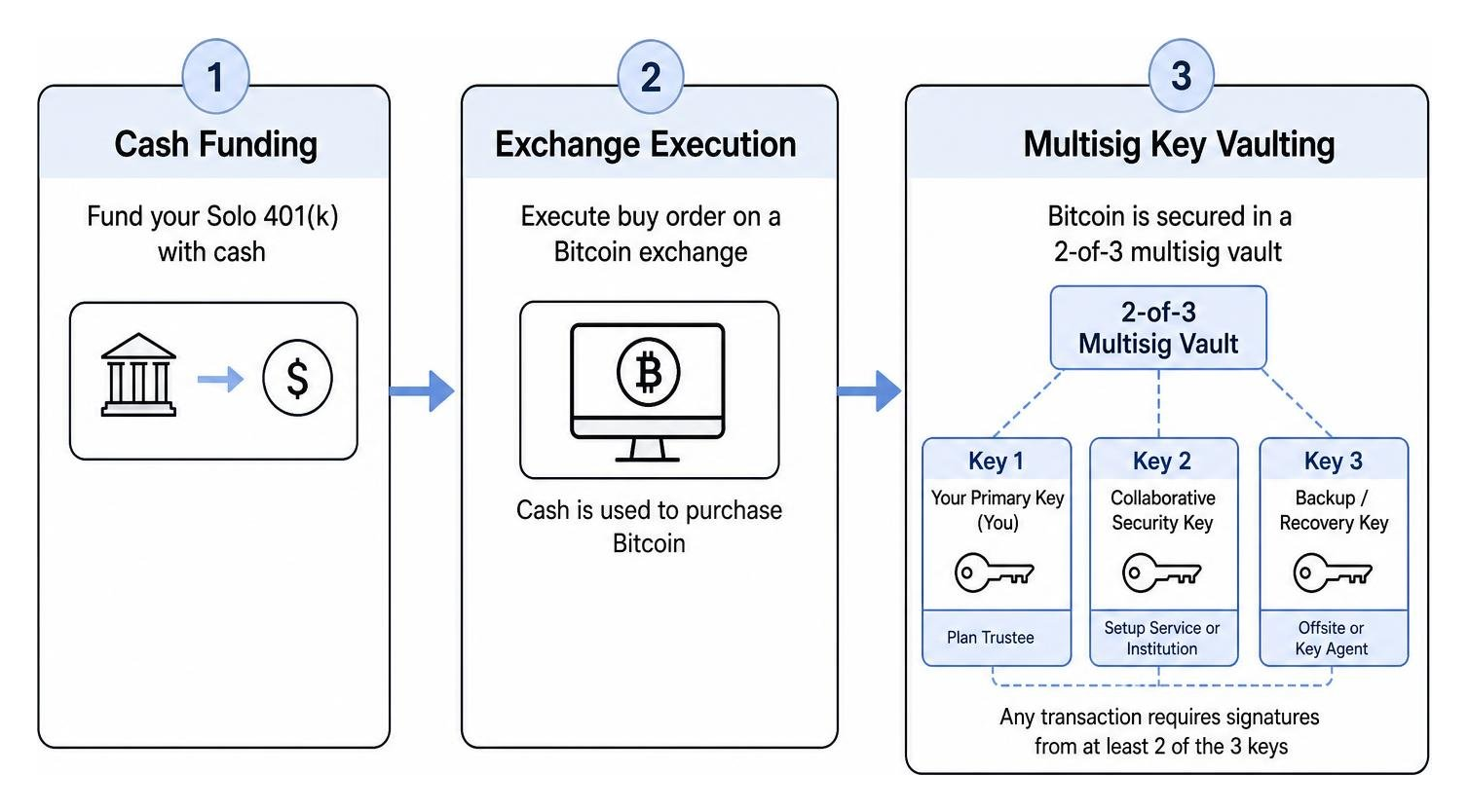
- Fund the Plan: Execute a tax-free rollover from an existing 401(k) or IRA, or make an initial eligible business contribution.
- Acquire Real Bitcoin: Execute purchases through a trusted, institutional-grade Bitcoin exchange partner tied directly to your plan trust account.
- Withdraw to Multisig Storage: Move the acquired Bitcoin off the exchange into your self-directed 2-of-3 multisig vault setup.
If you are just starting out with self-directed digital asset strategies, read our comprehensive beginners guide to cryptocurrency self-directed IRA systems to understand how these workflows operate from end to end.
Frequently Asked Questions About Bitcoin Solo 401(k) Accounts
Can I legally hold the private keys to my retirement Bitcoin?
Yes. When you operate a self-directed Solo 401(k) as the designated plan trustee, you can legally hold and manage the keys for the benefit of the plan. However, key management must follow formal administrative rules. The keys must control assets titled exclusively to the retirement trust, and the assets cannot be spent or used for personal benefit prior to reaching retirement age without incurring tax distribution penalties.
What happens if my collaborative security partner goes out of business?
Because collaborative security relies on standard open-source multisig smart contracts (2-of-3 setup), you are never trapped. If your setup partner or plan service provider ceases operations, your single trustee key combined with your second backup key allows you to sweep funds safely to a new vault without needing approval from the defunct company.
How does a Bitcoin Solo 401(k) work for a self-employed business owner?
If you operate a sole proprietorship, single-member LLC, S-Corp, or partnership with no full-time non-owner employees, you qualify for a Solo 401(k). Your business adopts the retirement plan, you serve as the trustee, and you make pre-tax or Roth contributions directly from business earnings to purchase Bitcoin inside the plan’s dedicated trust account.
Before You Move Retirement Funds
Adding physical, key-controlled Bitcoin to your long-term retirement strategy is one of the most powerful moves a self-employed business owner can make. However, preserving tax advantages and avoiding costly IRS compliance errors requires getting the foundation right from day one.
At Independent IRA, we guide you through every phase of building, funding, and securing your retirement accounts. Whether you are looking to combine crypto with classic tangible assets like real estate—such as in our building your future with a bitcoin ira real estate combo guide—or simply want to establish a ironclad collaborative security vault for your business’s Solo 401(k), we provide the structure and support you need.
Explore Self-Directed Retirement Solutions today to speak with our team and secure your financial independence.