

 GIVE US A CALL
When syndicators and fund managers seek new funding sources, learning how to pitch alternative assets to IRA investors unlocks access to trillions of dollars in patient retirement capital. To succeed, sponsors must present institutional-grade documentation, respect strict custodial boundaries, and proactively address tax complexities like debt-financed income. By structuring offerings properly through Raising Private Capital IRAs, deal makers can build lasting trust with self-directed account holders looking for tangible diversification. These retirement savers prioritize capital preservation and absolute compliance over speculative sales tactics.
Retirement savers are increasingly looking beyond public stock tickers and traditional bond yields to protect their wealth against macroeconomic headwinds. With public market volatility and inflation eroding traditional purchasing power, capital preservation and non-correlated diversification have become top priorities for self-directed IRA (SDIRA) owners. Account owners recognize that relying exclusively on Wall Street index funds leaves their retirement security exposed to systemic market corrections and currency debasement.
By utilizing self-directed retirement vehicles, individuals can invest in unlisted, tangible, and private market opportunities. These include direct real estate acquisitions, private equity syndications, energy production projects, The Real Estate Investor’s Guide to IRA Promissory Notes, and digital currencies via a Beginners Guide to Cryptocurrency Self-Directed IRA.
For asset sponsors, syndicators, and private lenders, this retirement pool represents trillions of dollars in patient, long-term capital that is not subject to the immediate liquidity demands of retail day-traders. However, these investors have unique operational, regulatory, and tax considerations. When you pitch private deals to retirement account holders, you must speak directly to portfolio risk management, inflation hedging, non-recourse debt rules, and the precise mechanics of holding non-traditional assets inside tax-advantaged structures.
How to Pitch Alternative Assets to IRA Investors Compliantly and Effectively
When you prepare to pitch alternative assets to ira investors, your presentation must balance compelling potential returns with rigorous compliance and structural transparency. Retirement investors are protective of their nest eggs. Any presentation that relies on urgency, exaggerated claims, or vague mechanics will instantly raise red flags.
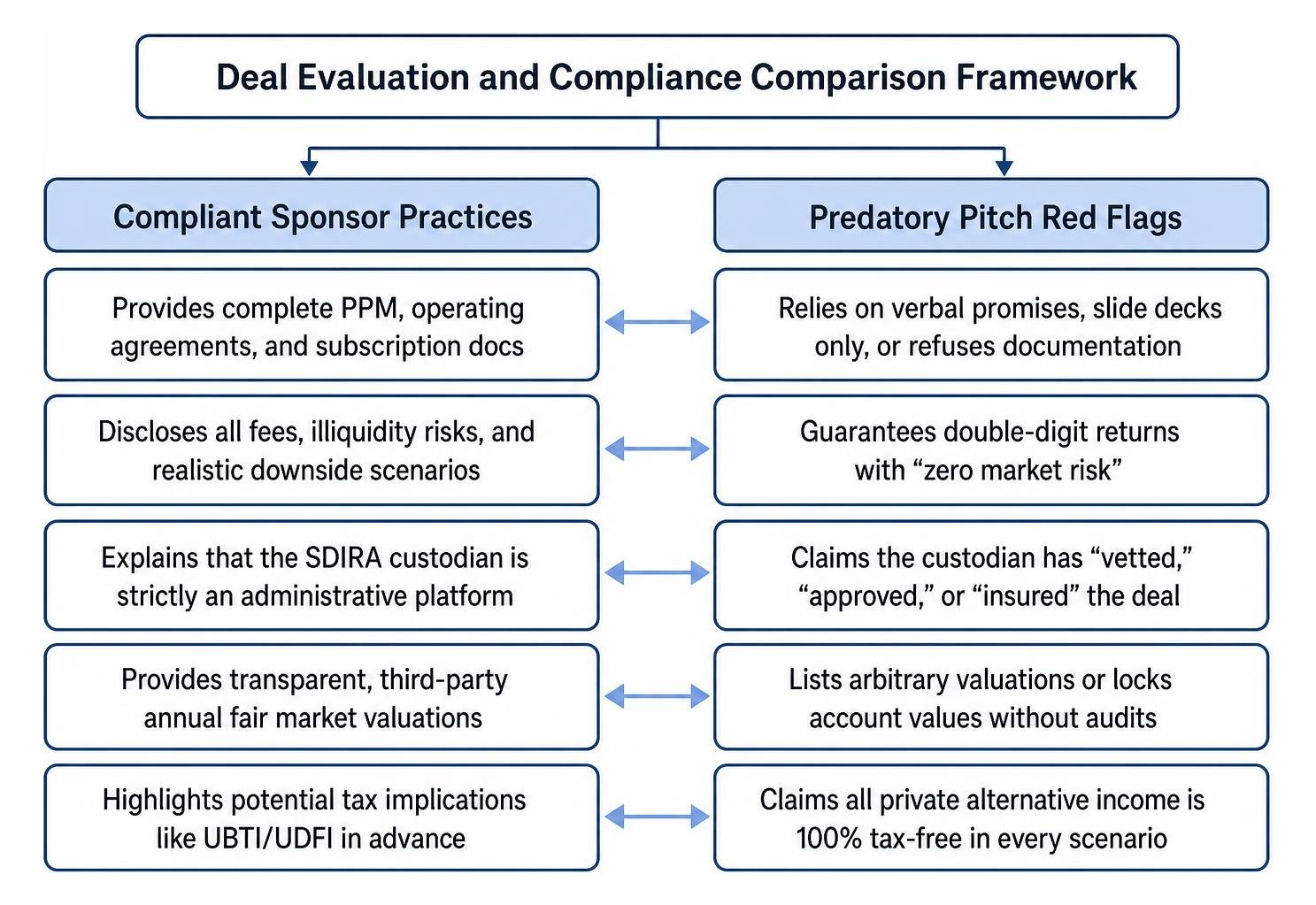
Credible sponsors succeed by providing complete documentation upfront, setting realistic expectations, and respecting the operational rules that govern self-directed retirement accounts. Because SDIRA owners often commit significant sums from rollover accounts, they conduct rigorous due diligence and expect institutional-grade clarity.
| Compliant Sponsor Practices | Predatory Pitch Red Flags |
|---|---|
| Provides complete PPM, operating agreements, and subscription docs | Relies on verbal promises, slide decks only, or refuses documentation |
| Discloses all fees, illiquidity risks, and realistic downside scenarios | Guarantees double-digit returns with “zero market risk” |
| Explains that the SDIRA custodian is strictly an administrative platform | Claims the custodian has “vetted,” “approved,” or “insured” the deal |
| Provides transparent, third-party annual fair market valuations | Lists arbitrary valuations or locks account values without audits |
| Highlights potential tax implications like UBTI/UDFI in advance | Claims all private alternative income is 100% tax-free in every scenario |
Structuring the Offer: Key Elements Needed to Pitch Alternative Assets to IRA Investors
A successful pitch requires an institutional-grade document package. SDIRA investors cannot simply write a personal check; their custodial account or dedicated entity must execute specific legal instruments to remain compliant with IRS guidelines.
To present a compliant opportunity, ensure your offer includes:
- Private Placement Memorandum (PPM) & Subscription Agreements: Clearly detail the asset class, offering terms, voting rights, and risk factors so investors can evaluate the legal safeguards of the placement.
- Fair Market Valuation (FMV) Procedures: Outline how and when annual asset valuations will be delivered to the custodian for IRS Form 5498 reporting, ensuring account holders avoid IRS non-compliance penalties.
- Tax Awareness (UBTI & UDFI): If an asset utilizes leverage (such as debt-financed real estate) or operates an active business, acknowledge Unrelated Business Taxable Income (UBTI) or Unrelated Debt-Financed Income (UDFI) up front.
- Clear Liquidity and Exit Schedules: Detail lock-up periods, distribution schedules, and secondary redemption policies, whether raising funds for private equity, real estate, or Tax Liens Tax Deeds San Diego.
Clarifying Custodian Roles When You Pitch Alternative Assets to IRA Investors
One of the quickest ways to lose credibility—or attract regulatory scrutiny—is to misrepresent the role of the self-directed IRA custodian.
A U.S. Government Accountability Office (GAO) report noted that investing in alternative assets increases account owners’ responsibilities significantly, specifically because custodians do not perform investment due diligence. Most custodial agreements explicitly state that the custodian has no fiduciary duty regarding performance and does not evaluate the quality, legitimacy, or safety of any promoter or asset.
When presenting a deal, emphasize that the custodian is a passive, non-fiduciary administrator. Sponsors should encourage investors to utilize Self-Directed IRA Control via checkbook structures or traditional custodial processing, while conducting thorough due diligence. If you are showing an investor How to Turn Your IRA Into a Startup Investing Machine, highlight that custodial acceptance simply means the asset meets basic IRS structural eligibility, not an investment endorsement.

Overcoming Skepticism: Addressing IRA Investor Fraud and Risk Concerns
Alternative asset investors have good reason to be cautious. Fraudulent operators frequently target retirement accounts because early withdrawal penalties discourage individuals from quickly pulling their capital out, allowing illicit schemes to go unnoticed for years.
Furthermore, account statements from custodians often list an asset’s value based on original purchase price or self-reported promoter estimates, which may obscure underlying distress. Discerning investors understand these risks and look for indicators of institutional hygiene before transferring any funds.
To overcome skepticism when you pitch alternative assets to ira investors, proactively address these common concerns:
- Unsolicited Offers & High-Pressure Sales: Avoid cold high-pressure tactics. Professional sponsors rely on established networks, educational seminars, and transparent disclosures that allow prospective investors to make informed decisions at their own pace.
- “Guaranteed” Returns: Never use the word “guaranteed” when discussing private yields. Frame returns as projected targets backed by historical data, sensitivity models, and clear market assumptions, highlighting downside mitigation strategies.
- Third-Party Verification: Encourage prospective investors to review the pitch with their CPA, tax attorney, or independent financial advisor. Connecting investors with professional resources, like Alternative Investments – Witkop Financial – San Diego, CA, reinforces that your offer stands up to scrutiny.
- Institutional Structuring: If offering private debt, pooled equity, or strategies covered in our Beginners Guide to Self-Directed IRA Hedge Funds, show clear audits, dedicated escrow accounts, and documented fund administrators.
Best Practices for Closing Deals with Self-Directed IRA Capital
Closing a deal using self-directed retirement funds involves administrative steps not found in traditional private placements. Coordinating these moving parts ensures a smooth closing process and prevents costly delays:
- Account Establishment & Rollover Timelines: Direct rollovers from previous 401(k) plans or custodian-to-custodian transfers can take several weeks. Account for these processing windows in your capital call schedules so funding deadlines are not missed.
- Titled Documentation: Ensure all subscription documents, deeds, or notes are titled correctly in the name of the custodian for the benefit of (FBO) the investor’s IRA (or in the name of the investor’s checkbook LLC).
- Checkbook LLC Integration: For faster closings and direct oversight, investors often use an IRA-owned LLC. Learn how checkbook control functions for assets like real estate or crypto via Building Your Future with a Bitcoin IRA Real Estate Combo.
- Ongoing Reporting & Communication: Provide consistent distribution updates and timely year-end valuation letters so account owners remain compliant with IRS reporting rules when executing Private Equity Private Lending San Diego.
For complex account coordination or administrative workflow questions, Brian Davis and our processing team at Independent IRA assist sponsors and investors through every step of custodial onboarding.
Frequently Asked Questions About SDIRA Capital Raising
Do self-directed IRA custodians evaluate the quality or legitimacy of an investment pitch?
No. Self-directed IRA custodians serve solely as passive administrators and recordkeepers. They do not review, endorse, or verify the financial viability, legitimacy, or background of promoters or underlying assets. The responsibility for due diligence falls entirely on the account owner.
What common red flags make SDIRA investors reject an alternative asset pitch?
Investors are trained to walk away from offerings that promise “guaranteed” high returns with zero risk, pitches that claim the SDIRA custodian has “approved” or “backed” the deal, offerings lacking formal documentation (PPMs or subscription agreements), and promoters who pressure them to move retirement funds immediately.
How do tax rules like UBTI or UDFI impact alternative asset pitches?
While traditional IRA earnings grow tax-deferred (and Roth earnings grow tax-free), holding leveraged assets (such as real estate with non-recourse debt) or active operating businesses within an IRA can trigger Unrelated Debt-Financed Income (UDFI) or Unrelated Business Taxable Income (UBTI). Sponsors must disclose these potential tax liabilities so investors can structure their investments appropriately with their tax professionals.
What professional advice should an investor seek before committing retirement funds?
Before funding an alternative asset through an SDIRA, investors should consult an independent CPA or tax attorney to review the deal’s structure, confirm compliance with IRS prohibited transaction rules, and evaluate any potential state or federal tax impacts.
Before You Move Retirement Funds
Successfully raising capital from self-directed retirement accounts requires absolute transparency, clean legal structuring, and an appreciation for the rules governing retirement plans. By setting realistic expectations and respecting the administrative framework of self-directed accounts, sponsors can build lasting partnerships with private investors.
As an Authorized Agent of Accuplan Benefits Services, Independent IRA provides administrative coordination, checkbook LLC setups, and onboarding support needed to hold IRS-permitted assets compliantly.
To explore how our team can support your capital-raising process or help you navigate self-directed accounts, learn more about Raising Private Capital IRAs or contact us directly today.
This content is for informational and educational purposes only and does not constitute legal, tax, or investment advice. Rules, limits, and requirements may change. Consult a qualified tax advisor, attorney, or financial professional before making retirement planning or investment decisions. Independent IRA is an Authorized Agent of Accuplan Benefits Services and is not a custodian or trust company.