

 GIVE US A CALL
How to choose an alternative asset custodian starts with one practical question: can the provider safely administer the exact investments you want to hold in a self-directed IRA or Solo 401(k)? Look for clear support for your asset class, transparent fees, sound recordkeeping, responsive service, and an account structure that helps you follow IRS rules on prohibited transactions and personal benefit. Independent IRA, an Authorized Agent of Accuplan, helps investors move beyond the narrow menu at conventional brokerages while keeping retirement-account administration and compliance central to the decision.
A good custodian is not simply a place to park assets. For real estate, private notes, precious metals, private equity, and digital assets, the right fit can affect how easily you fund investments, document transactions, use checkbook control, and protect retirement assets over time. This guide explains the questions to ask before you commit funds, including where custodial responsibilities begin and end.
Brian Davis and our team walk you through the custody factors that matter most before you build or expand an alternative-asset retirement portfolio.
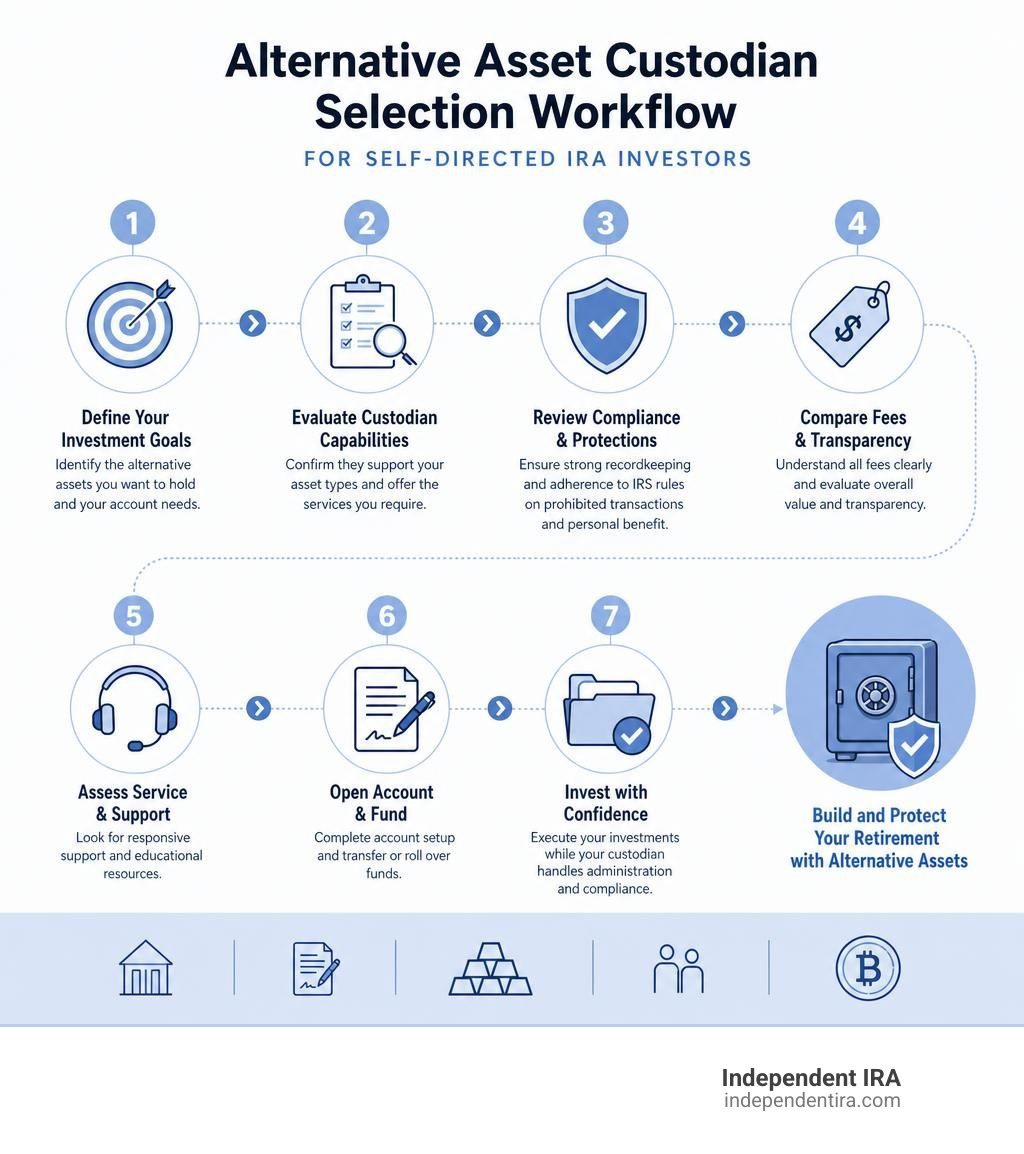
Understanding SDIRA Asset Coverage and Key IRS Compliance Rules
Standard Wall Street brokerage platforms restrict retirement savings to paper assets like stocks, mutual funds, and bonds. However, self-directed retirement structures, including Self-Directed IRAs (SDIRAs) and Solo 401(k)s, allow account holders to invest in tangible real estate, private lending notes, physical gold, startup equity, and cryptocurrencies.
The expanding landscape of non-traditional investing has driven massive industry growth. The global institutional and retail custody market grew to $708 billion in 2025 and is projected to reach $1.6 trillion by 2030. Furthermore, tokenized Real-World Assets (RWAs), representing fractionalized real estate, private credit, and treasury bonds, have expanded past $26.4 billion toward a projected $16 trillion market by 2030. Knowing how to choose an alternative asset custodian requires understanding which platforms support specific asset classes and how they safeguard your account against regulatory pitfalls.
Supported Alternative Assets in Self-Directed IRAs
Not all self-directed custodians accept every asset class. Some specialize exclusively in real estate or precious metals, while others focus on digital assets or private placement shares. At Independent IRA, we believe your custodian should seamlessly match your investment focus across four primary categories:
- Real Estate and Land: Single-family rental properties, commercial buildings, tax deeds, raw land, and syndicated multi-family funds.
- Private Debt and Equity: Promissory notes, peer-to-peer mortgage notes, private equity funds, and venture startup investments. You can read our detailed AZ Guide to Private Lending With IRA to see how debt deals are structured inside retirement accounts.
- Physical Precious Metals: IRS-permitted gold, silver, platinum, and palladium coins or bullion stored in certified depositories.
- Digital Assets and Crypto: Bitcoin, Ethereum, tokenized securities, and decentralized protocol assets. To understand how crypto works inside tax-advantaged structures, review our Beginners Guide to Cryptocurrency Self-Directed IRA.
Investors looking for cross-asset flexibility often combine complementary investments, such as combining cash flow from rental units with digital asset exposure, which we discuss in our analysis on building your future with a Bitcoin IRA real estate combo.
How to Choose an Alternative Asset Custodian for IRS Regulatory Compliance
While self-directed investing grants control, the Internal Revenue Service (IRS) imposes strict regulatory boundaries under Internal Revenue Code Section 4975. A specialized custodian ensures all transactions flow strictly through the retirement entity, helping prevent accidental disqualification. The IRS also provides general guidance on retirement plan investment rules through its retirement plan investments FAQs.
Understanding prohibited transactions is vital. The IRS prohibits direct or indirect benefits between a retirement plan and a disqualified person, which includes the account holder, their spouse, direct ancestors, lineal descendants, and entities controlled by them. Key rules include:
- No Personal Benefit or Self-Dealing: You cannot live in an IRA-owned rental property, rent it to your children, or use IRA funds to pay yourself a management fee.
- Strict Transaction Isolation: All property expenses, including property taxes, insurance, and repairs, must be paid directly using IRA cash, and all income, such as rent checks or interest payments, must flow directly back into the IRA account.
- No Direct Personal Possession of Metal or Crypto Keys: Physical metals must be stored in an IRS-sanctioned non-bank depository. Similarly, holding crypto private keys directly in a personal wallet without a compliant IRA structure risks treating the full account value as an immediate taxable distribution.
Failing to maintain asset segregation can result in severe tax penalties, immediate account distribution status, and early withdrawal taxes. To avoid these traps, consult our guide on the taxman cometh for your crypto retirement.
Step-by-Step Checklist for How to Choose an Alternative Asset Custodian
Evaluating prospective custodians requires an organized framework to assess regulatory standing, technology, and risk management practices.
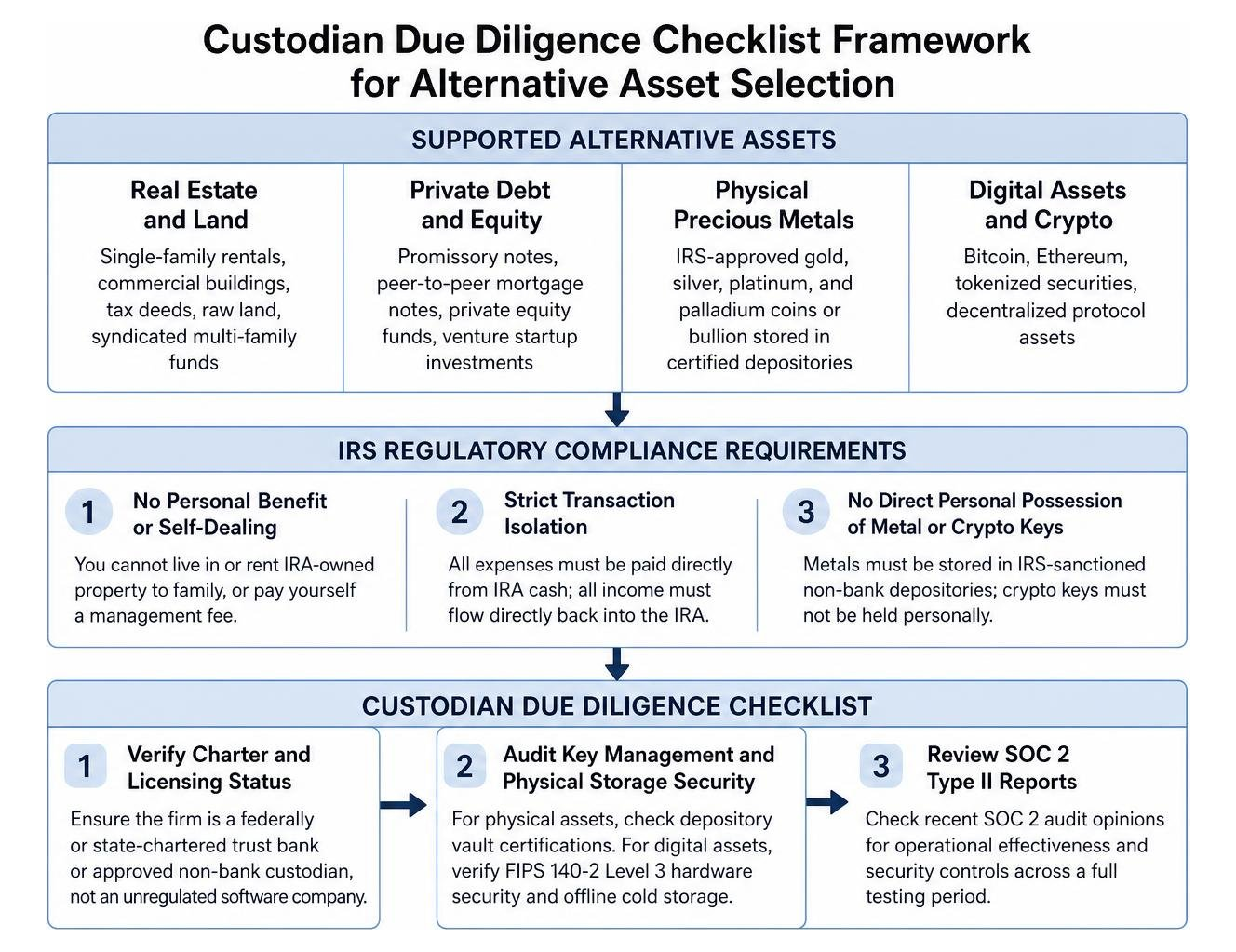
When conducting due diligence, use this actionable checklist to evaluate each potential partner:
- Verify Charter and Licensing Status: Ensure the firm is a federally or state-chartered trust bank or approved non-bank custodian, rather than an unregulated software company.
- Audit Key Management and Physical Storage Security: For physical assets, check depository vault certifications. For digital assets, verify FIPS 140-2 Level 3 hardware security and offline cold storage.
- Review SOC 2 Type II Reports: Check recent SOC 2 audit opinions for operational effectiveness and security controls across a full testing period.
- Analyze Proof of Reserves and Segregation: Confirm that assets sit in bankruptcy-remote, segregated accounts rather than commingled omnibus funds.
- Calculate All-In Custodial Costs: Compare flat-rate fee models against percentage-based Assets Under Custody (AUC) fees across your projected portfolio growth.
Qualified Custodians vs. Technology Providers
A major point of confusion for investors is the distinction between a qualified custodian and a technology provider.
A qualified custodian is a regulated entity, such as a state-chartered trust company, national bank, or registered broker-dealer, governed by strict legal frameworks, including SEC Rule 206(4)-2 and state banking rules. Qualified custodians owe fiduciary duties to account holders, hold legal title to assets on behalf of the IRA, maintain asset segregation, and carry institutional insurance.
By contrast, a technology provider sells security software, such as Multi-Party Computation key management, to help organizations run self-custody systems internally. Software providers do not hold legal regulatory charters, do not take legal custody of IRA assets, and carry no legal liability for custodial loss. Relying on an unchartered tech platform without a recognized custodial structure puts your retirement account’s tax-exempt status in grave jeopardy.
How to Choose an Alternative Asset Custodian Based on Security Architecture
For digital assets and tokenized securities held in retirement accounts, security key generation and storage architecture dictate account safety. Historical data reveals that 67% of digital asset custody breaches stem from compromised key generation or storage processes. To guard against these vulnerabilities, evaluate how custodians handle private key security:
- Offline Cold Storage: Air-gapped hardware isolated entirely from the internet. Reputable institutional custodians maintain at least 95% of client digital holdings in secure offline cold storage vaults.
- Multi-Signature (Multi-Sig): Requires multiple unique, physically distributed private keys to authorize a single blockchain transaction, such as 2-of-3 or 3-of-5 key approval rules.
- Multi-Party Computation (MPC): Mathematically breaks a private key into secret key shards distributed across distinct systems. The complete key is never created or stored in a single place during key generation or transaction signing.
- Hardware Security Modules (HSM): Tamper-evident hardware devices certified to FIPS 140-2 Level 3 or higher standards, ensuring private keys cannot be exported or extracted.
When reviewing digital asset custody for a self-directed IRA or Solo 401(k), ask the custodian to explain which controls apply to your retirement assets, who can authorize transactions, and how exception approvals are documented.
Operational Due Diligence, Insurance, and Proof of Reserves
Before entrusting retirement assets to any institution, examine their risk management and financial backstops:
- Insurance Limitations: FDIC or SIPC protections do not cover alternative investments or cryptocurrency assets against operational loss or theft. Look for dedicated institutional crime and specie insurance policies. Always review exclusion clauses; standard insurance policies cover physical vault breach or employee theft, but explicitly exclude client credential compromise or market loss.
- Bankruptcy Remoteness: Confirm that client assets are segregated on-chain and on book balances from the custodian’s corporate balance sheet. In the event of custodian insolvency, segregated assets cannot be seized by general corporate creditors.
- Proof of Reserves (PoR): Reputable digital custodians undergo regular cryptographic proof-of-reserves audits conducted by independent third-party accounting firms to prove 1-to-1 backing of customer deposits.
- Off-Exchange Settlement Networks: For active digital asset trading inside an IRA, off-exchange settlement systems allow trades to settle across exchanges without pre-funding exchange hot wallets. This mitigates exchange counterparty risk during volatile market cycles.
Use these items to pressure-test whether a custodian can support the specific alternative assets you want to hold while keeping your retirement account structure, transaction records, and control procedures aligned with IRS expectations.
Evaluating Custodial Fee Structures and Portfolio Scaling

Self-directed custodians operate under fee structures distinct from traditional brokerage platforms. Understanding these pricing models prevents administrative friction and unnecessary fees from eroding your compound retirement returns.
Fee Breakdown: Setup, Storage, and Transactional Costs
Alternative asset custodial fees generally fall into two models: Flat-Fee Structures and Assets Under Custody (AUC) Percentage Models.
- Flat-Fee Structures: The custodian charges fixed, predictable dollar amounts per year regardless of account size (e.g., $300 to $500 per year per asset). This structure benefits growing accounts, as fees remain constant whether a rental property appreciates from $200,000 to $1,000,000.
- Percentage-Based (AUC) Fee Models: The custodian charges an annual basis-point fee on total asset value (typically 10 to 50 basis points, or 0.10% to 0.50% annually). While affordable for entry-level portfolios, percentage fees scale rapidly as account assets appreciate.
| Fee Type | Typical Cost Range | What to Watch Out For |
|---|---|---|
| Account Setup Fee | $50 – $300 (one-time) | Higher initial setup costs for complex entity formations |
| Annual Maintenance Fee | $200 – $600 (flat) or 0.10%–0.50% AUC | Tiered asset pricing that increases automatically as balance grows |
| Transaction / Purchase Fees | $50 – $250 per transaction | High wire transfer fees or document processing fees per real estate deal |
| Storage / Depository Fees | $100 – $300/yr (metals/crypto) | Commingled vs. segregated storage pricing differentials |
| Termination / Out-Transfer | $100 – $250 per asset | Hidden penalty fees when transferring assets out of the custodian |
Be on the lookout for hidden expenses, such as processing fees for routine real estate bills, wire charges for private loan funding, or asset valuation fees required for annual IRS Form 5498 filings. If you are funding startups or angel deals through an IRA, review our walkthrough on how to turn your IRA into a startup investing machine.
Portfolio Scaling from $10,000 to Over $1 Million
Your ideal custodial setup depends directly on total account valuation and transaction frequency:
- Entry-Level ($10,000 to $100,000): Focus on minimizing fixed administration fees. Institutional custody fees can swallow returns on smaller balances, making flat-fee custodial structures or direct asset platforms ideal.
- Mid-Tier ($100,000 to $1,000,000): Redundancy and operational control become essential. This range often benefits from a Checkbook Control IRA (or Solo 401(k)), where the IRA owns a dedicated Limited Liability Company (LLC). Checkbook control allows account owners to sign real estate contracts and write checks directly from a business bank account, eliminating per-transaction custodian processing fees. Learn how to set up this structure in our Step-by-Step Guide to Checkbook IRA.
- Institutional Tier (Above $1 Million): Large accounts prioritize multi-signatory approval workflows, dedicated cold storage vaults, custom SOC 2 audit reviews, and off-exchange settlement integrations.
Frequently Asked Questions About Custodian Selection
What is the difference between a qualified custodian and a crypto tech provider?
A qualified custodian is a regulated financial institution (such as a bank or trust company) that holds legal fiduciary responsibility for client assets, maintains asset segregation under government supervision, and carries institutional crime insurance. A technology provider offers software infrastructure (such as MPC wallet key generation software) that enables self-custody. While tech providers supply security tools, they take no regulatory responsibility or legal custody of your retirement funds.
How does off-exchange settlement reduce counterparty risk for SDIRA trading?
Off-exchange settlement allows investors to trade digital assets on public exchanges without transferring private keys directly into exchange hot wallets. Funds remain secured inside a chartered custodian’s cold storage vault until trade execution. Once matched, the settlement network swaps assets instantly, shielding retirement capital from exchange insolvencies or withdrawal halts.
What key red flags should disqualify an alternative asset custodian?
Key red flags include operating without a verifiable state or federal trust charter, commingling client investments with corporate operating funds, refusing to share independent SOC 2 Type II audit reports, relying on unverified or proprietary security technology, and failing to provide transparent fee schedules.
Before You Move Retirement Funds
Choosing the right alternative asset custodian determines how efficiently, safely, and cost-effectively your non-traditional investments grow. By thoroughly evaluating regulatory credentials, key management frameworks, fee structures, and IRS compliance support, you can deploy retirement capital with confidence.
At Independent IRA, an Authorized Agent of Accuplan, we streamline alternative asset investing through self-directed IRAs, Checkbook Control LLCs, and self-trusteed Solo 401(k) plans. Whether you are acquiring physical real estate, funding promissory debt, or building long-term digital asset reserves, our team provides single-source support every step of the way.
Ready to take control of your retirement portfolio? Explore our full suite of self-directed IRA services or contact Independent IRA experts today to start building your wealth on your own terms.
This content is for informational and educational purposes only and does not constitute legal, tax, or investment advice. Rules, limits, and requirements may change. Consult a qualified tax advisor, attorney, or financial professional before making retirement planning or investment decisions. Independent IRA is an Authorized Agent of Accuplan Benefits Services and is not a custodian or trust company.