

 GIVE US A CALL
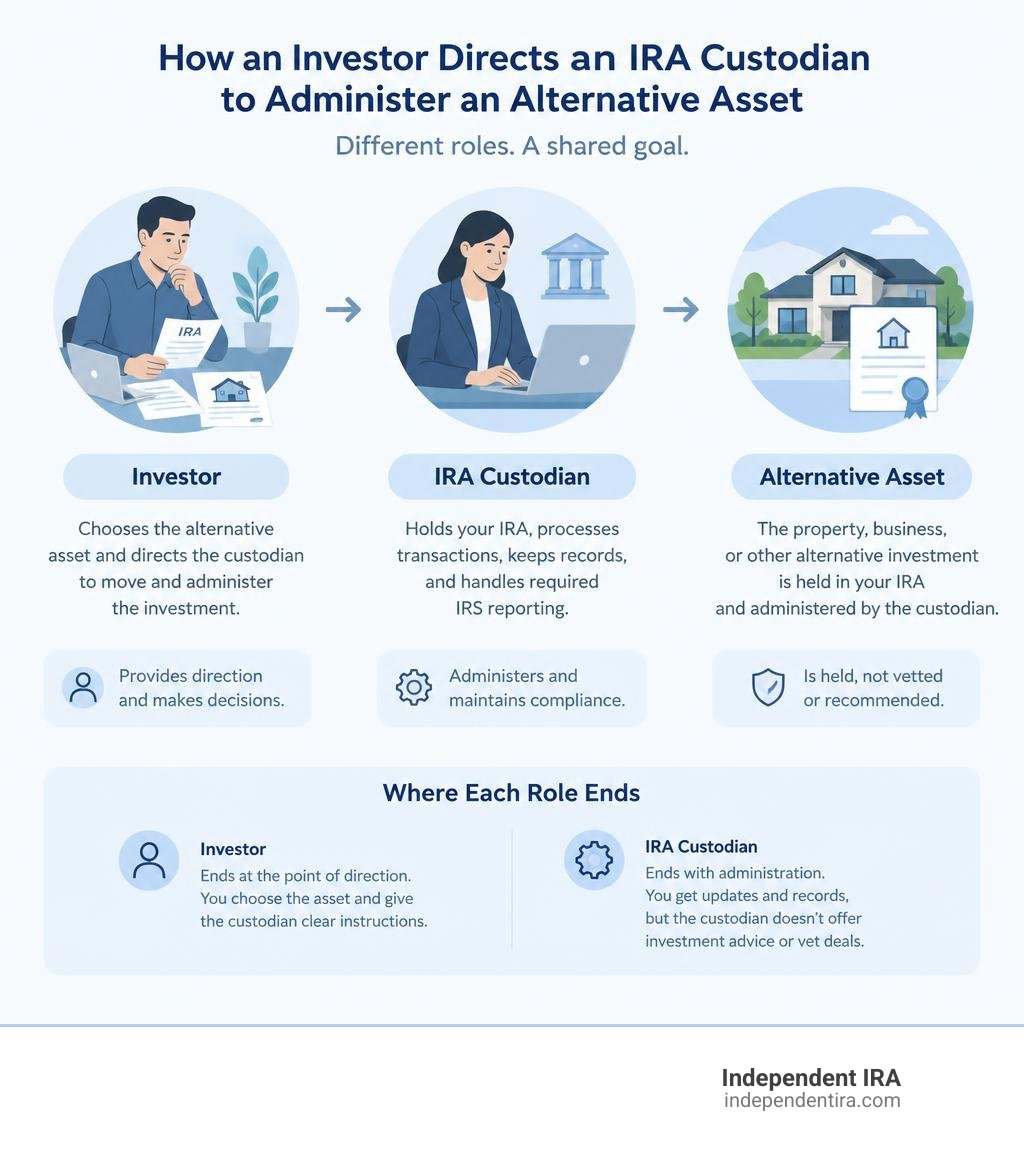
Thinking about using retirement savings to buy a rental property or invest in a private business? A self-directed IRA custodian is an IRS-approved institution that holds and administers your retirement account while you select your investments. It processes transactions, maintains official records, and handles mandatory tax reporting, but it does not vet deals or provide investment advice. Before moving funds, learn how to choose a compliant SDIRA custodian and understand where your own administrative duties begin.
Essential what is a self-directed ira custodian terms:
- alternative asset custodian considerations
- best alternative asset custodian
- how to choose an alternative asset custodian
What Is a Self-Directed IRA Custodian and What Is Their Legal Role?
Every Individual Retirement Account requires an IRS-approved trustee or custodian to hold its assets. In a standard brokerage account, that institution is typically a major retail brokerage that restricts your holdings to publicly traded stocks, mutual funds, and exchange-traded funds.
When you expand your portfolio into alternative investments—such as residential real estate, private equity placements, tax liens, or precious metals—you need a specialized provider. That brings up the fundamental question: what is a self-directed IRA custodian under federal tax law?
Under Internal Revenue Code (IRC) Section 408, a self-directed IRA (SDIRA) custodian is an entity authorized by the IRS to act as a passive trustee or nonbank custodian. Rather than directing your investments, promoting mutual funds, or managing a model portfolio, an SDIRA custodian functions as an administrative gatekeeper. The custodian holds legal title to your alternative assets on behalf of your IRA, processes purchase and sale documentation at your written instruction, and reports all account activity to the IRS.
IRC Section 408 Compliance and Legal Custody
Federal tax law requires that retirement funds remain segregated from personal funds to retain their tax-advantaged status. Section 408(a)(2) states that the trustee must be a bank, a federally insured credit union, a state-chartered trust company, or a nonbank entity that demonstrates to the satisfaction of the IRS Commissioner that it meets rigorous operational, financial, and fiduciary standards.
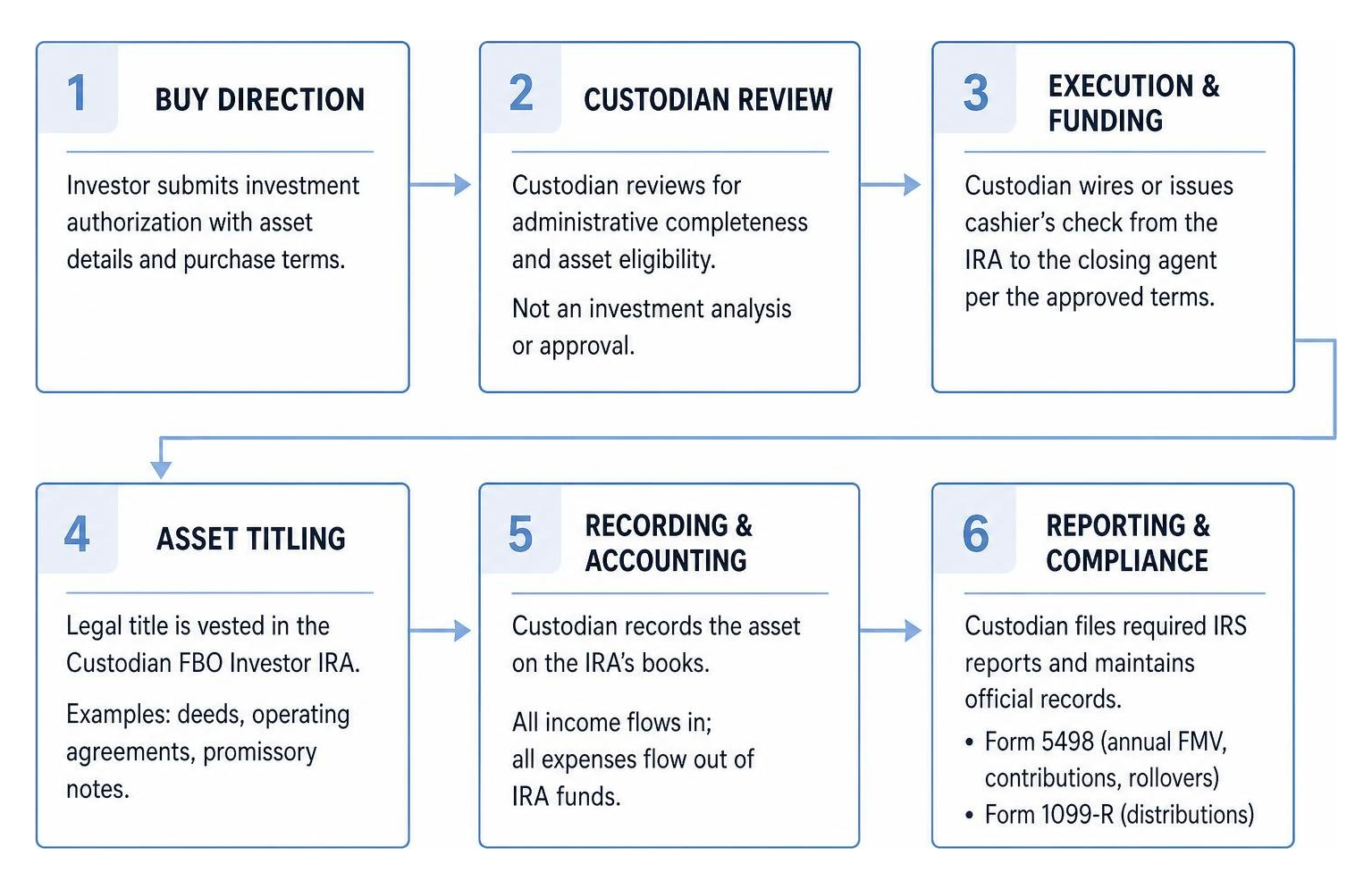
These regulatory safeguards ensure that the custodian maintains proper accounting, maintains sufficient net worth reserves, and carries adequate fidelity bond protection. The custodian is legally responsible for filing annual informational returns with the federal government:
- IRS Form 5498: Reports the annual Fair Market Value (FMV) of the account as of December 31, along with any annual contributions or rollover amounts received.
- IRS Form 1099-R: Reports any distributions taken from the account, documenting whether distributions are taxable, early, or qualified (in the case of a Roth IRA).
What Is a Self-Directed IRA Custodian Doing Behind the Scenes?
While you are negotiating real estate acquisitions or reviewing private placement memorandums, the custodian works behind the scenes to keep the retirement wrapper legally sound.
When you submit an investment authorization form, the custodian examines the paperwork exclusively for administrative completeness and asset eligibility. They ensure the legal title on deeds, operating agreements, or promissory notes reads correctly. They verify that the funds leave the custodial cash account via wire or cashier’s check to the closing agent, and they record the newly acquired asset on your annual balance sheet.
Responsibilities vs. Limitations: What SDIRA Custodians Do and Do Not Do
One of the most dangerous assumptions an investor can make is believing that an SDIRA custodian acts as a financial adviser or watchdog. Because custodians are passive, their statutory duties are strictly administrative.

Mandatory Custodial Duties: Titling, Tax Reporting, and Transaction Execution
Federal law outlines explicit operational mandates that every qualified custodian must perform:
- Asset Vesting and Titling: Holding legal title to non-traditional assets to preserve the retirement trust umbrella.
- Transaction Execution: Releasing funds for purchases, receiving incoming investment income (rental checks, dividend disbursements, note interest), and processing authorized distributions.
- Recordkeeping and Statements: Maintaining ledgers of all uninvested cash, recorded investments, and asset valuations.
- Tax Filings: Submitting Forms 5498 and 1099-R directly to the IRS.
- Deposit Account Protection: Ensuring uninvested cash is kept in FDIC-insured depository accounts.
Critical Boundaries: Why Custodians Do Not Vet Deals or Provide Advice
Custodial agreements explicitly state that the custodian has no fiduciary duty regarding investment performance, asset quality, or fraud detection.
| Custodian DOES Perform | Custodian DOES NOT Perform |
|---|---|
| Hold title to assets for the benefit of the IRA | Provide financial, legal, or tax advice |
| Process buy and sell directions upon request | Vet, screen, or run due diligence on investment promoters |
| Collect and deposit investment yields into your account | Evaluate the profitability or risk of an asset |
| File required annual forms with the IRS | Verify the accuracy of financial statements or appraisals |
| Reject investments outside administrative scope (e.g., life insurance) | Guarantee that an investment complies with state securities laws |
The Securities and Exchange Commission (SEC) and the Financial Industry Regulatory Authority (FINRA) have repeatedly issued investor alerts regarding alternative investments in self-directed accounts. Fraudulent promoters often claim their offerings are “approved” or “endorsed” by an SDIRA custodian.
In reality, a custodian’s acceptance of an asset merely means the paperwork satisfies their operational guidelines—not that the investment is safe or legitimate. If an asset fails or is revealed as a scam, the account holder absorbs 100% of the loss. Brian Davis often reminds clients that conducting your own thorough due diligence on sponsors and deal terms is the only real protection for your retirement capital.
How SDIRA Custodians Handle Alternative Assets: Real Estate, Private Equity, and Notes
Different alternative asset classes present unique custodial requirements. Understanding how these transactions operate will help you avoid costly administrative delays.
Real Estate Titling and Expense Processing
When you purchase investment property using an SDIRA, you cannot take title in your personal name. If you do, the IRS considers the purchase a full distribution of funds, triggering immediate taxes and potential penalties.
Instead, the title and deed must be vested directly in the custodian’s name for your benefit:
Correct Deed Vesting Format:
[Custodian Name] FBO [Your Name] IRA #[Account Number]
When holding real estate in a self-directed IRA, all financial transactions must run through the custodian. Rent checks are made payable to the custodian and deposited into your account’s uninvested cash balance.
Similarly, property taxes, insurance premiums, maintenance invoices, and contractor bills must be submitted to the custodian for payment out of IRA funds. You cannot pay these expenses with personal cash or credit cards.
Private Equity, Lending, and Checkbook Control LLCs
For private placements, startups, and private equity deals, the custodian reviews the subscription agreement, operating agreement, and private placement memorandum (PPM) to verify that the IRA is correctly named as the subscribing member. Investors interested in these opportunities should carefully review private equity IRA investment rules to remain compliant with federal regulations.
If you are issuing private debt or trust deeds, the custodian holds the original promissory note and receives payments from the borrower.
To avoid custodial processing delays on routine transactions, many investors establish a checkbook IRA LLC structure. In this arrangement:
- The custodian invests your IRA funds into a newly formed, specialized single-member Limited Liability Company (LLC).
- The custodian holds 100% of the LLC membership units on behalf of your IRA.
- You act as the non-compensated manager of the LLC, holding dedicated checking account access to deploy capital and pay expenses instantly.
Custodial Fees, Fraud Risks, and Due Diligence: Protecting Your Retirement
Unlike retail stock brokerages that monetize client cash sweeps and order flow, SDIRA custodians earn revenue through account administration fees.

Understanding Fee Structures: Asset-Value vs. Flat-Fee Pricing
Custodial fee schedules generally fall into two categories:
- Asset-Value Tiered Pricing: The custodian charges an annual fee calculated as a percentage of your total account value or tiered according to asset valuation bands. This structure can become expensive as your real estate or private equity assets appreciate.
- Flat-Fee Pricing: The custodian charges a predictable, fixed annual fee per asset or per account regardless of portfolio growth. Typical flat maintenance fees range from $80 to $200+ per year.
Beyond annual maintenance fees, custodians may charge for specific processing events, such as wire transfers, document reviews, paper statements, and special asset revaluations. Before selecting a provider, make sure to evaluate potential hidden transaction fees that could erode your compounding investment returns.
Verifying Nonbank Custodians and Avoiding Prohibited Transactions
Before transferring retirement funds, confirm that your prospective custodian is legitimate:
- Check the IRS Nonbank Trustee List: The IRS maintains an approved list of nonbank entities that meet the standards of Treasury Regulation Section 1.408-2(e).
- Review State Banking Charters: Most trust companies operating as custodians are chartered and audited by state banking divisions.
- Inspect Custodial Agreements: Read the fine print to confirm their process for holding uninvested cash and handling annual fair market valuations.
Even with a legitimate custodian in place, the responsibility of avoiding prohibited transactions falls entirely on you. Under IRC Section 4975, your IRA cannot buy, sell, lease, or exchange property with a “disqualified person,” which includes:
- You (the account owner) and your spouse
- Your lineal ascendants (parents, grandparents)
- Your lineal descendants (children, grandchildren) and their spouses
- Entities (corporations, LLCs, trusts) in which disqualified persons hold a 50% or greater controlling stake
Violating these rules—for example, by hiring your son to paint your IRA-owned rental property or staying in an IRA-owned condo—triggers severe statutory penalties.
Frequently Asked Questions About SDIRA Custodians
What is a self-directed IRA custodian and do they guarantee investment legitimacy?
A self-directed IRA custodian is an IRS-approved financial institution that holds and administers alternative assets, but they never vet, endorse, or guarantee the legitimacy or profitability of any investment. All due diligence and investment risks remain the sole responsibility of the account owner.
Can an SDIRA custodian reject an investment request?
Yes, a custodian can reject an investment if the documentation is incomplete, if the asset violates IRS rules regarding collectibles or S-corporation stock, or if the asset falls outside the custodian’s administrative capabilities.
What happens if an SDIRA executes a prohibited transaction?
If a prohibited transaction occurs, the IRA loses its tax-exempt status as of the first day of that tax year, causing the entire account value to be treated as a taxable distribution subject to income tax and potential early withdrawal penalties.
How does an SDIRA custodian handle annual asset valuations?
Federal regulations require the custodian to report the fair market value of your account to the IRS each year. For alternative assets without a public exchange price, the custodian will require you to submit an annual third-party valuation, property appraisal, or sponsor-provided balance statement.
Before You Move Retirement Funds
Selecting a self-directed IRA custodian is a critical step toward building an alternative asset portfolio. Because your custodian operates strictly as a passive administrator, the ongoing compliance and performance of your retirement holdings rely on your own independent due diligence, qualified professional guidance, and adherence to tax guidelines.
At Independent IRA, we serve as an Authorized Agent of Accuplan Benefits Services, helping investors establish checkbook IRA LLC structures and self-trusteed solo 401(k) plans with dedicated administrative support.
To explore compliant structures for your retirement plans:
- Explore our tailored self-directed IRA services
- Discover local investment strategies via our San Diego self-directed IRA solutions
- Connect directly with Brian Davis and our team by contacting our retirement specialists
This content is for informational and educational purposes only and does not constitute legal, tax, or investment advice. Rules, limits, and requirements may change. Consult a qualified tax advisor, attorney, or financial professional before making retirement planning or investment decisions. Independent IRA is an Authorized Agent of Accuplan Benefits Services and is not a custodian or trust company.