

 GIVE US A CALL

Choosing the right alternative investment sponsor is critical when diversifying your self-directed IRA or Solo 401(k) beyond traditional public markets. These sponsors source, structure, and manage private assets like real estate, private debt, and private equity. To protect your retirement capital, you must thoroughly evaluate a sponsor’s track record, fee structure, liquidity constraints, and adherence to IRA rules for investing in private equity. I’m Brian Davis, and this guide provides the practical due diligence framework you need to evaluate sponsors effectively.
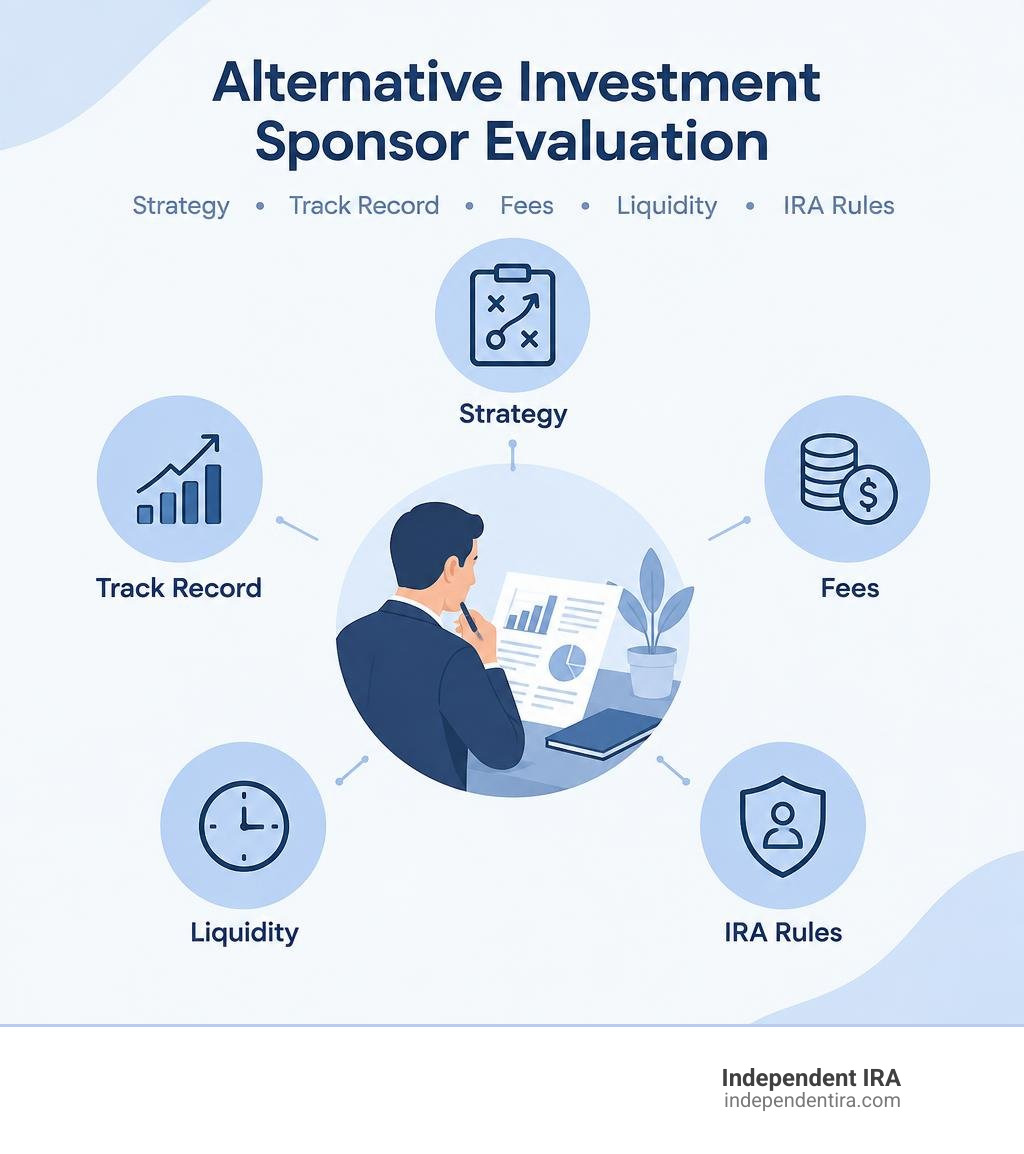
Alternative investment sponsors word roundup:
How Alternative Investment Sponsors Operate in Modern Portfolios
When constructing a retirement portfolio designed to endure varying market cycles, relying solely on publicly traded equities and fixed income can leave your nest egg vulnerable to broad public market drawdowns. Alternative investments represent non-traditional assets that do not trade on public exchanges. These assets differ fundamentally from standard equities, offering institutional and individual retirement investors an avenue toward meaningful portfolio diversification and potential non-correlated returns.
In a standard private market arrangement, an alternative investment sponsor acts as the General Partner (GP). The sponsor originates opportunities, conducts due diligence, secures financing, manages operations, and navigates asset dispositions. Investors, including those utilizing a Self-Directed IRA (SDIRA) or Solo 401(k), participate as Limited Partners (LPs). The LP commits capital, receives equity or debt interests, and earns distributions without taking on day-to-day operational liabilities.
For retirement savers, deploying capital into private placement memorandums (PPMs) alongside experienced sponsors allows retirement assets to compound in a tax-sheltered environment. Before committing retirement capital, reviewing the core IRA rules for investing in private equity ensures your self-directed account stays compliant with IRS rules regarding disqualified persons and prohibited transactions.
| Feature | Public Market Equities & Bonds | Private Alternative Assets |
|---|---|---|
| Pricing & Valuation | Daily market pricing; real-time fluctuations | Periodic valuations (quarterly NAV or appraisal-based) |
| Market Correlation | High correlation with public market sentiment | Low to moderate correlation; driven by asset fundamentals |
| Liquidity | High (T+1 settlement on exchanges) | Low (multi-year lockups or quarterly redemption gates) |
| Access to Alpha | Efficient markets with public information | Sourced via operational improvements, proprietary deal flow |
| Retirement Integration | Standard brokerage IRAs | Self-Directed IRAs, Checkbook LLCs, and Solo 401(k) plans |
Distinct Characteristics of Alternative Asset Classes
Alternative assets span a wide spectrum of risk, return, and duration profiles. When building a diversified self-directed retirement strategy, retirement investors typically allocate across several primary sectors:
- Commercial Real Estate (CRE): Sponsors acquire multifamily properties, industrial distribution centers, medical office buildings, and retail assets. Real estate provides cash flow distributions, inflation protection, and long-term capital appreciation. Investors exploring tangible property often start by mastering real estate in a self-directed IRA to maximize rental yield and tax deferral.
- Private Debt and Direct Lending: In response to bank lending consolidation, private credit sponsors step in to provide senior secured loans, mezzanine debt, and asset-based financing to mid-market companies. These instruments generate predictable interest income, which flows directly back into your tax-advantaged retirement account.
- Private Equity (PE): Buyout sponsors acquire controlling stakes in established private companies, optimize operations, and seek profitable exits through strategic sales or initial public offerings.
- Venture Capital (VC): Early-stage sponsors invest in nascent startups with high growth potential. SDIRA investors can learn how to turn an IRA into a startup investing vehicle to access private equity upside while retaining long-term tax advantages.
- Infrastructure & Real Assets: Involves essential economic assets—such as renewable energy installations, toll roads, data centers, and utilities—that feature inelastic demand and stable, contractual revenues.
Institutional vs. Retail Access: Selecting Alternative Investment Sponsors
Historically, institutional gatekeeping limited access to top-tier alternative investment sponsors to sovereign wealth entities, multi-billion-dollar pension plans, and ultra-high-net-worth family offices. Regulatory standards established by the SEC set qualification hurdles:
- Accredited Investors: Individuals with an annual income exceeding $200,000 ($300,000 for married couples) for the past two years, or a net worth exceeding $1 million (excluding the primary residence).
- Qualified Purchasers: Individuals or family-owned entities with $5 million or more in investable assets, or institutional entities managing $25 million or more.

Over the past decade, financial technology platforms like iCapital, CAIS, and Cadre have broadened access to these private markets. By establishing feeder fund structures, these platforms aggregate smaller capital commitments from Registered Investment Advisors (RIAs) and high-net-worth retail investors into institutional-grade funds. iCapital, for instance, administers over $6 billion in assets tied to individual investors across 130 funds, lowering traditional minimum investments from $5 million down to $25,000 or $50,000.
For self-directed retirement investors, these platforms provide institutional access, but due diligence on both the platform feeder and the underlying asset sponsor remains critical.
Profiling Leading Asset Managers and Innovative Financing Models
The global alternative asset management landscape features institutional managers who deploy capital at massive scale across global markets:
- Blackstone: As the world’s largest alternative asset manager, Blackstone oversees more than $1.3 trillion in assets under management (AUM) with a portfolio encompassing over 13,000 real estate assets and 270+ portfolio companies. Their wealth solutions division has engineered perpetual, semi-liquid vehicles designed to deliver institutional credit and real estate strategies to individual accredited investors.
- Investcorp: Highlighting the global expansion of private markets, Investcorp has expanded its AUM from $10 billion to over $64 billion in the past decade. The firm operates across private equity, real assets, credit management, and liquid absolute return strategies across North America, Europe, the GCC, and Asia.
- Mubadala Capital: Managing, advising, and administering over $755 billion in assets, Mubadala Capital leverages sovereign-backed scale to execute complex, value-driven transactions across private equity, private credit, and venture capital.
- Multi-Asset Credit Vehicles: Specialized funds like the Blackstone Private Multi-Asset Credit and Income Fund (BMACX) illustrate the convergence of diversified income strategies. BMACX blends private corporate credit, asset-based and real estate credit, structured finance, and liquid credit into an umbrella structure targeting consistent yield for income-focused portfolios.
The Rise of NAV Financing and Strategic Lending
As market liquidity needs evolve, fund-level financing solutions have become an important mechanism for private equity and debt sponsors. Firms such as 17Capital have pioneered Net Asset Value (NAV) financing and strategic lending solutions. Having raised $23 billion across 8 vintage funds, 17Capital delivers structured, non-dilutive capital secured against the NAV of an entire portfolio rather than single assets.
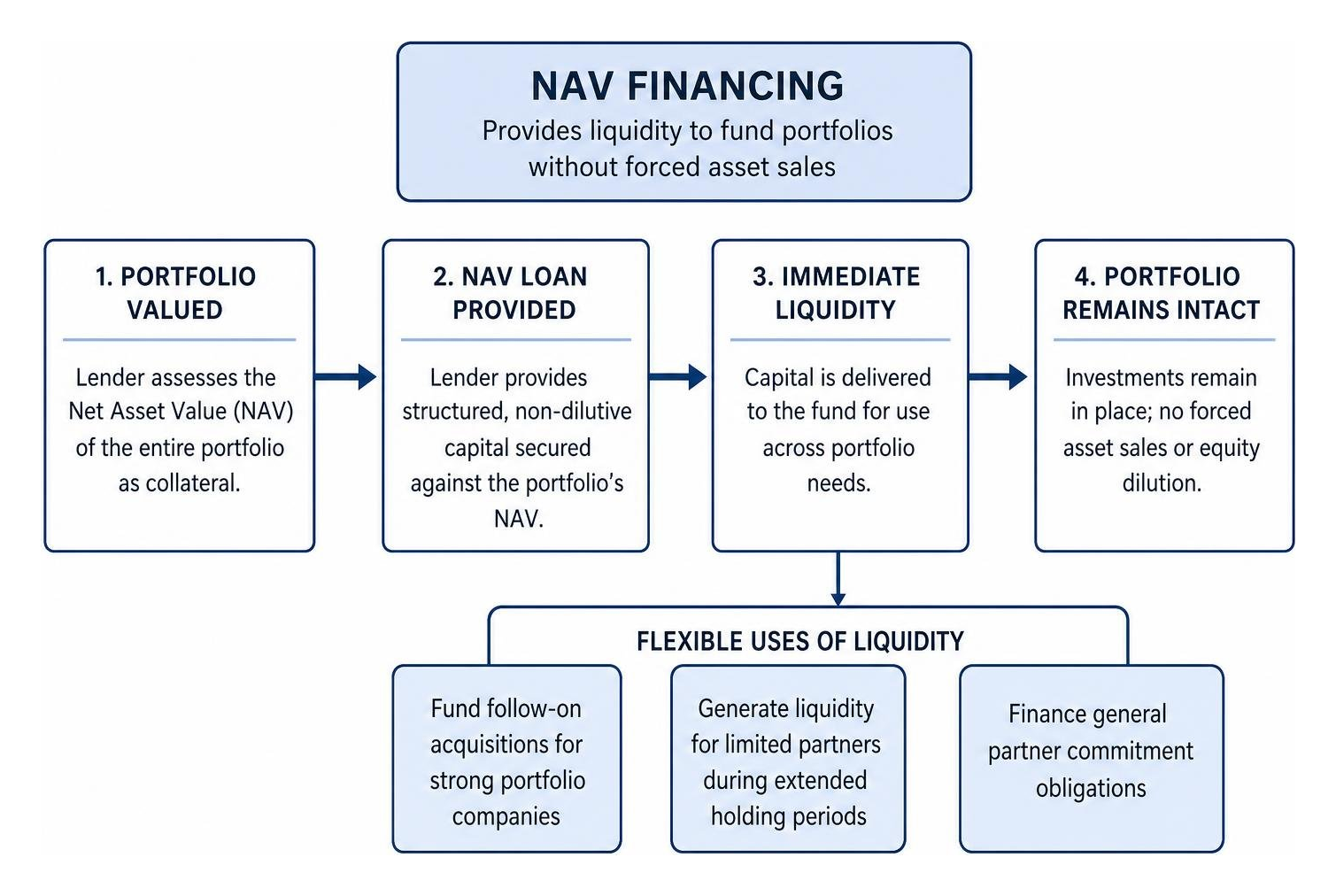
NAV loans allow private equity general partners to fund follow-on acquisitions for strong portfolio companies, generate liquidity for limited partners during extended holding periods, or finance general partner commitment obligations without diluting equity or executing premature asset sales. Understanding how a sponsor manages fund-level leverage helps self-directed investors evaluate structural risk before allocating retirement capital.
Modern Technological Integration and AI in Deal Sourcing
Top alternative investment sponsors increasingly incorporate artificial intelligence, machine learning, and predictive analytics across their investment pipelines:
- Deal Origination and Sourcing: Machine learning models scan millions of data points—from commercial registry filings and patent databases to supply chain logs—identifying acquisition targets before they hit broad investment banking auctions.
- Underwriting and Risk Analysis: AI platforms synthesize debt covenants, lease terms, and historical financial statements in real time, standardizing risk scoring across thousands of prospective investments.
- Portfolio Company Monitoring: Real-time software integrations allow sponsors to monitor point-of-sale data, operational KPIs, and workforce metrics across portfolio assets, allowing for proactive adjustments during shifting market conditions.
Due Diligence Framework for SDIRA and Solo 401(k) Investors
Deploying retirement funds into private markets requires rigorous due diligence. When investing via a Self-Directed IRA or Solo 401(k), the IRS requires you, the account holder, to make all investment choices. While administrative service providers like Independent IRA, an Authorized Agent of Accuplan Benefits Services, facilitate account administration and recordkeeping, they do not provide investment advice or assess the financial viability of a sponsor’s offering.

When vetting offerings, start by reviewing our alternative asset custodian selection guide and understanding the essential features of compliant alternative asset custodians to establish a secure foundation for your transactions.
Key Criteria for Vetting Alternative Investment Sponsors
Before executing subscription documents, run prospective sponsors through a thorough evaluation framework:
- Audited Track Record and Vintage Year Performance: Evaluate how the sponsor performed across multiple economic cycles, specifically during recessions and rising interest rate environments. Look for consistent net internal rates of return (Net IRR) and multiple on invested capital (MOIC) figures verified by independent accounting firms.
- Alignment of Interest (Skin in the Game): Examine the GP’s direct cash contribution to the fund. Sponsors who commit significant personal capital alongside limited partners are naturally aligned to prioritize capital preservation and prudent risk management.
- Fee Structures and Hurdle Rates: Understand the waterfall structure. Standard private offerings feature an annual management fee (typically 1.5% to 2.0%) and a performance-based carried interest fee (often 20%). Ensure the sponsor must surpass a preferred return hurdle rate (such as 7% or 8% annualized) before participating in performance splits.
- Operational Infrastructure and Compliance: Verify the sponsor utilizes independent third-party fund administrators, SEC-registered compliance frameworks, and established valuation practices. Brian Davis and our onboarding team regularly assist investors in coordinating these subscription documents with fund managers.
- Account Structure Options: For active alternative investors who participate in multiple private placements or direct lending opportunities, setting up checkbook control can reduce transactional delays. Review our guide to self-directed IRA LLC legal structures to evaluate if this approach aligns with your investment strategy.
Navigating Liquidity Risks, Interest Rates, and Market Volatility
Alternative investments are inherently illiquid. Unlike public stocks that can be sold instantly during market hours, capital committed to private syndications, private equity funds, or direct debt offerings is typically locked for 3 to 10 years.
Semi-liquid interval funds and non-traded real estate trusts often implement redemption gates (typically limiting quarterly redemptions to 2% to 5% of aggregate fund NAV). These gates protect remaining investors from forced asset sales during broader market downturns. In fluctuating interest rate environments, private credit strategies have demonstrated resilience by employing floating-rate loans with protective interest rate floors. For investors focused on regional opportunities, exploring private equity and private lending strategies can offer attractive, asset-backed yields.
Frequently Asked Questions About Alternative Investments
What is the primary role of an alternative investment sponsor?
An alternative investment sponsor identifies, underwrites, structures, acquires, and manages non-traditional assets—such as private equity, commercial real estate, private credit, and infrastructure—on behalf of institutional and individual investors. The sponsor acts as the fund’s General Partner, managing day-to-day operations and executing business plans to deliver returns.
How can investors participate in sponsor-backed funds using a Self-Directed IRA?
Investors establish a Self-Directed IRA (SDIRA) or Solo 401(k) through a specialized custodial setup. Working with Independent IRA, an Authorized Agent of Accuplan Benefits Services, the investor directs the account to invest capital directly into the sponsor’s private placement memorandum (PPM), private credit fund, or syndication. All investment income, dividends, and proceeds flow back directly into the tax-advantaged retirement account.
What eligibility requirements apply to investing in private alternative funds?
Most private alternative funds require investors to meet SEC standards as accredited investors (individual annual income over $200,000, joint income over $300,000, or net worth exceeding $1 million excluding primary residence) or qualified purchasers ($5 million+ in investable assets). Certain semi-liquid or interval funds may offer access to non-accredited investors under specific SEC exemption rules.
Before You Move Retirement Funds
Directing your self-directed retirement capital into private markets allows you to diversify beyond traditional assets and build long-term portfolio resilience. Choosing the right alternative investment sponsor requires disciplined vetting of their historical track records, structural fee transparency, operational workflows, and risk-adjusted return profiles.
At Independent IRA, an Authorized Agent of Accuplan Benefits Services, we facilitate self-directed IRA and Solo 401(k) administrative solutions, along with checkbook-control entity structures that give you administrative control over your alternative assets. Whether you are allocating capital to established global asset managers or working on raising private capital through retirement accounts, maintaining compliance and working with experienced professionals helps support your retirement goals.
To get started with self-directed alternative assets, explore our comprehensive self-directed IRA services and review our guide on choosing a compliant SDIRA custodian to ensure your investment journey begins on solid regulatory ground.
This content is for informational and educational purposes only and does not constitute legal, tax, or investment advice. Rules, limits, and requirements may change. Consult a qualified tax advisor, attorney, or financial professional before making retirement planning or investment decisions. Independent IRA is an Authorized Agent of Accuplan Benefits Services and is not a custodian or trust company.